France sets out long-term nuclear recycling plans

Minister for the Economy, Finance, Industrial and Digital Sovereignty Bruno Le Maire announced the decision to continue with France's treatment-recycling strategy for used nuclear fuel beyond 2040, with plans to extend the life of existing recycling plants and to launch studies for a new MOX fuel fabrication plant and a new used fuel processing plant.

Lescure (second from left) and Le Maire (centre) pictured with La Hague Site Director Stéphanie Gaiffe (far left) and Orano CEO Nicolas Maes (on the right) during the visit (Image: Orano)

The announcement was made during a visit by Le Maire and Minister Delegate for Industry and Energy Roland Lescure to Orano's La Hague recycling site, days after France's Nuclear Policy Council (Conseil de Politique Nucléaire) said on 26 February that the country would continue with its closed nuclear fuel cycle strategy.

Le Maire announced three measures that will be taken towards this goal: a sustainability/resilience programme extending the life of the La Hague and Melox recycling plants beyond 2040; the launch of studies for a new MOX fuel fabrication plant at the La Hague site; and the launch of studies for a new used fuel processing plant, also at La Hague, by 2045-2050.

"A new page in French nuclear history is about to open. The time for large-scale national projects has returned and the nuclear energy sector has a central role to play," Le Maire said during his visit to La Hague.

In a post on X, Le Maire said the visit to La Hague by the two ministers sends a strong signal. "Thanks to this strategy, we will ultimately reduce the volume of nuclear waste by 75%," he said. "Our message is clear: nuclear power occupies a central place in the decarbonisation of our economy, the strengthening of our energy sovereignty and the reindustrialisation of our country."

Orano CEO Nicolas Maes said the announcements provide for major investments for the La Hague site. "Processing-recycling is one of the French industry's centres of excellence, representing know-how that has been mastered for some 50 years in our plants and of which all the group's employees can be proud," he said.

From the very beginning of its nuclear programme France has chosen to pursue a closed fuel cycle, reprocessing used nuclear fuel to recover uranium and plutonium for re-use. Reprocessing and recycling fuel in this way also significantly reduces the activity and volume of radioactive waste material requiring final disposal.

In the French model, the reusable materials which make up some 96% of used fuel are separated at La Hague. The plutonium recovered from this processing is reused in MOX (mixed-oxide) fuels manufactured by Orano at the Melox plant. Some 10% of nuclear electricity in France today is generated by recycling materials in the form of MOX fuel, Orano said, and this can rise to 25% and to almost 40% if used MOX fuel is further recycled.

Only the plutonium recovered from processed fuel is currently used in MOX. Reprocessed uranium - or RepU - can be re-enriched for use as fuel in existing light-water reactors. Four of France's reactors - at the Cruas-Meysse plant in Auvergne-Rhône-Alpes - are certified to use such uranium. In February, Cruas 2 became the first of those units to operate with a full core of fuel made from recycled uranium.Researched and written by World Nuclear News. France sets out long-term nuclear recycling plans : Waste & Recycling - World Nuclear News
Read More........

Emperor penguins face a bleak future – but some colonies will do better than others in diverse sea-ice conditions

The long-term future looks bleak for Emperor penguins, but our new research shows some birds may be able to survive in certain conditions, depending on where they live, at least for the next few decades.

Over the past two years, Antarctic sea ice has declined dramatically, prompting scientists to suggest it could reach a “new state”.

A study based on satellite images shows that sea ice broke out early in Antarctica’s Bellingshausen Sea in 2022, potentially resulting in breeding failures across several Emperor penguin colonies in that region.

Our research shows Emperors form colonies in surprisingly diverse environmental conditions that vary depending on location around the continent. Within each of these regions, there is little difference between where birds make their homes and other sites, suggesting they could shift if they had to. This provides a ray of hope in an otherwise bleak outlook.

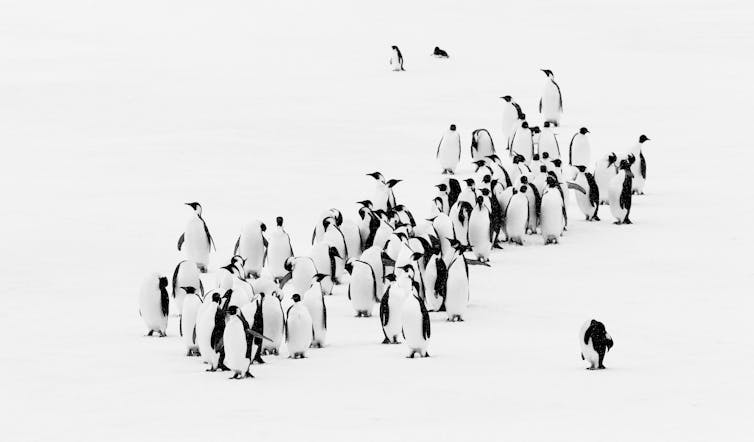
Emperor penguins may be the only birds to rarely set foot on land. They are unique among penguin species in that they breed on sea ice during the harsh Antarctic winter.

Male Emperor penguins incubate eggs and raise the chicks on sea ice during the Antarctic winter. Sara Labrousse/French Polar Institute, CC BY-SA
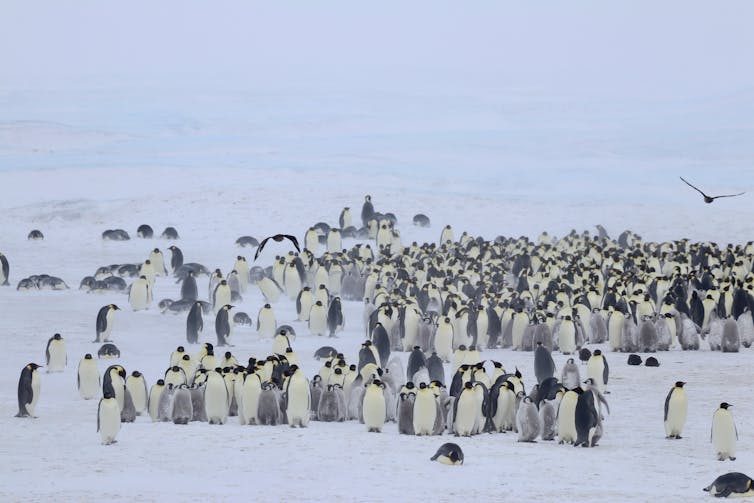
We know that they need “fast ice” – the coastal sea ice attached to the Antarctic continent or ice shelves. But they actually inhabit a range of fast-ice locations that differ in the timing of ice formation, how much ice forms and breaks, and even how close they get to other penguin species.

Depending on where they are along the Antarctic coast, Emperors make use of the habitat available to them. Their behaviour may be flexible enough to allow some colonies to cope better in a warming world.

Why fast ice is important

Emperor penguins rely on fast ice as a stable platform for their breeding season. Female Emperors lay their eggs and the males incubate them for about two and a half months.

Even though Antarctica’s sea ice is diminishing, this refers to a measure known as “sea ice extent”, which includes all sea ice covering the polar ocean, whether it is fast ice or drifting pack ice.

A decrease in sea ice extent is not necessary linearly linked to a drop in the area covered by fast ice (although the reverse is true).

If fast ice were to disappear, we would expect more than 90% of Emperor colonies to become functionally extinct by the end of the century. However, our study suggests that in the short to medium term, we should consider the differences in the penguins’ breeding habitats when we think about ways to protect them.

Emperors are unlikely to move far

By looking a little closer at different fast-ice habitats, we found Emperor penguins have certain preferences. The persistence of the ice (how long it lasts into the summer) was important because chicks had more time to develop their water-proof swimming feathers.

In some cases, being close to Adélie penguins made a difference. In other cases, Emperors preferred sites with shallow ocean depths below the colony.

Our results suggest that two of these habitat conditions support larger colonies: stable fast ice that lasts throughout the breeding season (with only small changes in the growth and retreat seasonal cycle) and a good balance between a fast-ice platform that is wide enough to raise chicks but close enough to the ocean to get food for them.

Emperor penguins need access to the ocean to feed their chicks during the breeding season. Sara Labrousse/French Polar Institute, CC BY-SA
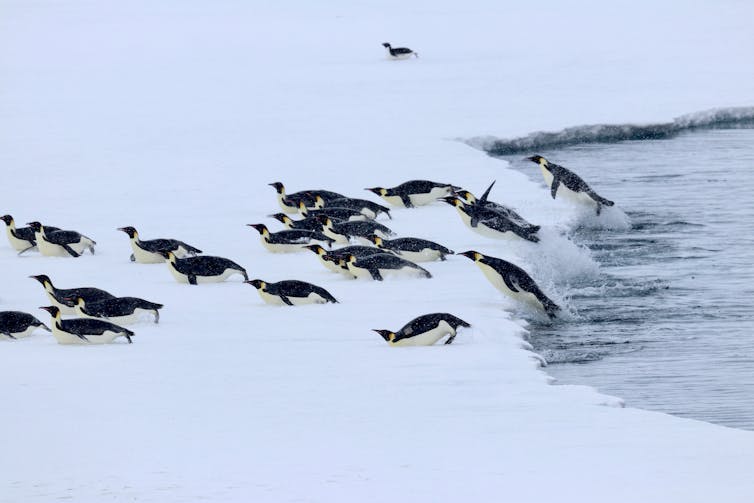
We need further studies to clarify these links and the relationship between population size and habitat quality. In our study, we weren’t able to consider prey availability and there may be other factors that play an important role.

Previous research has already shown that Emperor penguins have limited capacity to disperse to find more suitable climate refuges. This is supported by the genetic partitioning among the penguin populations in different Antarctic regions we studied.

It is therefore unlikely Emperors would move far to avoid more severe climate impacts, even if “better” habitats existed and could host larger colonies.

Emperors don’t easily move to other breeding sites, even if the conditions are better. Sara Labrousse/French Polar Institute, CC BY-SA

Protecting penguin habitat

Climate change is currently one of the main pressures driving Emperor penguins closer to extinction.

However, the latest global assessment by the Intergovernmental Science-Policy Platform on Biodiversity and Ecosystem Services (IPBES) clearly identified fishing activities as historic and current drivers of the erosion of marine biodiversity worldwide.

This is also true for Antarctica. While fishing pressure there is limited to a fraction of the global fishing fleet, some of the largest vessels target krill, a tiny shrimp-like crustacean consumed by many Antarctic predators, including Emperor penguins.

With climate models predicting further reductions in sea ice extent, new fishing grounds could open and amplify pressure on other Antarctic wildlife.

If we want to live in a world with Emperor penguins, the most important thing to do would be to cut greenhouse gas emissions steeply. Another key action could be to prevent fishing in areas where climate change will have the most impact.

In this respect, truly protected areas are one conservation tool at our disposal. Now that our research provides more detailed information about penguin habitats, we can begin the process of more careful planning for conservation.

The world’s largest marine protected area exists in the Ross Sea, which is home to about 25% of the world’s Emperor penguins. Lessons we learn from protection there could help mitigate future declines of Emperors around Antarctica.The Conversation

Sara Labrousse, Chercheuse en écologie polaire, Sorbonne Université and Michelle LaRue, Associate Professor in Conservation Biology, University of Canterbury

This article is republished from The Conversation under a Creative Commons license. Read the original article.

Read More........

Arianespace makes history by orbiting Intelsat 20 and HYLAS 2 on Ariane 5’s 50th consecutive success

Ariane 5 ECA ready for launch
ESA / ARIANESPACE - Flight VA208 mission poster / ARIANESPACE - Ariane 5 - 50 Successes in a Row patch. Ariane Flight VA208 Arianespace’s mission that orbited the Intelsat 20 and HYLAS 2 satellites today marked the milestone 50th consecutive success for its Ariane 5 heavy-lift launcher, confirming this vehicle’s role as the launch services industry reference in reliability, flexibility and performance. Ariane 5 ECA flight VA208 launch With the deployment of its latest two passengers during a flight of 34 minutes from the Spaceport in French Guiana, Ariane 5’s combined lift performance
 in the 50 straight successes totals more than 434,000 kg., delivering payloads to geostationary transfer orbit, low Earth orbit, Sun-synchronous polar orbit and Earth escape trajectories.
HYLAS 2 satellite
Payloads carried by Ariane 5 have included civilian and defense telecommunications satellites, TV broadcast relay platforms, resupply vessels for the International Space Station, civilian and military Earth observation systems, meteorology and environmental spacecraft and deep-space exploration probes; along with auxiliary and piggyback payloads for scientific and industrial experiments, for defense early warning, electronic intelligence (ELINT) and climate research.
Intelsat 20 satellite
Recognizing those who contribute to Ariane 5’s success In post-launch comments from the Spaceport, Arianespace Chairman & CEO Jean-Yves Le Gall paid homage to all who contribute to Ariane 5’s successes, from the mission personnel in Europe and the launch teams in French Guiana to Europe’s industrial suppliers, as well as the European Space Agency and France’s CNES space agency – which have played key roles in the launcher’s development and operation. “Thanks to all you in Europe and French Guiana, Ariane 5 is something that works…works very well…and will continue to work for a long time,” he added. “Following tonights launch, and with all of the contracts we’ve signed since the start of this year, our order book effectively covers no less than 19 firm Ariane 5 launches, which guarantees us more than three years of activity. Therefore, thank you and bravo to everyone!” The numbers from Ariane 5’s unbroken string of 50 mission successes are impressive. In its most frequent role as the launcher of choice for telecommunications and TV broadcast satellite operators and manufacturers worldwide, Ariane 5 has delivered platforms with a total equivalent relay capacity of well over 3,200 transponders, channels
Ariane 5 on the launch-pad
and beams for both civil and military The largest payload lofted by Ariane 5 is Europe’s Automated Transfer Vehicle for servicing of the International Space Station, with the heaviest of the three orbited so far weighing more than 19,700 kg.; while the smallest were piggyback satellites such as Spain's Nanosat, with had a liftoff mass of less than 20 kg. users. Le Gall said today’s mission also was historic from another aspect, as its lift performance of nearly 10.2 metric tons beat the world’s record for total mass launched to geostationary transfer orbit. “We captured the previous record last year with just over 10 tons, and this demonstrates the pertinence of our improvement strategy, which – step-by-step – enables us to increase the capacity of our launcher while retaining its extraordinary reliability.” Intelsat 20 was installed as the upper payload on this latest Ariane 5 launch, and was released first during the mission at 28 minutes into the flight. Built for international satellite operator Intelsat by Space Systems/Loral of Palo Alto, California based on its 1300-series platform, Intelsat 20 weighed approximately 6,090 kg. at liftoff, and is configured with Ku-band, C-band and Ka-band transponders. Intended to replace the Intelsat 7 and Intelsat 10 satellites in orbit, Intelsat 20 is to provide video, telephone and data transmission services for Europe, Africa, Russia, Asia and the Middle East. Two key customers on Ariane 5’s milestone mission According to Le Gall, today marks the 53rd time Intelsat has placed its confidence in Arianespace’s launch services. “In fact, more than one payload in six launched by Ariane vehicles from the beginning have been for Intelsat,” he continued. “This proves, more than any words, the quality and intensity of our relationship. And with a satellite as powerful as Intelsat 20, built by Space Systems/Loral, we are certain that Intelsat will be able to respond to the growing demands of its customers – in particular for the African continent.” The HYLAS 2 satellite orbited by Ariane 5 on today’s flight was deployed 34 minutes after liftoff, and will be used by European satellite operator Avanti Communications. Produced by Orbital Sciences Corporation of Dulles, Virginia using the Star 2.4E platform, HYLAS 2 is equipped with Ka-band transponders for data capacity offered to telecommunications, enterprise and government
Photo collage highlighting the 50 consecutive Ariane 5 successes
customers in Europe, the Middle East and portions of Africa. Le Gall noted that Arianespace orbited Avanti Communications’ first satellite – HYLAS 1 – on an Ariane 5 mission in 2010. “We are very proud that to have been chosen by Avanti in contributing to the development of very high-speed data services,” he added. The Arianespace mission pace will continue with its next two flights announced for September: the September 21 launch of another Ariane 5 from the Spaceport with the Astra 2F and GSAT-10 telecommunications relay platforms; and the September 16 mission of a Soyuz from Baikonur Cosmodrome in Kazakhstan, performed by Arianespace's Starsem affiliate and carrying Eumetsat's MetOp-B meteorological satellite. See the photo collage highlighting the 50 consecutive Ariane 5 successes: http://www.arianespace.com/news-feature-story/2012/8-2-2012-50th-success-launch.asp, See the Arianespace launch kit for further details: http://www.arianespace.com/news-launch-kits/2011-present-archive.asp, Related links: Avanti Communications HYLAS 2 launch website: http://www.avantiplc.com/hylas2/#, Avanti Communications corporate website: http://www.avantiplc.com/, Orbital Sciences Corporation website: http://www.orbital.com/, Intelsat website: http://www.intelsat.com/, Space Systems/Loral website: http://www.ssloral.com/, Images, Video, Text, Credits: Arianespace / Intelsat / Orbital. Greetings, Orbiter.ch Source: Orbiter.ch Space News
Read More........

Birth Of A Giant Planet: Candidate Protoplanet Spotted Inside Its Stellar Womb


Credit: ESO/L. Calçada
Astronomers using ESO’s Very Large Telescope have obtained what is likely the first direct observation of a forming planet still embedded in a thick disc of gas and dust. If confirmed, this discovery will greatly improve our understanding of how planets form and allow astronomers to test the current theories against an observable target. This artist’s impression shows the formation of a gas giant planet in the ring of dust around the young star HD 100546. This system is also suspected to contain another large planet orbiting closer to the star. The newly-discovered object lies about 70 times further from its star than the Earth does from the Sun. This protoplanet is surrounded by a thick cloud of material so that, seen from this position, its star almost invisible and red in colour because of the scattering of light from the dust. An international team led by Sascha Quanz (ETH Zurich, Switzerland) has studied the disc of gas and dust that surrounds the young star HD 100546, a relatively nearby neighbour located 335 light-years from Earth. They were surprised to find what seems to be a planet in the process of being formed, still embedded in the disc of material around the young star. The candidate planet would be a gas giant similar to Jupiter. “So far, planet formation has mostly been a topic tackled by computer simulations,”
says Sascha Quanz. “If our discovery is indeed a forming planet, then for the first time scientists will be able to study the planet formation process and the interaction of a forming planet and its natal environment empirically at a very early stage.” This composite image shows a view from the NASA/ESA Hubble Space Telescope (left) and from the NACO system on ESO’s Very Large Telescope (right) of the gas and dust around the young star HD 100546. The Hubble visible-light image shows the outer disc of gas and dust around the star. The new infrared VLT picture of a small part of the disc shows a candidate protoplanet. Both pictures were taken with a special coronagraph that suppresses the light from the brilliant star. The position of the star is marked with a red cross in both panels.  HD 100546 is a well-
Credit: ESO/NASA/ESA/Ardila et al.
studied object, and it has already been suggested that a giant planet orbits about six times further from the star than the Earth is from the Sun. The newly found planet candidate is located in the outer regions of the system, about ten times further out [1]. The planet candidate around HD 100546 was detected as a faint blob located in the circumstellar disc revealed thanks to the NACO adaptive optics instrument on ESO’s VLT, combined with pioneering data analysis techniques. The observations were made using a special coronagraph in NACO, which operates at near-infrared wavelengths and suppresses the brilliant light coming from the star at the location of the protoplanet candidate [2]. This image from the NACO system on ESO’s Very Large Telescope shows a candidate protoplanet in the disc of gas and dust around the young star HD100546. This picture was taken with a special coronagraph that suppresses the light from the brilliant star and allows the region of the protoplanet to be seen in great detail. The brightest part of this picture is the candidate protoplanet and the dark disc at the bottom is hiding the very bright. 
Credit: ESO
star itself According to current theory, giant planets grow by capturing some of the gas and dust that remains after the formation of a star [3]. The astronomers have spotted several features in the new image of the disc around HD100546 that support this protoplanet hypothesis. Structures in the dusty circumstellar disc, which could be caused by interactions between the planet and the disc, were revealed close to the detected protoplanet. Also, there are indications that the surroundings of the protoplanet are potentially heated up by the formation process. This chart shows the position of the young star HD 100546 in the southern constellation of Musca (The Fly). Most of the stars that are visible to the unaided eye from a clear and dark site are shown. The star HD 100546 is surrounded by a ring of dust where a planet appears to be in the process of formation. This star is a little too faint to see with the unaided eye,
Credit: ESO, IAU and Sky & Telescope
but can be picked up easily in binoculars. The planets and the dust ring cannot be seen in small telescopes. Adam Amara, another member of the team, is enthusiastic about the finding. “Exoplanet research is one of the most exciting new frontiers in astronomy, and direct imaging of planets is still a new field, greatly benefiting from recent improvements in instruments and data analysis methods. In this research we used data analysis techniques developed for cosmological research, showing that cross-fertilisation of ideas between fields can lead to extraordinary progress.” This image from the NASA/ESA Hubble Space Telescope shows a visible light view of the outer dust around the young star HD100546.
Credit: ESO/NASA/ESA/Ardila et al.
The position of the newly discovered protoplanet is marked with an orange spot. The inner part of this picture is dominated by artifacts from the brilliant central star, which has been digitally subtracted, and the black blobs are not real. Although the protoplanet is the most likely explanation for the observations, the results of this study require follow-up observations to confirm the existence of the planet and discard other plausible scenarios. Among other explanations, it is possible, although unlikely, that the detected signal could have come from a background source. It is also possible that the newly detected object might not be a protoplanet, but a fully formed planet which was ejected from its original orbit closer to the star. When the new object around HD 100546 is confirmed to be a forming planet embedded in its parent disc of gas and dust, it will become an unique laboratory in which to study the formation process of a new planetary system. This picture shows the sky around the young star HD 100546 in the southern constellation of Musca (The Fly). It was created from images from the Digitized Sky Survey 2. The cross-
Credit: ESO/Digitized Sky Survey 2. Acknowledgement: Davide De Martin
like features that are centred on brighter stars, as well as the coloured circles around them, are artifacts of the telescope and photographic process and are not real. Notes: [1] The protoplanet candidate orbits about 70 times further from its star than the Earth does from the Sun. This distance is comparable to the size of the orbits of outer Solar System dwarf planets such as Eris and Makemake. This location is controversial, as it does not fit well with current theories of planet formation. It is unclear at present whether the newfound planet candidate has been in its current position for the whole time since it formed or whether it could have migrated from the inner regions. [2] The team made use of a special feature called an apodised phase plate that increases the contrast of the image close to the star. [3] To study planet formation, astronomers cannot look at the Solar System, as all the planets in our neighborhood were formed more than four billion years ago. But for many years, theories about planet formation were strongly influenced by what astronomers could see in our local surroundings, as no other planets were known. Since 1995, when the first exoplanet around a sunlike star was discovered, several hundred planetary systems have been found, opening up new opportunities for scientists studying planetary formation. Up to now however, none have been “caught in the act” in the process of being formed, whilst still embedded in the disc of material around their young parent star. More information: This research was presented in a paper “A Young Protoplanet Candidate Embedded in the Circumstellar disc of HD 100546”, by S. P. Quanz et al., to appear online in the 28 February 2013 issue of Astrophysical Journal Letters. The team is composed of Sascha P. Quanz (ETH Zurich, Switzerland), Adam Amara (ETH), Michael R. Meyer (ETH), Matthew A. Kenworthy (Sterrewacht Leiden, Netherlands), Markus Kasper (ESO, Garching, Germany) and Julien H. Girard (ESO, Santiago, Chile). ESO is the foremost intergovernmental astronomy organisation in Europe and the world’s most productive ground-based astronomical observatory by far. It is supported by 15 countries: Austria, Belgium, Brazil, the Czech Republic, Denmark, France, Finland, Germany, Italy, the Netherlands, Portugal, Spain, Sweden, Switzerland and the United Kingdom. ESO carries out an ambitious programme focused on the design, construction and operation of powerful ground-based observing facilities enabling astronomers to make important scientific discoveries. ESO also plays a leading role in promoting and organising cooperation in astronomical research. ESO operates three unique world-class observing sites in Chile: La Silla, Paranal and Chajnantor.  At Paranal, ESO operates the Very Large Telescope, the world’s most advanced visible-light astronomical observatory and two survey telescopes. VISTA works in the infrared and is the world’s largest survey telescope and the VLT Survey Telescope is the largest telescope designed to exclusively survey the skies in visible light. ESO is the European partner of a revolutionary astronomical telescope ALMA, the largest astronomical project in existence. ESO is currently planning the 39-metre European Extremely Large optical/near-infrared Telescope, the E-ELT, which will become “the world’s biggest eye on the sky”. Contacts and sources: Sascha P. Quanz, ETH Zurich, Zurich, Switzerland, Julien H. Girard, ESO, Santiago, Chile, Richard Hook, ESO , Links, Research paperPhotos of the VLTSource: Nano Patents And Innovations
Read More........

PSLV-C20 successfully places 7 satellites in orbit news

PSLV-C20 / SARAL launch
An Indian Polar Satellite Launch Vehicle (PSLV) rocket successfully launched on February 25th 2013 at 12:31 UTC carrying Saral and 6 commercial secondary payloads into orbit from the Satish Dhawan Space Centre. ISRO's Polar Satellite Launch Vehicle, PSLV-C20, successfully launched the joint Indo-French Satellite, SARAL, today in its twenty third flight from Satish Dhawan Space Centre (SDSC) SHAR, Sriharikota. Six other satellites, namely, UNIBRITE (NLS 8.1) and BRITE (NLS 8.2) from Austria, SAPPHIRE and NEOSSAT from Canada, AAUSAT-3 (NLS 8.3) from Denmark; and STRaND-1 from the
Launch of Indian PSLV Rocket with Saral
United Kingdom, have also been launched into their planned orbits along with SARAL. At the completion of the countdown, PSLV-C20 lifted off from the First Launch Pad at SDSC SHAR, at 1801 hrs (IST) with the ignition of the first stage of the launch vehicle. The important flight events, namely, stage ignitions, heat-shield separation, stage separations and satellite injections took place exactly as planned. After a flight of 17 minutes 55 seconds, the main payload, SARAL, weighing 407 kg was injected to an orbit very close to the intended orbit. Following this, the six auxiliary satellites were also successfully injected. 
SARAL ocean altimetry satellite
This has been the twenty second successive successful launch of ISRO's workhorse launch vehicle PSLV. Since its first successful launch in 1994, PSLV has launched 27 Indian satellites and 35 satellites for customers from abroad, including the satellites launched today. It has also launched India's geosynchronous satellites, Kalpana-1 and GSAT-12, thereby proving its versatility. PSLV also launched India's first spacecraft mission to moon, Chandrayaan-1, in 2008. It is scheduled to launch India's first interplanetary mission, the Mars Orbiter Mission (MOM) spacecraft, by the end of this year. Satellite with Argos and Altika (SARAL) is an oceanographic satellite jointly developed by ISRO and the French Space Agency CNES. The satellite is built by ISRO, whereas CNES contributed the ARGOS and ALTIKA payloads. Data from SARAL will be useful for researchers besides having many practical applications like marine meteorology and sea state forecasting, climate monitoring, continental ice studies, environmental monitoring, protection of biodiversity and improvement in maritime security. ISRO Telemetry, Tracking and Command Network (ISTRAC) in Bangalore took over the SARAL's monitoring and control operations immediately after its injection. Following the automatic deployment of SARAL's solar panels, shortly after reaching orbit, all the subsequent operations are proceeding normally.Images, Video, Text, Credits: Indian Space Research Organization (ISRO) / CNES, Greetings, Orbiter.ch, Source: Orbiter.ch Space News
Read More........

Nemesis Star: How The Planets Would Be Affected By Binary System


Credit; Wikipedia
A binary star is a star system consisting of two stars orbiting around their common center of mass. Binary stars are often detected optically, in which case they are called visual binaries. Many visual binaries have long orbital periods of several centuries or millennia and therefore have orbits which are uncertain or poorly known An international team of astrophysicists has shown that planetary systems with very distant binary stars are particularly susceptible to violent disruptions, more so than if they had stellar companions with tighter orbits around them. Unlike the Sun, many stars are members of binary star systems – where two stars orbit one another – and these stars' planetary systems can be altered by the gravity of their companion stars. The orbits of very distant or wide stellar companions often become very eccentric – ie. less circular – over time, driving the once-distant star into a plunging orbit that passes very close to the planets once per orbital period. The gravity of this close-passing companion can then wreak havoc on planetary systems, triggering planetary scatterings and even ejections. A simulated example of a binary star, where two bodies with similar mass orbit around a common barycenter in elliptic orbits This movie shows two simulations of planetary system disruption by galactic disturbances to wide binary stars. On the left is a zoomed-out view showing the orbit of a hypothetical 0.1 solar mass binary star around our own solar system with an initial orbital separation of 10,000 AU (1 AU is the distance between the Earth and the sun). On the right is a zoomed-in 
Credit: Nathan Kaib
view of the orbits of Jupiter, Saturn, Uranus, and Neptune. As the binary orbit becomes eccentric, this eventually excites the planetary orbits and Uranus and Neptune are both ejected. "The stellar orbits of wide binaries are very sensitive to disturbances from other passing stars as well as the tidal field of the Milky Way," said Nathan Kaib, lead author of a study published today in Nature describing the findings. "This causes their stellar orbits to constantly change their eccentricity – their degree of circularity. If a wide binary lasts long enough, it will eventually find itself with a very high orbital eccentricity at some point in its life." When a wide binary orbit becomes very eccentric, the two stars will pass very close together once per orbit on one side of the orbital ellipse, while being very far apart on the other side of the ellipse. This can have dire consequences for planets in these systems since the gravity of a close-passing star can radically change planetary orbits around the other star, causing planets to scatter off of one another and sometimes get ejected to interstellar space. Kaib, a postdoctoral fellow in the Center for Interdisciplinary Exploration and Research in Astrophysics (CIERA) and the Department of Physics and Astronomy at Northwestern University and a National Fellow in the Canadian Institute for Theoretical Astrophysics at the University of Toronto, conducted computer simulations of the process with Queen's University physics professor Martin Duncan and Sean N. Raymond, a researcher at the University of Bordeaux and the Centre national de la recherche scientifique in France. They added a a hypothetical wide binary companion to the Earth's solar system which eventually triggered at least one of four giant planets (Jupiter, Saturn, Uranus and Neptune) to be ejected in almost half of the simulations. "This process takes hundreds of millions of years if not billions of years to occur in these binaries. Consequently, planets in these systems initially form and evolve as if they orbited an isolated star," said Kaib, who will present the findings this week at the 221st meeting of the American Astronomical Society in Long Beach, California. "It is only much later that they begin to feel the effects of their companion star, which often times leads to disruption of the planetary system." "We also found that there is substantial evidence that this process occurs regularly in known extrasolar planetary systems," said Duncan. "Planets are believed to form on circular orbits, and they are only thought to attain highly eccentric orbits through powerful and/or violent perturbations. When we looked at the orbital eccentricities of planets that are known to reside in wide binaries, we found that they are statistically more eccentric than planets around isolated stars like our Sun. " The researchers believe this is a telltale signature of past planetary scattering events, and that those with eccentric orbits are often interpreted to be the survivors of system-wide instabilities. "The eccentric planetary orbits seen in these systems are essentially scars from past disruptions caused by the companion star," said Raymond. The researchers note that this observational signature could only be reproduced well when they assumed that the typical planetary system extends from its host star as much as 10 times the distance between the Earth and the Sun. Otherwise, the planetary system is too compact to be affected by even a stellar companion on a very eccentric orbit. "Recently, planets orbiting at wide distances around their host stars have been directly imaged. Our work predicts that such planets are common but have so far gone largely undetected," says Duncan. Contacts and sources: Sean Bettam, University of Toronto, Source: Nano Patents And Innovations
Read More........

Peugeot Teases New Onyx Supercar Concept for Paris Motor Show

There was no doubt in our mind that France's "Big Three", Peugeot, Citroen and Renault, will each try to impress visitors and the press alike with dazzling concept models at the 2012 edition of the Paris Motor Show. The first study to come into light ahead of the show is from Peugeot and it's named Onyx. The French carmaker released a teaser image and video to prepare us about the concept for a futuristic looking supercar. No other official details have been announced yet, though Spain's es.Autoblog reported that the Onyx will boast a hybrid drivetrain combining a 1.6-liter turbocharged petrol engine tweaked to deliver around 250 horsepower with an electric motor for a total system output of about 400hp. Until we find out more from Peugeot, hop over the break to watch the teaser clip. Story References: Peugeot via Worldcarfans & es.Autblog Another hat tip to Bruno R! Source; Carscoop
Read More........

Scientists discover glaciers in Asian mountain range are actually getting bigger

Area of Glaceries are increasing in Karakoram range
Photos taken by a French satellite show glaciers in a mountain range west of the Himalayashave grown during the last decade. The growing glaciers were found in the Karakoram range, which spans the borders between Pakistan, Indiaand China and is home to the world's second highest peak, K2. The startling find has baffled scientists and comes at a time when glaciers in other parts of the region, and across the world, are shrinking. French scientists from the National Centre for Scientific Research and theUniversityof Grenoble, were forced to rely on satellite images, to study the region - because much of the Karakoram range is inaccessible. They compared observations made in 1999 and 2008 and found a marginal mass increase. They estimated the glaciers had gained between 0.11 and 0.22 metres of ice each year. The researchers are unsure why the region bucks the global trend - but they know from other studies in other parts of the world that in very cold regions, like the Karakoram range, climate change can
cause extra precipitation, which then freezes and adds to ice mass. Lead reseacher Julie Gardelle told BBC News: 'We don't really know the reason. Right now we believe that it could be due to a very specific regional climate over Karakoram because there have been meteorological measurements showing increased winter precipitation; but that's just a guess at this stage.' Stephan Harrison, associate professor in quaternary science at the UK'sUniversity of Exeter, said the new research had showed there is 'considerable variability' in the global climate and in how glaciers respond to it. Harrison said much of their mass gain also comes from avalanches from the high mountains surrounding them.'Overall, the impact of melting glaciers such as these on sea level rise is known to be negligible, but it does mean that there is much more to be learnt about exactly how the world's glaciers will respond to continued global warming.' The findings provide welcome respite at a time when glaciers across the globe are shrinking at a rapid rate. A study of the neighbouring Himalayas in 2011 found the rate of ice loss inglaciers - which provide fresh water for around 1.3 billion people - has doubled since the 1980s. Source; Ananta-Tech
Read More........

Diet quality key to survival of whales, dolphins: study

The survival of whales and dolphins depends on the quality of their diet and this plays an important role in conservation, according to a new study. The study, published in the online journal PLOS ONE, was conducted by researchers from the University of British Columbia (UBC) in Canada and University of La Rochelle (ULR) in France. "The conventional wisdom is that marine mammals can eat anything," said co-author Andrew Trites, a marine mammal expert at UBC. "However, we found that some species of whales and dolphins require calorie rich diet to survive while others are built to live off low quality prey." The researchers compared the diet of 11 species of whales, dolphins and porpoises in the Northeast Atlantic Ocean, and found differences in the qualities of prey consumed that could not be explained by the different body sizes of the predators. The key to understanding the differences in their diet was to look at their muscle performance, as high energy prey tend to be more mobile, and require their predators to spend more energy to catch them, according to the researchers. The researchers believe the findings will help better assess the impact of resource changes to marine mammals. "Species with high energy needs are more sensitive to depletion of their primary prey," said Jerome Spitz, first author of the study and a post-doctoral fellow at ULR in France. "It is no longer a question of how much food do whales and dolphins need, but whether they are able to get the right kinds of food to survive." Spitz added. Source: SAM Daily TimesImage
Read More........

The price of your soul: How your brain decides whether to 'sell out'


.Subscribe
By Carol Clark: A neuro-imaging study shows that personal values that people refuse to disavow, even when offered cash to do so, are processed differently in the brain than those values that are willingly sold. “Our experiment found that the realm of the sacred – whether it’s a strong religious belief, a national identity or a code of ethics – is a distinct cognitive process,” says Gregory Berns, director of the Center for Neuropolicy at Emory University and lead author of the study. The results were published in Philosophical Transactions of the Royal Society. Sacred values prompt greater activation of an area of the brain associated with rules-based, right-or-wrong thought processes, the study showed, as opposed to the regions linked to processing of costs-versus-benefits. Berns headed a team that included Emory economist Monica Capra; Michael Prietula, a professor of information systems and operations management at Emory's Goizueta Business School; a psychologist from the New School for Social Research and anthropologists from the Institute Jean Nicod in Paris, France. (Click here to see the full list of names.) The research was funded by the U.S. Office of Naval Research, the Air Force Office of Scientific Research and the National Science Foundation. “We’ve come up with a method to start answering scientific questions about how people make decisions involving sacred values, and that has major implications if you want to better understand what influences human behavior across countries and
cultures,” Berns says. “We are seeing how fundamental cultural values are represented in the brain.” The researchers used functional magnetic resonance imaging (fMRI) to record the brain responses of 32 U.S. adults during key phases of an experiment. In the first phase, participants were shown statements ranging from the mundane, such as “You are a tea drinker,” to hot-button issues such “You support gay marriage” and “You are Pro-Life.” Each of the 62 statements had a contradictory pair, such as “You are Pro-Choice,” and the participants had to choose one of each pair. Click here to download the full list of questions, and the responses by the subjects. At the end of the experiment, participants were given the option of auctioning their personal statements: Disavowing their previous choices for actual money. The participants could earn as much as $100 per statement by simply agreeing to sign a document stating the opposite of what they believed. They could choose to opt out of the auction for statements they valued highly. “We used the auction as a measure of integrity for specific statements,” Berns explains. “If a person refused to take money to change a statement, then we considered that value to be personally sacred to them. But if they took money, then we considered that they had low integrity for that statement and that it wasn’t sacred.” The brain imaging data showed a strong correlation between sacred values and activation of the neural systems associated with evaluating rights and wrongs (the left temporoparietal junction) and semantic rule retrieval (the left ventrolateral prefrontal cortex), but not with systems associated with reward. “Most public policy is based on offering people incentives and disincentives,” Berns says. “Our findings indicate that it’s unreasonable to think that a policy based on costs-and-benefits analysis will influence people’s behavior when it comes to their sacred personal
values, because they are processed in an entirely different brain system than incentives.” Research participants who reported more active affiliations with organizations, such as churches, sports teams, musical groups and environmental clubs, had stronger brain activity in the same brain regions that correlated to sacred values. “Organized groups may instill values more strongly through the use of rules and social norms,” Berns says. The experiment also found activation in the amygdala, a brain region associated with emotional reactions, but only in cases where participants refused to take cash to state the opposite of what they believe. “Those statements represent the most repugnant items to the individual,” Berns says, “and would be expected to provoke the most arousal, which is consistent with the idea that when sacred values are violated, that induces moral outrage.” The study is part of a special issue of the Philosophical Transactions of the Royal Society, titled “The Biology of Cultural Conflict.” Berns edited the special issue, which brings together a dozen articles on the culture of neuroscience, including differences in the neural processing of people on the opposing sides of conflict, from U.S. Democrats and Republicans to Arabs and Israelis. “As culture changes, it affects our brains, and as our brains change, that affects our culture. You can’t separate the two,” Berns says. “We now have the means to start understanding this relationship, and that’s putting the relatively new field of cultural neuroscience onto the global stage.” Future conflicts over politics and religion will likely play out biologically, Berns says. Some cultures will choose to change their biology, and in the process, change their culture, he notes. He cites the battles over women’s reproductive rights and gay marriage as ongoing examples.Source: eScienceCommons
Read More........

84 Million Stars and Counting

VISTA gigapixel mosaic of the central parts of the Milky Way
Using a whopping nine-gigapixel image from the VISTA infrared survey telescope at ESO’s Paranal Observatory, an international team of astronomers has created a catalogue of more than 84 million stars in the central parts of the Milky Way. This gigantic dataset contains more than ten times more stars than previous studies and is a major step forward for the understanding of our home galaxy. The image gives viewers an incredible, zoomable view of the central part of our galaxy. It is so large that, if printed with the resolution of a typical book, it would be 9 metres long and 7 metres tall.
Wide-field view of the Milky Way, showing the extent of a new VISTA gigapixel image
“By observing in detail the myriads of stars surrounding the centre of the Milky Way we can learn a lot more about the formation and evolution of not only our galaxy, but also spiral galaxies in general,” explains Roberto Saito (Pontificia Universidad Católica de Chile, Universidad de Valparaíso and The Milky Way Millennium Nucleus, Chile), lead author of the study.
Optical/infrared comparison of the central parts of the Milky Way
Most spiral galaxies, including our home galaxy the Milky Way, have a large concentration of ancient stars surrounding the centre that astronomers call the bulge. Understanding the formation and evolution of the Milky Way’s bulge is vital for understanding the galaxy as a whole. However, obtaining detailed observations of this region is not an easy task. “Observations of the bulge of the Milky Way are very hard because it is obscured by dust,” says Dante Minniti (Pontificia Universidad Catolica de Chile, Chile), co-author of the study. “To peer into the heart of the galaxy, we need to observe in infrared light, which is
Colour–magnitude diagram of the Galactic bulge
less affected by dust.”the The large mirror, wide field of view and very sensitive infrared detectors of ESO’s 4.1-metre Visible and Infrared Survey Telescope for Astronomy (VISTA) make it by far the best tool for this job. The team of astronomers is using data from the VISTA Variables in the Via Lactea programme (VVV) [1], one of six public surveys carried out with VISTA. The data have been used to create a monumental 108 200 by 81 500 pixel colour image containing nearly nine billion pixels. This is one of the biggest astronomical images ever produced. The team has now used these data to compile the largest catalogue of the central concentration of stars in the Milky Way ever created [2].
Annotated map of VISTA’s view of the centre of the Milky Way
To help analyse this huge catalogue the brightness of each star is plotted against its colour for about 84 million stars to create a colour–magnitude diagram. This plot contains more than ten times more stars than any previous study and it is the first time that this has been done for the entire bulge. Colour–magnitude diagrams are very valuable tools that are often used by astronomers to study the different physical properties of stars such as their temperatures, masses and ages [3]. “Each star occupies a particular spot in this diagram at any moment during its lifetime. Where it falls depends on how bright it is and how hot it is. Since the new data gives us a snapshot of all the stars in one go, we can now make a census of all the stars in this part of the Milky Way,” explains Dante Minniti. Video above: Infrared/visible light comparison of VISTA’s gigapixel view of the centre of the Milky Way. The new colour–magnitude diagram of the bulge contains a treasure trove of information about the structure and content of the Milky Way. One interesting result revealed in the new data is the large number of faint red dwarf stars. These are prime candidates around which to search for small exoplanets using the transit method [4]. “One of the other great things about the VVV survey is that it’s one of the ESO VISTA public surveys. This means that we’re making all the data publicly available through the ESO data archive, so we expect many other exciting results to come out of this great resource," concludes Roberto Saito. Notes: [1] The VISTA Variables in the Via Lactea (VVV) survey is an ESO public survey dedicated to scanning the southern plane and bulge of the Milky Way through five near-infrared filters. It started in 2010 and was granted a total of 1929 hours of observing time over a five-year period. Via Lactea is the Latin name for the Milky Way. [2] The image used in this work covers about 315 square degrees of the sky (a bit less than 1% of the entire sky) and observations were carried out using three different infrared filters. The catalogue lists the positions of the stars along with their measured brightnesses through the different filters. It contains about 173 million objects, of which about 84 million have been confirmed as stars. The other objects were either too faint or blended with their neighbours or affected by other artefacts, so that accurate measurements were not possible. Others were extended objects such as distant galaxies. The image used here required a huge amount of data processing, which was performed by Ignacio Toledo at the ALMA OSF. It corresponds to a pixel scale of 0.6 arcseconds per pixel, down-sampled from the original pixel scale of 0.34 arcseconds per pixel. [3] A colour–magnitude diagram is a graph that plots the apparent brightnesses of a set of objects against their colours. The colour is measured by comparing how bright objects look through different filters. It is similar to a Hertzsprung-Russell (HR) diagram but the latter plots luminosity (or absolute magnitude) rather than just apparent brightness and a knowledge of the distances of the stars plotted is also needed. [4] The transit method for finding planets searches for the small drop in brightness of a star that occurs when a planet passes in front of it and blocks some of its light. The small size of the red dwarf stars, typically with spectral types K and M, gives a greater relative drop in brightness when low-mass planets pass in front of them, making it easier to search for planets around them. More information: This research was presented in a paper “Milky Way Demographics with the VVV Survey I. The 84 Million Star Colour–Magnitude Diagram of the Galactic Bulge“ by R. K. Saito et al., which was published in the journal Astronomy & Astrophysics (A&A, 544, A147). The team is composed of R. K. Saito (Pontificia Universidad Católica de Chile, Santiago, Chile; Universidad de Valparaíso, Chile; The Milky Way Millennium Nucleus, Chile), D. Minniti (Pontificia Universidad Católica de Chile; Vatican Observatory), B. Dias (Universidade de São Paulo, Brazil), M. Hempel (Pontificia Universidad Católica de Chile), M. Rejkuba (ESO, Garching, Germany), J. Alonso-García (Pontificia Universidad Católica de Chile), B. Barbuy (Universidade de São Paulo), M. Catelan (Pontificia Universidad Católica de Chile), J. P. Emerson (Queen Mary University of London, United Kingdom), O. A. Gonzalez (ESO, Garching, Germany), P. W. Lucas (University of Hertfordshire, Hatfield, United Kingdom) and M. Zoccali (Pontificia Universidad Católica de Chile). The year 2012 marks the 50th anniversary of the founding of the European Southern Observatory (ESO). ESO is the foremost intergovernmental astronomy organisation in Europe and the world’s most productive ground-based astronomical observatory by far. It is supported by 15 countries: Austria, Belgium, Brazil, the Czech Republic, Denmark, France, Finland, Germany, Italy, the Netherlands, Portugal, Spain, Sweden, Switzerland and the United Kingdom. ESO carries out an ambitious programme focused on the design, construction and operation of powerful ground-based observing facilities enabling astronomers to make important scientific discoveries. ESO also plays a leading role in promoting and organising cooperation in astronomical research. ESO operates three unique world-class observing sites in Chile: La Silla, Paranal and Chajnantor. At Paranal, ESO operates the Very Large Telescope, the world’s most advanced visible-light astronomical observatory and two survey telescopes. VISTA works in the infrared and is the world’s largest survey telescope and the VLT Survey Telescope is the largest telescope designed to exclusively survey the skies in visible light. ESO is the European partner of a revolutionary astronomical telescope ALMA, the largest astronomical project in existence. ESO is currently planning a 40-metre-class European Extremely Large optical/near-infrared Telescope, the E-ELT, which will become “the world’s biggest eye on the sky”. Links: Research paper (A&A, 544, A147): http://www.aanda.org/10.1051/0004-6361/201219448, Photos of the VISTA telescope: http://www.eso.org/public/images/archive/search/?adv=&subject_name=Visible%20and%20Infrared%20Survey%20Telescope%20for%20Astronomy, Images taken with the VISTA telescope: http://www.eso.org/public/images/archive/search/?adv=&facility=30, Image, Text, Credits: ESO/VVV Consortium/Acknowledgement: Ignacio Toledo, Martin Kornmesser/Nick Risinger (skysurvey.org)/Videos: ESO/VVV Consortium/Nick Risinger (skysurvey.org)/Music: Delmo -- Acoustic (disasterpeace.com)/Acknowledgement: Ignacio Toledo, Martin Kornmesser., Greetings, Orbiter.ch, Source: Orbiter.ch Space News
Read More........

French and American scientists win Nobel Physics Prize

2012 Nobel Prize for physics laureates Serge Haroche of France and David Wineland of the US at the Royal Swedish Academy of Science in Stockholm. Reuters
A French-American duo shared the 2012 Nobel Prize in physics on Tuesday for inventing methods to observe the bizarre properties of the quantum world, research that has led to the construction of extremely precise clocks and helped scientists take the first steps toward building superfast computers. Serge Haroche of France and American David Wineland opened the door to new experiments in quantum physics by showing how to observe individual quantum particles without destroying them. That was previously thought impossible because single quantum particles lose their mysterious quantum properties when they interact with the outside world, the Royal Swedish Academy of Sciences said. A quantum particle is one that is isolated from everything else. In this situation, an atom or electron or photon takes on strange properties. It can be in two places at once, for example. It behaves in some ways like a wave. But these properties are instantly changed when it interacts with something else, such as when somebody observes it. Working separately, the two scientists, both 68, developed "ingenious laboratory methods" that allowed them to manage and measure and control fragile quantum states, the academy said. The laureates "Their ground-breaking methods have enabled this field of research to take the very first steps towards building a new type of superfast computer 
A graphic featuring work by Serge Haroche of France and David Wineland of US who won the 2012 Nobel Prize in Physics. AFP photo
based on quantum physics," the academy said. "The research has also led to the construction of extremely precise clocks that could become the future basis for a new standard of time." Wineland traps ions electrically charged atoms and measures them with light, while Haroche controls and measures photons, or light particles. Haroche, of the College de France and Ecole Normale Superieure in Paris, said he was out walking with his wife when he got the call from the Nobel judges. "I was in the street and passing a bench so I was able to sit down," Haroche told a news conference in Stockholm by telephone. "It's very overwhelming." Wineland is a physicist at the National Institute of Standards and Technology in Boulder, Colorado. The physics prize was the second of the 2012 Nobel Prizes to be announced, with the medicine award going Monday to stem cell pioneers John Gurdon of Britain and Japan's Shinya Yamanaka. Each
award is worth 8 million kronor, or about $1.2 million. Only two women have won the physics prize since it was first awarded in 1901: Marie Curie in 1903 and Maria Goeppert-Mayer in 1963. The prizes are always handed out on December 10, the anniversary of prize founder Alfred Nobel's death in 1896. A glance at the Nobel Prize for physics: Who won? Frenchman Serge Haroche of the College de France and Ecole Normale Superieure, Paris, and American David Wineland of the University of Colorado in Boulder. For what? The two were cited for inventing and developing methods for observing tiny quantum particles without destroying them. The significance? Their research has led to the construction of extremely precise clocks that could become the basis for a new standard of measuring time and helped scientists take the first steps toward building superfast computers. What they said? Haroche: "It's very overwhelming. ... At first I called my children. ... There are a lot of people in the world that deserve the prize so I tried to not to expect too much." Wineland: "It was certainly surprising, and kind of overwhelming right now...I feel like I got a lot smarter overnight. ... When they also told me that the prize was shared with a good friend, that was nice to hear, too." Source: Hindustan Times
Read More........

Nobel Prize: John Gurdon, Shinya Yamanaka win in medicine

Shinya YamanakaBritish researcher John Gurdon and Shinya Yamanaka of Japan  won  this  year's  Nobel  Prize  in medicine today for the discovery that mature, specialized cells of the body can be reprogrammed into blank slates that can become any kind of cell. The prize committee at Stockholm's Karonlinska Institute said the discovery has "revolutionized our understanding of how cells and organisms develop." "The discoveries of Gurdon and Yamanaka have shown that specialized cells can turn back the developmental clock under certain circumstances," the committee said. "These discoveries have also provided new tools for scientists around the world and led to remarkable progress in many areas of medicine." The medicine award was the first Nobel Prize to be announced this year. The physics award will be announced tomorrow, followed by chemistry on Wednesday, literature on Thursday and the Nobel Peace Prize on Friday. The economics prize, which was not among the original awards, but was established by the Swedish central bank in 1968, will be announced on October 15. All prizes will be handed out on December 10, the anniversary of prize founder Alfred Nobel's death in 1896. Last year's medicine award to Canadian-born Ralph Steinman, American Bruce Beutler and French scientist Jules Hoffmann briefly created some confusion when it was announced that Steinman had died a few days earlier. Posthumous prizes are normally not allowed, but the award was left unchanged since the judges were not aware of Steinman's death when they selected him as a winner.  Source: Indian Express
Read More........

India launches GSAT-10 successfully

An Ariane 5 rocket carrying two satellites, ASTRA 2F and GSAT-10, blasts off from the European space centre of Kourou, French Guiana. AFP/CNES/CSG/S Martin
India's advanced communication satellite GSAT-10 that would augment telecommunication, direct-to-home broadcasting and radio navigation services was successfully launched early on Saturday on board Ariane-5 rocket from Europe's spaceport in French Guiana in South America. At the end of a smooth countdown lasting 11 hours and 30 minutes, Ariane-5 ECA rocket injected GSAT-10 into an elliptical Geosynchronous Transfer Orbit (GTO), very close to the intended one, after a flight of 30 minutes and 45 seconds, Indian Space Research Organisation said. At 3,400kg at lift-off, GSAT-10 is the heaviest built by Bangalore-headquartered Isro. GSAT-10 project is a Rs. 750 crore mission that includes the cost of satellite, launch services by the European space consortium Arianespace and insurance. Soon after GSAT-10 was hurtled into space, Isro's Master Control Facility (MCF) at Hassan in Karnataka took over the command and control of the satellite and declared the launch of Indian space agency's 101st space mission a success. "The satellite is in good health," Isro said after checks on various subsystems of the spacecraft, adding all its parameters were satisfactory. Blasting off from the launch pad at 2.48am (IST), Arianespace's rocket first injected European co-passenger ASTRA 2F into orbit followed by GSAT-10. With a 15-year design life, GSAT-10 is expected to be operational by November and will augment telecommunication, DTH and radio navigation services by adding 30 more to the much-in-demand transponder capacity, now hit by a crunch. Isro chairman K Radhakrishnan, who was at MCF at Hassan at the launch, said, "By November 2012, we expect to operationalise GSAT-10 and make it available to the user community. GSAT-10 is fitted with 30 transponders (12 Ku-band, 12 C-band and six Extended C-Band), which will provide vital augmentation to INSAT/GSAT transponder capacity. With a scramble for transponders, India is now managing a significant part of its requirement by leasing foreign transponders to meet the domestic demand. GSAT-10 also has a navigation payload – GAGAN (GPS aided Geo Augmented Navigation) -- that would provide improved accuracy of GPS signals (of better than seven metres) to be used by Airports Authority of India for civil aviation requirements. This is the second satellite in INSAT/GSAT constellation with GAGAN payload after GSAT-8, launched in May 2011. GSAT-10 was originally scheduled for a Sept 22 launch, but was deferred after scientists detected a small glitch --one gram of dust -- in the upper part of the rocket. GSAT-10 project director TK Anuradha, additional secretary of department of Space, S Srinivasan and director of Isro Satellite Centre SK Shivakumar were among key Isro officials who were in French Guiana for the launch. Shivakumar said GSAT-10 would give an impetus to the 'communication revolution' in India.Arianespace chairman & CEO Jean-Yves Le Gall said at the launch base that Isro is a highly loyal customer, as the collaboration with it began more than 30 years ago with its Apple satellite's orbiting by the third flight of an Ariane vehicle – an Ariane 1 version launched in June 1981. In the coming five days, orbit raising manoeuvres will be performed to place the satellite in the Geostationary Orbit with required inclination with reference to the equator, Isro said. The satellite will be moved to the Geostationary Orbit (36,000km above the equator) by using the satellite propulsion system in a three step approach. After the completion of orbit raising operations, the two solar panels and both the dual gridded antenna reflectors of GSAT-10 will be deployed for further tests and operations. It is planned to experimentally turn on the communication payloads in the second week of October, Isro said. After the successful completion of all in-orbit tests, GSAT-10 will be ready for operational use by November. GSAT-10 will be positioned at 83 deg East orbital location along with INSAT-4A and GSAT-12.Source: Hindustan Times
Read More........

India launches 100th space mission successfully


Making history in its space odyssey, India on Sunday successfully launched its 100th mission with its workhorse PSLV-C21 placing in orbit two foreign satellites in a flawless flight from the spaceport here. The third wholly commercial launch with no Indian satellite was a textbook mission as ISRO's Polar Satellite Launch Vehicle placed in orbit French spacecraft SPOT 6 and Japanese micro satellite Proiteres some 18 minutes after lift-off at 9.53 am.The lift-off was delayed by two minutes at the end of the 51-hour countdown to avoid collision with space debris. The historic mission was described as a 'spectacular success' by Prime Minister Manmohan Singh, who keenly watched the launch sequence at the mission control centre at Satish Dhawan Space Centre here, about 110 km from Chennai. "I warmly congratulate the Department of Space and all members of Indian Space Research Organisation fraternity for this spectacular success," he told the scientists minutes after the successful launch. Describing the mission as a milestone  in  the  nation's space capabilities, he said the launch was 'testimony to the commercial competitiveness of the Indian space industry and is a tribute to Indian innovation and ingenuity'. A beaming ISRO chief K. Radhakrishnan told the post-launch media conference that with today's successful mission the agency has launched 62 satellites, one space recovery module and 37 rockets, making it a grand 100. Each Indian rocket going up is considered a mission as also each Indian satellite being placed in orbit. The 44-metre PSLV took off on its 22nd flight, zoomed into the overcast skies carrying the French satellite with a lift-off mass of 712 kg, the heaviest ever to be launched by India for an international client, and the 15 kg Japanese micro spacecraft. The mission was a historic landmark for ISRO in its five- decade old space programme since beginning on a humble note with the launch of the indigenous 'Aryabhatta' on board a Russian rocket on April 19, 1975. PSLV yet again proved its versatility and robustness scripting its 21st successful mission in a row after its first flight in September 1993 ended in a failure. SPOT-6 is the biggest commercial lift so far since India forayed into the multi-billion dollar global commercial satellite launch market after 350 kg Agile of Italy, put in orbit in 2007 by PSLV. Twelve other foreign commercial satellites launched by ISRO weighed below 300 kg. Significantly, France's five earlier SPOT satellites were launched by European Araine rocket. SPOT-6 is an earth observation satellite, while Proiteres is intended to observe Kansai district of Japan through high-resolution camera. Radhakrishnan said the launch originally scheduled for 9.51 am was adjusted to 9.53 am following analysis of space debris for the past few days. According to American space agency NASA, over 500,000 pieces of debris or 'space junk' are tracked as they orbit the Earth. The debris, which travel at speed up to 17,500 mph, could damage a satellite or a spacecraft. Radhakrishnan declined to divulge the cost of today's mission, saying it was paid by the customers. Mission director Kunhali Krishnan termed the launch a 'grand success' and said all four stages of the rocket performed 'exceedingly well'.  Source: Deccan Chronicle
Read More........

Swiss solar boat finishes historic world tour

On Board The Planet Solar, Italy — Scanning the horizon on his solar-powered catamaran, Swiss electrical engineer Raphael Domjan counts down the hours to the completion of his record-breaking world tour. "The idea was not to perform a feat but an eco-adventure with the aim of passing on the message that change is possible," Domjan told AFP-TV as his boat furrowed through choppy waves from Italy's Elba Island to Corsica in France. Domjan began his journey from Monaco in September 2010 on the boat he built after seeing the effects of climate change on an Icelandic glacier, and he is due to complete it on May 4 when he returns to the Mediterranean port. "I realised climate change was real and I had to do something," he said. The 31-metre (102-foot) white Planetsolar, with 537 square metres of black solar panels mounted around a raised cockpit, cost 15 million euros to build, and the project only became possible after Domjan joined up with German businessman Immo Stroeher. Domjan, 40, and his crew, including a captain, a chief builder and a mechanic, are hoping that their exhausting but historic 600-day journey will herald a new era in eco-friendly travel, particularly in the tourism sector. After crossing the Atlantic and passing through the Panama Canal, they crossed the Pacific and returned to Europe via the Suez Canal. There were a few hiccups along the way, including a frustrating three-day wait off the coast of Australia when a storm blocked out the sun. "We have everything at our disposal: the know-how, technology, raw materials and renewable energy to become sustainable and protect the planet," said the engineer, a nature lover who is also a pilot, ambulance man and mountain guide. Planetsolar can produce up to 500 or 600 kiloWatts per hour in good weather -- enough to travel 300 kilometres (186 miles) when the battery is fully charged using engines no more powerful than those on a scooter. Everything on board is solar-powered: from the boat's engines and the on-board computers to the hot water and the light bulbs. "The boat wasn't easy to build, but we built it in a record time of year-and-a-half years," said Jens Langwasser, 28, the chief builder. "We had a lot of problems with finding the right panels, the right battery. It hasn't been easy. This is solar energy. You go on the road with storms, rain and all types of conditions. You never know what will happen." As the boat requires maximum sunlight to move, it had to sail as close as possible to the Equator and follow routes that constantly had to change, based on how much sunlight was forecast for any particular day. "Twice a day we get a bulletin with sunlight forecasts. Sometimes we have to slow down to go through a patch of clouds and find a sunny spot," said captain Erwann Le Rouzic, 40, an experienced sailor. Erwann said that despite all the frustrations he was thrilled about the implications of solar-powered travel. "Of course it only works in sunny areas and on some types of boat, and I'm not saying we'll see cargo ships becoming solar powered in 10 years, but now we know it works and there are a lot of possible uses," he said. Ibor, a resident of Calvi where the ship arrived on one of its final legs of the world tour, said he was impressed. "There's no two ways about it. This is the future. No doubt about it," he said. Raphael said he has managed to show to industrialists, businessmen and politicians that his were not just fantasies from the novels of Jules Verne such as "Around the World in 80 days", but feasible ideas.  His first victory is already secure. As the Planetsolar was passing the Galapagos Islands, the government there decided to ban access to one of the archipelago's islands to all boats except for solar or electric-powered ones. Source: The Way I See It
Read More........