Scorpion Venom May Provide the Next Breast Cancer Breakthrough

– credit Marino Linic

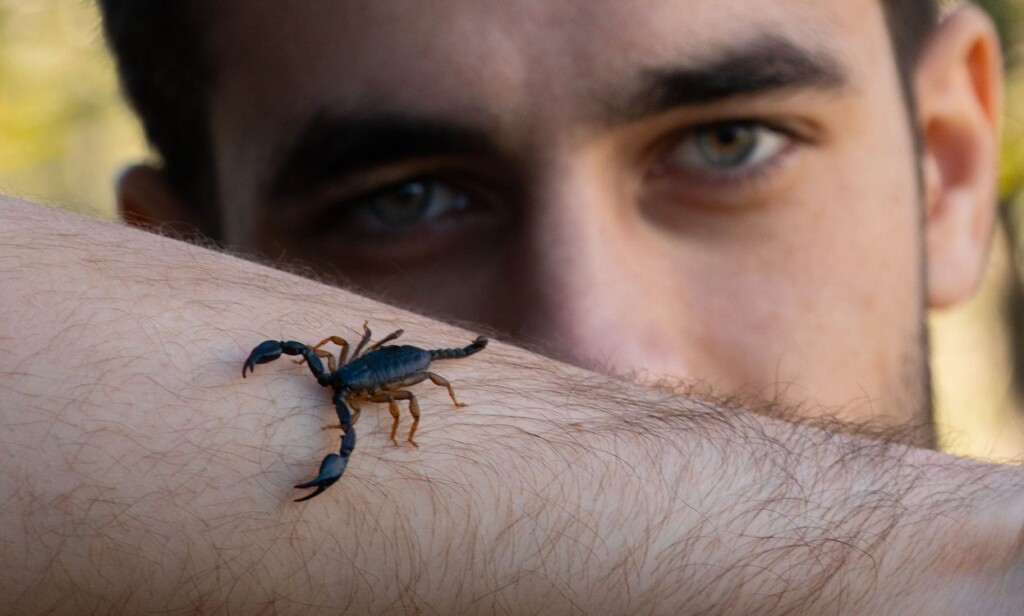
Scientists in Brazil are currently testing to see if the venom of an Amazonian scorpion could be used to poison breast cancer tumors.

Researchers at the University of São Paulo’s Preto School of Pharmaceutical Sciences (FCFRP-USP) have long worked to clone and express proteins from rattlesnake and scorpion venom with hopes of transforming these powerful compounds into medicines.

Recently, their work identified that venom of the scorpion Brotheas amazonicus appears to attack breast cancer cells in a way similar to a widely used chemotherapy medication.

These early findings were generated through a collaboration with scientists from the National Institute for Amazonian Research (INPA) and the Amazonas State University (UEA).

“Through bioprospecting, we were able to identify a molecule in the species of this Amazonian scorpion that is similar to that found in the venoms of other scorpions and that acts against breast cancer cells,” said Eliane Candiani Arantes, a professor at FCFRP-USP and the coordinator of the project.

Arantes and her team identified two neurotoxins in scorpion venom with immunosuppressive effects. Working with collaborators at INPA and UEA, they found a peptide named BamazScplp1 in the venom of Brotheas amazonicus that appears to have anti-tumor potential.

Laboratory tests showed that the peptide’s impact on breast cancer cells was comparable to paclitaxel, a commonly prescribed chemotherapy treatment. It primarily triggers necrosis, a form of cell death previously associated with molecules from other scorpion species.

Arantes and her team have isolated other components of venoms from scorpions and from snakes that have been used to help develop other clinical applications, including an internal wound sealant that mimics the body’s natural clotting and scaffolding processes. It’s undergoing trials for use in nerve repair, bone healing, and restoring movement following spinal cord injury.Next time you see a scorpion, and think it a nasty creepy crawly that will send you to the hospital, show a bit of grace; they might help save a woman’s life some day. Scorpion Venom May Provide the Next Breast Cancer Breakthrough
Read More........

Brazilian satellite to be orbited by Indian rocket reaches Chennai


Brazilian satellite Amazonia-1, slated to be put into orbit by Indian Space Research Organisation's (ISRO) rocket Polar Satellite Launch Vehicle (PSLV), has landed here on an Emirates SkyCargo flight, it was announced on Wednesday. In a statement, Emirates said its freight division Emirates SkyCargo flew the Amazonia-1 satellie from Sao Jose dos Campos, Brazil to Chennai.

This is the first time that Emirates SkyCargo has transported a space satellite from South America.

Amazonia-1 is the first satellite to have been developed completely in Brazil by the National Institute for Space Research (INPE), Brazil's apex body dedicated for space research and exploration.

The satellite took eight years to be developed and once launched into space, will help monitor the ecosystem of the Amazon rainforest, the world's largest tropical rainforest, the statement said.

The satellite is due to be sent to space in February 2021 from the Satish Dhawan Space Centre located in Andhra Pradesh's Sriharikota.

Emirates SkyCargo, together with the INPE, the airport and local partners, conducted two comprehensive simulation sessions ahead of the transport date to be able to transport the sensitive cargo safely.

During the transportation process, the Amazonia-1 satellite was dismantled into multiple components to facilitate easy loading and unloading from the aircraft.

The satellite components were packed inside large containers to avoid any damage during the transport.

ISRO Chairman K.Sivan had told IANS: "End of February or early March 2021, we will be sending our rocket Polar Satellite Launch Vehicle-C51 (PSLV-C51). The primary payload will be the Brazilian satellite called Amazonia, an earth observation satellite."

"The PSLV-C51 mission will be a very special mission not only for ISRO but also for India as the rocket will be carrying the earth observation satellite Anand made by an Indian startup called Pixxel (incorporated as Syzygy Space Technologies Pvt Ltd)," he had added.

The PSLV-C51 will also carry a communication satellite built by the students of city-based Space Kidz India and another satellite built by a consortium of three Indian universities. (IANS), Source: https://southasiamonitor.org
Read More........