World's first virtual reality rollercoaster

In a groundbreaking move that could revolutionise the world of theme parks, the UK's Alton Towers Resort announces today it is launching a rollercoaster entirely dedicated to virtual reality.
Set to open in April, Galactica is the world's first rollercoaster entirely customised for the full virtual reality experience, transforming riders into astronauts and plunging them into outer space with a G force of 3.5, which is more powerful than the 3G of a real rocket launch. The exhilarating new ride will combine the physical exertion and adrenaline rush of Alton Towers' iconic flying rollercoaster, with the breathtaking sensation of travelling through space. Cutting edge technology launches riders into a different world, complete with virtual space suits, stunning visuals and an exciting adventure. The visuals have been
perfectly  synchronised to the thrilling twists, turns and loops of the roller coaster to recreate the sensation of hurtling through space. Visitors will ride in a prone position along the 840-meter long (2,760 ft) track, to recreate the feeling of flying. Galactica's epic space theme is set to be hugely popular following Tim Peake's maiden voyage into space in December 2015. Stunning, high-quality visuals deliver an immersive experience that its designers claim is breathtakingly realistic. Each rider wears a modified Samsung Gear VR headset. Through this, an on-board artificial intelligence guides them from the launch pad up into space – flying and looping beyond the stars, banking through wormholes and speeding across distant galaxies, revealing the wonders of the cosmos in stunning clarity.Commenting on the new attraction, Marketing Director Gill Riley says: "Galactica uses groundbreaking technology to
give riders a breathtaking and completely unique rollercoaster experience. Tim Peake captured the imagination of millions of Brits last year when he set off on his mission to the International Space Station – and now our visitors can become astronauts too. "There is nowhere else in the world that people can experience the feeling of a flying rollercoaster combined with soaring through the universe. For two minutes, our guests will be transported into space and we believe Galactica showcases the future for theme parks around the world – it's a complete game changer!"Source: http://www.futuretimeline.net/
Read More........

World's first virtual reality rollercoaster

In a groundbreaking move that could revolutionise the world of theme parks, the UK's Alton Towers Resort announces today it is launching a rollercoaster entirely dedicated to virtual reality.  Set to open in April, Galactica is the world's first rollercoaster entirely customised for the full virtual reality experience, transforming riders into astronauts and plunging them into outer space with a G force of 3.5, which is more powerful than the 3G of a real rocket launch. The exhilarating new ride will combine the physical exertion and adrenaline rush of Alton Towers' iconic flying rollercoaster, with the breathtaking sensation of travelling through space. Cutting edge technology launches riders into a different world, complete with virtual space suits, stunning visuals and an exciting adventure. The visuals have been perfectly synchronised to the thrilling twists, turns and loops of the rollercoaster to recreate the sensation
of hurtling through space. Visitors will ride in a prone position along the 840-metre long (2,760 ft) track, to recreate the feeling of flying. Galactica's epic space theme is set to be hugely popular following  Tim Peake's maiden voyage into space in December 2015. Stunning, high-quality visuals deliver an immersive experience that its designers claim is breathtakingly realistic. Each rider wears a modified Samsung Gear VR headset. Through this, an on-board artificial intelligence guides them from the launch pad up into space – flying and looping beyond the stars, banking through wormholes and speeding across distant galaxies, revealing the wonders of the cosmos in stunning clarity. Commenting on the new attraction, Marketing Director Gill Riley says: "Galactica uses groundbreaking technology to give riders a
breathtaking and completely unique rollercoaster experience. Tim Peake captured the imagination of millions of Brits last year when he set off on his  mission to the International Space Station – and now our visitors can become astronauts too. "There is nowhere else in the world that people can experience the feeling of a flying rollercoaster combined with soaring through the universe. For two minutes, our guests will be transported into space and we believe Galactica showcases the future for theme parks around the world – it's a complete game changer!"World's first virtual reality rollercoaster
Read More........

VR startup adds new skin to real world

Tech startup Wild has become the latest company to blend virtual reality with the physical world. The project uses a dedicated environment that serves as a physical framework that the user can explore while interacting with a virtual overlay as seen through a VR headset. WILD is initially aiming its creation at the marketing and visitor attraction markets. 
Merging real and virtual environments is a popular concept at the moment, with several companies such as Surreal Vision - a company recently acquired by Oculus Rift – and VOID (Vision Of Infinite Dimensions) developing similar projects. US-firm Wild’s prototype has been built in its offices in Oregon and allows a user to open a door into a world where they can speed up and slow down traffic outside the office’s virtual window and change the weather with the flick of a 'real' switch. The explorers can interact – or in some cases eat – things that exist in both the real and virtual world such as popcorn.  Wild’s prototype uses a Samsung Gear VR headset with integrated smartphone. Multiple sensors track the whereabouts of the user, and establishes their interaction with the items in the space. It is these interactions with real world objects that ‘grounds’ the experience for the user, developers believe, and ultimately makes it more believable. Wild describes itself as a firm that provides creative technology for branded environments and live events. Earlier in the year it launched an interactive game called CTRL ALT PDX which was installed on 750 square feet (or more than nine million pixels) of storefront windows in Wild’s hometown of Portland. Source: InAVate
Read More........

Scientists create ‘virtual Arctic’ to monitor impact of humans on frozen environment

The Digital Smart Arctic will simulate realistic processes taking place in the environment and predict any problems linked to mining and drilling for oil and gas. Picture: Sergey Anisimov
By The Siberian Times reporter: Hi-tech project would use computer models to predict climate change and help with safe production of oil and gas in Northern Russia. A hi-tech virtual Arctic is being created by Siberian scientists to predict climate change and monitor the impact of mining and oil production on the roof of the world. The frozen northern region is thought to be rich with natural resources, particularly oil and gas, and a number of countries including Russia plan exploiting untapped reserves. However, environmentalists have expressed concerns about the possible knock-on effect of industrialisation and pollution. But a new computer project being developed by experts at the Siberian branch of the Russian Academy of Science will help answer many of the questions. The Digital Smart Arctic will simulate realistic processes taking place in the environment and predict any problems linked to mining and drilling for oil and gas. It will also be able to model complex safety systems, analyse pollution sources and their impact, study volcanic activity in the area and look at the climate of the Arctic basin. Being designed at the RAS Institute of Computational Mathematics and Mathematical Geophysics (ICM&MG), it will be able to make predictions decades in advance. A presentation on the project was given to scientists in Moscow by Sergey Kabanikhin, the deputy head of the ICM&MG.
The information will be incorporated into models mimicking processes in the Arctic to monitor and predict any changes in the environment. Pictures: Sergey Anisimov, Arctica Info
While it will have many uses, including being able to monitor global weather patterns and natural disasters, it will be of particular interest in the safe development of oil and gas. The system will be able to incorporate data from a number of satellites and land stations across Europe, Siberia and the Russian Far East. That information will then be incorporated into models mimicking processes in the Arctic to monitor and predict any changes in the environment. Data on what is happening in Northern Russia will be given special emphasis with patterns used to create both short-term and long-term economic planning, for agriculture, mining and the development of transport infrastructure. According to Kabanikhin it will be vital in mapping pollution in the Arctic once the excavation of oil and gas is under way, since there will be burning flare stacks in place. The experts would be able to look at the impact of petrocarbohydrate pollution in the same way that analysis has taken place for polyaerosol nickel compounds in Norilsk. The exploration of the Arctic for oil and gas reserves is considered more technically challenging than in any environment so far as a result of the cold and ice. In 2008, a US Geological Survey found that areas north of the Arctic Circle have about 90 billion barrels of undiscovered oil. Russia is eager to develop the frozen region with a new oil field discovered in October christened 'Pobeda', meaning victory. Meanwhile scientists believe there is a need to establish a Situational Analysis Centre for the Arctic, based on the Siberian supercomputer centre of the RAS and the data centre of Novosibirsk State University.Source: Article
Read More........

Bracelet transforms wrist into a touchscreen

A bracelet that turns skin into a smartphone style interface is on the cusp of mass development after its developers promised a prototype in a matter of weeks. The Cicret bracelet incorporates a pico-projector and eight proximity sensors to display an interface on the back or the front of the user's wrist and support touch interaction.
The video in this story shows multiple consumer applications but the bracelet could also be used to access control interfaces or presentation materials in the professional environment. Cicret says the
product will be available in 16 and 32 GB versions and is durable and waterproof. It is a similar concept to Microsoft’s Sikinput system but demonstrates a product that can be deployed in a small and ergonomic format. Source: InAVate
Read More........

Ultrasonic tech enables touchless gesture control

Elliptic Labs has developed technology that provides touchless gesture control around the display up to 180 degrees. It works by sending ultrasound signals through the air from speakers integrated into smartphones/tablets that bounce against the hand, which are then recorded by microphones also integrated in these devices.
This allows Elliptic Labs’ technology to recognise hand gestures and uses them to move objects on a screen, very similar to how bats use echolocation to navigate. One major benefit of Elliptic Labs’ ultrasound technology it that it offers 180 degree field of view. The technology uses microphones and transmitters to sense movement in front of a screen and to the sides, enabling an interaction zone extending over the screen and beyond the sides. Elliptic Labs enables gesturing both from a distance and very close to the screen. Another feature is distributed sensing, which enables motion capture of the hand from multiple angles, avoiding occlusion of objects or parts of an object. Sensors used are MEMS microphones, which can also double up and be used for speech enhancement and recognition. The ability to separate the 'first returning' echoes from other, echoes arriving later, means that Elliptic Labs’ touchless gesturing technology can separate foreground from background. This is essential both, for separating finger motion from wrist, and hand motion from movements or reflections from the body. This prevents unwanted and accidental gestures from being recognised. Elliptic Labs is now making the ultrasonic technology (and an SDK) available to manufacturers interested in integrating it into their smartphones/tablets. Smartphones using the tech are expected to be released by Q2 2015. Source: InAVate
Read More........

Human-like AI is becoming a reality:Year 2029 (Prospects)

Year 2029 (Prospects): A major milestone is reached in the field of artificial intelligence this year, as a computer passes the Turing Test for the first time.** This test is conducted by a human judge who is made to engage in a natural language conversation with one human and one machine, each of which tries to appear human. The participants are placed in isolated locations. Information technology has seen exponential growth for decades. This has led to vast improvements in memory, processing power, software algorithms, voice recognition and overall machine intelligence. It has now reached the stage where an independent judge is literally unable to tell which is the real human and which is not.* Answers to certain "obscure" questions posed by the judge may appear childlike from the AI – but they are humanlike nonetheless. Source: Future Time Line
Read More........

Apple paves way for creation of 3D, interactive images from handheld devices

Apple has patented a device display that uses lasers, micro lenses and sensors to create a 3D "holographic" image as well as detecting how a user interacts with it in real time, according to Apple news feed and forum Apple Insider. The "Interactive holographic display device" would allow a 2D display panel to create a 3D, interactive image, which Apple presumably intends to deploy in devices such as iPhones and iPads. The system would generate multiple views of an on-screen object from various viewing angles with lenses deflecting laser light.  Apple Insider reports that single finger gestures would turn or move the image, while pinch gestures would change the size. Finger speed would also have an impact on turning or moving the image.  The patent was filed for in February 2011. More information... Apple Insider, Contact Details and Archive... AppleSource: InAVate
Read More........

Augmented reality gets serious with high-tech hard hat


.Subscribe
Augmented reality developer DAQRI is targeting industrial applications with a hard hat that incorporates 360 degree navigation cameras and a high resolution depth sensor to deliver augmented reality to workers in the field. It uses DAQRI's tracking technology, Intellitrack to overlay 4D virtual content on the wearer’s field of vision.
Intellitrack was designed for industrial applications and can maintain tracking when dealing with non-standard shapes and low lighting. Even if the majority of DAQRI Smart Helmet’s sensors are obscured or blocked, tracking will continue to function. The helmet was designed to integrate with existing hardware and software and become part of an existing workflow. The interface can be controlled and touched via integration with new form factors such as smart watches.Source: InAVate
Read More........

In your face projection mapping delivers virtual make-up

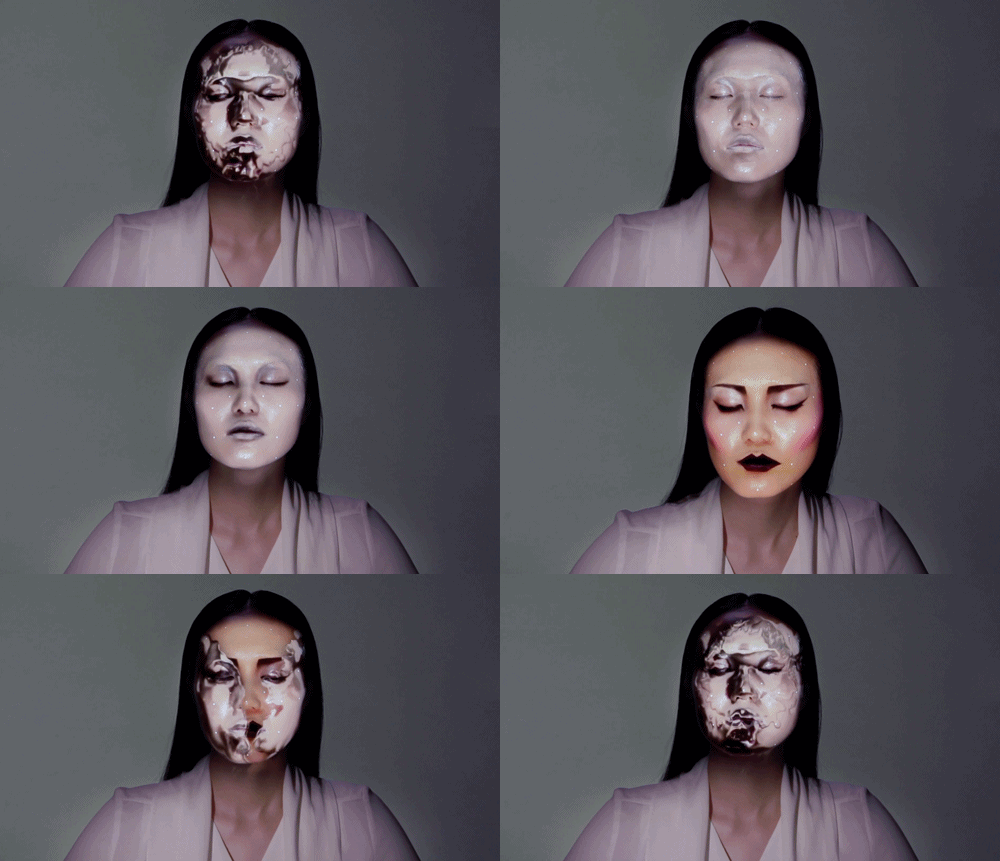
Japanese artist, director and producer Nobumichi Asai has unveiled Omote, his latest project that uses projection mapping techniques to create stunning illusions on a model’s face. In his recently released video the model moves her head while projected graphics constantly transform how she appears; creating masks and cyber influenced visuals. He was inspired by the Japanese Noh mask.
Laser scanning was used to create a mesh that followed the contours of the model’s face and it’s rumoured that Asai is now looking to create a system the covers the whole body. Asai has built up a large

portfolio of work that includes a number of projection mapping projects, usually featuring huge backdrops including buildings, a dockyard and a large stage show for Subaru. Source: InAVate, Image-Courtesy: https://33.media.tumblr.com
Read More........

Astronomers Create First Realistic Virtual Universe

Credit: Dr Debora Sijacki, Cambridge University
Tracking 13 billion years of cosmic evolution, astronomers have created the first realistic virtual simulation of the Universe. A newly-developed computer simulation has created the first realistic version of the Universe, enabling researchers to understand how galaxies, black holes and other cosmic phenomena developed from shortly after the Big Bang to the present day. The simulation, known as Illustris, follows the complex development of both normal and dark matter over 13 billion years, matching many of the features observed in the real Universe for the first time. Developed by an international team of researchers, Illustris tracks the development of the Universe from 12 million years after the Big Bang up to the present, and identified more than 41,000 galaxies in a cube of simulated space 350 million light years on each side. The results are reported in the May 8th issue of the journal Nature.  Over the past two decades, researchers have been attempting to build accurate computer simulations of the development of the Universe, using computer programs which are capable of encapsulating all the relevant laws of physics governing the formation of galaxies. Previous attempts to simulate the universe were hampered by lack of computing power and the complexities of the underlying physics.As a result those programseither were limited in resolution, or forced to focus on a small portion of the universe. Earlier simulations also had trouble modelling complex feedback from star formation, supernova explosions, and supermassive black holes. Illustris employs a sophisticated computer program to recreate the evolution of the universe in high fidelity. It includes both normal matter and dark matter using 12 billion 3D “pixels,” or resolution elements. Illustris yields a realistic mix of spiral galaxies like the Milky Way and giant elliptical galaxies. It also recreated large-scale structures like galaxy clusters and the bubbles and voids of the cosmic web. The team dedicated five years to developing the Illustris project. The actual calculations took three months of run time, using a total of 8,000 CPUs running in parallel. In comparison, the same calculations would have taken an average desktop computer more than 2,000 years to complete. “Until now, no single simulation was able to reproduce the Universe on both large and small scales simultaneously,” says lead author Dr Mark Vogelsberger of the Massachusetts Institute of Technology and Harvard University, who conducted the work in collaboration with researchers at the University of Cambridge, the Harvard-Smithsonian Center for Astrophysics and the Heidelberg Institute for Theoretical Studies. “The Illustris simulation is a remarkable technical achievement,” said Dr Debora Sijacki of Cambridge’s Institute of Astronomy, one of the paper’s co-authors. “It shows us for the first time how the bewildering variety of galaxies and the supermassive black holes at their centres have formed.” Since light travels at a fixed speed, the farther away astronomers look, the farther back in time they can see. A galaxy one billion light-years away is seen as it was a billion years ago. Telescopes like Hubble can give us views of the early Universe by looking to greater distances. However, astronomers can’t use Hubble to follow the evolution of a single galaxy over time. “Illustris is like a time machine. We can go forward and backward in time. We can pause the simulation and zoom into a single galaxy or galaxy cluster to see what’s really going on,” said co-author Dr Shy Genel of Harvard University. A selection of videos and imagery from the project are available online at www.illustris-project.orgSource: Ineffableisia.com 
  • Contacts and sources: Dr Debora Sijacki, Institute of Astronomy, Cambridge University
Read More........

Virtual keyboard and gesture control system on brink of development


.Subscribe
A virtual keyboard was recently developed by researchers at MÀlardalen University (MDH) in Sweden. The concept uses existing head mounted displays, such as Google Glass, and a pair of wrist or hand-worn sensors that support gesture control as well as sensing the keyboard input. The research project started in 2005 with a focus on robotic vision and developers are now confident that, with extra funding, they could have a product in a year.
Lars Asplund, Professor Emeritus in Robotics at MDH, said: “Keyboards today look almost the same as, and work in almost the same way, as 19th century typewriters. Our virtual keyboard makes a completely new form of interaction possible and offers positions which may, for instance, decrease the risk of repetitive strain injury.” Asplund’s research team moot a number of possible business and individual applications for the solution including use in small spaces and for journalists conducting interviews. The solution could also make its way into wider virtual reality applications, in either entertainment or research and development, as well as providing field workers with a system to type notes while working out of the office. The team is now calling for more funding. “The project has great potential and can be completed in a year, but we need another SEK 10-15 million (approximately €1.1-1.7 million) to develop the hardware design, manufacture a series and launch the product on the market,” said Asplund. Source: InAVate
Read More........

AV Tech opens up a world of museums in Romania

A museum in Romania is utilising 3D projection, 3D screens and a host of touchscreens to allow visitors to explore exhibitions and displays from numerous museums around the world. The Digital Museum was designed by architect Claudiu Ionsecu to deliver a great number of presentations within a very small space. It is situated near the Mures Floodplain Natural Park in Pecica, Romania.
Forty-five inch touchscreens and passive 3D technologies are packed into the 125m² space. Content ranges from exhibits from museums around the world down to information on the local area. The museum also encourages visitors to explore the local area virtually using exercise bikes coupled with digital displays or physically using one of 60 mountain bikes. Ionescu said: “Inspired by Constantin Brancusi’s ‘miracle’ sculpture, the building rises naturally from the ground through golden spirals (the fibonacci spirals) and crystallizes in a shape that, just like its muse, tries to set itself free from ‘the past burdens’, striving to rise high. Its shape offers the visitor a feeling of aspiration, an aspiration not only of the building, but of life itself.” Source: InAVate
Read More........

NASA-Funded Scientists Detect Water on Moon's Surface that Hints at Water Below


Chandrayaan-1 Moon mission description
NASA-funded lunar research has yielded evidence of water locked in mineral grains on the surface of the 
moon from an unknown source deep beneath the surface. Using data from NASA's Moon Mineralogy Mapper (M3) instrument aboard the Indian Space Research Organization's Chandrayaan-1 spacecraft, scientists remotely detected magmatic water, or water that originates from deep within the moon's interior, on the surface of the moon. The findings, published Aug. 25 in Nature Geoscience, represent the first detection of this form of water from lunar orbit. Earlier studies had shown the existence of magmatic water in lunar samples returned during the Apollo program. M3 imaged the lunar impact crater Bullialdus, which lies near the lunar equator. Scientists were interested in studying this area because they could better quantify the amount of water inside the rocks due to the crater's location and the type of rocks it held. The central peak of the crater is made up of a type of rock that forms deep within the lunar crust and mantle when magma is trapped underground. "This rock, which normally resides deep beneath the surface, was excavated from the lunar depths by the impact that formed Bullialdus crater," said Rachel Klima, a planetary geologist at the Johns Hopkins University
NASA patch / NASA / ISRO - Chandrayaan-1 Moon Mineralogy Mapper (M3) patch's.
Applied Physics Laboratory (APL) in Laurel, Md. "Compared to its surroundings, we found that the central portion of this crater contains a significant amount of hydroxyl - a molecule consisting of one oxygen atom and one hydrogen atom -- which is evidence that the rocks in this crater contain water that originated beneath the lunar surface," Klima said. In 2009, M3 provided the first mineralogical map of the lunar surface and discovered water molecules in the polar regions of the moon. This water is thought to be a thin layer formed from solar wind hitting the moon's surface. Bullialdus crater is in a region with an unfavorable environment for solar wind to produce significant amounts of water on the surface. "NASA missions like Lunar Prospector and the Lunar Crater Observation and Sensing Satellite and instruments like M3 have gathered crucial data that fundamentally changed our understanding of whether water exists on the surface of the moon," said S. Pete Worden, center director at NASA's Ames Research Center in Moffett Field, Calif. "Similarly, we hope that
LADEE Mission poster
upcoming NASA missions such as the Lunar Atmosphere and Dust Environment Explorer, or LADEE, will change our understanding of the lunar sky." The detection of internal water from orbit means scientists can begin to test some of the findings from sample studies in a broader context, including in regions that are far from where the Apollo sites are clustered on the near side of the moon. For many years, researchers believed that the rocks from the moon were bone-dry and any water detected in the Apollo samples had to be contamination from Earth. "Now that we have detected water that is likely from the interior of the moon, we can start to compare this water with other characteristics of the lunar surface," said Klima. "This internal magmatic water also provides clues about the moon's volcanic processes and internal composition, which helps us address questions about how the moon formed, and how magmatic processes changed as it cooled." APL is a not-for-profit division of Johns Hopkins University. Joshua Cahill and David Lawrence of APL and Justin Hagerty of the U.S. Geological Survey's Astrogeology Science Center in Flagstaff, Ariz., co-authored the paper. NASA's Lunar Advanced Science and Engineering Program, the NASA Lunar Science Institute (NLSI) at Ames and the NASA Planetary Mission Data Analysis Program supported the research. NLSI is a virtual organization jointly funded by NASA's Science Mission Directorate and NASA's Human Exploration and Operations Mission Directorate in Washington, to enable collaborative, interdisciplinary research in support of NASA lunar science programs. For more information about NASA programs, visit: http://www.nasa.gov. Images, Text, Credit: NASA / JPL / ISRO. Greetings, Orbiter.ch. Source: Orbiter.ch Space News
Read More........

Docomo turns surfaces interactive with smart glasses

Docomo showed off a Google Glass rival that transforms any surface into a touchscreen at Japan's Ceatec show last week. The company demonstrated a number of applications including manipulation of virtual content on any surface using the 'intelligent-glasses' and a ring sensor. Ceatec ran from October 1 to 5, 2013 at the Makuhari Messe convention center outside Tokyo.
Other uses on show included facial recognition capabilities, which pulled up relevant profile information on the person being viewed and character recognition enabling instant language translation. Technology news site Slashgear reported on the technology showcased at  the mobile industry trade show, posting
the video featured above. The concept builds on existing Docomo developments. At last year’s Ceatec show Docomo demonstrated. glasses that enabled hands-free video callingSource: InAVate
Read More........

AR robot brings avatars to life

An augmented reality robot that adds life to virtual characters could be commercialised after being taken on by Japanese start-up, Different Dimension. The solution was originally called U-Tsu-Shi-O-Mi and developed in 2006 by Michihiko Shoji, a researcher at NTT DoCoMo Labs and then Yokohama National University. The "mixed reality" system synchronises a robot, covered in green-screen material, and a
virtual avatar, which is viewed as an interactive figure through a head mounted display (HMD). The robot is controlled by a force-feedback system that provides realistic physical interaction for the user. Potential applications for the solution could include very realistic, immersive telepresence solutions. Source: InAVate, Image: Screen Shot On Video
Read More........

Virtual Women Reveal More Skin, Regardless Of Body Proportions

.:: DELISH ::. Complete Avatar - Haley - Flawless **Almost FREE!!**
Credit: Second Life
Unrelated to traditional measures of physical attractiveness, female avatars in Second Life expose more skin In the virtual world of Second Life, female avatars expose substantially more skin than males, independent of their virtual body proportions, according to research published December 26 in the open access journal PLOS ONE by Matthieu Guitton and colleagues from Laval University, Canada. The human tendency to cover up stems from climatic, environmental, physical and cultural constraints, so measuring people's propensity to reveal skin can be difficult in the real world. To study human behavior free of at least some of these constraints, the researchers analyzed how male and female avatars in the virtual, 3- dimensional world of Second Life dressed. Second Life offers users options to choose the gender, appearance and attire of their virtual avatars, and users can select clothing from several items created in this virtual world, rather than being restricted to a predefined costume. They found that out of over 400 virtual people studied, 71% of male avatars covered between 75-100% of their skin, while only 5% of females did. In contrast, 47% of the virtual females they studied covered between 25-49% of their skin, compared to 9% of males. The amount of skin covered was independent of traditional gender-specific measures of physical attractiveness for virtual avatars, such as waist-chest ratios for females. According to the study, "These findings have implications for understanding how sex specific aspects of skin disclosure influence human social interactions in both virtual and real settings." Guitton adds, "Virtual settings provide a unique tool to study human behavior unhindered by physical and environmental constraints.This tool enabled us to find a dramatic gender difference in the propensity to disclose naked skin." Citation: Lomanowska AM, Guitton MJ (2012) Virtually Naked: Virtual Environment Reveals Sex-Dependent Nature of Skin Disclosure. PLoS ONE 7(12): e51921.doi:10.1371/journal.pone.0051921, Contacts and sources: Jyoti Madhusoodanan, Public Library of ScienceSource: Nano Patents And Innovations
Read More........

DoCoMo glasses enable mobile, hands-free video calling

Screen Shot On Uploaded Video
DoCoMo NTT, Japanese mobility specialist, has unveiled a glasses-like headset for hands-free videoconferencing at CEATEC in Japan. Images taken by multiple, ultra-wide-angle cameras in the glasses-like frame make the far-end participant feel as if they are right in front of the user. The system recreates the participant’s face into a life-like digital image with audio information used to create realistic  lip movement. DoCoMo ultimately wants to integrate displays into the HMD so that two participants can have a hands-free video conference in any space. A camera on the rear of the glasses captures the scene behind the user so ven their backdrop appears real to the far-end participant. Video via DigInfo, Source: InAVate
Read More........

High-impact visuals for large events

Bluman Associates took over signage displays in New York’s Times Square, controlling screens of varying in size and format and spread across four blocks of the city
It's AV, but not as we know it. Pod Bluman, founder of production company Bluman Associates, talks to Anna Mitchell about being chased by the police, recycling the red carpet from the Harry Potter premier and staging an off-grid gig.
Even if you haven’t heard of Pod Bluman, the chances are you’ve seen his work. Anyone who missed worldwide press coverage of a "No War on Iraq" message projected on the Houses of Parliament may have watched the Harry Potter premier at Leicester Square in London. And if both these events passed you by; you might have caught the Batman symbol on Battersea Power Station, a complete takeover of New York’s Times Square for a Nokia launch or gigs by the Arctic Monkeys, Faithless or Obital (to name but a few). In September 2004, Bluman started Bluman Associates after building up a strong reputation as a freelancer in the live events industry. "We’re a traditional production company in the range of services we offer," explains Bluman. "But, in terms of the niche we occupy we’re very specialised within the video industry and particularly in displaying content on large displays." The company provides services in every link of the visual display chain; from content creation and capture through to the display and dissemination of that content. "We don’t own any equipment," continues Bluman. "We’re purely a production company and we pride ourselves on our independence and ability to advise clients on what we believe is the best technology for the job." Learn more about some of Bluman’s projects, why projection mapping needs to move on and what makes a successful ‘guerrilla projection’ campaign in  Source: InAVate
Read More........

Scientists to build ' Artificial human brain'; useful to cure brain disease

The human brain’s power could rival any machine. And now scientists are trying to build one using the world’s most powerful computer. It is intended to combine all the information so far uncovered about its mysterious workings - and replicate them on a screen, right down to the level ofindividual cells and molecules. Supercomputer will simulate the entire mind and will help fight against brain diseases If it works it could be revolutionary for understanding devastating neurological diseases such as Alzheimer’s and Parkinson’s, and even shedding light into how we think, and make decisions. Leading the project is Professor Henry Markram based in Switzerland, who will be working with scientists from across Europe including the Wellcome Trust Sanger Institute at Cambridge. They hope to complete it within 12 years. He said: ‘The complexity of the brain, with its billions of interconnected neurons, makes it hard for neuroscientists to truly understand how it works. ‘Simulating it will make it much easier – allowing them
to manipulate and measure any aspect of the brain.’Housed at a facility in Dusseldorf in Germany, the ‘brain’ will feature thousands of three-dimensional images built around a semi-circular ‘cockpit’ so scientists can virtually ‘fly’ around different areas and watch how they communicate with each other. It aims to integrate all the neuroscience research being carried out all over the world – an estimated 60,000 scientific papers every year - into one platform. The project has received some funding from the EU and has been shortlisted for a 1 billion euro (£825million) EU grant which will be decided next month. When complete it could be used to test new drugs, which could dramatically shorten the time required for licencing them than human trials, and pave the way for more intelligent robots and computers. But Prof Markram said: ‘This will, when successful, help two billion people annually who suffer from some type of brain impairment. They have also simulated part of a rat’s brain using a computer. But the human brain is a totally different proposition. Our brains have 100 billion neurons. Each one performs billions of ‘calculations’ per second – roughly similar to a desktop computer. So the brain computer will need to be able to do a billion billion calculations which will require the output of a nuclear power station. Finding a way to power the supercomputer will be one of the researchers’ major challenges. The brain is still largely an unknown quantity for researchers and unravelling its mysteries - which have evolved over millions of years - is widely considered the final frontier of science. Richard Walker, who works with Professor Markram, said: ‘Our brains consume tiny amounts of energy but they last for 90 or more years. ‘At the moment we cannot even afford to run the biggest computers we could build, so if we can find out how the brain works, it could bring huge advances.’ Disorders of the brain, from depression and mental illness to the diseases of old age such as Alzheimer’s – which affects 800,000 people in Britain– are also a growing problem. David Cameron recently pledged £66million to fund research into the ‘national crisis’ of dementia. Source: Ananta-Tech
Read More........