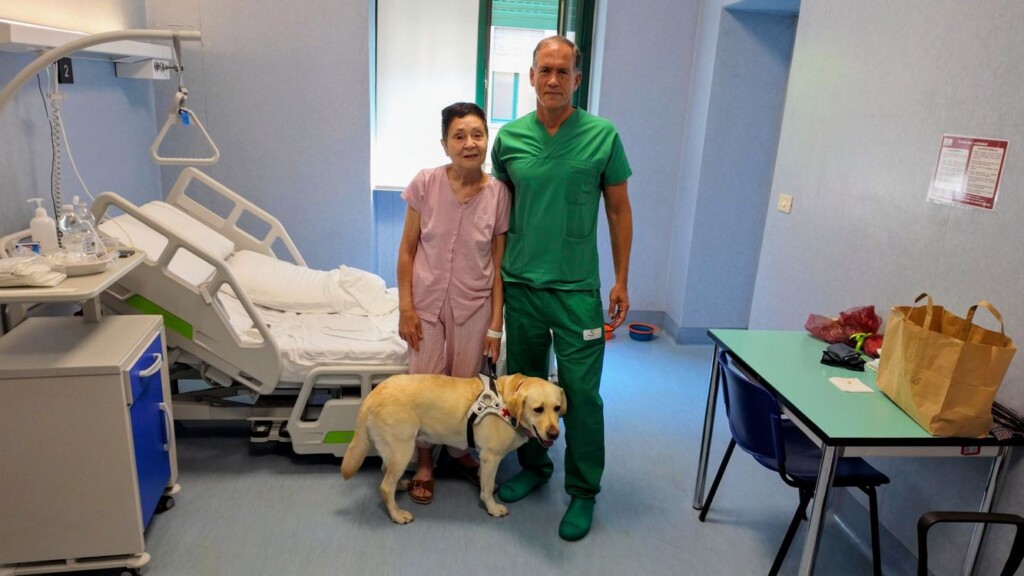
Elena with her dog Joe, and Professor Michele Reibaldi – credit, Ospedale Molinette, supplied
From Turin comes a surgical world-first: the simultaneous transplant of a complete human macula, along with the cornea, sclera, and connective tissue, from one of the patient’s eyes to the other.
It allowed a woman blind for several years to immediately gain enough vision to recognize both her son and her faithful canine companion, Joe.
La Stampa, a Turn-based national newspaper, reported that the intervention was lead by the “intuition” of ocular surgeon Professor Michele Reibaldi, who himself described the process as a “complicated marathon,” lasting 6 hours and requiring careful coordination by surgeons, anesthetists, and orderlies.
The patient was 67-year-old Elena, who lost her eyesight in a road incident which completely severed the optic nerve in her left eye. Responsible for transmitting light absorbed and delineated through the eye to the brain, the irreversible damage was not shared by the rest of eye tissues, which remained largely intact.
In an interesting coincidence, the reverse was true for her right eye. While the optic nerve was undamaged, the trauma of the crash destroyed other parts of her eye including the retina, the cornea, and the portion of the eye containing ocular stem cells, rendering any hope of a normal corneal transplant impossible.
In short, there was enough undamaged components between her two eyes to create one that could function. The only problem was that it would require a surgery never done in the history of medicine, a macular transplant. The macula is a small, light-sensitive region at the back of the retina, itself located in the middle of the eyeball, responsible for high-definition sight. The common cause of blindness, macular degeneration, refers to this small tissue.
Elena also needed a new cornea, and the sclera—the white of the eyeball. Professor Reibaldi resolved to salvage those from the left eye and transplant them all to the right eye, in which the ocular nerve was preserved through the crash.
“This procedure represents a new frontier in ocular surgery,” Reibaldi, who practices at the Molinette Hospital in Turn’s City of Health and Science, said according to a translation. “Before today, such a contemporaneous transplant of the anterior eye tissue had occurred just once before, while the central retina has never been possible.”
“Now we will wait and see how well the transplanted retina functions, though early signs are encouraging.”
Follow-ups have confirmed that the tissues have reattached correctly, and that Elena is regaining sight in her right eye.Reibaldi praised the extraordinary collaboration within the team which carried out the procedure, before adding that the biggest prize for them was “the incredible moment in which Elena, opening her eyes, could finally recognize her son and faithful companion in life, Joe the dog.” Woman Can See Again After World’s First Transplant of a Central Retina