UFO, Humanity & time travel are the signage of positive index

Concerning about Unidentified flying objects (UFO’S) are only relate to the calculation of their positive ability index. As Positive means development and negative means demolishment, and time is the biggest terms move along with population and its exploration with respect to various field of doing. Productivity is the goal to achieve to move along with time or beyond time. It’s called moving in time frame or doing a rate of time travel. With Respect to earth as model humanity is a very big term of time as it's being with pure value of development with coordination.

As Human has a brain of vision and program with feel and curiosity which are the nucleus of human so we can say so as human we are on earth for managing the earth resources along with its proper utilization and distributions among each as with nature.

So legality is the biggest term of humanity. As it’s manage human in right direction and reduce the rate of resistance among the various field of exploration and their proper integration.

As its being with a rate of positive ability index which is defined the rate of development and human movements on earth as well all across the planetary system.

As it’s a simple formulation of humanity on earth which moves with positive frame of time with the enhancement of its population which is bounded by legal frame work for the positive directions of mass of the people on earth which provides earth explorations and its massive integration provide a rate of productivity which is the sign to do time travel or move beyond time. So acceptance of legal data, terms provides nonstop improvements in the exploration of earth which is a nonstop process runs in infinite terms.

Positive Ability Index of humans mean variable less doings of humans or any species all across the planetary system and as time progresses we use to find the springs of liberty to move far ahead on earth as well in outer space as like UFO’S (advance species with a level of advancement to move on earth or all across the planetary system)

So thinking about UFO’S (Aliens) are as demon is just a myth of imagination if they are not being with positive ability index then their movement in time and advancement is not possible.

So world must need to save itself from any kinds of war, negativity as humanity got current time after the thousands of years of hardship of generations and era of incarnations and once any strong negativity comes then humanity will run in backward of time frame.

So positivism provides explorations with term of infinity and its integration produce a real process of time travel which applicable on universe’s including earth as whole. Positivism is subject to divine and negativity is subject to demon both has time travel on upwards and second downwards. Image Pixabay LicenseFree for commercial use, No attribution required
Read More........

Japan begins space capsule analysis hoping for asteroid sample

Scientists in Japan on Tuesday began analysing a capsule sent back to Earth by a probe, hoping to find asteroid material that could offer clues on how the universe was formed.

Officials from Japan’s space agency said they were jubilant about the successful return of the capsule, which landed in Australia on Sunday after separating from the Hayabusa-2 probe.

“I’m genuinely appreciative of the fact that the capsule came back, after a 5.24 billion-kilometre round-trip,” project manager Yuichi Tsuda told reporters.

Scientists hope it will yield up to 0.1 grams of material collected from the asteroid Ryugu some 300 million kilometres from Earth — though they won’t know for sure until they look inside.

“I’m really looking forward to seeing (the samples) with my own eyes,” Tsuda said.

But that isn’t expected to happen before at least next week, with a series of steps required first to ensure the material is not contaminated.

For now, the capsule is “in a secure location” at a space centre in Sagamihara, south of Tokyo, agency director general Hitoshi Kuninaka said.

“Now we move to the matter-analysis phase,” he said. The samples — collected last year — are hoped to include both surface dust and pristine material stirred up when Hayabusa-2 fired an “impactor” into Ryugu.

Scientists hope they can shed light on how the formation of the universe unfolded, as well as on the origins of life on Earth.

The space agency has begun carefully processing the capsule, beginning by collecting gas inside. It will be opened later under strict conditions, including a nitrogen-filled box for the capsule.

“The key is that samples will not be polluted by Earth’s environment… so they can be provided to researchers around the world,” said Tomohiro Usui, leader of the extraterrestrial matter-analysis group.

“If we see something black inside the capsule, which is itself made of aluminium and whiteish, it’s near-certain it is from Ryugu,” he added. “But that is just supporting evidence, and we’ll not be able to say something for sure until we do chemical analysis.”

The nature of the gas extracted from the capsule also needs to be clarified, though officials said they believe it too was collected from the asteroid.

Half of Hayabusa-2’s samples will be shared between the Japanese space agency and other international organisations, while the rest will be kept for future study as advances are made in technology.The probe’s mission has been extended for more than a decade, with two new asteroids now being targeted for observation. Source: https://www.daily-bangladesh.com
Read More........

A Blazar in the Early Universe: Details Revealed in Galaxy's Jet 12.8 Billion Light-Years from Earth

Credit: Spingola et al.; Bill Saxton, NRAO/AUI/NSF.

The supersharp radio "vision" of the National Science Foundation's Very Long Baseline Array (VLBA) has revealed previously unseen details in a jet of material ejected at three-quarters the speed of light from the core of a galaxy some 12.8 billion light-years from Earth. The galaxy, dubbed PSO J0309+27, is a blazar, with its jet pointed toward Earth, and is the brightest radio-emitting blazar yet seen at such a distance. It also is the second-brightest X-ray emitting blazar at such a distance. 

In this image, the brightest radio emission comes from the galaxy's core, at bottom right. The jet is propelled by the gravitational energy of a supermassive black hole at the core, and moves outward, toward the upper left. The jet seen here extends some 1,600 light-years, and shows structure within it.

At this distance, PSO J0309+27 is seen as it was when the universe was less than a billion years old, or just over 7 percent of its current age.

An international team of astronomers led by Cristiana Spingola of the University of Bologna in Italy, observed the galaxy in April and May of 2020. Their analysis of the object's properties provides support for some theoretical models for why blazars are rare in the early universe. The researchers reported their results in the journal Astronomy & Astrophysics.

The National Radio Astronomy Observatory is a facility of the National Science Foundation, operated under cooperative agreement by Associated Universities, Inc.

Contacts and sources: 
Dave Finley
The National Radio Astronomy Observatory i

Read More........

Incredible! See 5 planets in naked eyes tomorrow

Five planets can be seen in the sky. Photo: Collected.

The universe is a great mystery. Experts immersed in continuous research to unravel its various mysteries. The world sees all the wonderful things that have happened in the universe at different times through the telescope or with the naked eye. This time on Sunday the world will be able to see a wonder. On that day five planets will be seen in the sky. And everyone can see it with the naked eye.

It is claimed that Mercury, Venus, Mars, Jupiter, and Saturn will be seen with the moon on Sunday. These can be seen with the naked eye without any telescope. You have to wake up a little early to see this wonder.

Researchers say that to see the five planets with the naked eye, one has to look at the sky at least one hour before sunrise. Then this cosmic wonder will be seen.

If you miss the scene this time around, you'll have to wait until June 2022 to see the five planets together again.

Astronomer Jeffrey Hunt told CNET that Mercury, Mars, Saturn, and Jupiter will be seen as bright stars just hours before sunrise. Mercury will be seen in the north-northwest of the sky, Mars will be seen in the south-east, and Jupiter and Saturn will be seen in the south-west. 

It is claimed that Mercury, Venus, Mars, Jupiter, and Saturn will be seen with the moon on Sunday. These can be seen with the naked eye without any telescope. You have to wake up a little early to see this wonder.

Researchers say that to see the five planets with the naked eye, one has to look at the sky at least one hour before sunrise. Then this cosmic wonder will be seen.

If you miss the scene this time around, you'll have to wait until June 2022 to see the five planets together again.

Astronomer Jeffrey Hunt told CNET that Mercury, Mars, Saturn, and Jupiter will be seen as bright stars just hours before sunrise. Mercury will be seen in the north-northwest of the sky, Mars will be seen in the south-east, and Jupiter and Saturn will be seen in the south-west. Source: https://www.daily-bangladesh.com/
Read More........

China operates world's biggest radio telescope to discover 'laws of universe'

World's largest radio telescope has become operational in southwestern China, with officials in Beijing saying that the project will help scientists search for alien life.
Since the early 1930s, when the first primitive radio telescopes began operating in an attempt to hunt for alien radio signals, astronomers have been busy sifting through the data collected from the immensity of the space to detect the faintest radio signals transmitted from a supposed alien civilization and to help the mankind feel, at last, that its loneliness in the incomprehensible universe is finally eased. The latest of such scientific endeavors is the world’s biggest radio telescope made by Chinese scientists and unveiled on Sunday.
The Aperture Spherical Telescope (FAST), measuring 500 meters in diameter, is erected in a scenic karst valley in Pingtang county, a mountainous area in the southeastern province of Guizhou in China.
The gigantic telescope, which took five years and devoured some $180 million to complete, clearly demonstrates China's growing ambitions in outer space explorations and its vigorous pursuit of global scientific prestige. 
The new Chinese telescope, whose massive dish is made of 4,450 panels, dwarfs the half-a-century old Arecibo Observatory in Puerto Rico as the world's largest single-dish radio telescope, since its sensitivity is twice as the old pal with a reflector as big as 30 football fields. The speed of FAST in surveying is also five to 10 times more than that of the Arecibo Observatory.
The 500-meter Aperture Spherical Telescope (FAST) is seen at the final stage of construction, in the mountains in Pingtang county, Guizhou province, China. (Photo by Reuters)
“The ultimate goal of FAST is to discover the laws of the development of the universe,” said Qian Lei, an associate researcher with the National Astronomical Observatories of the Chinese Academy of Sciences, in remarks broadcast by state broadcaster CCTV on Sunday.
“In theory, if there is civilization in outer space, the radio signal it sends will be similar to the signal we can receive when a pulsar (spinning neutron star) is approaching us,” Qian added.
The huge Chinese cosmic ear requires a radio silence within a five-kilometer radius, therefore the 8,000 residents of the eight villages in the vicinity of the telescope site were forced to abandon their homes.
According to state media, the displaced villagers would be compensated, in the form of cash or new houses, from a budget of $269 million.
The CCTV report said that FAST managed to receive radio signals from a pulsar as far as 1,351 light years from the Earth during its recent test. Source: http://www.jokpeme.com
Read More........

Universe is expanding faster than expected


Photo Source: Thinkstock
Washington: The universe is expanding 5 to 9 per cent faster than thought, astronomers using NASA's Hubble Space Telescope have discovered. "This surprising finding may be an important clue to understanding those mysterious parts of the universe that make up 95 per cent of everything and don't emit light, such as dark energy, dark matter, and dark radiation," said study leader and Nobel Laureate Adam Riess of the Space Telescope Science Institute and The Johns Hopkins University in the US. Researchers made the discovery by refining the universe's current expansion rate to unprecedented accuracy, reducing the uncertainty to only 2.4 per cent. The team made the refinements by developing innovative techniques that improved the precision of distance measurements to faraway galaxies. They looked for galaxies containing both Cepheid stars and Type Ia supernovae. Cepheid stars pulsate at rates that correspond to their true brightness, which can be compared with their apparent brightness as seen from Earth to accurately determine their distance. Type Ia supernovae, another commonly used cosmic yardstick, are exploding stars that flare with the same brightness and are brilliant enough to be seen from relatively longer distances. By measuring about 2,400 Cepheid stars in 19 galaxies and comparing the observed brightness of both types of stars, researchers accurately calculated distances to roughly 300 Type Ia supernovae in far-flung galaxies. They compared those distances with the expansion of space as measured by the stretching of light from receding galaxies. The team used these two values to calculate how fast the universe expands with time, or the Hubble constant. The improved Hubble constant value is 73.2 km per second per megaparsec. A megaparsec equals 3.26 million light-years. The new value means the distance between cosmic objects will double in another 9.8 billion years. This refined calibration presents a puzzle, however, because it does not quite match the expansion rate predicted for the universe from its trajectory seen shortly after the Big Bang. Measurements of the afterglow from the Big Bang by NASA's Wilkinson Microwave Anisotropy Probe and the European Space Agency's Planck satellite mission yield predictions for the Hubble constant that are 5 per cent and 9 per cent smaller. "If we know the initial amounts of stuff in the universe, such as dark energy and dark matter, and we have the physics correct, then you can go from a measurement at the time shortly after the big bang and use that understanding to predict how fast the universe should be expanding today," said Riess. "However, if this discrepancy holds up, it appears we may not have the right understanding, and it changes how big the Hubble constant should be today," he said. The research appears in The Astrophysical Journal. — PTI. Source: http://www.tribuneindia.com/
Read More........

So you want to know the secrets of the universe...?

The fragments were passed to scientists by teachers from Novosibirsk, who were in the village Emanzhelinka, Chelyabinsk region when the meteorite struck on 15 February. Picture: The Siberian Times 
By Kate Baklitskaya: Fragments of the meteorite which exploded over the Urals have revealed their geological identity to Siberian scientists. The main minerals of these samples are silicates: olivine (Mg, Fe) 2SiO4 and orthopyroxene (Mg, Fe) 2Si2O6, it was disclosed. Iron and nickel sulfides (troilite, FeS, heazlewoodite Ni3S2), and native metals Fe and Ni (kamacite, taenite) were found in smaller amounts. In addition scientists found chromite (Fe, Mg) Cr2O4, clinopyroxene (diopside CaMgSi2O6), plagioclase (Ca, Na) Al2Si2O8, as well as glass feldspar composition in the fragments of a meteorite. The analysis was carried out using scanning microscopy and a gas chromatography-mass spectrometer at the V S Sobolev Institute of Geology and Mineralogy, part of the Siberian Branch of the Russian Academy of Sciences.  Experts from the Central Siberian Geological Museum Institute were also involved. 
Such preliminary data is important for the reconstruction of the early stages of the solar system: it is believed that meteorites are similar to the very stuff which, in fact, formed the planets. Pictures: SORAN media centre 
The geologists explained it is likely that a small amount of iron and nickel phosphide is present among the elements. According to the scientists, they obtained information about the composition of volatile components in the meteorite fragments, Siberian Branch of Russian Academy of Science media centre reported. Such preliminary data is important for the reconstruction of the early stages of the solar system: it is believed that meteorites are similar to the very stuff which, in fact, formed the planets. The fragments were passed to scientists by teachers from Novosibirsk, who were in the village Emanzhelinka, Chelyabinsk region when the meteorite struck on 15 February. Siberian geologists also have samples collected by geographer and mineralogist Sergei Kolesnichenko and Novosibirsk State University graduate Igor Karlov, near the village Zauralskiy Chelyabinsk region. Now these pieces of the meteorite are being studied. Source: http://siberiantimes.com
Read More........

A New Way To See The High-Energy Sky

Credit: HAWC Collaboration
University of Maryland (UMD) physicists pioneered development of observatory that has located new high-energy sources in the universe and provided more detail on known sources in first year of full operation. HAWC observations show that a previously known gamma ray source in the Milky Way galaxy, TeV J1930+188, which is probably due to a pulsar wind nebula, is far more complicated than originally thought. Where researchers previously identified a single gamma ray source, HAWC identified several hot spots. The United States and Mexico constructed the High Altitude Water Cherenkov (HAWC) Gamma-ray Observatory to observe some of the most energetic phenomena in the known universe--the aftermath when massive stars die, glowing clouds of electrons around rapidly spinning neutron stars, and supermassive black holes devouring matter and spitting out powerful jets of particles. These violent explosions produce high-energy gamma rays and cosmic rays, which can travel large distances--making it possible to see objects and events far outside our own galaxy. Today, scientists operating HAWC released a new survey of the sky made from the highest energy gamma rays ever observed. The new sky map, which uses data collected since the observatory began running at full capacity last March, offers a deeper understanding of high-energy processes taking place in our galaxy and beyond. "HAWC gives us a new way to see the high-energy sky," said Jordan Goodman, professor of physics at the University of Maryland, and U.S. lead investigator and spokesperson for the HAWC collaboration. "This new data from HAWC shows the galaxy in unprecedented detail, revealing new high-energy sources and previously unseen details about existing sources." HAWC researchers presented the new observation data and sky map April 18, 2016, at the American Physical Society meeting. They also participated in a press conference at the meeting. The new sky map shows many new gamma ray sources within our own Milky Way galaxy. Because HAWC observes 24 hours per day and year-round with a wide field-of-view and large area, the observatory boasts a higher energy reach especially for extended objects. In addition, HAWC can uniquely monitor for gamma ray flares by sources in our galaxy and other active galaxies, such as Markarian 421 and Markarian 501. This is a view of two-thirds of the entire sky with very-high-energy gamma rays observed by HAWC. Many sources are clearly visible in our own Milky Way galaxy, as well as two other galaxies: Markarian 421 and Markarian 501. Some well-known constellations are shown as a reference. The center of the Milky Way is located toward
Credit: HAWC Collaboration
Sagittarius. One of HAWC's new observations provides a better understanding of the high-energy nature of the Cygnus region--a northern constellation lying on the plane of the Milky Way. A multitude of neutron stars and supernova remnants call this star nursery home. HAWC scientists observed previously unknown objects in the Cygnus region and identified objects discovered earlier with sharper resolution. In a region of the Milky Way where researchers previously identified a single gamma ray source named TeV J1930+188, HAWC identified several hot spots, indicating that the region is more complicated than previously thought. "Studying these objects at the highest energies can reveal the mechanism by which they produce gamma rays and possibly help us unravel the hundred-year-old mystery of the origin of high-energy cosmic rays that bombard Earth from space," said Goodman. HAWC--located 13,500 feet above sea level on the slopes of Mexico's Volcán Sierra Negra--contains 300 detector tanks, each holding 50,000 gallons of ultrapure water with four light sensors anchored to the floor. When gamma rays or cosmic rays reach Earth's atmosphere they set off a cascade of charged particles, and when these particles reach the water in HAWC's detectors, they produce a cone-shaped flash of light known as Cherenkov radiation. The effect is much like a sonic boom produced by a supersonic jet, because the particles are traveling slightly faster than the speed of light in water when they enter the detectors. The complete array of HAWC detector tanks is seen here in Dec. 2014.
Credit: HAWC Collaboration
The light sensors record each flash of Cherenkov radiation inside the detector tanks. By comparing nanosecond differences in arrival times at each light sensor, scientists can reconstruct the angle of travel for each particle cascade. The intensity of the light indicates the primary particle's energy, and the pattern of detector hits can distinguish between gamma rays and cosmic rays. With 300 detectors spread over an area equivalent to more than three football fields, HAWC "sees" these events in relatively high resolution. "Unlike traditional telescopes, with HAWC we have now an instrument that surveys two-thirds of the sky at the highest energies, day and night," said Andrés Sandoval, Mexico spokesperson for HAWC. HAWC exhibits 15-times greater sensitivity than its predecessor--an observatory known as Milagro that operated near Los Alamos, New Mexico, and ceased taking data in 2008. In eight years of operation, Milagro found new sources of high-energy gamma rays, detected diffuse gamma rays from the Milky Way galaxy and discovered that the cosmic rays hitting earth had an unexpected non-uniformity. "HAWC will collect more data in the next few years, allowing us to reach even higher energies," said Goodman. "Combining HAWC observations with data from other instruments will allow us to extend the reach of our understanding of the most violent processes in the universe." Contacts and sources:Abby Robinson, University of Maryland (UMD) Source: http://www.ineffableisland.com/
Read More........

A Deep Look Into A Single Molecule

Credit: PTB
The quantum state of a molecular ion has been measured live and in a non-destructive fashion for the first time. The interaction of thermal energy from the environment with motional degrees of freedom is well known and often referred to as Brownian motion (also thermal motion). But in the case of polar molecules, the internal degrees of freedom - in particular the rotational quantum state - are also influenced by the thermal radiation. So far, the detection of the rotational state was only possible by destroying the molecule. However, a German research group has now demonstrated the first implementation of a non-destructive state detection technique for molecular ions. Piet Schmidt and his colleagues from the QUEST-Institute at the Physikalisch-Technische Bundesanstalt (PTB) observed changes in the rotational state of a trapped and indirectly cooled molecular ion in real time and in situ. This technique enables novel spectroscopy methods with applications ranging from chemistry to tests of fundamental physics. The results are published in the current issue of "Nature". Basic concept of the experiment: MgH+ (orange) and Mg+ (green) are trapped together in a linear ion trap. The two-ion compound is cooled to the motional ground state via the atomic ion. An oscillating dipole force changes the motional state according to the rotational state of the molecular ion. This motional excitation can be detected on the atomic ion.  Nowadays atoms can be manipulated with lasers and their spectral features can be investigated with high precision e.g. in optical clocks. In these experiments state detection plays a crucial role: the fluorescence of an atom under illumination with laser light reveals its internal quantum state. Many atoms and most molecules, however, do not fluoresce at all. Therefore, one of the standard procedures for state detection in molecules exploited the fact that molecules can be broken apart with laser light of a certain frequency, depending on their quantum state. This lets one measure the quantum state of the molecule by destroying it. Of course this detection procedure can only be applied once per molecule. Project leader Piet Schmidt has a long experience of systems in which state detection is difficult to achieve. He was involved in the development of 'quantum logic spectroscopy' in the research group of Nobel laureate David J. Wineland and extended it with his own research team to 'photon recoil spectroscopy'. Typical detection signal, where a quantum jump into the (J=1)-rotational state (from red to blue area) and a subsequent jump out of this state (blue to red) can be seen All of these novel
Credit: PTB
spectroscopy techniques are based on a common principle: beside the ion under investigation, one traps a second ion of a different species that is controllable and whose fluorescence can be used for state detection. Because of their electrical repulsion, both particles behave as if they were connected by a strong spring, such that their motion is synchronized. This is how the measurement of one particle can reveal properties of the other particle. Schmidt and his colleagues use a molecular MgH+-ion (which is the subject of the investigation) and an atomic Mg+-ion (on which the measurements will be performed). They hold both particles with electric fields in an ion trap. Then, lasers are used to cool the particles' motion to the ground state, where the synchronous motion almost comes to rest. The new trick demonstrated in this experiment relies on an additional laser, whose action is similar to an optical tweezer. It can be used to exert forces on the molecule. "The laser shakes the molecule only if the molecule is in one particular rotational state" explains Fabian Wolf, physicist in Schmidt's research group "We can detect the effect¬ -which is an excitation of the common motion of the molecule and the atom- on the atomic ion by using additional lasers. If the atom lights up, the molecule was in the state we probed. If it stays dark, the molecule was in some other state." Piet Schmidt highlights two main results of the team's findings: "Because of the non-destructive nature of our technique, we could observe the molecule jumping from one rotational state to the other. It is the first time such quantum jumps have been observed directly in an isolated molecule. Moreover, we could improve on the uncertainty of a transition frequency to an electronically excited state". He also points towards future goals: "The next step is the systematic preparation of the molecule in that quantum state instead of waiting for the thermal radiation to randomly prepare it." The researchers feel confident that their development will be important for the scientific communities that need precise methods for spectroscopy, e.g. quantum chemistry, where the inner structure of molecules is investigated, or astronomy, where spectra of cold molecules can teach us new things about the origin and the properties of the universe. Furthermore, precision molecular spectroscopy is important for the search for a variation of the fundamental constants and so far hidden properties of fundamental particles, such as the electric dipole moment of the electron. These tests of fundamental physics were Schmidt's original motivation for working on the novel detection technique."To make these applications practical, we have to push molecular spectroscopy to a level similar to that of today's optical clocks based on atoms", says Piet Schmidt, when he gets asked for his long term goal, "For this purpose we have to improve our measurement resolution by orders of magnitude, which for sure will take several years". Source: http://www.ineffableisland.com/
  • Contacts and sources: Prof. Dr. Piet O. Schmidt
  • QUEST-Institute at the Physikalisch-Technische Bundesanstalt (PTB)
  • Citation: F. Wolf, Y. Wan, J.C. Heip, F. Gebert, C. Shi, P.O. Schmidt: Non-destructive state detection for quantum logic spectroscopy of molecular ions. Nature (2016), DOI: 10.1038/nature16513
Read More........

Superluminous Supernova 20 Times Brighter Than 100 Billion Stars Wows Astronomers

Records are made to be broken, as the expression goes, but rarely are records left so thoroughly in the dust. Stunned astronomers have witnessed a cosmic explosion about 200 times more powerful than a typical supernova--events which already rank amongst the mightiest outbursts in the universe--and more than twice as luminous as the previous record-holding supernova. At its peak intensity, the explosion--called ASASSN-15lh--shone with 570 billion times the brightness of the Sun. If that statistic does not impress, consider that this luminosity level is approximately 20 times the entire output of the 100 billion stars comprising our Milky Way galaxy. The record-breaking blast is thought to be an outstanding example of a "superluminous supernova," a recently discovered, supremely rare variety of explosion unleashed by certain stars when they die. Scientists are frankly at a loss, though, regarding what sorts of stars and stellar scenarios might be responsible for these extreme supernovae. These are pseudo-color images showing the host galaxy before the explosion of ASASSN-15lh taken by the Dark Energy Camera (DECam) [Left], and the supernova by the Las Cumbres Observatory Global Telescope Network (LCOGT) 1-meter telescope network [Right]. As described in a new study published today in Science, ASASSN-15lh
Credit: The Dark Energy Survey, B. Shappee and the ASAS-SN team
is amongst the closest superluminous supernovae ever beheld, at around 3.8 billion light years away. Given its uncanny brightness and closeness, ASASSN-15lh might offer key clues in unlocking the secrets of this baffling class of celestial detonations. "ASASSN-15lh is the most powerful supernova discovered in human history," said study lead author Subo Dong, an astronomer and a Youth Qianren Research Professor at the Kavli Institute for Astronomy and Astrophysics (KIAA) at Peking University. "The explosion's mechanism and power source remain shrouded in mystery because all known theories meet serious challenges in explaining the immense amount of energy ASASSN-15lh has radiated." ASASSN-15lh was first glimpsed in June 2015 by twin telescopes with 14-centimeter diameter lenses in Cerro Tololo, Chile conducting the All Sky Automated Survey for SuperNovae (ASAS-SN), an international collaboration headquartered at The Ohio State University. (Hence ASASSN-15lh's somewhat menacing moniker.) These two tiny telescopes sweep the skies to detect suddenly appearing objects like ASASSN-15lh that are intrinsically very bright, but are too far away for human observers to notice. "ASAS-SN is the first astronomical project in history to frequently scan the entire optical sky for optical transients," said Krzysztof Stanek, professor of astronomy at the Ohio State University and the co-Principal Investigator of ASAS-SN. "Every time in science we open up a new discovery space, exciting findings should follow. The trick is not to miss them." Dong and colleagues immediately put out word about the sighting of ASASSN-15lh in order for as much data as possible to be gathered. Multiple, far larger ground-based telescopes across the globe, as well as NASA's Swift satellite, have since taken part in an intense observing campaign that continues to this day. In just the first four months after it went kablooie, so much energy beamed out of ASASSN-15lh that it would take our Sun in its current state more than 90 billion years to equal its emissions. By examining this bright, slowly fading afterglow, astronomers have gleaned a few basic clues about the origin of ASASSN-15lh. Using the 2.5-meter du Pont telescope in Chile, Dong's colleagues Ben Shappee and Nidia Morrell at the Carnegie Observatories in the United States took the first spectrum of ASASSN-15lh to identify the signatures of chemical elements scattered by the explosion. This spectrum puzzled the ASAS-SN team members, for it did not resemble any of spectra from the 200 or so supernovae the project had discovered to date. These are two of the 14-centimeter diameter lens telescopes in use for the All Sky Automated Survey for SuperNovae (ASAS-SN) that discovered ASASSN-15lh. Since this photo was taken, two more
Credit: Wayne Rosing
telescopes have been added to the ASAS-SN station in Cerro Tololo, Chile. Inspired by suggestions from Jose Prieto at Universidad Diego Portales and Millennium Institute of Astrophysics in Chile and Stanek, Dong realized that ASASSN-15lh might in fact be a superluminous supernova. Dong found a close spectral match for ASASSN-15lh in a 2010 superluminous supernova, and if they were indeed of a kind, then ASASSN-15lh's distance would be confirmable with additional observations. Nearly 10 days passed as three other telescopes, stymied by bad weather and instrument mishaps, attempted to gather these necessary spectra. Finally, the 10-meter South African Large Telescope (SALT) secured the observations of elemental signatures verifying ASASSN-15lh's distance and extreme potency. "Upon seeing the spectral signatures from SALT and realizing that we had discovered the most powerful supernova yet, I was too excited to sleep the rest of the night," said Dong, who had received word of the SALT results at 2 AM in Beijing on July 1, 2015. The ongoing observations have further revealed that ASASSN-15lh bears certain features consistent with "hydrogen-poor" (Type I) superluminous supernovae, which are one of the two main types of these epic explosions so named for lacking signatures of the chemical element hydrogen in their spectra. ASASSN-15lh has likewise shown a rate of temperature decrease and radius expansion similar to some previously discovered Type I superluminous supernova. Yet in other ways, besides its brute power, ASASSN-15lh stands apart. It is way hotter, and not just brighter, than its apparently nearest of supernova kin. The galaxy it calls home is also without precedent. Type I superluminous supernova seen to date have all burst forth in dim galaxies both smaller in size and that churn out stars much faster than the Milky Way. Noticing the pattern, astronomers hoped this specific sort of galactic environment had something to do with superluminous supernovae, either in the creation of the exotic stars that spawn them or in setting these stars off. Exceptionally, however, ASASSN-15lh's galaxy appears even bigger and brighter than the Milky Way. On the other hand, ASASSN-15lh might in fact reside in an as-yet-unseen, small, faint neighboring galaxy of its presumed, large galactic home. To clear up where exactly ASASSN-15lh is located, as well as numerous other mysteries regarding it and its hyper-kinetic ilk, the research team has been granted valuable time this year on the Hubble Space Telescope. With Hubble, Dong and colleagues will obtain the most detailed views yet of the aftermath of ASASSN-15lh's stunning explosion. Important insights into the true wellspring of its power should then come to light. One of the best hypotheses is that superluminous supernovae's stupendous energy comes from highly magnetized, rapidly spinning neutron stars called magnetars, which are the leftover, hyper-compressed cores of massive, exploded stars. But ASASSN-15lh is so potent that this compelling magnetar scenario just falls short of the required energies. Instead, ASASSN-15lh-esque supernovae might be triggered by the demise of incredibly massive stars that go beyond the top tier of masses most astronomers would speculate are even attainable. "The honest answer is at this point that we do not know what could be the power source for ASASSN-15lh," said Dong. "ASASSN-15lh may lead to new thinking and new observations of the whole class of superluminous supernova, and we look forward to plenty more of both in the years ahead." 
Contacts and sources:  Jim Cohen: The Kavli Institute for Astronomy and Astrophysics (KIAA) 

More information:
Read More........

World’s First Puppies Born Via In Vitro Fertilization

For the first time, a litter of puppies was born by in vitro fertilization, thanks to work by Cornell University researchers. Credit: Cornell Universiity
The breakthrough, described in a study to be published online Dec. 9 in the journal Public Library of Science ONE, opens the door for conserving endangered canid species, using gene-editing technologies to eradicate heritable diseases in dogs and for study of genetic diseases. Canines share more than 350 similar heritable disorders and traits with humans, almost twice the number as any other species. Nineteen embryos were transferred to the host female dog, who gave birth to seven healthy puppies, two from a beagle mother and a cocker spaniel father, and five from two pairings of beagle fathers and mothers. "Since the mid-1970s, people have been trying to do this in a dog and have been unsuccessful," said Alex Travis, associate professor of reproductive biology in the Baker Institute for Animal Health in Cornell's College of Veterinary Medicine. Jennifer Nagashima, a graduate student in Travis' lab and the first to enroll in the Joint Graduate Training Program between the Smithsonian Conservation Biology Institute and Cornell's Atkinson Center for a Sustainable Future, is the paper's first author. For successful in vitro fertilization, researchers must fertilize a mature egg with a sperm in a lab, to produce an embryo. They must then return the embryo into a host female at the right time in her reproductive cycle. The first challenge was to collect mature eggs from the female oviduct. The researchers first tried to use eggs that were in the same stage of cell maturation as other animals, but since dogs' reproductive cycles differ from other mammals, those eggs failed to fertilize. Through experimentation, Nagashima and colleagues found if they left the egg in the oviduct one more day, the eggs reached a stage where fertilization was greatly improved. The second challenge was that the female tract prepares sperm for fertilization, requiring researchers to simulate those conditions in the lab. Nagashima and Skylar Sylveste, found that by adding magnesium to the cell culture, it properly prepared the sperm. "We made those two changes, and now we achieve success in fertilization rates at 80 to 90 percent," Travis said. The final challenge for the researchers was freezing the embryos. Travis and colleagues delivered Klondike, the first puppy born from a frozen embryo in the Western Hemisphere in 2013. Freezing the embryos allowed the researchers to insert them into the recipient's oviducts (called Fallopian tubes in humans) at the right time in her reproductive cycle, which occurs only once or twice a year. The findings have wide implications for wildlife conservation because, Travis said, "We can freeze and bank sperm, and use it for artificial insemination. We can also freeze oocytes, but in the absence of in vitro fertilization, we couldn't use them. Now we can use this technique to conserve the genetics of endangered species." In vitro fertilization allows conservationists to store semen and eggs and bring their genes back into the gene pool in captive populations. In addition to endangered species, this can also be used to preserve rare breeds of show and working dogs. With new genome editing techniques, researchers may one day remove genetic diseases and traits in an embryo, ridding dogs of heritable diseases. While selecting for desired traits, inbreeding has also led to detrimental genetic baggage. Different breeds are predisposed to different diseases; Golden retrievers are likely to develop lymphoma, while Dalmatians carry a gene that predisposes them to blockage with urinary stones. "With a combination of gene editing techniques and IVF, we can potentially prevent genetic disease before it starts," Travis said. Finally, since dogs and humans share so many diseases, dogs now offer a "powerful tool for understanding the genetic basis of diseases," Travis said. Contacts and sources: Melissa Osgood, Cornell University, Source: http://www.ineffableisland.com/
Read More........

Origin of Heavy Elements in the Universe Uncovered by Hebrew University Team

In a letter published in the prestigious journal Nature Physics, a team of scientists from The Hebrew University of Jerusalem suggests a solution to the Galactic radioactive plutonium puzzle. Rare mergers of binary neutron stars proposed as the source of radioactive plutonium-244 in nature. All the Plutonium used on Earth is artificially produced in nuclear reactors. Still, it turns out that it is also produced in nature. "The origin of heavy elements produced in nature through rapid neutron capture ('r-process') by seed nuclei is one of the current nucleosynthesis mysteries," Dr. Kenta Hotokezaka, Prof. Tsvi Piran and Prof. Michael Paul from the Racah Institute of Physics at the Hebrew University of Jerusalem said in their letter. Plutonium is a radioactive element. Its longest-lived isotope is plutonium-244 with a lifetime of 120 million years. Detection of plutonium-244 in nature would imply that the element was synthesized in astrophysical phenomena not so long ago (at least in Galactic time scales) and hence its origin cannot be too far from us. Several years ago it was discovered that the early Solar system contained a significant amount of plutonium-244. Considering its short-lived cycle, plutonium-244 that existed over four billion years ago when Earth formed has long since decayed but its daughter elements have been detected. But recent measurements of the deposition of plutonium-244, including analysis of Galactic debris that fell to Earth and settled in deep sea, suggest that only very small amount of plutonium has reached Earth from outer space over the recent 100 million years. This is in striking contradiction to its presence at the time when the Solar system was formed, and that is why the Galactic radioactive plutonium remained a puzzle. The Hebrew University team of scientists have shown that these contradicting observations can be reconciled if the source of radioactive plutonium (as well as other rare elements, such as gold and uranium) is in mergers of binary neutron stars. These mergers are extremely rare events but are expected to produce large amounts of heavy elements. The model implies that such a merger took place accidentally in the vicinity of our Solar System within less than a hundred million years before it was born. This has led to the relatively large amount of plutonium-244 observed in the early Solar system. On the other hand, the relatively small amount of plutonium-244 reaching Earth from interstellar space today is simply accounted for by the rarity of these events. Such an event hasn't occurred in the last 100 million years in the vicinity of our Solar system. Contacts and sources: The Hebrew University of Jerusalem, Citation: Short-lived 244Pu points to compact binary mergers as sites for heavy r-process nucleosynthesis. Kenta Hotokezaka, Tsvi Piran & Michael Paul. Nature Physics 1042 (2015) doi:10.1038/nphys3574, Published 01 December 2015 (http://www.nature.com/nphys/journal/v11/n12/full/nphys3574.html). Source: Article
Read More........

Pigeons use mental map to navigate

white dove snip
Washington, Homing pigeons fly off from anand still manage to find their way home using a mental map, a new study has revealed. Despite intensive research, it is not yet definitively clear where this unusual gift comes from. All we know is that homing pigeons and migratory birds determine their flight direction with the help of the Earth's magnetic field, the stars and the position of the sun. Research proposes two approaches to explain how homing pigeons can find their home loft when released from an unfamiliar place. The first version assumes that pigeons compare the coordinates of their current location with those of the home loft and then systematically reduce the difference between the two until they have brought the two points together. If this version is accurate, it would mean that pigeons navigate like flying robots. The second version accords the pigeons a spatial understanding and "knowledge" of their position in space relative to their home loft. This would presuppose a type of mental map in their brain and thus cognitive capabilities. Up until now, there has not been any clear evidence to support the two navigation variants proposed. For their experiments, Nicole Blaser, a doctoral student in biology at the University of Zurich and her colleagues fitted homing pigeons with miniature GPS loggers in order to monitor the birds' flight paths. Blaser concluded that pigeons can determine their location and their direction of flight relative to the target and can choose between several targets. They thus have a type of cognitive navigational map in their heads and have cognitive capabilities. The study is published in the Journal of Experimental Biology. (ANI). Source: ArticleImage: flickr.com
Read More........

Monkey Head Nebula Target For Hubble Space Telescopes 24th Anniversary

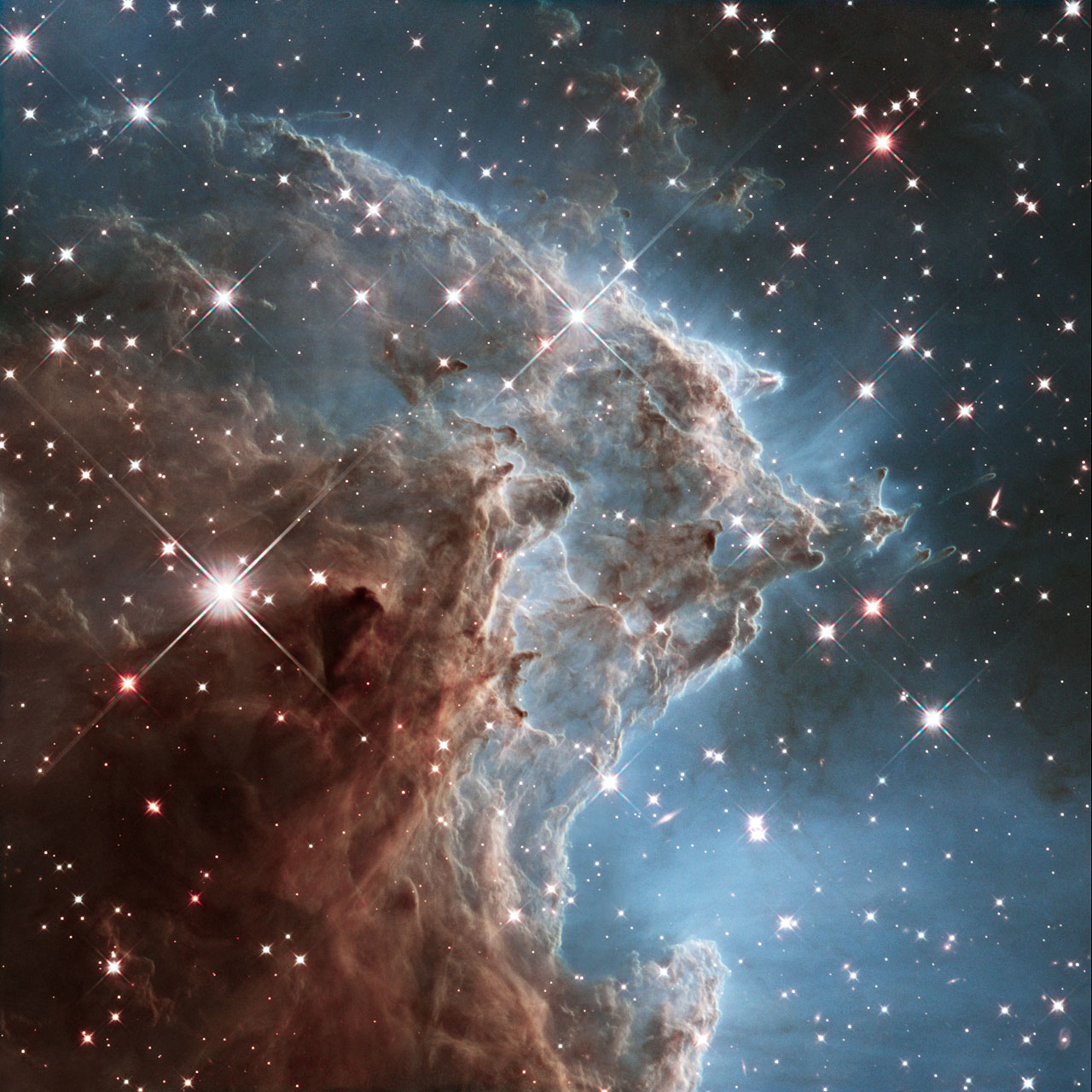
Credit: NASA, ESA, and the Hubble Heritage Team (STScI/AURA), This portion of the Monkey Head Nebula was imaged in the infrared using Hubble'sWide Field Camera 3. Credit: ESA/Hubble
To celebrate its 24th year in orbit, the NASA/ESA Hubble Space Telescope has released a beautiful new image of part of NGC 2174, also known as the Monkey Head Nebula. This colourful region is filled with young stars embedded within bright wisps of cosmic gas and dust. NGC 2174 lies about 6400 light-years away in the constellation of Orion (The Hunter). Hubble previously viewed this part of the sky back in 2001, creating a stunning image released in 2011, and the space telescope has now revisited the region to celebrate its 24th year of operation. Nebulae are a favourite target for Hubble. Their colourful plumes of gas and fiery bright stars create ethereally beautiful pictures. Some of the most famous of Hubble's images have been of nebulae — for example, the telescope's 22nd and 23rd anniversary images of the Tarantula (heic1206) and Horsehead (heic1307) nebulae, and its festive 2012 image of planetary nebula NGC 5189 (heic1220). In April of this year, the NASA/ESA Hubble Space Telescope will be celebrating 24 years of observing. To celebrate this milestone, the observatory is releasing a brand new image of part of NGC 2174, otherwise known as the Monkey Head nebula. This new Hubblecast episode showcases this beautiful image, which views a colourful region filled with young stars embedded within

Credit: ESA/Hubble
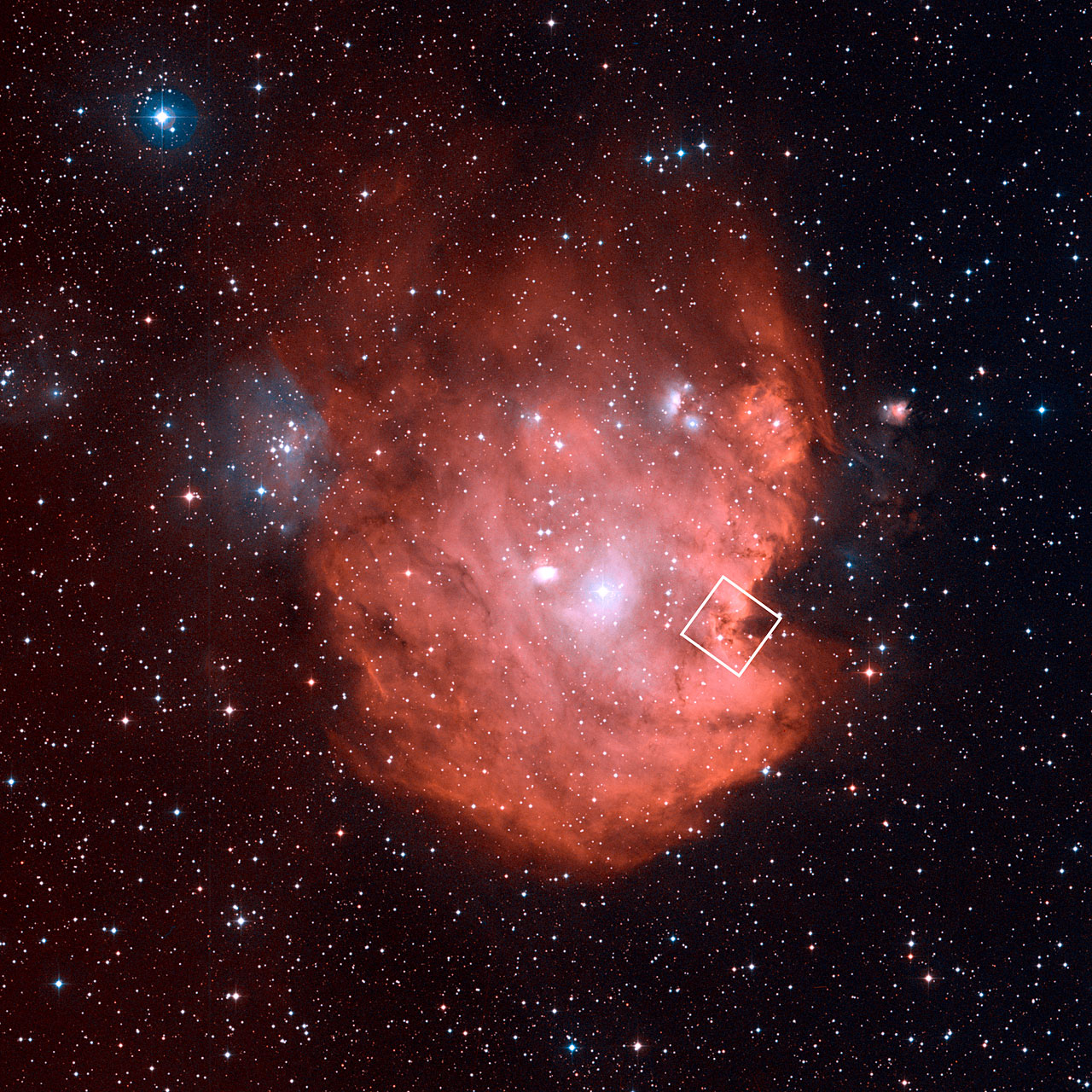
bright wisps of cosmic gas and dust. The nebula is a violent stellar nursery, packed with the ingredients needed for star formation. However, the recipe for cooking up new stars isn't very efficient and most of the ingredients are wasted as the cloud of gas and dust disperses. This process is accelerated by the presence of fiercely hot young stars which trigger high velocity winds that help to blow the gas outwards. This image, a composite of red and blue exposures from the Digitized Sky Survey 2, shows the region of sky surrounding NGC 2174, more popularly known as the Monkey Head Nebula. To celebrate its 24th year observing Hubble revisited the Monkey Head Nebula and a brand new image was released of one of its breathtaking pillars. The small square near the centre of this image is where the pillar can be found. A vibrant palette of colours can be seen  in this new image of NGC 2174. Dark brown and rust-coloured dust clouds billow outwards, framed against a background of bright blue gas. These striking hues are formed by combining several Hubble images taken with different coloured filters, to reveal a broad range of colours not normally visible to the human eye.
Credit: NASA, ESA, Digitized Sky Survey (DSS), STScI/AURA, Palomar/Caltech
The icing on this cosmic birthday cake takes the form of young white and pink stars sprinkled amongst the glowing clouds, pushing away the dark stellar nurseries in which they formed. The key ingredient in NGC 2174 is hydrogen gas, which is ionised by the ultraviolet radiation emitted by the young stars. As a result, this region is also known as an HII region — a large cloud of ionised gas. This video sequence begins by zooming through the constellation of Orion (The Hunter), finishing on new NASA/ESA Hubble Space Telescope observations of part of NGC 2174, also known as the Monkey Head Nebula. NGC 2174 lies about 6400 light-years away. Hubble previously viewed this part of the sky back in 2011, and the space telescope has now revisited the region to celebrate its 24th year of operation. This image was created using infrared observations from Hubble's Wide Field Camera 3.
Credit: NASA, ESA, and G. Bacon (STScI) 
This image marks 24 years of Hubble. This milestone will be further celebrated by a conference being held in Rome, Italy, in March of this year. The conference, entitled Science with the Hubble Space Telescope IV, will highlight and celebrate the scientific breakthroughs that Hubble has made over the last two decades and look into the future at the topics and key questions that will shape the field of astrophysics in the next decade. This video sequence pans across new NASA/ESA Hubble Space Telescope observations of part of NGC 2174, also known as the Monkey Head Nebula. NGC 2174 lies about 6400 light-years away. Hubble previously viewed this part of the sky back in 2011, and the space telescope has now revisited the region to celebrate its 24th year of operation. This image was created using infrared observations
Credit: NASA, ESA, and the Hubble Heritage Team(STScI/AURA) 
from Hubble's Wide Field Camera 3. This portion of the Monkey Head Nebula was imaged in the infrared using Hubble's Wide Field Camera 3. Hubble's earlier Wide Field Planetary Camera 2 image from 2011 inspired its choice as the telescope's 24th anniversary image. A processed version of the WFPC2 dataset was entered into the Hubble's Hidden Treasures image processing competition by Yurij Tukachev. Contacts-sources: Georgia Bladon, ESA/Hubble, Public Information Officer. Source: Article
Read More........

Astronomers Create First Realistic Virtual Universe

Credit: Dr Debora Sijacki, Cambridge University
Tracking 13 billion years of cosmic evolution, astronomers have created the first realistic virtual simulation of the Universe. A newly-developed computer simulation has created the first realistic version of the Universe, enabling researchers to understand how galaxies, black holes and other cosmic phenomena developed from shortly after the Big Bang to the present day. The simulation, known as Illustris, follows the complex development of both normal and dark matter over 13 billion years, matching many of the features observed in the real Universe for the first time. Developed by an international team of researchers, Illustris tracks the development of the Universe from 12 million years after the Big Bang up to the present, and identified more than 41,000 galaxies in a cube of simulated space 350 million light years on each side. The results are reported in the May 8th issue of the journal Nature.  Over the past two decades, researchers have been attempting to build accurate computer simulations of the development of the Universe, using computer programs which are capable of encapsulating all the relevant laws of physics governing the formation of galaxies. Previous attempts to simulate the universe were hampered by lack of computing power and the complexities of the underlying physics.As a result those programseither were limited in resolution, or forced to focus on a small portion of the universe. Earlier simulations also had trouble modelling complex feedback from star formation, supernova explosions, and supermassive black holes. Illustris employs a sophisticated computer program to recreate the evolution of the universe in high fidelity. It includes both normal matter and dark matter using 12 billion 3D “pixels,” or resolution elements. Illustris yields a realistic mix of spiral galaxies like the Milky Way and giant elliptical galaxies. It also recreated large-scale structures like galaxy clusters and the bubbles and voids of the cosmic web. The team dedicated five years to developing the Illustris project. The actual calculations took three months of run time, using a total of 8,000 CPUs running in parallel. In comparison, the same calculations would have taken an average desktop computer more than 2,000 years to complete. “Until now, no single simulation was able to reproduce the Universe on both large and small scales simultaneously,” says lead author Dr Mark Vogelsberger of the Massachusetts Institute of Technology and Harvard University, who conducted the work in collaboration with researchers at the University of Cambridge, the Harvard-Smithsonian Center for Astrophysics and the Heidelberg Institute for Theoretical Studies. “The Illustris simulation is a remarkable technical achievement,” said Dr Debora Sijacki of Cambridge’s Institute of Astronomy, one of the paper’s co-authors. “It shows us for the first time how the bewildering variety of galaxies and the supermassive black holes at their centres have formed.” Since light travels at a fixed speed, the farther away astronomers look, the farther back in time they can see. A galaxy one billion light-years away is seen as it was a billion years ago. Telescopes like Hubble can give us views of the early Universe by looking to greater distances. However, astronomers can’t use Hubble to follow the evolution of a single galaxy over time. “Illustris is like a time machine. We can go forward and backward in time. We can pause the simulation and zoom into a single galaxy or galaxy cluster to see what’s really going on,” said co-author Dr Shy Genel of Harvard University. A selection of videos and imagery from the project are available online at www.illustris-project.orgSource: Ineffableisia.com 
  • Contacts and sources: Dr Debora Sijacki, Institute of Astronomy, Cambridge University
Read More........

How molecules are a lot like birds


.Subscribe
Emory chemist Jay Goodwin was featured in an interview by Ari Daniel of PRI's "Living on Earth." Below is an excerpt from the interview transcript
ARI DANIEL: Once in a while, if you’re lucky, you catch a glimpse of something that gives away a secret of the universe. It’s like a window – up into the heavens and deep into ourselves. This is a story about someone who poked his head through just this kind of window, and we find him in Atlanta. It’s a perfect day here – Jay Goodwin walks over to a bench to sit down. And he can’t help but be reminded about a day just like this one, 5 years ago, in western Michigan where he used to live. JAY GOODWIN: I was outside – I think I was going for a walk, just to kind of clear my head a little bit. I turned a corner, and I saw this flock of birds and they took off into the sky and they started to form a shape – sort of an amorphous shape. And it was one that was dynamic, and it was changing – but it had a boundary to it, like looking at a blob of oil in water. DANIEL: It stopped Goodwin in his tracks. Several hundred birds pulsing and dipping and soaring to an invisible beat in the sky. GOODWIN: It wasn’t clear what they were responding to – there weren’t any predator birds in the sky. And you never got the sense that there was anything that was directing it from within. There was no leader bird that they were all following. But just watching it was, well, it was beautiful. DANIEL: Goodwin realized he had no way of predicting the flock’s behavior by simply taking lots of individual birds flapping their wings, and adding them up. Rather, it was something that emerged once all these birds threw themselves together. And it’s this notion of emergence – how really complex patterns and properties can arise from combining somewhat simple units – that now defines how Goodwin thinks about his real work. Chemistry.  Goodwin heads into his lab at Emory University. He’s a chemist here. And since seeing that flock, he’s come to appreciate how molecules are a lot like birds. That is – you get to know how the individuals behave and parade on their own, but then, you put them together. And often, something new and astonishing emerges. You can read the whole transcript, and listen to the podcast, on the "Living on Earth" web site. Source: eScienceCommons
Read More........

The Council Of Giants And Earth's Place In The Universe


Credit: Marshall McCall / York University
We live in a galaxy known as the Milky Way – a vast conglomeration of 300 billion stars, planets whizzing around them, and clouds of gas and dust floating in between. Though it has long been known that the Milky Way and its orbiting companion Andromeda are the dominant members of a small group of galaxies, the Local Group, which is about 3 million light years across, much less was known about our immediate neighbourhood in the universe. An animation that illustrates the positions of the nearby galaxies, including those in the "Council of Giants, " in three dimensions. 

Now, a new paper by York University Physics & Astronomy Professor Marshall McCall, published today in the Monthly Notices of the Royal Astronomical Society, maps out bright galaxies within 35-million light years of the Earth, offering up an expanded picture of what lies beyond our doorstep. "All bright galaxies within 20 million light years, including us, are organized in a 'Local Sheet' 34-million light years across and only 1.5-million light years thick," says McCall. "The Milky Way and Andromeda are encircled by twelve large galaxies arranged in a ring about 24-million light years across – this 'Council of Giants' stands in gravitational judgment of the Local Group by restricting its range of influence." This is a diagram showing the brightest galaxies within 20 million light years of the Milky Way, as seen from above. The largest galaxies, here shown in yellow at different points around the dotted line, make up the "Council of Giants." McCall says twelve of the fourteen giants in the Local Sheet, including the Milky Way and Andromeda, are "spiral galaxies" which have highly flattened disks in which stars are forming. The remaining two are more puffy "elliptical galaxies", whose stellar bulks were laid down long ago. Intriguingly, the two ellipticals sit on opposite sides of the Council. Winds expelled in the earliest phases of their development might have shepherded gas towards the Local Group, thereby helping to build the disks of the Milky Way and Andromeda. McCall also examined how galaxies in the Council are spinning. He comments: "Thinking of a galaxy as a screw in a piece of wood, the direction of spin can be described as the direction the screw would move (in or out) if it were turned the same way as the galaxy rotates. Unexpectedly, the spin directions of Council giants are arranged around a small circle on the sky. This unusual alignment might have been set up by gravitational torques imposed by the Milky Way and Andromeda when the universe was smaller." This is a diagram showing the brightest galaxies within 20 million light years of the Milky Way, this time viewed from the side. 

Credit: Marshall McCall / York University
The boundary defined by the Council has led to insights about the conditions which led to the formation of theMilky Way. Most important, only a very small enhancement in the density of matter in the universe appears to have been required to produce the Local Group. To arrive at such an orderly arrangement as the Local Sheetand its Council, it seems that nearby galaxies must have developed within a pre-existing sheet-like foundation comprised primarily of dark matter. "Recent surveys of the more distant universe have revealed that galaxies lie in sheets and filaments with large regions of empty space called voids in between," says McCall. "The geometry is like that of a sponge. What the new map reveals is that structure akin to that seen on large scales extends down to the smallest." Contacts and sources: Robin HeronYork UniversitySource: ArticleImage Source1-2
Read More........

Do Alien Civilizations Inevitably ‘Go Green’?

In the famous words of Arthur C. Clarke, “Any sufficiently advanced technology is indistinguishable from magic.” This phrase is often quoted to express the idea that an alien civilization which may be thousands or millions of years older than us would have technology so far ahead of ours that to us it would appear to be “magic.” Now, a variation of that thought has come from Canadian science fiction writer Karl Schroeder, who posits that ”any sufficiently advanced technology is indistinguishable from nature.” The reasoning is that if a civilization manages to exist that long, it would inevitably “go green” to such an extent that it would no longer leave any detectable waste products behind. Its artificial signatures would blend in with those of the natural universe, making it much more difficult to detect them by simply searching for artificial constructs versus natural ones. The idea has been proposed as an explanation for why we haven’t found them yet, based on the premise that such advanced societies would have visited and colonized our entire galaxy by now (known as the Fermi Paradox). The question becomes more interesting in light of the fact that astronomers now estimate that there are billions of other planets in our galaxy alone. If a civilization reaches such a “balance with nature” as a natural progression, it may mean that traditional methods of searching for them, like SETI, will ultimately fail. Of course, it is possible, perhaps even likely, that civilizations much older than us would have advanced far beyond radio technology anyway. SETI itself is based on the assumption that some of them may still be using that technology. Another branch of SETI is searching for light pulses such as intentional beacons as opposed to radio signals. But even other alternate searches, such as SETT (Search for Extraterrestrial Technology), may not pan out either, if this new scenario is correct. SETT looks for things like the spectral signature of nuclear fission waste being dumped into a star, or leaking tritium from alien fusion powerplants. Another solution to the Fermi Paradox states that advanced civilizations will ultimately destroy themselves. Before they do though, they could have already sent out robotic probes to many places in the galaxy. If those probes were technologically savvy enough to self-replicate, they could have spread themselves widely across the cosmos. If there were any in our solar system, we could conceivably find them. Yet this idea could also come back around to the new hypothesis – if these probes were advanced enough to be truly “green” and not leave any environmental traces, they might be a lot harder to find, blending in with natural objects in the solar system. It’s an intriguing new take on an old question. It can also be taken as a lesson – if we can learn to survive our own technological advances long enough, we can ultimately become more of a green civilization ourselves, co-existing comfortably with the natural universe around us. Source: Article.
Read More........

Deceased--Halton C. Arp

"Halton C. Arp, Astronomer Who Challenged Big Bang Theory, Dies at 86"
By: Dennis Overbye, January 6th, 2014, The New York Times: Halton C. Arp, a prodigal son of American astronomy whose dogged insistence that astronomers had misread the distances to quasars cast doubt on the Big Bang theory of the universe and led to his exile from his peers and the telescopes he loved, died on Dec. 28 in Munich. He was 86. The cause was pneumonia, said his daughter Kristana Arp, who said he also had Parkinson’s disease. As a staff astronomer for 29 years at Hale Observatories, which included the Mount Wilson and Palomar Mountain observatories in Southern California, Dr. Arp was part of their most romantic era, when astronomers were peeling back the sky and making discovery after discovery that laid the foundation for the modern understanding of the expansion of the universe. But Dr. Arp, an artist’s son with a swashbuckling air, was no friend of orthodoxy. A skilled observer with regular access to a 200-inch telescope on Palomar Mountain, he sought out unusual galaxies and collected them in “The Atlas of Peculiar Galaxies” (1966), showing them interacting and merging with loops, swirls and streamers that showed the diversity and beauty of nature. But these galaxies also revealed something puzzling and controversial. In the expanding universe, as discovered by Edwin Hubble in 1929, everything is moving away from us. The farther away it is, the faster it is going, as revealed by its redshift, a stretching of light waves — like the changing tone of an ambulance siren as it goes past — known as a Doppler shift. Dr. Arp found that galaxies with radically different redshifts, and thus at vastly different distances from us, often appeared connected by filaments and bridges of gas. This suggested, he said, that redshift was not always an indication of distance but could be caused by other, unknown physics. The biggest redshifts belonged to quasars — brilliant, pointlike objects that are presumably at the edge of the universe. Dr. Arp found, however, that they were often suspiciously close in the sky to relatively nearby spiral galaxies. This suggested to him that quasars were not so far away after all, and that they might have shot out of the nearby galaxies. If he was right, the whole picture of cosmic evolution given by the Big Bang — of a universe that began in a blaze of fire and gas 14 billion years ago and slowly condensed into stars, galaxies and creatures over the eons — would have to go out the window. A vast majority of astronomers dismissed Dr. Arp’s results as coincidences or optical illusions. But his data appealed to a small, articulate band of astronomers who supported a rival theory of the universe called Steady State and had criticized the Big Bang over the decades. Among them were Fred Hoyle, of Cambridge University, who had invented the theory, and Geoffrey Burbidge, a witty and acerbic astrophysicist at the University of California, San Diego. Dr. Arp survived both of them. “When he died, he took a whole cosmology with him,” said Barry F. Madore, a senior research associate at the Carnegie Observatories in Pasadena, Calif. Halton Christian Arp was born on March 21, 1927, in New York City, the only son of August and Anita Arp. His father was an artist and his mother ran institutions for children and adolescents. Halton grew up in Greenwich Village and various art colonies and did not go to school until fifth grade. After bouncing around public schools in New York, he was sent to Tabor Academy, on Buzzards Bay in Massachusetts, a prep school for the United States Naval Academy. After a year in the Navy, he attended Harvard, where he majored in astronomy. He graduated in 1949 and went on to obtain a Ph.D. in 1953 at the California Institute of Technology, which had started an astronomy graduate program to prepare for the advent of the 200-inch telescope. At Harvard, he became one of the best fencers in the United States, ultimately competing in world championship matches in Paris in 1965. Cutting a dashing figure, he would adopt a fencer’s posture when giving talks. “He would strut across the stage and then strut back, as if he were dueling,” Dr. Madore said. Dr. Arp married three times. He is survived by his third wife, Marie-Helene Arp, an astronomer in Munich; four daughters, Kristana, Alissa, Andrice and Delina Arp; and five grandchildren. Dr. Arp became a staff astronomer at the Hale Observatories after stints as a postdoctoral fellow at the Carnegie Institution for Science and Indiana University. His breakthrough occurred, as he recalled, on a rainy night at Palomar in 1966, when he decided to investigate a chance remark by a colleague that a lot of his peculiar galaxies had radio sources near them in the sky. Looking them up in the Palomar library, he realized that many of those radio sources were quasars that could have been shot out of a nearby galaxy, an idea first explored by the Armenian astronomer Victor Ambartsumian a decade earlier. “It is with reluctance that I come to the conclusion that the redshifts of some extragalactic objects are not due entirely to velocity causes,” Dr. Arp wrote in a paper a year later. He combed the sky for more evidence that redshifts were not ironclad indicators of cosmic distance, knowing that he was striking at the heart of modern cosmology. He turned out to be an expert at finding quasars in suspicious places, tucked under the arm of a galaxy or at the end of a tendril of gas. One of the most impressive was a quasarlike object known as Markarian 205, which had a redshift corresponding to a distance of about a billion light years but appeared to be in front of a galaxy only 70 million light years away. The redshift controversy came to a boil in 1972, when Dr. Arp engaged in a debate, arranged by the American Association for the Advancement of Science, with John N. Bahcall, a young physicist at the Institute for Advanced Study. Timothy Ferris described the event in his book “The Red Limit” (1977): “When the debate was over, it was difficult not to be impressed with Arp’s sincerity and his love for the mysterious galaxies he studied, but it was also difficult to feel that his case had suffered anything short of demolition.” As Dr. Arp’s colleagues lost patience with his quest, he was no longer invited to speak at major conferences, and his observing time on the mighty 200-inch telescope began to dry up. Warned in the early 1980s that his research program was unproductive, he refused to change course. Finally, he refused to submit a proposal at all on the grounds that everyone knew what he was doing. He got no time at all. Dr. Arp took early retirement and joined the Max Planck Institute for Astrophysics near Munich, where he continued to promote his theories. He told his own side of the redshift story in a 1989 book, “Quasars, Redshifts and Controversies.”  Halton C. Arp [Wikipedia]Halton C. Arp - The Official WebsiteArp Peculiar Galaxy Club IntroductionATLAS OF PECULIAR GALAXIESSource: Article
Read More........

What sea squirts can teach us about brains


Bluebell tunicates are bottle-shaped sea squirts. Photo by Nick Hobgood
John Onians, a professor emeritus of art studies from the University of East Anglia in England, recently spoke at Emory about the links between neuroscience and art history. His eclectic talk also included a reference to sea squirts, which was highlighted in "ThoughtWork," the newsletter of the Academic Exchange: "Why do we have a brain? I didn't know this previously: The reason we have a brain is because like all other organisms from amoebas to elephants, we need to move in order to reproduce and get food. A plant can reproduce and get food without moving. That's why plants don't have brains. This is illustrated by this marvelous creature the sea squirt. The sea squirt swims around the ocean until it's found a place where it can settle, and then when it settles it attaches itself and then it proceeds to consume its own brain because it no longer needs it, which is often unflatteringly compared to a professor that gets tenure. It is important to remember that the brain is there to help us move in order to get things which are of vital importance to us. The brain isn't primarily consumed with knowledge, the sort of things we were taught about. That was just an idea that the Greeks had because it was a good way of getting young men to forget their emotions. But really everything we do is driven by our emotional needs."Source: eScienceCommons
Read More........