In your face projection mapping delivers virtual make-up

Japanese artist, director and producer Nobumichi Asai has unveiled Omote, his latest project that uses projection mapping techniques to create stunning illusions on a model’s face. In his recently released video the model moves her head while projected graphics constantly transform how she appears; creating masks and cyber influenced visuals. He was inspired by the Japanese Noh mask.
Laser scanning was used to create a mesh that followed the contours of the model’s face and it’s rumoured that Asai is now looking to create a system the covers the whole body. Asai has built up a large

portfolio of work that includes a number of projection mapping projects, usually featuring huge backdrops including buildings, a dockyard and a large stage show for Subaru. Source: InAVate, Image-Courtesy: https://33.media.tumblr.com
Read More........

Copper Protein Sculpture

Ubiquitin, Copper, Steel: Ubiquitin is a small regulatory protein found in almost all tissues of eukaryotic organisms. The cell attaches short chains of Ubiquitin molecules to proteins, which labels them for destruction and subsequent recycling. The Ubiquitin tag directs proteins to the proteasome, which is a large protein complex in the cell that degrades unneeded proteins back into their amino acid
constituents. These are then reused to synthesize new proteins. The constant recycling of proteins not only ensures damaged proteins are removed quickly but also allows rapid regulation of enzyme levels in the cell. Structurally, Ubiquitin features all of the major structural features of typical proteins including two a-helices a curved b-sheet. Its small size (76 amino acids) makes it one of the most studied proteins for protein folding and dynamics. KcsA Potassium ChannelCopperSteel: Potassium channels form potassium-selective pores that span cell membranes. They are the most widely distributed
 type of ion channel found in virtually all living organisms. The four identical subunits are situated in a four-fold symmetrical manner around a central pore, which allows potassium ions to pass freely. At the top of the structure, formed by four loops lining the pore, a selectivity filter is situated which prevents other ions (such as sodium ions) from passing. The correct ions are detected by their size and charge. Note that that no active pumping of ions occurs; it merely allows passive conductance of ions down the con-centration gradient between the two sides of the membrane.The KcsA is an archetypal membrane protein with eight tightly packed membrane-spanning a-helices. The four short helices in the center where the chain crosses half the membrane and then returns to the top are a more unusual feature. More pics on: http://www.miketyka.com/art/Source: Beautiful Proteins
Read More........

Herschel Discovers Water Vapor Around Dwarf Planet Ceres

Dwarf planet Ceres is located in the main asteroid belt, between the orbits of Mars and Jupiter, as illustrated in this artist's conception. Observations by the Herschel space observatory between 2011 and 2013 find that the dwarf planet has a thin water vapor atmosphere. This is the first unambiguous detection of water vapor around anobject in the asteroid belt. Illustration credit: ESA/ATG medialab, Note: For more information, see PIA17831: Water Detection on Ceres, Herschel Telescope Detects Water on Dwarf Planet and Herschel Discovers Water Vapor Around Dwarf Planet CeresSource: Article
Read More........

NASA's Kepler Provides Insights on Enigmatic Planets


Artist's view of a Earth-size rocky exoplanet. Image credit: NASA/JPL-Caltech
More than three-quarters of the planet candidates discovered by NASA's Kepler spacecraft have sizes ranging from that of Earth to that of Neptune, which is nearly four times as big as Earth. Such planets dominate the galactic census but are not represented in our own solar system. Astronomers don't know how they form or if they are made of rock, water or gas. The Kepler team today reports on four years of ground-based follow-up observations targeting Kepler's exoplanet systems at the American Astronomical Society meeting in Washington. These observations confirm the numerous Kepler discoveries are indeed planets and yield mass measurements of these enigmatic worlds that vary between Earth and Neptune in size. Included in the findings are five new rocky planets ranging in size from 10 to 80 percent larger than Earth. Two of the new rocky worlds, dubbed Kepler-99b and Kepler-406b, are both 40 percent larger in size than Earth and have a density similar to lead. The planets orbit their host stars in less than five and three days respectively, making these worlds too hot for life as we know it. A major component of these follow-up observations was Doppler measurements of the planets' host stars. The team measured the reflex wobble of the host star, caused by the gravitational tug on the star exerted by the orbiting planet. That measured wobble reveals the mass of the planet: the higher the mass of the planet, the greater the gravitational tug on the star and hence the greater the wobble. "This marvelous avalanche of information about the mini-Neptune planets is telling us about their core-envelope structure, not unlike a peach with its pit and fruit," said Geoff Marcy, professor of astronomy at the University of California, Berkeley, who led the summary analysis of the high-precision Doppler study. "We now face daunting questions about how these enigmas formed and why our solar system is devoid of the most populous residents in the galaxy." Using one of the world's largest ground-based telescopes at the W. M. Keck Observatory in Hawaii, scientists confirmed 41 of the exoplanets discovered by Kepler and determined the masses of 16. With the mass and diameter in hand, scientists could immediately determine the density of the planets, characterizing them as rocky or gaseous, or mixtures of the two. The density measurements dictate the possible chemical composition of these strange, but ubiquitous planets. The density measurements suggest that the planets smaller than Neptune -- or mini-Neptunes -- have a rocky core but the proportions of hydrogen, helium and hydrogen-rich molecules in the envelope surrounding that core vary dramatically, with some having no envelope at all. The ground-based observation research validates 38 new planets, six of which are non-transiting planets only seen in
Chart of Kepler planet candidates as of January 2014. Image Credit: NASA Ames
the Doppler data. The paper detailing the research is published in the Astrophysical Journal today. A complementary technique used to determine mass, and in turn density of a planet, is by measuring the transit timing variations (TTV). Much like the gravitational force of a planet on its star, neighboring planets can tug on one another, causing one planet to accelerate and another planet to decelerate along its orbit. Ji-Wei Xie of the University of Toronto used TTV to validate 15 pairs of Kepler planets ranging from Earth-sized to a little larger than Neptune. Xie measured masses of the 30 planets, thereby adding to the compendium of planetary characteristics for this new class of planets. The result also was published in the Astrophysical Journal in Dec. 2013. "Kepler's primary objective is to determine the prevalence of planets of varying sizes and orbits. Of particular interest to the search for life is the prevalence of Earth-sized planets in the habitable zone," said Natalie Batalha, Kepler mission scientist at NASA's Ames Research Center in Moffett Field, Calif. "But the question in the back of our minds is: are all planets the size of Earth rocky? Might some be scaled-down
Artist's concept of NASA's Kepler space telescope. Image credit: NASA/JPL-Caltech
versions of icy Neptunes or steamy water worlds? What fraction are recognizable as kin of our rocky, terrestrial globe?" The dynamical mass measurements produced by Doppler and TTV analyses will help to answer these questions. The results hint that a large fraction of planets smaller than 1.5 times the radius of Earth may be comprised of the silicates, iron, nickel and magnesium that are found in the terrestrial planets here in the solar system. Armed with this type of information, scientists will be able to turn the fraction of stars harboring Earth-sizes planets into the fraction of stars harboring bona-fide rocky planets. And that's a step closer to finding a habitable environment beyond the solar system. Ames is responsible for the Kepler mission concept, ground system development, mission operations and science data analysis. NASA's Jet Propulsion Laboratory in Pasadena, Calif., managed Kepler mission development. Ball Aerospace & Technologies Corp. in Boulder, Colo., developed the Kepler flight system and supports mission operations with the Laboratory for Atmospheric and Space Physics at the University of Colorado in Boulder. The Space Telescope Science Institute in Baltimore archives, hosts and distributes Kepler science data. Kepler is NASA's 10th Discovery mission and was funded by the agency's Science Mission Directorate. For more information about the Kepler space telescope, visit: http://www.nasa.gov/kepler . The California Institute of Technology in Pasadena manages JPL for NASA. Images (mentioned), Text, Credits: NASA / J.D. Harrington / JPL / Michele Johnson / Ames Research Center / Michele Johnson. Best regards, Orbiter.ch, Source: Orbiter.ch Space NewsSource: Image1-2
Read More........

AV Tech opens up a world of museums in Romania

A museum in Romania is utilising 3D projection, 3D screens and a host of touchscreens to allow visitors to explore exhibitions and displays from numerous museums around the world. The Digital Museum was designed by architect Claudiu Ionsecu to deliver a great number of presentations within a very small space. It is situated near the Mures Floodplain Natural Park in Pecica, Romania.
Forty-five inch touchscreens and passive 3D technologies are packed into the 125m² space. Content ranges from exhibits from museums around the world down to information on the local area. The museum also encourages visitors to explore the local area virtually using exercise bikes coupled with digital displays or physically using one of 60 mountain bikes. Ionescu said: “Inspired by Constantin Brancusi’s ‘miracle’ sculpture, the building rises naturally from the ground through golden spirals (the fibonacci spirals) and crystallizes in a shape that, just like its muse, tries to set itself free from ‘the past burdens’, striving to rise high. Its shape offers the visitor a feeling of aspiration, an aspiration not only of the building, but of life itself.” Source: InAVate
Read More........

Water Found On Extrasolar Planet, Jupiter-Sized Alien World Has Atmosphere With Water Vapor

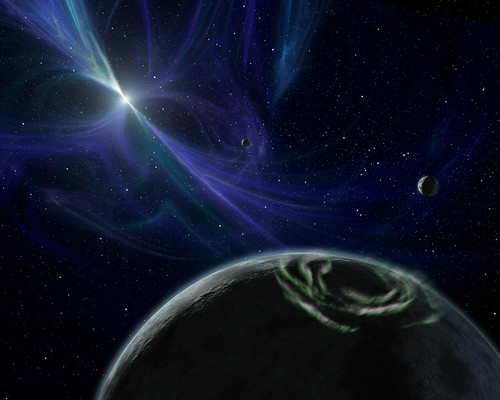
Released to Public: Artist View of Pulsar Planet System by NASA/JPL (NASA)
A team of international scientists including a Lawrence Livermore National Laboratory astrophysicist has made the most detailed examination yet of the atmosphere of a Jupiter-size like planet beyond our solar system. The finding provides astrophysicists with additional insight into how planets are formed. Artist's rendering of the planetary system HR 8799 at an early stage in its evolution, showing the planet HR 8799c, a disk of gas and dust, and interior planets.  "This is the sharpest spectrum ever obtained of an extrasolar planet," said co-author Bruce Macintosh, an astronomer at Lawrence Livermore National Laboratory. "This shows the power of directly imaging a planetary system -- the exquisite resolution afforded by these new observations has allowed us to really begin to probe planet formation."  According to lead author Quinn Konopacky, an astronomer with the Dunlap Institute for Astronomy & Astrophysics, University of Toronto and a former LLNL postdoc: "We have been able to observe this planet in unprecedented detail because of Keck Obervatory's advanced instrumentation, our ground-breaking observing and data processing techniques, and because of the nature of the planetary system." The paper appears online March 14 in Science Express and in the March 21 edition of the journal, Science.  The team, using the OSIRIS instrument on the Keck II telescope on the summit of Mauna Kea, Hawaii, has uncovered the chemical fingerprints of specific molecules, revealing a cloudy atmosphere containing water vapor and carbon monoxide. "With this level of detail," says co-author Travis Barman, an astronomer at the Lowell Observatory, "we can compare the amount of carbon to the amount of oxygen present in the atmosphere, and this chemical mix provides clues as to how the planetary system formed." One of the discovery images of  the system obtained at the Keck II telescope using the adaptive optics system and NIRC2 Near-Infrared Imager. The rectangle indicates the field-of-view of the OSIRIS instrument for planet C, There has been uncertainty about how planets in other solar systems formed, with two leading models, called core accretion and gravitational instability. When stars form, they are surrounded by a planet-forming disk. In the first scenario, planets form gradually as solid cores slowly grow big enough to start absorbing gas from the disk. In the latter, planets form almost instantly as parts of the disk collapses on itself. Planetary properties, such as the composition of a planet's atmosphere, are clues as to whether a system formed according to one model or the other. Although the planet's atmosphere shows clear evidence of water vapor, that signature is weaker than would be expected if the planet shared the composition of its parent star. Instead, the planet has a high ratio of carbon to oxygen -- a fingerprint of its formation in the gaseous disk tens of millions of years ago. As the gas cooled with time, grains of water ice form, depleting the remaining gas of oxygen. Planetary formation began when ice and solids collected into planetary cores -- very similar to how our solar system formed. "Once the solid cores grew large enough, their gravity quickly attracted surrounding gas to become the massive planets we see today," said Konopacky. "Since that gas had lost some of its oxygen, the planet ends up with less oxygen and less water than if it had formed through a gravitational instability." The planet is one of four gas giants known to orbit a star called HR 8799, 130 light-years from Earth. The authors and their collaborators previously discovered this planet, designated HR 8799c, and its three companions back in 2008 and 2010. Unlike most other planetary systems, whose presence is inferred by their effects on their parent star, the HR8799 planets can be individually seen. "We can directly image the planets around HR 8799 because they are all large, young, and very far from their parent star. This makes the system an excellent laboratory for studying exoplanet atmospheres," said coauthor Christian Marois, an astronomer at the National Research Council of Canada and another former LLNL postdoc. "Since its discovery, this system just keeps on surprising us." Although the planet does have water vapor, it's incredibly hostile to life -- like Jupiter, it has no solid surface, and it has a temperature of more than a thousand degrees Fahrenheit as it glows with the energy of its original formation. Still, this discovery provides clues as to the possibility of other Earthlike planets in other solar systems. "The fact that the HR 8799 giant planets may have formed the same way our own giant planets did is a good sign -- that same process also made the rocky planets close to the sun," Macintosh said. The research is funded by Livermore's Laboratory Directed Research and Development program. LLNL is leading the construction of a new planet-finding instrument for the Gemini South telescope in Chile, known as the Gemini Planet Imager (GPI). Designed from the ground up for exoplanet detection, GPI (and similar new instruments at the Palomar and European Southern Observatories) will be capable of seeing planets that are much older, smaller and fainter than the HR-8799 giants. "GPI is the next big step in this field," said Macintosh, the principal investigator for the project. "It will be an order of magnitude more sensitive than we are now." Simulations predict that a large-scale GPI survey should discover dozens of new exoplanets. By studying planets at different stages of their evolution, the GPI science team will further chip away at the puzzle of how planets form. GPI is currently undergoing final testing at UC Santa Cruz and will ship to Chile later in the year. The W. M. Keck Observatory operates the largest, most scientifically productive telescopes on Earth. The two, 10-meter optical/infrared telescopes on the summit of Mauna Kea on the Island of Hawaii feature a suite of advanced instruments including imagers, multi-object spectrographs, high-resolution spectrographs, integral-field spectroscopy and a world-leading laser guide star adaptive optics system. The Observatory is a private 501(c) 3 non-profit organization and a scientific partnership of the California Institute of Technology, the University of California and NASA. Contacts and sources: Anne Stark, DOE/LawrenceSource: Nano Patents And InnovationsImage: flickr.com
Read More........

Celestial Fireworks When Milky Way's Giant Black Hole Swallowed A Satellite Galaxy

Julie Turner, Vanderbilt University
These days the core of the Milky Way galaxy is a pretty tame place...cosmically speaking. The galactic black hole at the center is a sleeping giant. Existing stars are peacefully circling. Although conditions are favorable, there doesn’t even seem to be much new star formation going on. But there is growing evidence that several million years ago the galactic center was the site of all manner of celestial fireworks. A pair of assistant professors – Kelly Holley-Bockelmann at Vanderbilt and Tamara Bogdanović at Georgia Institute of Technology – have come up with an explanation that fits these “forensic” clues. Artist's illustration of a satellite galaxy on a collision course with the galactic black hole. Writing in the March 6 issue of the Monthly Notices of the Royal Astronomical Society, the astronomers describe how a single event – a violent collision and merger between the galactic black hole and an intermediate-sized black hole in one of the small “satellite galaxies” that circle the Milky Way – could have produced the features that point to a more violent past for the galactic core. “Tamara and I had just attended an astronomy conference in Aspen, Colorado, where several of these new observations were announced,” said Holley-Bockelmann. “It was January 2010 and a snow storm had closed the airport. We decided to rent a car to drive to Denver. As we drove through the storm, we pieced together the clues from the conference and realized that a single catastrophic event – the collision between two black holes about 10 million years ago - could explain all the new evidence.” The most dramatic of these extraordinary clues are the Fermi bubbles. These giant lobes of high-energy radiation - caused by particles moving nearly the speed of light - extend some 30,000 light years above and below the Milky Way center. If they were glowing in visible light they would fill about half of the night sky. But they radiate X-ray and gamma-ray light, so you need X-ray vision to see them. The discovery was reported by astronomers at the Harvard-Smithsonian Center for Astrophysics. Another puzzling characteristic of the GC, the astronomer’s abbreviation for the galactic center, is the fact that it contains the three most massive clusters of young stars in the entire galaxy. The Central, Arches and Quintuplet clusters each contain hundreds of young, hot stars that are much larger than the Sun. These stars typically burn out in “only” a few million years because of their extreme brightness, so there had to have been a relatively recent burst of star formation at the GC. The supermassive black hole that dominates the center of the Milky Way weighs in at about four million solar masses and is roughly 40 light seconds in diameter: only nine times the size of the sun. Such an object produces intense gravitational tides. So astronomers were surprised to discover a number of clumps of bright new stars closer than three lights years from the black hole’s maw. It wouldn’t be that surprising if the stars were being sucked into the black hole, but they show every sign of having formed in place. For this to happen, the clouds of dust and gas that they formed from must have been exceptionally dense: 10,000 times thicker than the other molecular clouds in the GC. While there is an excess of young hot stars in the galactic core, there is also a surprising dearth of older stars. Theoretical models predict that the density of old stars should increase as you move closer to the black hole. Instead, there are very few old stars found within several light years of the sleeping giant. When she got home from the conference, Holley-Bockelmann recruited Vanderbilt graduate student Meagan Langto work on the problem with them. With the assistance of Pau Amaro-Seoane from the Max Planck Institute for Gravitational Physics in Germany, Alberto Sesana from the Institut de CiÚncies de l'Espai in Spain, and Vanderbilt Research Assistant Professor Manodeep Sinha, they came up with a theoretical model that fits the observations and makes some testable predictions. The scenario began about 13 billion years ago, when the path of one of the smaller satellite galaxies orbiting the Milky Way is diverted so that it began drifting inward toward the core. According to a recent study, this may have happened dozens of times in the lifetime of the Milky Way. As the satellite galaxy – a collection of stars and gas with an intermediate-sized black hole with a mass equal to about 10,000 suns – spiraled in, most of its mass was gradually stripped away, finally leaving the black hole and a handful of gravitationally bound stars. About 10 million years ago, the stripped down core of the satellite galaxy finally reached the galactic center. When two black holes merge, they first go through an elaborate dance. So the smaller black hole would have circled the galactic black hole for several million years before it was ultimately consumed. As the smaller black hole circled closer and closer, it would have churned up the dust and gas in the vicinity and pushed enough material into the galactic black hole in the process to produce the Fermi bubbles. The violent gravitational tides produced by the process could easily have compressed the molecular clouds in the core to the super densities required to produce the young stars that are now located on the central black hole’s doorstep. In addition, the vigorous churning would have swept out the existing stars from the area surrounding the massive central black hole. In fact, the astronomer’s model predicts that the black holes’ merger dance should have flung a large number of the missing old stars out into the galaxy at hyper velocities, thus explaining the absence of old stars immediately around the super-massive black hole. “The gravitational pull of the satellite galaxy’s black hole could have carved nearly 1,000 stars out of the galactic center,” said Bogdanović. “Those stars should still be racing through space, about 10,000 light years away from their original orbits.” It should be possible to detect these stars with large surveys like the Sloan Digital Sky Survey because these stars would be traveling at much higher velocities than stars that have not undergone this type of interaction. So discovery of a large number of "high velocity stars" racing outward through the galaxy would strongly support the proposed scenario of the Milky Way and satellite galaxy merger. The research was supported by National Science Foundation Career Grant AST-0847696 and National Aviation and Space Administration grants NNX08AG74G and PF9-00061 as well as an NSF Graduate Research Fellowship. Contacts and sources: Vanderbilt Univerity, Citation: Monthly Notices of the Royal Astronomical Society, Source: Nano Patents And Innovations
Read More........

Kepler-37 Planetary System


NASA's Kepler mission has discovered a new planetary system that is home to the smallest planet yet found around a star like our sun, approximately 210 light-years away in the constellation Lyra. The line up compares artist's concepts of the planets in the Kepler-37 system to the moon and planets in the solar system. The smallest planet, Kepler-37b, is slightly larger than our moon, measuring about one-third the size of Earth. Kepler-37c, the second planet, is slightly smaller than Venus, measuring almost three-quarters the size of Earth. Kepler-37d, the third planet, is twice the size of Earth. A "year" on these planets is very short. Kepler-37b orbits its host star every 13 days at less than one-third the distance Mercury is to the sun. The other two planets, Kepler-37c and Kepler-37d, orbit their star every 21 and 40 days. All three planets have orbits lying less than the distance Mercury is to the sun, suggesting that they are very hot, inhospitable worlds. Illustration credit: NASA/Ames/JPL-Caltech, Note: For more information, see PIA16693: A Tiny Planet (Artist's Concept) and NASA's Kepler Mission Discovers Tiny Planet System.Source: Minex
Read More........

Birth Of A Giant Planet: Candidate Protoplanet Spotted Inside Its Stellar Womb


Credit: ESO/L. Calçada
Astronomers using ESO’s Very Large Telescope have obtained what is likely the first direct observation of a forming planet still embedded in a thick disc of gas and dust. If confirmed, this discovery will greatly improve our understanding of how planets form and allow astronomers to test the current theories against an observable target. This artist’s impression shows the formation of a gas giant planet in the ring of dust around the young star HD 100546. This system is also suspected to contain another large planet orbiting closer to the star. The newly-discovered object lies about 70 times further from its star than the Earth does from the Sun. This protoplanet is surrounded by a thick cloud of material so that, seen from this position, its star almost invisible and red in colour because of the scattering of light from the dust. An international team led by Sascha Quanz (ETH Zurich, Switzerland) has studied the disc of gas and dust that surrounds the young star HD 100546, a relatively nearby neighbour located 335 light-years from Earth. They were surprised to find what seems to be a planet in the process of being formed, still embedded in the disc of material around the young star. The candidate planet would be a gas giant similar to Jupiter. “So far, planet formation has mostly been a topic tackled by computer simulations,”
says Sascha Quanz. “If our discovery is indeed a forming planet, then for the first time scientists will be able to study the planet formation process and the interaction of a forming planet and its natal environment empirically at a very early stage.” This composite image shows a view from the NASA/ESA Hubble Space Telescope (left) and from the NACO system on ESO’s Very Large Telescope (right) of the gas and dust around the young star HD 100546. The Hubble visible-light image shows the outer disc of gas and dust around the star. The new infrared VLT picture of a small part of the disc shows a candidate protoplanet. Both pictures were taken with a special coronagraph that suppresses the light from the brilliant star. The position of the star is marked with a red cross in both panels.  HD 100546 is a well-
Credit: ESO/NASA/ESA/Ardila et al.
studied object, and it has already been suggested that a giant planet orbits about six times further from the star than the Earth is from the Sun. The newly found planet candidate is located in the outer regions of the system, about ten times further out [1]. The planet candidate around HD 100546 was detected as a faint blob located in the circumstellar disc revealed thanks to the NACO adaptive optics instrument on ESO’s VLT, combined with pioneering data analysis techniques. The observations were made using a special coronagraph in NACO, which operates at near-infrared wavelengths and suppresses the brilliant light coming from the star at the location of the protoplanet candidate [2]. This image from the NACO system on ESO’s Very Large Telescope shows a candidate protoplanet in the disc of gas and dust around the young star HD100546. This picture was taken with a special coronagraph that suppresses the light from the brilliant star and allows the region of the protoplanet to be seen in great detail. The brightest part of this picture is the candidate protoplanet and the dark disc at the bottom is hiding the very bright. 
Credit: ESO
star itself According to current theory, giant planets grow by capturing some of the gas and dust that remains after the formation of a star [3]. The astronomers have spotted several features in the new image of the disc around HD100546 that support this protoplanet hypothesis. Structures in the dusty circumstellar disc, which could be caused by interactions between the planet and the disc, were revealed close to the detected protoplanet. Also, there are indications that the surroundings of the protoplanet are potentially heated up by the formation process. This chart shows the position of the young star HD 100546 in the southern constellation of Musca (The Fly). Most of the stars that are visible to the unaided eye from a clear and dark site are shown. The star HD 100546 is surrounded by a ring of dust where a planet appears to be in the process of formation. This star is a little too faint to see with the unaided eye,
Credit: ESO, IAU and Sky & Telescope
but can be picked up easily in binoculars. The planets and the dust ring cannot be seen in small telescopes. Adam Amara, another member of the team, is enthusiastic about the finding. “Exoplanet research is one of the most exciting new frontiers in astronomy, and direct imaging of planets is still a new field, greatly benefiting from recent improvements in instruments and data analysis methods. In this research we used data analysis techniques developed for cosmological research, showing that cross-fertilisation of ideas between fields can lead to extraordinary progress.” This image from the NASA/ESA Hubble Space Telescope shows a visible light view of the outer dust around the young star HD100546.
Credit: ESO/NASA/ESA/Ardila et al.
The position of the newly discovered protoplanet is marked with an orange spot. The inner part of this picture is dominated by artifacts from the brilliant central star, which has been digitally subtracted, and the black blobs are not real. Although the protoplanet is the most likely explanation for the observations, the results of this study require follow-up observations to confirm the existence of the planet and discard other plausible scenarios. Among other explanations, it is possible, although unlikely, that the detected signal could have come from a background source. It is also possible that the newly detected object might not be a protoplanet, but a fully formed planet which was ejected from its original orbit closer to the star. When the new object around HD 100546 is confirmed to be a forming planet embedded in its parent disc of gas and dust, it will become an unique laboratory in which to study the formation process of a new planetary system. This picture shows the sky around the young star HD 100546 in the southern constellation of Musca (The Fly). It was created from images from the Digitized Sky Survey 2. The cross-
Credit: ESO/Digitized Sky Survey 2. Acknowledgement: Davide De Martin
like features that are centred on brighter stars, as well as the coloured circles around them, are artifacts of the telescope and photographic process and are not real. Notes: [1] The protoplanet candidate orbits about 70 times further from its star than the Earth does from the Sun. This distance is comparable to the size of the orbits of outer Solar System dwarf planets such as Eris and Makemake. This location is controversial, as it does not fit well with current theories of planet formation. It is unclear at present whether the newfound planet candidate has been in its current position for the whole time since it formed or whether it could have migrated from the inner regions. [2] The team made use of a special feature called an apodised phase plate that increases the contrast of the image close to the star. [3] To study planet formation, astronomers cannot look at the Solar System, as all the planets in our neighborhood were formed more than four billion years ago. But for many years, theories about planet formation were strongly influenced by what astronomers could see in our local surroundings, as no other planets were known. Since 1995, when the first exoplanet around a sunlike star was discovered, several hundred planetary systems have been found, opening up new opportunities for scientists studying planetary formation. Up to now however, none have been “caught in the act” in the process of being formed, whilst still embedded in the disc of material around their young parent star. More information: This research was presented in a paper “A Young Protoplanet Candidate Embedded in the Circumstellar disc of HD 100546”, by S. P. Quanz et al., to appear online in the 28 February 2013 issue of Astrophysical Journal Letters. The team is composed of Sascha P. Quanz (ETH Zurich, Switzerland), Adam Amara (ETH), Michael R. Meyer (ETH), Matthew A. Kenworthy (Sterrewacht Leiden, Netherlands), Markus Kasper (ESO, Garching, Germany) and Julien H. Girard (ESO, Santiago, Chile). ESO is the foremost intergovernmental astronomy organisation in Europe and the world’s most productive ground-based astronomical observatory by far. It is supported by 15 countries: Austria, Belgium, Brazil, the Czech Republic, Denmark, France, Finland, Germany, Italy, the Netherlands, Portugal, Spain, Sweden, Switzerland and the United Kingdom. ESO carries out an ambitious programme focused on the design, construction and operation of powerful ground-based observing facilities enabling astronomers to make important scientific discoveries. ESO also plays a leading role in promoting and organising cooperation in astronomical research. ESO operates three unique world-class observing sites in Chile: La Silla, Paranal and Chajnantor.  At Paranal, ESO operates the Very Large Telescope, the world’s most advanced visible-light astronomical observatory and two survey telescopes. VISTA works in the infrared and is the world’s largest survey telescope and the VLT Survey Telescope is the largest telescope designed to exclusively survey the skies in visible light. ESO is the European partner of a revolutionary astronomical telescope ALMA, the largest astronomical project in existence. ESO is currently planning the 39-metre European Extremely Large optical/near-infrared Telescope, the E-ELT, which will become “the world’s biggest eye on the sky”. Contacts and sources: Sascha P. Quanz, ETH Zurich, Zurich, Switzerland, Julien H. Girard, ESO, Santiago, Chile, Richard Hook, ESO , Links, Research paperPhotos of the VLTSource: Nano Patents And Innovations
Read More........

Astronomers Witness Possible Birth Of A Quasar

Image credit: NASA 
Scientists in Australia believe they've identified a quasar in the process of lighting up, for the very first time. This discovery could help scientists answer lingering questions about how these exceptionally bright
334204_The best prices on thousands of health supplements with free home delivery.celestial bodies form, and how they helped the ancient universe shape today's galaxies. "I don't think we've really seen one of these objects in this stage," said Ray Norris, an astrophysicist at the Australia Telescope National Facility and leader of the research team. "We don't understand how they evolve or form." An artist's impression of an active quasar. Quasars are mostly found in far reaches of the ancient universe. Some formed only a few hundred million years after the Big Bang, making it difficult to observe their creation. Though quasars shine, they're not stars. They're intensely bright spots near the edge of a supermassive black hole. While no light can escape from the black hole itself, its accretion disk -- the churning mass of dust and gas spiraling down into the black hole -- can shine brightly. As dust and gas fall into the black hole, the mass speeds up, like water draining down a whirlpool. Simultaneously, matter smashes against other matter also falling into the black hole and heats up due to friction. Once the hot material is corkscrewing downward near the speed of light, it reaches millions of degrees and energized charged particles shoot off in enormous jets perpendicular to the spiraling disk. These jets can be hundreds of thousands of light years long, and emit powerful radio signals that can be heard by receivers billions of light years away. Norris and his team think that they've found two quasar jets just starting up after the collision of two galaxies. These "new" quasars actually formed about 3.2 billion years ago. Their radio signals are just now reaching Earth. "These two spiral galaxies are crashing into each other, there's all this debris going everywhere and right down at the middle is this black hole with these enormously powerful jets which are blowing their way up," Norris said of the radio source located in the Southern Hemisphere constellation Tucana the Toucan. The jets are still relatively small, only a few thousand light years long, and remain completely enveloped by the dust and debris from the two galaxies. The dust and gas keep their source mostly obscured from visual and infrared telescopes, but their radio signatures are making it through. That dust and gas won't be there for long. The two jets are burrowing through their gaseous envelopes, dispersing them in the process. "What we have here is the very early stages," Norris said. "When it bursts out it will indeed unearth the fully fledged quasar." Henrik Spoon, an astrophysicist at Cornell University in Ithaca, N.Y. wasn't part of Norris's team, but studies colliding galaxies and interstellar dust. "Usually these very deeply obscured galaxies are not associated with having radio jets," Spoon said "To actually see a galaxy that is still deeply buried, where the collision is ongoing, where the jets are still buried, that may be unique at this point." Spoon said that it was also remarkable because of its relative proximity to Earth -- for a quasar. "These kind of sources are so rare in the local universe, we are happy that this one exists," Spoon said. "Collisions between galaxies occurred much more frequently in the early universe." Astrophysicists are intrigued by Norris's results, however they are also cautious. "It's really not a slam dunk yet, but it looks exciting," said Martin Elvis, a scientist at the Harvard-Smithsonian Center for Astrophysics in Cambridge, Mass. "They really need better data." Norris and his team are working on getting more data about the burgeoning quasar. He applied for time on the Atacama Large Millimeter/submillimeter Array radio telescope in Chile hoping to get a better picture of the two jets, and has presented his results at several scientific conferences. Understanding how a quasar grows and matures could answer lingering questions about how the universe began to take shape billions of years ago. In 2005, scientists at the Max Planck Institute in Germany, developed a supercomputer-based simulation to recreate the evolution of the universe. "It was actually successful; it reproduced many of the main futures of the universe," Norris said. "But some things didn't work, and in particular it shows galaxies much more massive than we see, they grow more quickly and there should be more of them than we're seeing. Something is slowing down the process of galaxy formation." Astrophysicists now think that the gigantic plumes from quasars heated up the swirling dust and gas in primordial galaxies. Hot gas can't coalesce into stars as efficiently as cold gas, slowing star formation as a result. Norris hopes that by observing the formation of a quasar and its jets, they can better understand whether quasars first helped to form galaxies or vice versa. "Hopefully we'll find many more examples of these," Norris said, "If we get enough objects, all at different stages, we can then see how one evolves into another." These results are described in a paper posted on the arXiv website. Contacts and sources: By Mike Lucibella, ISNS Contributor, Inside Science News Servicea, Source: Nano Patents And Innovations

Read More........

Lamborghini Perdigón Design Concept by Ondrej Jirec is Razor Sharp, But is it Too Much?


Ever since Lamborghini  unleashed  the  limited-run Reventon Coupe and Roadster specials back in 2008
137790_Shop Under Armour Women's UA  + Free Shipping on $45and 2009 respectively, the famed Italian automaker turned a fresh page on the styling front using razor sharp lines inspired by jet fighters for its production and concept models such as the Aventador and the Sesto Elemento. Many design students have adopted the same design philosophy when it comes to creating their own concept drawings for future Lamborghini models, including Ondrej Jirec, a final year Transport Design student at the Art Center College of Design in Pasadena, California. Jirec's conceptual proposal is called theLamborghini Perdigón and it is named after a famous fighting bull from 1894, whose…head currently resides at the plaza Museum in Madrid. While our first guess would be that the Perdigón looks like a Gallardo replacement in terms of size, it is said to have been designed as a hypercar to compete against the likes of the Bugatti Veyron. The sharp angles and polygonal surfaces of the body of the concept are inspired by the F117 Nighthawk and F22 Raptor jet fighters, while a standout design feature is the large air intake with a visible fan positioned just below the windscreen and which kind of brings to mind the Batmobile from the Tim Burton movies. A full gallery of the Perdigón Concept follows below the break. Design Credits: Ondrej Jirec via Source: Carscoop

Read More........

Biggest Black Hole Blast Discovered (Material Ejected from Quasar SDSS J1106 1939)

This artist’s impression shows the material ejected from the region around the supermassive black hole in the quasar SDSS J1106+1939. This object has the most energetic outflows ever seen, at least five times more powerful than any that have been observed to date. Quasars are extremely bright galactic centers powered by supermassive  black holes. Many blast huge amounts of material out into their host galaxies,
and these outflowsplay a key role in the evolution of galaxies. But, before this object was studied, the observed outflows weren’t as powerful as predicted by theorists. The very bright quasar appears at the center of the picture and the outflow spreads about 1000 light-years out into the surrounding galaxy. Illustration credit: ESO/L. Calçada, Note: For more information, see Biggest Black Hole Blast Discovered.Source: Minex
Read More........

How Earth's Core Formed

Credit: LLNL
An international collaboration including researchers from Lawrence Livermore National Laboratory has discovered that the Earth's core formed under more oxidizing conditions than previously proposed. Through a series of laser-heated diamond anvil cell experiments at high pressure (350,000 to 700,000 atmospheres of pressure) and temperatures (5,120 to 7,460 degrees Fahrenheit), the team demonstrated that the depletion of siderophile (also known as "iron loving") elements can be produced by core formation under more oxidizing conditions than earlier predictions. An artist's conception of Earth's inner and outer core. "We found that planet accretion (growth) under oxidizing conditions is similar to those of the most common meteorites," said LLNL geophysicist Rick Ryerson. The research appears in the Jan. 10 edition of Science Express. While scientists know that the Earth accreted from some mixture of meteoritic material, there is no simple way to quantify precisely the proportions of these various materials. The new research defines how various materials may have been distributed and transported in the early solar system. As core formation and accretion are closely linked, constraining the process of core formation allows researchers to place limits on the range of materials that formed our planet, and determine whether the composition of those materials changed with time. (Was accretion heterogeneous or homogeneous?) "A model in which a relatively oxidized Earth is progressively reduced by oxygen transfer to the core-forming metal is capable of reconciling both the need for light elements in the core and the concentration of siderophile elements in the silicate mantle, and suggests that oxygen is an important constituent in the core," Ryerson said. The experiments demonstrated that a slight reduction of such siderphile elements as vanadium (V) and chromium (Cr) and moderate depletion of nickel (Ni) and cobalt (Co) can be produced during core formation, allowing for oxygen to play a more prominent role. Planetary core formation is one of the final stages of the dust-to-meteorite-to-planet formation continuum. Meteorites are the raw materials for planetary formation and core formation is a process that leads to chemical differentiation of the planet. But meteorite formation and core formation are very different processes, driven by different heat sources and occurring in very different pressure and temperature ranges. "Our ability to match the siderophile element signature under more oxidizing conditions allows us to accrete the Earth from more common, oxidized meteoritic materials, such as carbonaceous and ordinary chondrites," Ryerson said. The earth's magnetic field is generated in the core, and protects the Earth from the solar wind and associated erosion of the atmosphere. While the inner core of the Earth is solid, the outer core is still liquid. The ability to preserve a liquid outer core and the associated magnetic field are dependent on the composition of the core and the concentration of light elements that may reduce the melting temperature. "By characterizing the chemical interactions that accompany separation of core-forming melts from the silicate magma ocean, we can hope to provide additional constraints on the nature of light elements in the present-day core and its melting/freezing behavior," Ryerson said. Other teams members include Julien Siebert and Daniele Antonangeli (former LLNL postdocs) from the Université Pierre et Marie Curie, and James Badro (a faculty scholar at LLNL) from the Institut de Physique du Globe de Paris.\ Contacts and sources: Anne M Stark, Lawrence Livermore National Laboratory, Source: Nano Patents And Innovations
Read More........

Riedel transmits images from Baumgartner leap


Riedel Communications provided the entire communications solution for the multi-recording breaking Red Bull Stratos project which saw Felix Baumgartner skydive from 120,000 feet.
Riedel furnished the fiber-based video and signal distribution as well as the wireless video links from the capsule’s onboard cameras – enabling the stunning pictures delivered from the Red Bull Stratos capsule. Felix Baumgartner, renowned extreme base jumper and sky diver, ascended to 24 miles (39 kilometers) in a stratospheric balloon and made a freefall jump rushing toward earth at supersonic speeds before parachuting to the ground breaking three world records with one jump: the highest skydive, the longest free fall, the first to reach supersonic speeds in free fall and the highest manned balloon ride. For the capsule that transported Felix Baumgartner into the stratosphere, Riedel Communications provided the on-board video control system for nine HD video cameras with specially developed telemetry control. This system was responsible for the control of the video recording and also works as a comprehensive digital video router – not unlike a mini OB truck inside the capsule. It offered complete remote control of the whole video system and featured three HD video downlinks that were dynamically assigned to the selected cameras. The communications infrastructure on-site included the entire compound, the mission control, the production offices, the media/press center and the OB truck. All these facilities and positions were integrated into one single communications infrastructure via a Riedel Artist Digital Matrix system. Furthermore, Riedel furnished the on-site digital radio network with more than 100 radio receivers and ten channels, which were seamlessly integrated into the wired matrix intercom system. This means radio users were able to directly talk to intercom users and vice versa. All video signals on ground were distributed and routed with Riedel's MediorNet technology. For the Red Bull Stratos project, 24 Riedel MediorNet nodes were installed in a redundant ring topology to provide maximum reliability. Source: InAVate
Read More........

Nasa's Sampex Mission: A Space Weather Warrior

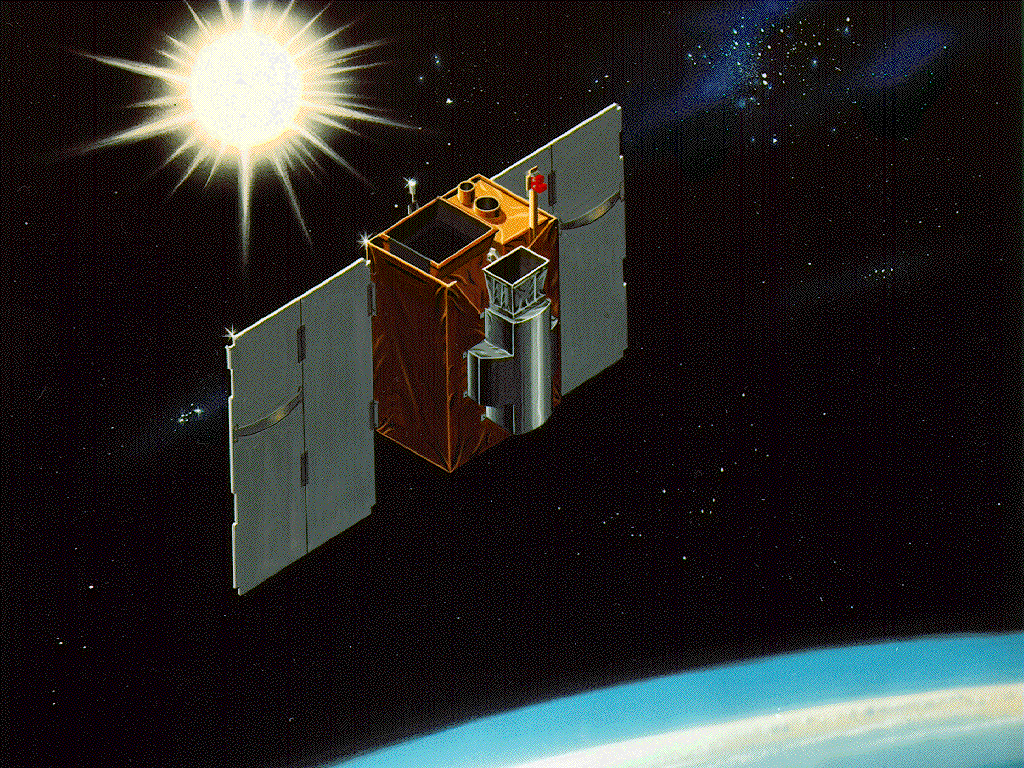
Image above: An artist's rendition of the Solar, Anomalous, and Magnetospheric Particle Explorer or SAMPEX. Credit: NASA.
NASA's very first small explorer, the Solar, Anomalous, and Magnetospheric Particle Explorer or SAMPEX, was launched July 3, 1992 to study the zoo of particles and cosmic rays surrounding Earth. Surviving much longer than its expected mission of three years and providing invaluable observations for those who study space weather, the SAMPEX mission is now almost over. In early November, the spacecraft's orbit will decay enough that it will re-enter Earth's atmosphere, burning up completely on re-entry. When SAMPEX launched, the sun was just finishing the peak of its 11-year solar cycle and beginning to move toward solar minimum. Scientists were eager to watch what happened in near-Earth space in those first few years, as eruptions on the sun shot out energy and solar material and eventually tapered down into a period of quiet. However, those same effects were also predicted to lead to the spacecraft's demise. As the sun once again ramped up to solar maximum around 2000, the sun's output would create enough atmospheric drag that SAMPEX was expected to tumble out of its stable orbit. Contrary to such predictions, SAMPEX is still in orbit having survived that maximum and continuing in orbit long enough to see the sun move toward another solar max, currently predicted for 2013. But time is running out. As the atmosphere near Earth heats and swells in response to the sun's activity, the expansion of the uppermost atmosphere has encased SAMPEX, slowing it down. Soon the 20-year-old spacecraft will succumb to the very space weather it has helped scientists to study. Some time at the end of 2012, the orbit of the five-by-three-foot craft will spiral far enough in that SAMPEX will re-enter Earth's atmosphere, burning up completely and disappearing forever. "SAMPEX was launched on a shoe string budget," says Shri Kanekal, a space weather scientist at NASA's Goddard Space Weather Center in Greenbelt, Md. who has been involved with SAMPEX research since its launch. "It was proposed as a minimum one-year mission with a goal of three years, but it lasted for an unexpectedly long time. It has provided 20 years of high quality data, used by nearly everyone who studies near-Earth space." In its two decades, SAMPEX provided one of the main sources of data on how the radiation environment around Earth changed over time, waxing and waning in response to incoming particles from the sun and galaxy.
Image above: SAMPEX data have provided some of the most useful observations of the Van Allen Belts -- two rings of radiation around Earth. This SAMPEX data shows the belts during what's known as the Halloween Storms in October 2003, a time when the radiation belts around Earth swelled so much that they merged into a single ring. Credit: NASA/Goddard Space Flight Center . 
SAMPEX confirmed earlier theories that cosmic rays streaming in from outer space were being trapped in Earth's own magnetic environment, the magnetosphere, and it helped pinpoint the location where they gathered in a belt around Earth. Another area of research has been to tease out the composition of various particle populations from high-speed and high-energy particles from the sun known as solar energetic particles, to the host of electrons in Earth's middle atmosphere. Also, SAMPEX has been one of our best eyes on the radiation belts – two giant donuts of radiation surrounding Earth that can affect satellites in orbit during their occasional bouts of swelling. Indeed, scientists are eager for SAMPEX data still, eking out the last weeks of observation time to compare with early data from the Radiation Belt Storm Probes (RBSP) mission that launched in August, 2012. When those who study the radiation belts realized how imminent was the demise of SAMPEX, they adjusted the schedule to turn on a SAMPEX-compatible instrument aboard RBSP, an instrument called Relativistic Electron Proton Telescope (REPT), earlier than planned. One of the space phenomena that SAMPEX has helped categorize is something called microbursts, an intense but short lived phase during which electrons drop out of the radiation belts. From its viewpoint under the radiation belts, SAMPEX can still record such microbursts. As part of RBSP, on the other hand, REPT can look at the electron population while traveling through the radiation belts proper. In combination, the data may help show what occurrences in the radiation belts correlate to the rain of electrons, the microbursts. "Since one of the main goals of RBSP is to understand why and how electrons rain down out of the radiation belts, this will be important science," says Kanekal. "It's made all the more impressive that we can do this kind of research despite the fact that SAMPEX's science mission officially ended in 2004." Although the spacecraft has remained in orbit, the official SAMPEX science mission ended in June 2004. New data remained available, however, thanks to The Aerospace Corporation of El Segundo, Calif., which continued to fund costs to download data, and to Bowie State University in Bowie, Md., which operated the spacecraft to maintain the download process as an educational tool for its students. Kanekal was also instrumental in getting a grant to process all the data from 2004 to 2012, so it will be usable by the science community. NASA's first small explorer had an impressive run, far outliving its planned three-year mission. It provided data crucial to understanding how the space around Earth responds to space weather from the sun and will continue to do so up until the moment it re-enters Earth's atmosphere, disappearing forever. NASA's SAMPEX Mission: http://science.nasa.gov/missions/sampex/, The SAMPEX Data Center: http://www.srl.caltech.edu/sampex/DataCenter/, Images (mentioned), Text, Credit: NASA Goddard Space Flight Center / Karen C. Fox., Greetings, Source: Orbiter.ch Space News
Read More........

Planet hunters found an exoplanet accompanied by four suns

Artistic rendering system 4 star KIC 4862625
A voluntary group of astronomers, using a website devoted to scientific astronomy, discovered an extrasolar planet orbiting four stars. This finding was subsequently confirmed by a second team of researchers. Barely a year ago, astronomers were not sure that planets could exist in a binary system of stars, where two stars orbit each other. But after the discovery of circumbinary exoplanet, which would be two suns in the sky (much like the famous Star Wars Tatooine) scientists have realized that these worlds are possible and found at least five other similar systems. About half of the stars in the universe are being a couple and if they can host planets then the chances of a life outside of our own world could be significantly increased. The new exoplanet orbiting within a 4 star, named KIC 4862625, approximately 3200 light years from Earth. Scientists "citizens" Jek Kian San Francisco and Robert Gagliano Cottonwood, Arizona, have used the site Planethunters.org to analyze the data of these stars captured by the Kepler space telescope NASA and have noticed a decrease in their periodic light (transit). 
The artistic rendering of PH1, with four suns exoplanet discoveries by planet hunters (Giguere / Yale / PA)
The data showed that the planet passed in front of its parent star, a binary pair, every 138 days, eclipsing their light. The planet has been nicknamed PH1 (Planet Hunters 1) and should be a gas giant with a radius of 6.2 times that of the Earth, which makes it a little bigger than Neptune, with a mass of roughly half that of Jupiter. Binary stars are about 1.5 and 0.41 times the mass of the sun and they turn around with a period of 20 days.The binary pairs of relatives PH1 in turn put into orbit by another binary pair of stars at a distance of 1000 times that between the Earth and the sun. If living beings could live on PH1, they do not just attend a double sunset, but they would also be able to identify two bright stars in their night sky, sailors among the stars. The work has been confirmed by astronomers at Yale University. It was presented October 15 at the Division of the American Astronomical Society for Planetary Sciences in Reno, Nevada and the study was published in the Astrophysical Journal: Planet Hunters: A Transiting Planet in a Circumbinary Quadruple Star System: http://arxiv.org/abs/1210.3612 In addition, an independent analysis conducted by Veselin Kostov of Johns Hopkins University, also found evidence of an exoplanet is in quadruple star system. Independent confirmation of a result is an important part of the scientific process and this is one of the fastest to confirm the presence of this planet a bit exotic. Kostov analysis corresponds very closely with the results of the Yale team, determining independently the mass and orbit of the exoplanet, despite having less data. The study will be published shortly on http://arxiv.org/. Related links: American Astronomical Society for Planetary Sciences: http://dps.aas.org/ Astrophysical Journal : Planet Hunters: A Transiting Circumbinary Planet in a Quadruple Star System:http://arxiv.org/abs/1210.3612 Astrophysical Journal: http://arxiv.org/, Images, Text, Credits: Planethunters.org / Giguere / PA / Johns Hopkins University / Yale University / American Astronomical Society for Planetary Sciences / Orbiter.ch. Cheers, Orbiter.ch, Source: Orbiter.ch Space News
Read More........

Bs in the Beehive

Astronomers have discovered two gas giant planets orbiting stars in the Beehive cluster, a collection of about 1,000 tightly packed stars. The planets are the first ever found around sun-like stars in a cluster of stars. Such planets, even though they are not habitable, would have skies filled with many bright stars as illustrated in this artist's concept. A gas giant planet is shown to the right of its sun-like star, and all
around, the stars of the Beehive cluster shine brightly in the dark. This image of the Beehive star cluster points out the location of its first known planets, Pr0201b and Pr0211b, or, as astronomers call them, the first 'b's' in the Beehive. The "open cluster," also called Praesepe, is a collection of about 1,000 stars all loosely bound together by gravity, located about 550 light-years away. The stars were born out of the same cloud and have remained together for the past 600 million years. Eventually, they will disperse and head out on their own. Astronomers found the planets Pr0201b and Pr0211b orbiting different sun-like stars in the cluster. The planets are both "hot Jupiters," which are gas giants like Jupiter but whip closely around their stars in just days. They are the first planets ever found around sun-like stars in a cluster, offering further proof that planets can sprout up in dense stellar environments. The Beehive cluster can be seen in dark northern skies in late winter or early spring with the naked eye. The stars themselves can be seen individually with the help of a telescope. Illustration credit: NASA/JPL-Caltech; image credit: Stuart Heggie, Note: For more information, see First Planets Found Around Sun-Like Stars in a Cluster.Source: Minex
Read More........

Interactive projections paint Europe’s walls with digital graffiti

A projector powered graffiti project that uses an infrared tracking device to create the illusion of digital content being painted on to a wall, is the subject of a Vimeo Award-winning video. Art collective, Sweatshoppe, scooped the 2012 award in the Captured category for a four-minute film detailing their Video Painting Europe project. The awards are designed to celebrate creativity with grants of $5,000 (€3,900)
Sweatshoppe saw off more than 14,000 entries from 147 countries to top their category the Captured category, which is described as honouring "a video that captures your own artistic expression or
performance as the subject". Awards were presented in New York City in a ceremony that also featured projection with a sound and motion-responsive, projection-mapped show, designed by arts and technology collective, seeper for the second year running. The winners were selected by panels of three judges per included category. Judges actor and director James Franco; Parks and Recreation star Aziz Ansari; 2012 Oscar Nominee Lucy Walker; Radiohead’s Colin Greenwood; Scott Pilgrim vs. the World director Edgar Wright; snowboard star Travis Rice; Thierry Mugler and UNIQLO creative director Nicola Formichetti; Shelley Page of DreamWorks Animation; and Barbara London of The Museum of Modern Art. Source: InAVate
Read More........

Possible Exoplanet UCF-1.01


Astronomers using NASA's Spitzer Space Telescope have detected what they believe is an alien world just two-thirds the size of Earth -- one of the smallest on record. The exoplanet candidate, known as UCF-1.01, orbits a star called GJ 436, which is located a mere 33 light-years away. UCF-1.01 might be the nearest world to our solar system that is smaller than our home planet. Although probably rocky in composition like Earth, UCF-1.01 would be a terrible place for life. The world orbits scorchingly close to its star, so in all likelihood this planet lacks an atmosphere and might even have a molten surface, as shown in this artist's impression. Evidence for UCF-1.01 turned up when astronomers were studying a known, Neptune-sized exoplanet, called GJ 436b, seen in the background in this image. The identification of nearby small planets may lead to their characterization using future instruments. In this way, worlds like UCF-1.01 might serve as stepping stones to one day finding a habitable, Earth-like exoplanet. Because of GJ 436's proximity to our solar system, the star field around it shares many of our culture's famous cosmic landmarks. To the far left, the constellation of Orion gleams, though in a distorted shape compared to our vantage point on Earth. The red giant Betelgeuse (Orion's right shoulder) and blue Rigel (Orion's left foot) stand out, as well as the three belt stars. From GJ 436's perspective, however, the stars do not align as they do in our sky. The Pleiades star cluster is located to the upper left of UCF-1.01. The artist's animation depicts a Star Trek-like voyage out to GJ 436, finished with a flyby of UCF-1.01. Starting from Earth, we quickly zoom out of the solar system into our sun's local neighborhood, populated by the closest stars that lie within a few light-years of Earth. Swinging around, we shift our attention to the dwarf star GJ 436, which is so faint that it is invisible to us until we get close enough to see its dim glow. From here we move into the GJ 436 system, at first seeing the candidate planet UCF-1.01 as it transits its star. Although probably rocky in composition like Earth, UCF-1.01 would be a terrible place for life. The world orbits scorchingly close to its star, so in all likelihood this planet lacks an atmosphere and might even have a molten surface, as shown in this animation. Near the end of the movie, a Neptune-sized exoplanet already known to exist around GJ 436, designated GJ 436b, appears in the background. Evidence for UCF-1.01 turned up when astronomers were studying this previously known world. Photo credit: NASA/JPL-Caltech, Note: For more information, see Spitzer Finds Possible Exoplanet Smaller Than Earth. To see the movie, click here.Source: Minsex
Read More........

Now Robot artist to sketches portraits


Even the most dedicated techie can have an artistic streak - and that includes robots. And at CeBIT in Hanover next month, delegates are being offered the chance to have their portrait drawn by an industrial robot. The Fraunhofer robot first takes a good look at its model via its camera, then uses a pencil to knock out a sketch in about ten minutes. Edge-processing software seeks out the contrasts in the image and translates these into movements of the robot’s arm. The main difficulty, says the team, was to adjust the algorithm for image processing so that the robot would overlook tiny wrinkles but still render the eyes - and deliver something that looked like a human-drawn portrait. "We attach great importance to the artistic look of the drawings that results, but on the other hand, we have also equipped the robot with an automatic system that enables it to carry out all of the steps itself," says Martina Richter, a scientist at the Fraunhofer Institute for Optronics, System Technologies and Image Exploitation IOSB. "With this installation, we have created an interface between art, science and technology." For the robot, though, art is more of a hobby. It's normally used by IOSBresearchers to analyze the optical reflection properties of various materials. The robot’s arm circles a sample such as a a reflector of the kind mounted on children’s school bags, measuring how the object reflects light. This helps design reflectors so that they return light in the most bundled way possible to the direction from which it comes – to a car driver, for instance. Then the reflector emits a bright flash that draws the driver’s attention to the child. Source: The Ultimate Update
Read More........