Docomo turns surfaces interactive with smart glasses

Docomo showed off a Google Glass rival that transforms any surface into a touchscreen at Japan's Ceatec show last week. The company demonstrated a number of applications including manipulation of virtual content on any surface using the 'intelligent-glasses' and a ring sensor. Ceatec ran from October 1 to 5, 2013 at the Makuhari Messe convention center outside Tokyo.
Other uses on show included facial recognition capabilities, which pulled up relevant profile information on the person being viewed and character recognition enabling instant language translation. Technology news site Slashgear reported on the technology showcased at  the mobile industry trade show, posting
the video featured above. The concept builds on existing Docomo developments. At last year’s Ceatec show Docomo demonstrated. glasses that enabled hands-free video callingSource: InAVate
Read More........

New Honda 'Asimo' Robot Now Smarter, Faster

Asimo at Disneyland    
.Subscribe
Honda's human - shaped  robot  can  now run  faster,  balance  itself  on  uneven surfaces, hop on one foot and pour a drink. Some of its technology may even be used to help out with clean-up operations at the stricken Fukushima nuclear plant. Honda's demonstration of the revamped "Asimo" on Tuesday at its Tokyo suburban research facility was not only to prove that the bubble-headed childlike machine was  more  limber and  a  bit  smarter. It was a way to try to answer some critics that Asimo, first shown in 2000, had been of little practical use so far, proving to be nothing more than a glorified toy and cute showcase for the Honda Motor Co. brand. Honda President Takanobu Ito told reporters some of Asimo's technology was used to develop a robotic arm in just six months with the intention of helping with the nuclear crisis in northeastern Japan. The mechanical arm can open and close valves  at  Fukushima Dai - ichi  nuclear  power  plant, which went  into meltdown after the March tsunami, according to Honda. The automaker is working with the utility behind the problem plant, Tokyo Electric Power Co., to try to meet demands to bring the plant under control. Ito acknowledged that the first idea was to send in Asimo to help out, but that was not possible because the robot cannot maneuver in rubble, and its delicate computer parts would malfunction in radiation. But in Tuesday's demonstration, Asimo was able to walk without falling over 2 centimeter (0.8 inch) padded bumps on the floor. It can also now jog faster than itdid in 2005, at 9 kilometers per hour (5.6 mph), instead of the earlier 6 kph (3.7 mph), pushing better with its toes so its run was smoother and not as jerky. Asimo was also able to distinguish the voices of three people spoken at once, using face recognition and analyzing sound, to figure out that one woman wanted hot coffee, another orange juice, and still another milk tea. The new Asimo got improved hands as well, allowing individual movement of each finger, so it could do sign language. "My name is Asimo," it said, making the signs of its words with stubby fingers. It also opened a thermos bottle and gracefully poured juice into a paper cup. Ito said Asimo had developed autonomous artificial intelligence so that it could potentially maneuver itself through crowds of people, without remote control or stopping each time to check on its programming. But he acknowledged that making robotics into a practical business will take more time, meaning Asimo wasn't about to show up in any home soon. "Maybe at the start this was a dream of engineers to make a machine that was close to a human being, like Astro Boy," he said. "We think Asimo is good." Other manufacturers are also developing robots, eager to cash in on the expected needs of Japan's rapidly aging population. Toyota Motor Corp., Japan's top automaker which makes the Prius hybrid and Lexus luxury models, is among those to have jumped on the robotics bandwagon. In the past, it has shown robots that can play the violin and talk like receptionists. Last week, it showed a computerized device that latches on to the body to help old or sick people walk and keep balance. Honda, which makes the Odyssey minivan and Accord sedan, has developed similar brace-like gadgets to help people get about. Neither the Toyota nor Honda product is on sale yet. Still, experts say such research is important to keep up. "Maybe it can't be put to use right away, but it is definitely a technology that we should keep working on to advance," Hiroshi Kobayashi, a mechanical engineering professor at Tokyo University of Science, said of the new Asimo. "It is common for what we achieve in research to turn out later to lead to many products," said Kobayashi, who has developed experimental robots. 
Read More........

First Footage of Giant Squid Airing This Sunday On Discovery Channel

The legendary Giant Squid has finally been caught on tape. For centuries, there have been stories of the great Kraken in Scandinavia and legends of it attacking ships. Once thought to be a myth, we now have evidence of the creature, not only has there been evidence of the creature tangled up in fishing nets and
washed ashore, scientists now have HD footage of the creature that was filmed during a six-week expedition 550 miles south of Tokyo back in June of 2012. The first video footage of a giant squid in its natural habitat will air this Sunday on the Discovery Channel in Monster Squid: The Giant is Real. Source: Bigfoot Evidence

Read More........

The peculiar 3D model which allows parents to hold their baby... BEFORE it's even born

Expectant parents in Japan who can't wait to show the world what their baby will look like can now buy a 3D model of the foetus
Expectant parents who cannot wait to hold their new child can now buy a three-dimensional model of the foetus to cradle and show friends. Japanese inventors have devised a way to transform the commonplace ultrasound scan into an anatomically correct resin replica for parents to handle and keep as a memento. The nine-centimetre (3.6-inch) resin model of the white foetus, encased in a transparent block in the shape of the mother's body, is fashioned by a 3D printer after an MRI scan. FASOTEC, the company offering the 'Shape of an Angel' model, even offers parents a miniature version which could be a 'nice adornment to a mobile phone strap or key chain.' Tomohiro Kinoshita, of FASOTEC, said: 'As it is only once in a lifetime that you are pregnant with that child, we received requests for these kind of models from pregnant women who... do not want to forget the feelings and experience of that time.' The 'Shape of an
3D model of their unborn child's face
Angel' costs 100,000 yen (or around £760), and the company said the ideal time for a scan is around eight or nine months into the pregnancy. For those who would like a less pricey version, the company will start offering a 3D model of the face of the foetus at 50,000 yen - £380 - in December. It will use ultrasound images taken at a medical clinic in Tokyo that has forged a tie-up with the company. FASOTEC, originally a supplier of devices including 3D printers, uses a layering technique to build up three-dimensional structures. The company also produces 3D models of internal organs that can be used by doctors to plan surgery or by medical students for training, a spokesman said. It is also possible that models can be used in hospitals to better inform patients what their problems are, instead of relying on difficult-to-understand diagrams. The technology 'realises not only the form but also texture of the model -- for example making it hard or soft', the firm said . 'By making a model that is similar to a real organ or bone, one can simulate operations and practise different surgical techniques.' Kinoshita said the company hit upon the idea of making 3D models of unborn babies in the hope that people would become more aware of the technology. But there are medical benefits too. The company said some medics could also foresee diagnostic possibilities with the models that may help predict difficulties in the birthing process. Three-dimensional printers have been around for several decades but advances in the technology mean it is now gaining in popularity in several fields. The machines work in a similar way to an inkjet printer, but instead of ink they deposit layers of material on top of each other, gradually building up the product they are making. Where traditional manufacturing only becomes efficient with economies of scale because of the need to produce moulds, 3D printing is capable of producing single copies of relatively complicated objects. The technology is not yet advanced enough to build telephones or computers but it is already used to make components. Source: Ananta-Tec
Read More........

Soon, car that can drive and park itself

nissan-nsc-2015-self-driving-car An electric car that is able to park itself and come to the driver when 'called' has been launched at the Ceatec 2012 show in Tokyo - Agencies
An electric car that is able to park itself and come to the driver when 'called' has been launched at the Ceatec 2012 show in Tokyo. Nissan's NSC-2015 is only a prototype, but its name suggests that the carmaker aims to have it on the market by 2015, the BBC reported. Many car companies have been working on autonomous technology, with a number of driverless cars unveiled in recent months. But one analyst warned that the mass use of such cars was a long way off. The NSC-2015 is a modified version of Nissan's Leaf model. It relies on sensors, cameras, computers and 4G communication technology for wireless links to navigate, and robotics to turn the steering wheel, change gears and brake. When demonstrated at Ceatec, the car drove itself at about 3mph (5km/h) in a straight line forward and in reverse, and was able to turn. It was shown that the car could recognise road markings and was able to stop at a crossing. A Nissan representative also controlled the car from the outside, making it drive towards him, as he pressed some buttons on his phone. "After the driver exits the NSC-2015, it starts to park itself automatically, following the instructions given by smartphone," the company said. "The vehicle looks for a vacant parking space while identifying its surroundings; once it detects an open parking space automated parking begins. "The driver can also use smartphone commands to make the NSC-2015 vehicle leave the parking space and return to the place where he or she is," the company said. The car's security camera system automatically works with a camera installed in the vehicle. If the system detects suspicious behaviour, the driver is alerted automatically by a report to his or her smartphone. Source: Deccan ChronicleImage: flickr.com
Read More........

All-rubber speaker is both thin and bassy

Screen Shot On Uploaded Video
Tokyo Rubber Industries has developed what it believes to be the world’s first all rubber loudspeaker. The device consists of a non-conductive rubber layer, sandwiched between two conductive layers of so-called
smart rubber. The conductive layers expand and contract when a current is applied, deforming the non-conductive layer to create the plane movement required to generate sound waves in the air. Source: InAVate
Read More........

Poo powered motorcycle kicking up a stink in Japan


The bike runs on bio-fuel from the discharge of livestock or waste water (Picture: AP Photo/Koji Sasahara)

An eco-friendly motorbike powered by poo has been kicking up a stink across Japan after being unveiled this week. Created by Japan's leading toilet makers TOTO, the energy efficient bike certainly meets the motor industry's demand for more climate friendly vehicles. Talks to turn the ambitious project into reality have been on-going since 2009, with the latest version of the 'Toilet Bike Neo' making its debut at s showroom in Fujisawa, near Tokyo, on Thursday. The environmentally friendly three-wheel 250cc motorcycle features a specially customised toilet-shaped seat that runs on bio-fuel from the discharge of livestock or waste water. Despite the eye-catching seat, TOTO is keen to point out that the motorcycle does actually not run on the rider's waste. 'Toilet Bike Neo' does not have the mechanism to run on the rider's waste,' explained the company in a blog post. 'It runs biogas fuel (fertilised, purified and compressed livestock waste and household wastewater) provided by Shika-oi Town in Hokkaido and Kobe city. 'Therefore, the Neo rest seat does not function as a toilet, and has been created for promoting TOTO's environmental efforts. 'TOTO has set up the project to inform everyone about what we have done in the past, and what we will do in the future. 'Source: SAM Daily Times
Read More........

A weekend of protests over environmental concerns

Anti-fracking protestors march in Washington, D.C. 
There were at least four major protests this weekend targeting fracking, nuclear power, pollution, and mountaintop-removal mining. There was Saturday’s banjo-festooned fracking protest in Washington, D.C. It was called “Stop the Frack Attack,” and it called on politicians to stop the frack attack. Some estimates suggest that 5,000 people participated in the action; UPI asked a pro-fracking guy how many were there and he said that he heard 1,500 from a cop, so UPI went with 1,500. There were also protests in Japan and China. Earlier this month, some 100,000 people rallied in Tokyo to try and prevent a nuclear generator from being turned back on. Over the weekend, tens of thousands more marched outside of Parliament with the same aim: calling on the prime minister to halt the use of nuclear power. In Qidong, China, a huge protest halted plans to run a wastewater pipeline from a paper plant into the ocean. The pipeline that residents fear will pollute their water will not be built, the government promised on the Qidong police micro-blog and the website of Nantong city, which oversees Qidong. This apparent victory for residents follows another one this month when protesters in the southwest city of Shifang, in Sichuan province, forced officials to scrap a planned copper refinery. A large demonstration halted a petrochemicals plant in Dalian, in eastern China, last year. Environmental experts cheer the growing rights awareness among China’s citizens that forced the Qidong decision, but they caution that China will face many more such protests unless the government overhauls its opaque decision-making process and allows the public to participate. And finally: A protest in Lincoln County, W. Va. — in the region heavily impacted by mountaintop-removal mining — shut down one mine for three hours on Saturday. Twenty protestors were taken to jail. A press release from the group behind the action, RAMPS, explained what happened: More than 50 protesters affiliated with the R.A.M.P.S. Campaign have walked onto Patriot Coal’s Hobet mine and shut it down. Ten people locked to a rock truck, boarded it and dropped banners: “Coal Leaves, Cancer Stays.” At least three have been arrested [Editor's note: This figure was preliminary] with another in a tree being threatened by miners with a chain saw. Earlier in the day, two people were arrested at Kanawha State Forest before a group of protesters headed to the state capitol Patriot Coal, the parent company of the mine, recently filed for bankruptcy. So that’s good news, anyway. And that was your “What Protests Happened Over the Weekend?” Source: Sam Daily Times
Read More........

Baldness can be cured using stem cells


Are you bald and having trouble facing people? If yes your worries are over as Japanese researchers have successfully grown hair on hairless mice by implanting follicles created from stem cells, they announced Wednesday, sparking new hopes of a cure for baldness.Led by Professor Takashi Tsuji from Tokyo University of Science, the team bioengineered hair follicles and transplanted them into the skin of hairless mice. The creatures eventually grew hair, which continued regenerating in normal growth cycles after old hairs fell out. When stem cells are grown into tissues or organs, they usually need to be extracted from embryos, but Tsuji and his researchers found hair follicles can be grown with adult stem cells, the study said. Baldness can now be cured “Our current study thus demonstrates the potential for not only hair regeneration therapy but also the realization of bioengineered organ replacement using adult somatic stem cells,” it said. The combination of the new and existing technologies is expected to improve treatment for baldness, possibly allowing people to use their own cells for implants that will give them their hair back. “We would like to start clinical research within three to five years, so that an actual treatment to general patients can start within a decade,” said researcher Koh-ei Toyoshima.The Ultimate Update: Baldness can be cured using stem cells
Read More........

Japanese scientists create first swimming robot


Swimming RobotDon't be amazed if organisers have to spot check for Japanese robots clinching the swimming medals at the next Olympics. For a team at the Tokyo University of Technology has created a 'Swumanoid' robot using a 3D scanner to perfectly map a human swimmer's physique, which has perfected the back-stroke and tries freestyle swimming. Apart from life-saving ambitions, the Swumanoid can be useful in helping research into swimming. The team, led by associate professor Motomu Nakashima, hopes that eventually robots like the Swumanoid can act as robot lifeguards, patrolling our shores and helping swimmers in distress, the 'Daily Mail' reported. It is difficult to secure motion-sensing pads to swimmers in the water, and it is also difficult for swimmers to perfectly repeat repetitive actions over and over. Swumanoids can do this well, helping researchers measure various elements like the force required to propel swimmers through the water. The research team created Swumanoid by using a 3D scanner to perfectly map a human swimmer's physique. These measurements were used to create the robot, with 20 waterproof, computer-controlled motors providing the swimming motion. The robot can currently swim the backstroke and the front crawl, but he will need a new pair of legs before he can tackle the breast-stroke. However, with a pace of six metres per second, Swumanoid swims at just a third of the fastest human world record. Source: Indian Express
Read More........

Honda to recycle rare earths to be green


TOKYO — Honda Motor Co said Wednesday it will start recycling rare earths and other key materials in hybrid auto batteries this year—a key innovation in the Japanese automaker’s effort to be green. Japan is dependent on imports, mostly from China, for rare earth elements, which are essential for making high-tech products, but a steady supply has been periodically threatened over political disputes with China. Honda officials said the company was targeting September or October to begin recycling of rare earths. They said it would be a first for the auto industry. Honda President Takanobu Ito said: “In the long term, we hope to move to renewable energy sources that won’t harm the environment.” Ito outlined Honda’s efforts to reduce pollution and global warming, including experimental projects to combine solar with its fuel-cell cars—what he called the Honda “dream” to derive energy solely from nature and emit just water. Fuel cells are powered by the energy created when hydrogen combines with oxygen to produce water. They are still too expensive for commercial use and remain experimental. Ito said Honda’s roots lie in its determination to develop a fuel-efficient gasoline engine to clear U.S. pollution-control regulations of the 1970s. Honda’s CVCC engine was the first in the world to clear the standard. Japan later adopted similar pollution regulations. Honda recovered from last year's earthquake and tsunami, which disrupted the supply of auto parts and sent sales plunging. January-March profit rose 61% from the previous year, and it’s projecting record global sales of 4.3 million vehicles for this fiscal year.Source: Sam Daily Times
Read More........

Projecting onto bubbles opens doors for interactive, 3D, flexible displays


Images and film have been projected onto bubbles in a move that could have a significant effect on the live events and visitor attraction industries. Soap film, used by a researcher at the University of Tokyo, is being dubbed as the world's thinnest screen and could be employed to create illusionary-type images, similar to those produced using the Pepper's ghost technique Yoichi Ochiai, from the University of Tokyo has worked
Read More........

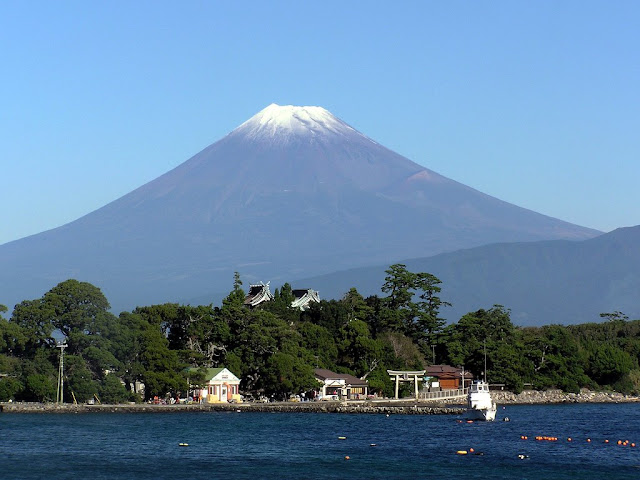
Mount Fuji, Japan's Highest Mountain

Mount Fuji capped wit snow
.Subscribe

Mount Fuji capped wit snow (Source)
At 3,776 meters (12,388 ft), Mount Fuji is Japan's Highest Mountain. It stands on the border between Yamanashi and Shizuoka Prefectures and can be seen from Tokyo and Yokohama on clear days. It is
located near the Pacific coast of central HonshÅ«. There are three small cities surrounding it: Gotemba (south), Fujiyoshida (north) and Fujinomiya (southwest). Although it's last eruption was in 1708, MountMount Fuji view from an airplane
Mount Fuji view from an airplane (Source)
Fuji is an active stratovolcano volcano. This nearly perfectly shaped volcano has been worshiped as a sacred mountain and experienced big popularity among artists, common people and tourists. Mount Fuji Mount Fuji from Osezaki beach

Mount Fuji from Osezaki beach (Source)
is surrounded by five lakes: Lake Kawaguchi, Lake Yamanaka, Lake Sai, Lake Motosu and Lake Shoji. The climate is very cold due to thealtitude and the cone is covered by snow for several months of the year. The lowest recorded temperature is −38.0 °C while on June 2008 the highesttemperature was recorded at 17.8 °C.Mount Fuji, Japan's Highest Mountain
Read More........

The Digital Future Of A Hotel Stay

Sam Daily Times: Our modern age is defined by our technology and how it's become a part of our day-to-day lives, yet when traveling hotels have struggled to keep up. Everyone from business travelers to the common vacationer has their life somehow linked to digital technology with iPods, smart phones, tablets, and laptops. Hotels, amazingly, are slow to offer a way for guests to plug-in and integrate with the hotel. Even something as simple as internet access is difficult to get without being charged a princely sum. Amazing because internet access is something that is freely available at coffee shops like Starbucks or even McDonald's now offers free internet access at many of their locations. However, some hotels are beginning to change by providing more ways for guests to plug-in. There may be a day very soon were guests could have a complete stay from making a reservation to ordering room service to receiving their checkout receipt without speaking to a single real person. They can achieve this completely by digital means.There are a couple of reasons for this change of attitude among hotels. One reason is that a hotel or a hotel chain can really stand out in the market by offering new and appealing technologies to their guests. A second reason is that early adopters of technology are an appealing demographic for hotels, not only because of their economic affluence but also their propensity to tell others practically immediately about their stay. A hotel with a significant technological component for the geek-set would be reason enough for them to brag across all social media platforms about their hotel stay.Social media is a great equalizer that both the large chain hotels and the small independently owned bed and breakfast can use. Consider how a guest can put up their own pictures from their smart phones onto Pinterest bragging about their stay. Or another guest tweeting in real-time how they are on Twitter using the hotel room's multiple monitors. Immediate word-of-mouth. An Example at Check-in: Taking concierge service into the digital age a pair of boutique hotels in New York are greeting guests at the door with an iPad carrying greeter. Using the iPad the hotel greeter is able to check-in guests and create room keys either in the lobby or in transit to the room. Not only does this service enable a more friendly and relaxed check-in, it also introduces the guests to the person who will be acting as their concierge for their stay. The greeter/concierge is easily made available by texting. One hotel in Hong Kong is doing away with people altogether. Check-in actually starts when they are picked up at the airport. The shuttle vehicle is equipped with internet access where people can both check-in and checkout without paper and without people. While these are just a few remote examples, they are a snapshot of the future of the hotel stay. An Example of a Room Key: One Las Vegas hotel is differentiating itself by providing keys that operate by using a sensor. While this is not new technology, as people have been "badging-in" at work for years now. The use of sensor keys as an access control to a person's hotel room is a new use of this technology. However, this being Las Vegas, the hotel does do some unique one-upmanship with it. As a person enters a room for the first time using the key, the room will turn on the lights, open the curtains, and turn on the television automatically. The television turns onto a list of controls that the guest can personalize for their stay. Also, the hotel not only offers but brags about its free internet access (or at least included in their room rate) which can be up to eight times faster than the other Vegas hotels. An Example of Entertainment in the Room: An upscale chain hotel in Seoul is providing a way for guests to plug in their equipment to the hotel room's audio and video systems at a single location. Then their video or music files can be controlled through the room's large screen televisions. Even one's laptop can be plugged into the system. This provides the ultimate of personalized entertainment, entertainment that the guest brought with them. A London hotel provides charging stations in the room's walls, but its true differentiator is that it gives guest an iPod 2 to use in the room. Also, the rooms come with 3D Blu-ray systems for the large screen 3D television. Of course, 3D specs are provided in the room for the television. Continuing that theme, the hotel also has a 103 inch 3D screen in the hotel bar with specs available there too. An Example of Things to Do: A hotel in Tokyo realizes that people come to stay in hotels but want activity outside it. Actually, hotels have known this for some time because ever hotel tries to tout its proximity to popular local attractions. So, in the digital age this Tokyo hotel provides walking tours of the surrounding neighborhoods via iPod. It even provides an iPod tour of the hotel's 1000 piece art collection. Should someone not have an iPod, then they can get one provided by the hotel. An Example of Reservations: One major US-based hotel chain is growing its app presence in the smart phone market, like those for the iPhone or Android phones. Their smart phone app lets people check for the closest hotels, availability, and the rates for those available rooms. This helps them gain more regular customers who will use the app for last minute reservations. Last minute reservations are actually growing as people are learning they can check for hotel availability from their digital devices (and often score the best rates for a last minute reservation). The app also helps those last minute users loyal to the chain. Source: Sam Daily Times
Read More........

Now, a device to communicate with dolphins

Dolphin Encounter 2008
Scientists have developed a new dolphin speaker device which they say could help one talk with these remarkably intelligent mammals. Dolphins live in a world of sound far beyond our own. They can distinguish very small differences in the pitches of sound waves and can hear, and generate low-frequency sounds below 20 khz, as well as high-frequency sounds of over 150 khz, which is well beyond the range of human hearing. In addition, they produce special sounds to communicate with others and to scan their surroundings and prey in the dark sea (called echolocation). Acoustic research of dolphins to date has mostly focused on recording their sounds and measuring their hearing skills. Few audio playback experiments have been attempted, since it's difficult to find speakers that can project from a wide range of low to high frequencies like dolphins do. Now, scientists in Japan have devised a prototype dolphin speaker that can project the full range of all of the sounds the mammals make -- from those used in communication to echolocation clicks. To develop the device, the researchers used piezoelectric components that convert electricity into physical movement and vice versa. These components were capable of broadcasting both high-frequency and low-frequency sounds. They precisely tailored the sizes of these components and the acrylic disk to create an extremely broad range of sounds. “I am happy if we can communicate with dolphins using the dolphin speaker,” lead researcher Yuka Mishima of the Tokyo University of Marine Science and Technology told LiveScience. The dolphin speaker, which was developed just a few weeks ago, has not been tested yet. Mishima and colleagues plan to work with such scientists using the new speaker. The idea is to broadcast specific series of vocalisations and then record the responses; over time, this back and forth could someday both reveal what dolphins are 'saying' and allow possible human-dolphin communication, the researchers detailed at Acoustical Society of America meeting in Hong Kong. “We know very little about how dolphins classify their own sounds -- we need more perceptual studies to find out, and this equipment may help us do that,” said Heidi Harley of New College of Florida in Sarasota who wasn't involved in the new research. As to whether or not this invention could one day result in a human-dolphin translator device, “I think we have a lot to learn about dolphin vocalisations -- their productions are complex, Harley said. “There is still a lot of basic perceptual and acoustic analysis that needs to be done before we can make strong claims about how dolphins are using their vocalisations,” he added. Image Link Flickr, Source: Indian Express
Read More........

Stem cells can be used to grow new teeth!! exciting news

The Ultimate Update: Scientists from Japan recently published a paper that details how they successfully grew new teeth from the stem cells of mice. According to MedicalXPress the researcCh paper describing their successful growth and transplantation of the new teeth was published in the open access journal PLoS One. Takashi Tsuji from Tokyo University of Science and his colleagues removed two different stem cells from the molar teeth of mice to build these teeth. They transported these cells to a laboratory where they could grow. To influence how the teeth grew in relation to size and shape, the cells were put inside of a mold to grow. When the cells developed into full tooth units, the researchers then placed them into the jaws of one-month-old mice. The transplanted choppers attachedthemselves to the jaw bones and tissues on an average of about 40 days. They also saw that nerve fibers had begun growing in the engineered teeth. Even better, the mice that were given the stem cell teeth had no problems chewing and eating like they normally would. Tsuji hopes that this development will eventually lead to growing human organs from stem cells. Scientists cannot currently make full organs outside of a human body. Tsuji maintains that the right stem cells must be used for building and repairingparts of the human body. Scientists think that in the future we will be able to make stem cell teeth for people. That way we can replace the teeth we lose in bar fights video game accidents.The best part about this whole development is that people who are interested in the regeneration of teeth in mice using stems cells can read the complete research paper online.After all, what good is a scientific development if people can’t read about it because of outdated pay walls?Source: The Ultimate Update
Read More........

How planes of the future might look


Bisarbeat: Engineers have developed a concept plane which they believe, might be similar to passenger planes in 40 years time. However in the past futurologists have been wide of the mark, with predictions of jet packs, flying cars, and cities in the sky. Rajan Datar investigates whether, in the year 2050, we are really likely to be flying in transparent aeroplanes powered by solar energy. Apart from evolutionary improvements in conventional aircraft, revolutionary changes are possible when the "rules" are changed. This is possible when the configuration concept iteself is changed and when new roles or requirements are introduced. The following details give some idea of the range of concepts that have been studied over the past few years, some of which are currently being pursued by NASA and industry. Blended Wing Body  The BWB design is intended to improve airplane efficiency through a major change in the airframe configuration. The thick centerbody accommodates passengers and cargo without the extra wetted area and weight of a fuselage. Orginally designed as a very large aircraft with as many as 800 passengers, versions of the BWB has been designed with as few as 250 passengers and more conventional twin, podded engines. Joined Wing
The joined wing design was developed principally by Dr. Julian Wolkovitch in the 1980's as an efficient structural arrangement in which the horizontal tail was used as a sturcural support for the main wing as well as a stabilizing surface. It is currently being considered for application to high altitiude long endurance UAVs.
Oblique Flying Wing One of the most unusual concepts for passenger flight is the oblique wing, studied by Robert T. Jones at NASA from 1945 through the 1990s. Theoretical considerations suggest that the concept is well suited to low drag supersonic flight, while providing a structurally efficient means of achieving variable geometry. Airbus has revealed concept photos of its vision of what a passenger jet might look like in 2050. Now the futurists Airbus have turned their attention to inflight entertainment and the cabin experience for passengers in such jets.
The "biomimetic" frame of the Airbus Concept Plane, as it is known, is inspired by the super-lightweight bones of birds - though the company isn't quite sure yet what it might make this bone-inspired material from. Airbus cabin designer Tobias Mayer says it could be a 3D-printed - and largely hollow - titanium based material that the firm's parent, EADS, is becoming adept at manufacturing at its Additive Layer Manufacturing lab in Filton, UK. With a criss-cross structure it will supposedly allow some kind of bird-strike-resistant dimmable glass to be used as the exterior skin - giving passengers the astonishing ability to see everything outside.
Airbus envisages its plane having many different zones - because by 2050 budget air travel will have been abolished (along with economy seats) - and there'll be no more squeezing-as- many-seats-in-as-possible. "Passengers in 2050 could join an interactive conference, enjoy a game of virtual golf, or read the kids back home a bedtime story whilst watching the planet spread out beneath their feet,".
It doesn't end there. Morphing seats will sense the tension in your body using an intelligent neural network, allowing the seat to morph and conform to your body shape - and no matter how obese the population gets by 2050, these seats will be able to cope, Airbus promises. You'll get "vitamin and antioxidant-enriched air, mood lighting, aromatherapy and acupressure treatments".
New Roles and Requirements In addition to new configuration ideas, new roles and requirements for aircrafrt may lead to new aircraft concepts. Some of these are summarized below.Pacific Rim Travel As global commerce continues to increase, the need for passenger and cargo transportation grows as well. Many have speculated that growth in pacific rim travel may be the impetus for high speed aircraft development. The time required for flight from Los Angeles to Tokyo varies with cruise Mach number. (The somewhat facetious Mach 8 aircraft requires extra time to cool off before passengers can deplane.)
Supersonic transportation (Boeing High Speed Civil Transport Concept)
Ground Effect Cargo Tranport Concept
Vehicles designed for missions other than carrying passengers include military aircraft with new constraints on radar detection (low observables), very high altitude aircraft, such as the Helios solar powered aircraft intended for atmospheric science and earth observation studies, and vehicles such as the Proteus, designed as a communications platform.
Low Observables (B2 Bomber)
Autonomous Air Vehicles (Pathfinder: a prototype for Helios solar UAV)
Halo Autonomous Air Vehicle for Communications Services (an AeroSat)
Finally a new class of air vehicles intended to provide lower cost access to space is under study. The near-term future of such designs depends on the economic health of the commercial space enterprise and it presently appears that these concepts are not likely to be seen soon.
Access to Space
Conclusions: (1) Improved understanding and analysis capabilities permit continued improvement in aircraft designs (2) Exploiting new technologies can change the rules of the game, permitting very different solutions (3) New objectives and constraints may require unconventional configurations (4) Future progress requires unprecedented communication among aircraft designers, scientists, and computational specialists. Source: Bisarbeat
Read More........