Preliminary conclusions: damage to the spacecraft "Progress MS-21" caused by external influence

The State Commission continues to analyze emergency situations with the Soyuz MS-22 manned spacecraft and Progress MS-21 cargo spacecraft that occurred on the International Space Station. The Soyuz MS-23 unmanned spacecraft will be launched to the station on February 24.

Survey of the outer surface of the Progress MS-21 cargo spacecraft

After undocking from the ISS on February 18, a detailed photo and video survey of the Progress MS-21 spacecraft was carried out.

According to preliminary data from the Rocket and Space Corporation Energia named after S.P. Korolev (part of the Roscosmos State Corporation), Progress MS-21, like Soyuz MS-22 before, was subjected to external influence. Such conclusions are made on the basis of photographs that show changes on the outer surface of the ship, including on the radiator of the instrument-aggregate compartment and solar panels. Holes were found on them that were not fixed either during the manufacture of Progress MS-21 at the plant, or during its preparation for launch at the Baikonur Cosmodrome, or during the flight and docking of the spacecraft with the ISS.

In addition, in order to exclude the version of a manufacturing defect, RSC Energia analyzed the history of comments on the thermal control system of the Soyuz and Progress spacecraft over the past 15 years.

“Remarks that could lead to such an emergency situation were not identified. The reliability reserve of the thermal control system is one year from the date of launch of the ship, so the system is guaranteed to be reliable in the design conditions of its operation,” follows from the report of the enterprise.
Image above: Photographs that show changes on the outer surface of the Progress MS-21 cargo spacecraft.

Experts continue to analyze the information received. It is also planned to conduct a series of ground experiments to simulate damage similar to what was detected on the Progress MS-21. This will help to finally check all versions and develop measures to counter such threats in the development and production of spacecraft and vehicles.

The information received allowed the state commission to decide on the possibility of an unmanned launch of the Soyuz MS-23 spacecraft on February 24 and its docking to the ISS on February 26. This ship is designed to replace the emergency Soyuz MS-22, the regular return to Earth of the crew consisting of Roscosmos cosmonauts Sergei Prokopiev, Dmitry Petelin and NASA astronaut Frank Rubio, as well as their urgent descent in case of an emergency.
Read More........

Hubble captures the start of a new 'spoke' season of Saturn: NASA

FEB 14, 2023 In a latest image of Saturn captured by National Aeronautics and Space Administration's (NASA's) Hubble Space Telescope, the appearance of spokes on the planet's rings heralded the start of a new 'spoke' season, according to a statement by NASA. Scientists will be looking for clues to explain the cause and nature of the spokes, the statement said. The suspected culprit for the spokes is the planet's variable magnetic field, the statement said. Planetary magnetic fields interact with the solar wind, creating an electrically charged environment. On Earth, when those charged particles hit the atmosphere this is visible in the northern hemisphere as the aurora borealis, or northern lights, NASA said. Scientists think that the smallest, dust-sized icy ring particles can become charged as well, which temporarily levitates those particles above the rest of the larger icy particles and boulders in the rings, NASA said. Like Earth, Saturn is tilted on its axis and therefore has four seasons, though because of Saturn's much larger orbit, each season lasts approximately seven Earth years, the space agency said. Equinox occurs when the rings are tilted edge-on to the Sun. The spokes disappear when it is near summer or winter solstice on Saturn, which is when the Sun appears to reach either its highest or lowest latitude, respectively, in the northern or southern hemisphere of a planet, the space agency said. As the autumnal equinox of Saturn's northern hemisphere on May 6, 2025, draws near, the spokes are expected to become increasingly prominent and observable, the statement said. The latest image captured by Hubble is heralded the start of Saturn's "spoke season" with the appearance of two smudgy spokes in the B ring, one of the rings, of Saturn, the statement said. The ephemeral features don't last long, but as the planet's autumnal equinox approaches, more will appear, the statement said. The ring spokes were first observed by NASA's Voyager mission in the early 1980s. The transient, mysterious features can appear dark or light depending on the illumination and viewing angles, the statement said. NASA senior planetary scientist Amy Simon, head of the Hubble Outer Planet Atmospheres Legacy (OPAL) program said, "Thanks to Hubble's OPAL program, which is building an archive of data on the outer solar system planets, we will have longer dedicated time to study Saturn's spokes this season than ever before." NASA's Hubble Space Telescope has observation time devoted to Saturn each year, thanks to the OPAL program, and the dynamic gas giant planet always showed something new, said the space agency. Saturn's last equinox occurred in 2009, while NASA's Cassini spacecraft was orbiting the gas giant planet for close-up reconnaissance, the agency said in the statement. With Cassini's mission completed in 2017, and the Voyager spacecrafts long gone, Hubble is continuing the work of long-term monitoring of changes on Saturn and the other outer planets, the space agency said. "Despite years of excellent observations by the Cassini mission, the precise beginning and duration of the spoke season is still unpredictable, rather like predicting the first storm during hurricane season," Simon said. While our solar system's other three gas giant planets also have ring systems, nothing compares to Saturn's prominent rings, making them a laboratory for studying spoke phenomena, the statement said. Whether spokes could or do occur at other ringed planets is currently unknown, NASA said. "It's a fascinating magic trick of nature we only see on Saturn for now at least," Simon said. Hubble's OPAL program will add both visual and spectroscopic data, in wavelengths of light from ultraviolet to near-infrared, to the archive of Cassini observations, NASA said. Scientists are anticipating putting these pieces together to get a more complete picture of the spoke phenomenon, and what it reveals about ring physics in general, the statement said.Copyright © Jammu Links News, Source: Jammu Links News
Read More........

Sun is white and not yellow, confirms former NASA astronaut!


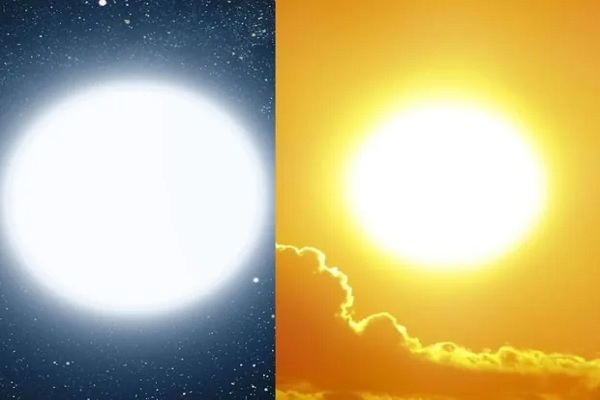
Most people believe the Sun is yellow since it appears yellow from the ground, but after reading this tweet, we may have to rethink our views.

This space truth was recently confirmed by NASA astronaut Scott Kelly in a widely shared tweet. The Sun's true colour is actually white, and the explanation the dwarf star typically seems yellow is due to an odd interaction between light physics that causes the sun to look yellow the majority of the time.

Our atmosphere causes the sun to appear yellow. But once you are outside of the atmosphere of the Earth, the Sun appears to be all white. NASA claims that this is because of way our eyes see colour.

Sunsets and sunrises seem red, yellow, or orange because the sun's light must traverse through all of Earth's atmosphere to reach the surface when it is lower in the sky than when it is directly overhead.

According to NASA, shorter light wavelengths, like blue, are more likely to be scattered through the atmosphere as time goes on, whereas longer light wavelengths, like red, can go considerably farther.

Since the amount of sunshine merely inundates the photoreceptor cells in our eyes, blending all the colours together, we are unable to distinguish a single colour from the sun. White is the result of combining all colours of light. As a result, the sun appears white in space and yellow on Earth. DailyBangladesh/RAH, Source: https://www.daily-bangladesh.com/
Read More........

Mars rover sees hints of past life in latest rock samples

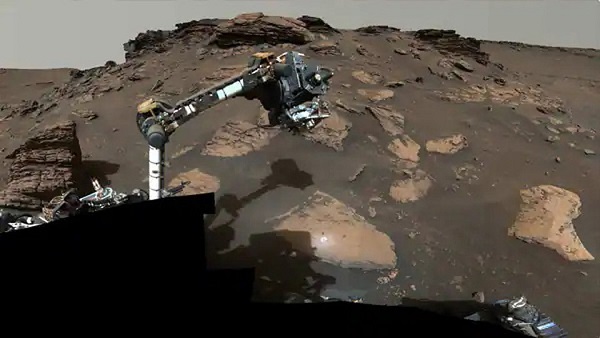
NASA's Perseverance Mars rover has detected its highest concentrations yet of organic molecules, in a potential signal of ancient microbes that scientists are eager to confirm when the rock samples are eventually brought to Earth.

While organic matter has been found on the Red Planet before, the new discovery is seen as especially promising because it came from an area where sediment and salts were deposited into a lake -- conditions where life could have arisen.

"It is very fair to say that these are going to be, these already are, the most valuable rock samples that have ever been collected," David Shuster, a Perseverance return sample scientist, told reporters during a briefing.

Organic molecules -- compounds made primarily of carbon that usually include hydrogen and oxygen, but also at times other elements -- are not always created by biological processes.

Further analysis and conclusions will have to wait for the Mars Sample Return mission -- a collaboration between NASA and the European Space Agency (ESA) to bring back the rocks that is set for 2033.

Nicknamed Percy, the rover landed on Mars' Jezero Crater in February 2021, tasked with caching samples that may contain signs of ancient life, as well as characterizing the planet's geology and past climate.

The delta it is exploring formed 3.5 billion years ago. The rover is currently there investigating sedimentary rocks, which came about from particles of various sizes settling in the then watery environment.

Percy cored two samples from a rock called "Wildcat Ridge," which is about three feet (one meter) wide, and on July 20 abraded some of its surface so it could be analyzed with an instrument called SHERLOC that uses ultraviolet light.

The results showed a class of organic molecules called aromatics, which play a key role in biochemistry.

"This is a treasure hunt for potential signs of life on another planet," NASA astrobiologist Sunanda Sharma said.

"Organic matter is a clue and we're getting stronger and stronger clues...I personally find these results so moving because it feels like we're in the right place, with the right tools, at a very pivotal moment."

There have been other tantalizing clues about the possibility of life on Mars before, including repeated detections of methane by Perseverance's predecessor, Curiosity.

While methane is a digestive byproduct of microbes here on Earth, it can also be generated by geothermal reactions where no biology is at play.DailyBangladesh/SA, Mars rover sees hints of past life in latest roc
Read More........

NASA scrubs launch of giant Moon rocket, may try again Friday

NASA scrubs launch of giant Moon rocket, may try again Friday
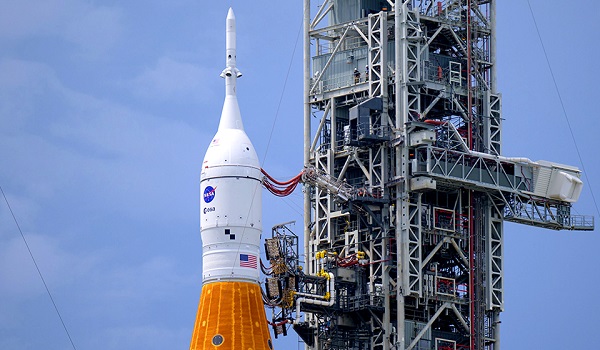
NASA has scrubbed a test flight of its powerful new rocket, in a setback to its plan to send humans back to the Moon and eventually to Mars, but may shoot for another launch attempt on Friday. "We don't launch until it's right," NASA administrator Bill Nelson said after an engine issue forced a cancellation of Monday's flight from the Kennedy Space Center in Florida. "This is a very complicated machine," Nelson said. "You don't want to light the candle until it's ready to go." The goal of the mission, baptized Artemis 1 after the twin sister of Apollo, is to test the 322-foot (98-meter) Space Launch System (SLS) rocket and Orion crew capsule that sits on top. The mission is uncrewed -- mannequins equipped with sensors are standing in for astronauts and will record acceleration, vibration and radiation levels. Mike Sarafin, mission manager of Artemis 1, said the space agency is hoping to make another launch attempt later this week. "Friday is definitely in play," Sarafin said. NASA would have a better idea of whether a Friday launch is feasible after a meeting on Tuesday of the management team, he said. "We just need a little bit of time to look at the data," Sarafin said. Next Monday, September 5, is an alternative launch date. Blastoff had been planned for 8:33 am (1233 GMT) but was cancelled because a test to get one of the rocket's four RS-25 engines to the proper temperature range for launch was not successful. Delays are "part of the space business," Nelson said, expressing confidence NASA engineers will "get it fixed and then we'll fly." Tens of thousands of people -- including US Vice President Kamala Harris -- had gathered to watch the launch, which comes 50 years after Apollo 17 astronauts last set foot on the Moon. "Our commitment to the Artemis Program remains firm, and we will return to the Moon," Harris tweeted. Veteran NASA astronaut Stan Love told reporters he was disappointed but "not really surprised." "This is a brand new vehicle," Love said. "It has a million parts. All of them have to work perfectly." Extreme temperatures: Overnight operations to fill the orange-and-white rocket with ultra-cold liquid hydrogen and oxygen were briefly delayed by a risk of lightning. A potential leak was detected during the filling of the main stage with hydrogen, causing a pause. After tests, the flow resumed. NASA engineers later detected the engine temperature problem and decided to scrub the launch. The Orion capsule is to orbit the Moon to see if the vessel is safe for people in the near future. At some point, Artemis aims to put a woman and a person of color on the Moon for the first time. During the 42-day trip, Orion will follow an elliptical course around the Moon, coming within 60 miles (100 kilometers) at its closest approach and 40,000 miles at its farthest -- the deepest into space by a craft designed to carry humans. One of the main objectives is to test the capsule's heat shield, which at 16 feet in diameter is the largest ever built. On its return to Earth's atmosphere, the heat shield will have to withstand speeds of 25,000 miles per hour and a temperature of 5,000 degrees Fahrenheit (2,760 degrees Celsius) -- roughly half as hot as the Sun. Crewed mission to Mars: NASA is expected to spend $93 billion between 2012 and 2025 on the Artemis program, which is already years behind schedule, at a cost of $4.1 billion per launch. The next mission, Artemis 2, will take astronauts into orbit around the Moon without landing on its surface. The crew of Artemis 3 is to land on the Moon in 2025 at the earliest. And since humans have already visited the Moon, Artemis has its sights set on another lofty goal: a crewed mission to Mars. The Artemis program aims to establish a lasting human presence on the Moon with an orbiting space station known as Gateway and a base on the surface.Gateway would serve as a staging and refueling station for a voyage to the Red Planet that would take a minimum of several months. Source: https://www.daily-bangladesh.com/
Read More........

Russia reports ‘non-standard’ air leak on Space Station

Russia said Tuesday that astronauts had found an air leak in its section of the International Space Station, with a senior space official calling the air loss beyond expected levels.

The crew on the ISS — Russian cosmonauts Anatoly Ivanishin and Ivan Vagner and NASA astronaut Christopher Cassidy — have been searching for the air leak since August, first checking the US segment.

Russia’s space agency, Roscosmos, said in a statement that after analysis and a search for the leak “it was established that the spot is located in the Zvezda (star) service module, which contains scientific equipment.”

It said a search was now underfoot to pinpoint the exact location, saying the situation “is not dangerous for the life and health of the ISS crew and does not prevent the ISS continuing manned flight.”

“It’s not critical in the near future,” said Sergei Krikalyov, the executive director of Russia’s manned space programs, in a televised comment.

He said the ISS always has slight air loss due to the air purifying system.

“These leaks are predictable. What’s happening now is more than the standard leakage and naturally if it lasts a long time, it will require supplies of extra air to the station,” he said.

He said the crew were now resting but hoped to find the precise spot and fix the leak on Wednesday.

“That’s not for sure,” he added, saying there was quite a large area to search.

“We have time. The leak exists of course. It’s not good that it’s there, but it’s not critical,” he said.

NASA said that the leak had appeared to grow in size overnight Monday to Tuesday and the crew were awakened by flight controllers to carry out a search.

It was later found that a temperature change had made the leak seem to grow, while the rate of air escaping was “unchanged,” the US space agency said.

Previously, astronauts had searched for the source of the leak in the US segment of the station using an ultrasound detector.

The incident comes after astronauts in 2018 found a hole in the wall of a Russian-made Soyuz space capsule docked onto the ISS.

The cause of the hole has not yet been made public.Three new crew members, Russians Sergei Ryzhikov and Sergei Kud-Sverchkov and NASA astronaut Kate Rubins, are set to arrive in a Russian Soyuz spacecraft due to launch October 14.  Source: https://www.daily-bangladesh.com/
Read More........

NASA to send a new toilet to Space Station

The US space agency NASA is set to test a new zero-gravity toilet to the International Space Station (ISS) before its probable use in a future mission to the Moon.

The $23m (195 crores BDT) toilet, which sucks waste from the body, will be sent to the ISS on a cargo ship.

According to NASA, the toilet's "vacuum system" was designed for the comfort of female astronauts, unlike previous models.

The toilet was supposed to be sent to the space station from Virginia by the rocket on Thursday afternoon. But three minutes before the launch, the mission was aborted due to a technical error. If the engineers can fix the errors, they will try again.

According to NASA, the Titanium Space Toilet will help in missions to more remote areas. The vacuum system is being used here to discharge body wastes in the zero gravity region.

The toilet uses a vacuum system to suck waste away from the body in a zero-gravity environment. For privacy, the toilet is located inside a cubicle - just like in a public bathroom on Earth.

It weighs 45kg (100lbs) and standing 28in (71cm) tall, the toilet is 65% smaller and 40% lighter than the one currently in use.

NASA project manager Melissa McKinley said the Universal Waste Management System (UWMS) toilet has been designed for a long time. The commode seat and urine funnel are more refined than before. Women astronauts will feel more comfortable.

In a video posted to Twitter, Nasa astronaut Jessica Meir described the toilet as a "vacuum system".

"So imagine you have a vacuum cleaner and you're sucking things down. You turn on a big fan, so that's pulling everything down inside the toilet," she said.She added that this toilet will process and recycle urine as drinking water for astronauts in a special way. Source:https://www.daily-bangladesh.com:
Read More........

Three-man US-Russian crew returns to Earth from ISS

An American astronaut and two Russian cosmonauts touched down on the Kazakhstan steppe on Thursday, completing a 196-day mission that began with the first launch under lockdown conditions.

NASA astronaut Chris Cassidy and Russian cosmonauts Anatoly Ivanishin and Ivan Vagner landed around 150 kilometres (90 miles) southeast of the Kazakh city of Zhezkazgan at 0254 GMT, footage broadcast by the Russian space agency Roscosmos showed.

A NASA commentator citing communications from crews on the ground at the landing site said that the Soyuz descent module had landed in a vertical position and that the crew were working on getting the trio out of the craft.

The three-man crew had blasted off minus the unusual fanfare in April with around half the world's population living under national lockdowns imposed to contain the spread of the coronavirus.

The mission coincided with the arrival at the space station in May of the first astronauts to blast off from US soil for almost a decade.

The mission carried out by tycoon Elon Musk's SpaceX company as part of NASA's commercial Commercial Crew Program has helped fuel talk of a new "space race" between a number of countries.

Prior to returning from his third mission in space, former US Navy SEAL Cassidy, 50, tweeted a picture of blood samples that astronauts have to submit at various points in their mission, including just before undocking.

"What is the price of a return ride back to Earth?....8 tubes of blood!! The 7 shown in this picture were taken in the morning to be placed in our deep freezer, and the 8th will be drawn just prior to undock for ground processing soon after landing," Cassidy wrote.

First-time-flyer Vagner was a rare Roscosmos presence on the micro-blogging platform, where most NASA astronauts have a profile.

"Mama, I'm coming home," the 35-year-old tweeted on Wednesday.

Ivanishin is wrapping up his third mission, after NASA's Kathleen Rubins, with whom he launched to the ISS in 2016, arrived for a second stint aboard the station last week along with Sergey Ryzhikov and Sergey Kud-Sverchkov of Roscosmos.

The ISS, has been a rare example of cooperation between Moscow and Washington.Next month will mark the 20th anniversary of the orbital lab being permanently occupied by humans, but the station is expected to be decommissioned in the next decade due to structural fatigue. Source: https://www.daily-bangladesh.com/
Read More........

Nokia, NASA to install 4G on the Moon

Finnish multinational telecommunications, information technology, and consumer electronics company Nokia announced its expansion into a new market on Monday, winning a deal to install the first cellular network on the Moon.

The Finnish equipment manufacturer said it was selected by NASA to deploy an “ultra-compact, low-power, space-hardened” wireless 4G network on the lunar surface, as part of the US space agency’s plan to establish a long-term human presence on the Moon by 2030, according to a report by AFP.

The $14.1 million contracts, awarded to Nokia’s US subsidiary, is part of NASA’s Artemis program which aims to send the first woman, and next man, to the moon by 2024.

The astronauts will begin carrying out detailed experiments and explorations which the agency hopes will help it develop its first human mission to Mars.

Nokia’s network equipment will be installed remotely on the Moon’s surface using a lunar hopper built by Intuitive Machines in late 2022, Nokia said.

“The network will self-configure upon deployment,” Nokia said in a statement, adding that the wireless technology will allow for “vital command and control functions, remote control of lunar rovers, real-time navigation and streaming of high definition video.”

The 4G equipment can be updated to a super-fast 5G network in the future, Nokia said.

In all, NASA announced last week it would distribute $370 million to 14 companies to supply “Tipping Point” technologies for its mission, which include robotics and new methods of harvesting the resources required for living on the moon, such as oxygen and energy sources.

Among them, Elon Musk’s SpaceX received $53.2 million for a demonstration of the transferring of ten metric tons of liquid oxygen between tanks on a starship vehicle, NASA said.Source: AFP Source: https://www.daily-bangladesh.com
Read More........

SpaceX Crew Dragon “Resilience” docks with ISS

A SpaceX Crew Dragon carrying four astronauts docked with the International Space Station Monday, the first of what NASA hopes will be many routine missions ending US reliance on Russian rockets.

“Dragon SpaceX, soft capture confirmed,” said an announcer as the capsule completed its 27.5 hour journey at 11:01 pm (0401 GMT Tuesday), with the second part of the procedure, “hard capture,” occurring a few minutes later.

The spacecraft, named “Resilience,” docked autonomously with the space station some 260 miles (400 kilometers) above the Midwestern US state of Ohio.

The crew is comprised of three Americans — Michael Hopkins, Victor Glover and Shannon Walker — and Japan’s Soichi Noguchi.

Earlier, mission commander Hopkins gave pilot Glover his “gold pin,” a NASA tradition when an astronaut first crosses the 100-kilometer Karman line marking the official boundary of space.

Glover is the first Black astronaut to make an extended stay at the ISS, while Noguchi is the first non-American to fly to orbit on a private spaceship.

The crew joins two Russians and one American aboard the station, and will stay for six months.

Along the way, there was a problem with the cabin temperature control system, but it was quickly solved.

SpaceX briefly transmitted live images from inside the capsule showing the astronauts in their seats, something neither the Russians nor the Americans had done before.

US President-elect Joe Biden hailed the launch on Twitter as a “testament to the power of science and what we can accomplish by harnessing our innovation, ingenuity, and determination,” while President Donald Trump called it “great.”

Vice President Mike Pence, who attended the launch with his wife Karen, called it a “new era in human space exploration in America.”

The Crew Dragon capsule earlier this week became the first spacecraft to be certified by NASA since the Space Shuttle nearly 40 years ago. Its launch vehicle is a reusable SpaceX Falcon 9 rocket.

At the end of its missions, the Crew Dragon deploys parachutes and then splashes down in water, just as in the Apollo era.

SpaceX is scheduled to launch two more crewed flights for NASA in 2021, including one in the spring, and four cargo refueling missions over the next 15 months.

NASA turned to SpaceX and Boeing after shuttering the checkered Space Shuttle program in 2011, which failed in its main objectives of making space travel affordable and safe.

The agency will have spent more than $8 billion on the Commercial Crew program by 2024, with the hope that the private sector can take care of NASA’s needs in “low Earth orbit” so it is freed up to focus on return missions to the Moon and then on to Mars.

SpaceX, founded by Elon Musk in 2002, leapfrogged its much older rival Boeing, whose program floundered after a failed test of its uncrewed Starliner last year.

– Russians unimpressed –

But SpaceX’s success won’t mean the US will stop hitching rides with Russia altogether, said NASA administrator Jim Bridenstine. The goal is to have an “exchange of seats” between American astronauts and Russian cosmonauts.

Bridenstine also explained it was necessary in case either program was down for a period of time.

The reality, however, is that space ties between the US and Russia — one of the few bright spots in their bilateral relations — have frayed in recent years.

Russia has said it won’t be a partner in the Artemis program to return to the Moon in 2024, claiming the NASA-led mission is too US-centric.

Dmitry Rogozin, the head of Russia’s space agency, has also repeatedly mocked SpaceX’s technology, telling a state news agency he was unimpressed with the Crew Dragon’s “rather rough” water landing and saying his agency was developing a methane rocket that will be reusable 100 times. But the fact that a national space agency feels moved to compare itself to a company arguably validates NASA’s public-private strategy.

SpaceX’s emergence has also deprived Roscosmos of a valuable income stream.

The cost of round-trips on Russian rockets had been rising and stood at around $85 million per astronaut, according to estimates last year.

– Biden incoming –

Presidential transitions are always a difficult time for NASA, and the ascension of Joe Biden in January is expected to be no different.

The agency has yet to receive from Congress the tens of billions of dollars needed to finalize the Artemis program.

Bridenstine has announced that he will step down, to let the new president set his own goals for space exploration.

So far, Biden has not commented on the 2024 timeline.Democratic party documents say they support NASA’s Moon and Mars aspirations, but also emphasize elevating the agency’s Earth sciences division to better understand how climate change is affecting our planet. Source: https://www.daily-bangladesh.com/
Read More........

Indian-American Raja Chari among 3 astronauts selected by NASA for SpaceX Crew-3 mission


DEC 16, 2020 WASHINGTON: Indian-American US Air Force Colonel Raja Chari has been selected as the Commander of the SpaceX Crew-3 mission to the International Space Station (ISS) by NASA and the European Space Agency. Chari, 43, will serve as the commander while NASA's Tom Marshburn will be pilot and ESA's Matthias Maurer will serve as a mission specialist for the SpaceX Crew-3 mission to the ISS, which is expected to launched next year. A fourth crew member will be added at a later date, following a review by NASA and its international partners, NASA said in a statement on Monday. "Excited and honored to be training with @astro_matthias and @AstroMarshburn in prep for a trip to the @Space_Station," Chari said in a tweet on Monday. "Proud to be working and training with Matthias Maurer and Thomas Henry Marshburn in preparation for a mission to the International Space Station aboard the SpaceX Crew Dragon," he posted on his Facebook page. This will be the first spaceflight for Chari, who became a NASA astronaut in 2017. He was born in Milwaukee, but considers Cedar Falls, Iowa, his hometown, NASA said. He is a colonel in the US Air Force and joins the mission with extensive experience as a test pilot. He has accumulated more than 2,500 hours of flight time in his career. Chari was selected earlier this month as a member of the Artemis Team and is now eligible for assignment to a future lunar mission, it said in a statement. Chari's father Srinivas Chari came to the US at a young age from Hyderabad for an engineering degree. "It's official... next stop: International @Space_Station! In late 2021, I'll fly to humankind's orbital outpost for the first time, continuing our quest to discover more in space for #Earth. Get ready for #cosmickiss - a declaration of love for space," Maurer tweeted. Maurer comes from Sankt Wendel, in the German state of Saarland. Like Chari, Maurer will be making his first trip to space with the Crew-3 mission. Before becoming an astronaut, Maurer held a number of engineering and research roles, both in a university setting and at European Space Agency (ESA). Marshburn is a Statesville, North Carolina, native who became an astronaut in 2004. Prior to serving in the astronaut corps, the medical doctor served as a flight surgeon at NASA's Johnson Space Center in Houston and later became medical operations lead for the International Space Station. The Crew-3 mission will be his third visit to the space station and his second long-duration mission. When Chari, Marshburn, and Maurer arrive at the orbiting laboratory, they will become expedition crew members for the duration of their six-month stay. The crew will have a slight overlap with the Crew-2 astronauts, who are expected to launch in the spring of 2021. This will not be the first commercial crew mission to overlap. The Crew-1 astronauts, who are currently on the station, and the Crew-2 astronauts, also are expected to coincide in their sojourns for a short time. Increasing the total number of astronauts aboard the station is allowing the agency to boost the number of science investigations conducted in the unique microgravity environment, NASA said. This will be the third crew rotation mission of SpaceX's human space transportation system and its fourth flight with astronauts, including the Demo-2 test flight, to the space station through NASA's Commercial Crew Program. The goal of the programme is to provide safe, reliable, and cost-effective crew access to the space station and low-Earth orbit in partnership with American aerospace industry. NASA's contract with SpaceX is for six total crew missions to the orbiting laboratory. Commercial transportation to and from the station will provide expanded utility, additional research time, and broader opportunities for discovery on the orbital outpost, the US space agency said. For more than 20 years, humans have lived and worked continuously aboard the International Space Station, advancing scientific knowledge and demonstrating new technologies, making research breakthroughs not possible on Earth. As a global endeavour, 242 people from 19 countries have visited the unique microgravity laboratory that has hosted more than 3,000 research and educational investigations from researchers in 108 countries and areas, the statement said. The station is a critical test bed for NASA to understand and overcome the challenges of long-duration spaceflight. As commercial companies focus on providing human transportation services to and from low-Earth orbit, NASA is free to focus on building spacecraft and rockets for deep space missions to the Moon and Mars, it said. Copyright © Jammu Links News, Source: Jammu Links News
Read More........

Indian-American among 18 astronauts selected for NASA's manned Moon mission


DEC 11, 2020 WASHINGTON: An Indian-American is among the 18 astronauts selected by NASA for its manned mission to the Moon and beyond. NASA on Wednesday named the 18 astronauts -- half of them women -- who will train for its Artemis moon-landing programme. Raja Jon Vurputoor Chari, 43, a graduate of the US Air Force Academy, MIT, and US Naval Test Pilot School, is the only Indian-American in the list. He was selected by NASA to join the 2017 Astronaut Candidate Class. He reported for duty in August 2017 and having completed the initial astronaut candidate training is now eligible for a mission assignment. "My fellow Americans, I give you the heroes of the future who will carry us back to the Moon and beyond: the Artemis Generation," Vice President Mike Pence said at NASA''s Kennedy Space Centre in Florida on Wednesday. "It really is amazing to think that the next man and the first woman on the Moon are among the names that we just read...We started today reflecting on a great hero of the past. The Artemis Generation are the heroes of American space exploration in the future," Pence said after he introduced the members of the Artemis Team during the eighth National Space Council meeting. The astronauts on the Artemis Team come from a diverse range of backgrounds, expertise and experience. Most of the astronauts in the group are in their 30s or 40s. The oldest is 55, the youngest 32. The agency's modern lunar exploration programme will land the first woman and next man on the Moon in 2024 and establish a sustainable human lunar presence by the end of the decade, NASA said. NASA will announce flight assignments for astronauts later, pulling from the Artemis Team. Additional Artemis Team members, including international partner astronauts, will join this group, as needed. "We are incredibly grateful for the president and vice president's support of the Artemis program, as well as the bipartisan support for all of NASA's science, aeronautics research, technology development, and human exploration goals," said NASA Administrator Jim Bridenstine. "As a result, we're excited to share this next step in exploration - naming the Artemis Team of astronauts who will lead the way, which includes the first woman and next man to walk on the lunar surface," he added. The selected astronauts will help NASA prepare for the coming Artemis missions, which begin next year working with the agency's commercial partners as they develop human landing systems; assisting in the development of training; defining hardware requirements; and consulting on technical development. They also will engage the public and industry on NASA''s exploration plans. "There is so much exciting work ahead of us as we return to the moon, and it will take the entire astronaut corps to make that happen," Chief Astronaut Pat Forrester said. "Walking on the lunar surface would be a dream come true for any one of us, and any part we can play in making that happen is an honour," he said. The other members on the list include Christina Koch and Jessica Meir -- the two astronauts who performed the world''s first all-female spacewalk last year. Copyright © Jammu Links News, Source: Jammu Links News
Read More........

Three-man US-Russian crew returns to Earth from ISS

An American astronaut and two Russian cosmonauts touched down on the Kazakhstan steppe on Thursday, completing a 196-day mission that began with the first launch under lockdown conditions.

NASA astronaut Chris Cassidy and Russian cosmonauts Anatoly Ivanishin and Ivan Vagner landed around 150 kilometres (90 miles) southeast of the Kazakh city of Zhezkazgan at 0254 GMT, footage broadcast by the Russian space agency Roscosmos showed.

A NASA commentator citing communications from crews on the ground at the landing site said that the Soyuz descent module had landed in a vertical position and that the crew were working on getting the trio out of the craft.

The three-man crew had blasted off minus the unusual fanfare in April with around half the world's population living under national lockdowns imposed to contain the spread of the coronavirus.

The mission coincided with the arrival at the space station in May of the first astronauts to blast off from US soil for almost a decade.

The mission carried out by tycoon Elon Musk's SpaceX company as part of NASA's commercial Commercial Crew Program has helped fuel talk of a new "space race" between a number of countries.

Prior to returning from his third mission in space, former US Navy SEAL Cassidy, 50, tweeted a picture of blood samples that astronauts have to submit at various points in their mission, including just before undocking.

"What is the price of a return ride back to Earth?....8 tubes of blood!! The 7 shown in this picture were taken in the morning to be placed in our deep freezer, and the 8th will be drawn just prior to undock for ground processing soon after landing," Cassidy wrote.

First-time-flyer Vagner was a rare Roscosmos presence on the micro-blogging platform, where most NASA astronauts have a profile.

"Mama, I'm coming home," the 35-year-old tweeted on Wednesday.

Ivanishin is wrapping up his third mission, after NASA's Kathleen Rubins, with whom he launched to the ISS in 2016, arrived for a second stint aboard the station last week along with Sergey Ryzhikov and Sergey Kud-Sverchkov of Roscosmos.

The ISS, has been a rare example of cooperation between Moscow and Washington.Next month will mark the 20th anniversary of the orbital lab being permanently occupied by humans, but the station is expected to be decommissioned in the next decade due to structural fatigue. Source: https://www.daily-bangladesh.com
Read More........

SpaceX Crew Dragon “Resilience” docks with ISS

A SpaceX Crew Dragon carrying four astronauts docked with the International Space Station Monday, the first of what NASA hopes will be many routine missions ending US reliance on Russian rockets.

“Dragon SpaceX, soft capture confirmed,” said an announcer as the capsule completed its 27.5 hour journey at 11:01 pm (0401 GMT Tuesday), with the second part of the procedure, “hard capture,” occurring a few minutes later.

The spacecraft, named “Resilience,” docked autonomously with the space station some 260 miles (400 kilometers) above the Midwestern US state of Ohio.

The crew is comprised of three Americans — Michael Hopkins, Victor Glover and Shannon Walker — and Japan’s Soichi Noguchi.

Earlier, mission commander Hopkins gave pilot Glover his “gold pin,” a NASA tradition when an astronaut first crosses the 100-kilometer Karman line marking the official boundary of space.

Glover is the first Black astronaut to make an extended stay at the ISS, while Noguchi is the first non-American to fly to orbit on a private spaceship.

The crew joins two Russians and one American aboard the station, and will stay for six months.

Along the way, there was a problem with the cabin temperature control system, but it was quickly solved.

SpaceX briefly transmitted live images from inside the capsule showing the astronauts in their seats, something neither the Russians nor the Americans had done before.

US President-elect Joe Biden hailed the launch on Twitter as a “testament to the power of science and what we can accomplish by harnessing our innovation, ingenuity, and determination,” while President Donald Trump called it “great.”

Vice President Mike Pence, who attended the launch with his wife Karen, called it a “new era in human space exploration in America.”

The Crew Dragon capsule earlier this week became the first spacecraft to be certified by NASA since the Space Shuttle nearly 40 years ago. Its launch vehicle is a reusable SpaceX Falcon 9 rocket.

At the end of its missions, the Crew Dragon deploys parachutes and then splashes down in water, just as in the Apollo era.

SpaceX is scheduled to launch two more crewed flights for NASA in 2021, including one in the spring, and four cargo refueling missions over the next 15 months.

NASA turned to SpaceX and Boeing after shuttering the checkered Space Shuttle program in 2011, which failed in its main objectives of making space travel affordable and safe.

The agency will have spent more than $8 billion on the Commercial Crew program by 2024, with the hope that the private sector can take care of NASA’s needs in “low Earth orbit” so it is freed up to focus on return missions to the Moon and then on to Mars.

SpaceX, founded by Elon Musk in 2002, leapfrogged its much older rival Boeing, whose program floundered after a failed test of its uncrewed Starliner last year.

– Russians unimpressed –

But SpaceX’s success won’t mean the US will stop hitching rides with Russia altogether, said NASA administrator Jim Bridenstine. The goal is to have an “exchange of seats” between American astronauts and Russian cosmonauts.

Bridenstine also explained it was necessary in case either program was down for a period of time.

The reality, however, is that space ties between the US and Russia — one of the few bright spots in their bilateral relations — have frayed in recent years.

Russia has said it won’t be a partner in the Artemis program to return to the Moon in 2024, claiming the NASA-led mission is too US-centric.

Dmitry Rogozin, the head of Russia’s space agency, has also repeatedly mocked SpaceX’s technology, telling a state news agency he was unimpressed with the Crew Dragon’s “rather rough” water landing and saying his agency was developing a methane rocket that will be reusable 100 times. But the fact that a national space agency feels moved to compare itself to a company arguably validates NASA’s public-private strategy.

SpaceX’s emergence has also deprived Roscosmos of a valuable income stream.

The cost of round-trips on Russian rockets had been rising and stood at around $85 million per astronaut, according to estimates last year.

– Biden incoming –

Presidential transitions are always a difficult time for NASA, and the ascension of Joe Biden in January is expected to be no different.

The agency has yet to receive from Congress the tens of billions of dollars needed to finalize the Artemis program.

Bridenstine has announced that he will step down, to let the new president set his own goals for space exploration.

So far, Biden has not commented on the 2024 timeline.Democratic party documents say they support NASA’s Moon and Mars aspirations, but also emphasize elevating the agency’s Earth sciences division to better understand how climate change is affecting our planet. Source:https://www.daily-bangladesh.com
Read More........

SpaceX capsule with 4 astronauts reaches space station


NOV 17, 2020 SpaceX's newly launched capsule with four astronauts arrived Monday at the International Space Station, their new home until spring. The Dragon capsule pulled up and docked late Monday night, following a 27-hour, completely automated flight from NASA''s Kennedy Space Center. The linkup occurred 262 miles (422 kilometers) above Idaho. "Oh, what a good voice to hear," space station astronaut Kate Rubins called out when the Dragon''s commander, Mike Hopkins, first made radio contact. "We can''t wait to have you on board," she added after the two spacecraft were latched together. This is the second astronaut mission for SpaceX. But it''s the first time Elon Musk''s company delivered a crew for a full half-year station stay. The two-pilot test flight earlier this year lasted two months. The three Americans and one Japanese astronaut will remain at the orbiting lab until their replacements arrive on another Dragon in April. And so it will go, with SpaceX - and eventually Boeing - transporting astronauts to and from the station for NASA. This regular taxi service got underway with Sunday night''s launch. Hopkins and his crew - Victor Glover, Shannon Walker and Japan''s Soichi Noguchi - join two Russians and one American who flew to the space station last month from Kazakhstan. Glover is the first African-American to move in for a long haul. A space newcomer, Glover was presented his gold astronaut pin Monday. The four named their capsule Resilience to provide hope and inspiration during an especially difficult year for the whole world. They broadcast a tour of their capsule Monday, showing off the touchscreen controls, storage areas and their zero gravity indicator: a small plush Baby Yoda. Walker said it was a little tighter for them than for the two astronauts on the test flight. "We sort of dance around each other to stay out of each other''s way," she said. For Sunday''s launch, NASA kept guests to a minimum because of coronavirus, and even Musk had to stay away after tweeting that he "most likely" had an infection. He was replaced in his official launch duties by SpaceX President Gwynne Shotwell, who assured reporters he was still very much involved with Sunday night''s action, although remotely. As they prepared for the space station linkup, the Dragon crew beamed down live window views of New Zealand and a brilliant blue, cloud-streaked Pacific 250 miles below. "Looks amazing," Mission Control radioed from SpaceX headquarters in Hawthorne, California. "It looks amazing from up here, too," Hopkins replied. Source: Jammu Links News
Read More........

Nasa's SOFIA finds water on sunlit surface of Moon

Nasa’s Stratospheric Observatory for Infrared Astronomy (SOFIA) – a telescope operating from an aircraft - has confirmed, for the first time, water on the sunlit surface of the Moon. This discovery indicates that water may be distributed across the lunar surface, and not limited to cold, shadowed places, Nasa revealed today.
SOFIA, a joint project of Nasa and the German Aerospace Centre. has detected water molecules (H2O) in Clavius Crater, one of the largest craters visible from Earth, located in the Moon’s southern hemisphere, the US space agency said. While previous observations of the Moon’s surface had detected some form of hydrogen, Nasa said, they were unable to distinguish between water and its close chemical relative, hydroxyl (OH). 
Data from this location reveal water in concentrations of 100 to 412 parts per million – roughly equivalent to a 12-ounce bottle of water – trapped in a cubic meter of soil spread across the lunar surface. The results are published in the latest issue of Nature Astronomy.
“We had indications that H2O – the familiar water we know – might be present on the sunlit side of the Moon,” said Paul Hertz, director of the Astrophysics Division in the Science Mission Directorate at NASA Headquarters in Washington. “Now we know it is there. This discovery challenges our understanding of the lunar surface and raises intriguing questions about resources relevant for deep space exploration.”
In comparison, the Sahara desert has 100 times the amount of water than what SOFIA detected in the lunar soil. Despite the small amounts, the discovery raises new questions about how water is created and how it persists on the harsh, airless lunar surface.
Since water is a precious resource in deep space and a key ingredient of life, Nasa is using its Artemis programme to study the presence of water on the Moon ahead of sending the first woman and next man to the lunar surface in 2024 with a view to establishing a sustainable human presence there by the end of the decade.
Under SOFIA’s results build on years of previous research examining the presence of water on the Moon. When the Apollo astronauts first returned from the Moon in 1969, it was thought to be completely dry. Orbital and impactor missions over the past 20 years, such as Nasa’s Lunar Crater Observation and Sensing Satellite, confirmed ice in permanently shadowed craters around the Moon’s poles.
Meanwhile, several spacecraft, including the Cassini mission and Deep Impact comet mission, as well as the Indian Space Research Organisation’s Chandrayaan-1 mission, and Nasa’s ground-based Infrared Telescope Facility, looked broadly across the lunar surface and found evidence of hydration in sunnier regions. Yet those missions were unable to definitively distinguish the form in which it was present – either H2O or OH.
“Prior to the SOFIA observations, we knew there was some kind of hydration,” said Casey Honniball, the lead author who published the results from her graduate thesis work at the University of Hawaii at Manoa in Honolulu. “But we didn’t know how much, if any, was actually water molecules – like we drink every day – or something more like drain cleaner.”
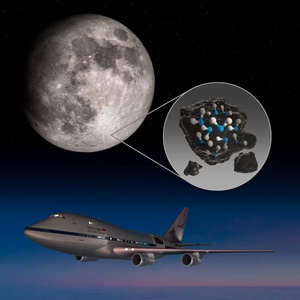
Scientists using Nasa’s telescope on an airplane, the Stratospheric Observatory for Infrared Astronomy, discovered water on a sunlit surface of the Moon for the first time. 
SOFIA is a modified Boeing 747SP aircraft that allows astronomers to study the solar system and beyond in ways that are not possible with ground-based telescopes. Molecular water, H2O, was found in Clavius Crater, one of the largest craters visible from Earth in the Moon’s southern hemisphere. This discovery indicates that water may be distributed across the lunar surface, and not limited to cold, shadowed places.
SOFIA offered a new means of looking at the Moon. Flying at altitudes of up to 45,000 feet, this modified Boeing 747SP jetliner with a 106-inch diameter telescope reaches above 99 per cent of the water vapor in Earth’s atmosphere to get a clearer view of the infrared universe. Using its Faint Object infraRed CAmera for the SOFIA Telescope (FORCAST), SOFIA was able to pick up the specific wavelength unique to water molecules, at 6.1 microns, and discovered a relatively surprising concentration in sunny Clavius Crater.
“Without a thick atmosphere, water on the sunlit lunar surface should just be lost to space,” said Honniball, who is now a postdoctoral fellow at Nasa’s Goddard Space Flight Center in Greenbelt, Maryland. “Yet somehow we’re seeing it. Something is generating the water, and something must be trapping it there.”
Several forces could be at play in the delivery or creation of this water. Micrometeorites raining down on the lunar surface, carrying small amounts of water, could deposit the water on the lunar surface upon impact. Another possibility is there could be a two-step process whereby the Sun’s solar wind delivers hydrogen to the lunar surface and causes a chemical reaction with oxygen-bearing minerals in the soil to create hydroxyl. Meanwhile, radiation from the bombardment of micrometeorites could be transforming that hydroxyl into water.
How the water then gets stored – making it possible to accumulate – also raises some intriguing questions. The water could be trapped into tiny beadlike structures in the soil that form out of the high heat created by micrometeorite impacts. Another possibility is that the water could be hidden between grains of lunar soil and sheltered from the sunlight – potentially making it a bit more accessible than water trapped in beadlike structures.
For a mission designed to look at distant, dim objects such as black holes, star clusters, and galaxies, SOFIA’s spotlight on Earth’s nearest and brightest neighbor was a departure from business as usual. The telescope operators typically use a guide camera to track stars, keeping the telescope locked steadily on its observing target. But the Moon is so close and bright that it fills the guide camera’s entire field of view. With no stars visible, it was unclear if the telescope could reliably track the Moon. To determine this, in August 2018, the operators decided to try a test observation.
“It was, in fact, the first time SOFIA has looked at the Moon, and we weren’t even completely sure if we would get reliable data, but questions about the Moon’s water compelled us to try,” said Naseem Rangwala, SOFIA’s project scientist at Nasa's Ames Research Center in California's Silicon Valley. “It’s incredible that this discovery came out of what was essentially a test, and now that we know we can do this, we’re planning more flights to do more observations.”
SOFIA’s follow-up flights will look for water in additional sunlit locations and during different lunar phases to learn more about how the water is produced, stored, and moved across the Moon. The data will add to the work of future Moon missions, such as Nasa’s Volatiles Investigating Polar Exploration Rover (VIPER), to create the first water resource maps of the Moon for future human space exploration.
In the same issue of Nature Astronomy, scientists have published a paper using theoretical models and Nasa's Lunar Reconnaissance Orbiter data, pointing out that water could be trapped in small shadows, where temperatures stay below freezing, across more of the Moon than currently expected. The results can be found here. 
“Water is a valuable resource, for both scientific purposes and for use by our explorers,” said Jacob Bleacher, chief exploration scientist for Nasa’s Human Exploration and Operations Mission Directorate. “If we can use the resources at the Moon, then we can carry less water and more equipment to help enable new scientific discoveries.”SOFIA is a joint project of Nasa and the German Aerospace Center. Ames manages the SOFIA programme, science, and mission operations in cooperation with the Universities Space Research Association, headquartered in Columbia, Maryland, and the German SOFIA Institute at the University of Stuttgart. The aircraft is maintained and operated by Nasa’s Armstrong Flight Research Center Building 703, in Palmdale, California. Source: https://www.domain-b.com/
Read More........

NASA astronaut to cast vote from space in US Elections 2020


NASA astronaut Kate Rubins plans to cast her vote for the upcoming US presidential elections 2020 from space as she will be aboard the International Space Station (ISS) on the day of the elections, the Associated Press reported. 

According to a CBS News report, the astronaut will be heading to the International Space Station more than 200 miles above the earth's end of October. She will vote in the United States under the Texas Law.

She is currently training in Moscow's Star City under NASA's Gagarin Cosmonaut Training Center. This time the astronaut will be in space for six months where she will be accompanied by two more astronauts.

"If we can do it from space, then I believe folks can do it from the ground, too," Rubins said.

Earlier, astronauts Kate and Shane Kimbrough voted from space in the 2016 presidential election. Source: https://www.daily-bangladesh.com/
Read More........

NASA reveals 4 new discovery missions


NASA announced four new possible discovery program investigations to develop concept studies on the solar system, according to a release of NASA’s Jet Propulsion Laboratory (JPL) on Thursday.

The space agency has given the green light to concept studies across Venus and the moons of Jupiter and Neptune for these Discovery Program investigations.

NASA’s Discovery Program invites scientists and engineers to assemble a team to design exciting planetary science missions, which will provide frequent flight opportunities for focused planetary science investigations, according to JPL.

“These selected missions have the potential to transform our understanding of some of the solar system’s most active and complex worlds,” said Thomas Zurbuchen, Associate Administrator of NASA’s Science Mission Directorate. “Exploring any one of these celestial bodies will help unlock the secrets of how it, and others like it, came to be in the cosmos.”

Two of the missions selected focus on Venus. DAVINCI+ (Deep Atmosphere Venus Investigation of Noble gases, Chemistry and Imaging Plus) would analyze the atmosphere of Venus to see how it was formed and evolved, and whether the planet ever had an ocean. VERITAS (Venus Emissivity, Radio Science, InSAR, Topography, and Spectroscopy) would map Venus’ surface to check out its geological history.

The other two missions are looking into celestial moons. Io Volcano Observer (IVO) would explore Jupiter’s volcanic moon Io, to learn about magma oceans and tidal forces. “Io is heated by the constant crush of Jupiter’s gravity and is the most volcanically active body in the solar system,” NASA said.

Lastly, the Trident mission would explore Neptune’s ice moon Triton, to see whether something so far from the sun could be inhabited.

The four nine-month studies will be given $3 million each by NASA to develop their concepts. NASA will evaluate each, and then choose two missions in 2021.

Established in 1992, NASA’s Discovery Program has so far supported the development and implementation of over 20 missions and instruments.


Read More........

Ammonia Sparks Unexpected, Exotic Lightning on Jupiter

Credit: NASA/JPL-Caltech/SwRI/MSSS/Gerald EichstÀdt

NASA’s Juno spacecraft – orbiting and closely observing the planet Jupiter – has unexpectedly discovered lightning in the planet’s upper atmosphere, according to a multi-institutional study led by the NASA/Jet Propulsion Laboratory (JPL), which includes two Cornell researchers.

This illustration used data obtained by NASA’s Juno mission to depict high-altitude electrical storms on Jupiter. Juno's sensitive Stellar Reference Unit camera detected unusual lightning flashes on the planet’s dark side during the spacecraft's close flybys of the planet.

The work was published Aug. 5 in the journal Nature.

Jupiter’s gaseous atmosphere seems placid from a distance, but up close the clouds roil in a turbulent, chemically dynamic realm. As scientists have probed the opaque surface with Juno’s sensitive instrumentation, they’ve learned that Jupiter’s lightning occurs not only deep within the water clouds but also in shallow atmospheric regions (at high altitudes with lower pressure) that feature clouds of ammonia mixed with water.

“On the night side of Jupiter, you see fairly frequent flashes – as if you were above an active thunderstorm on Earth,” said Jonathan I. Lunine, the David C. Duncan Professor in the Physical Sciences and chair of the Department of Astronomy in the College of Arts and Sciences. “You get these tall columns and anvils of clouds, and the lightning is going continuously. We can get some pretty substantial lightning here on Earth, and the same is true for Jupiter.”

The research, “Small Lightning Flashes From Shallow Electrical Storms on Jupiter,” was directed by Heidi N. Becker, the Radiation Monitoring Investigation lead of NASA’s Juno mission. Lunine and doctoral candidate Youry Aglyamov, M.S. ’20, were the two Cornell co-authors in the study.

Previous missions to Jupiter – such as Voyager 1, Galileo and New Horizons – had all observed lightning. But thanks to Juno’s Stellar Reference Unit, a camera designed to detect dim sources of light, the spacecraft’s close observational distance and instrument sensitivity enabled lightning detection at a higher resolution than previously possible.

Ammonia is the key. While there is water and other chemical elements such as molecular hydrogen and helium in Jupiter’s clouds, ammonia is the “antifreeze” that keeps water in those upper atmospheric clouds from freezing entirely.

Lunine notes Aglyamov’s ongoing dissertation work focuses on how lightning is generated under these conditions. The collision of the falling droplets of mixed ammonia and water with suspended water-ice particles constitutes a way to separate charge and produce cloud electrification – resulting in lightning storms in the upper atmosphere.

“The shallow lightning really points to the role of ammonia, and Youry’s models are starting to confirm this,” Lunine said. “This would be unlike any process that occurs on Earth.”

Jupiter’s wild gaseous world fascinates Aglyamov.

“Giant planets in general are a fundamentally different kind of world from Earth and other terrestrial planets,” he said. “There are hydrogen seas transitioning gradually into skies stacked with cloud decks, weather systems the size of the Earth and who-knows-what in the interior.”

The discovery of shallow lightning on Jupiter shifts our understanding of the planet, Aglyamov said.

“Shallow lightning hadn’t really been expected and indicates that there’s an unexpected process causing it,” he said. “It’s one more way in which Juno’s observations show a much more complex atmosphere of Jupiter than had been predicted. We know enough now to ask the right questions about processes going on there, but as Juno shows, we’re in a stage where every answer also tends to multiply the questions.”

Funding for the Cornell portion of this research comes from the Southwest Research Institute.

Contacts and sources:
Blaine Friedlander
Cornell University

Publication: Small lightning flashes from shallow electrical storms on Jupiter.Heidi N. Becker, James W. Alexander, Sushil K. Atreya, Scott J. Bolton, Martin J. Brennan, Shannon T. Brown, Alexandre Guillaume, Tristan Guillot, Andrew P. Ingersoll, Steven M. Levin, Jonathan I. Lunine, Yury S. Aglyamov, Paul G. Steffes. Nature, 2020; 584 (7819): 55 DOI: 10.1038/s41586-020-2532-1 Source: https://www.ineffableisland.com
Read More........

SpaceX craft departs ISS for Earth

This NASA video frame grab image shows SpaceX’s Crew Dragon spacecraft with NASA astronauts Douglas Hurley and Robert Behnken watching on their screens an infrared view of the International Space Station after undocking from it on August 1

AFP/Washington: The SpaceX Crew Dragon spacecraft shoved off from the International Space Station on Saturday with two US astronauts on board, beginning their journey back to Earth despite a storm threatening Florida.
NASA footage showed the capsule drifting slowly away from the ISS in the darkness of space, ending a two month stay for the first US astronauts to reach the orbiting lab on an American spacecraft in nearly a decade.
"And they are off!" the US space agency tweeted, with Doug Hurley and Bob Behnken set to splash down Sunday.

SpaceX Crew Dragon Endeavour firing one of its thrusters to back away from the International Space Station photographed by Space Station Commander Chris Cassidy.

"(They) will spend one more night in space prior to returning to their homeland, Earth," NASA tweeted.
Their proposed splash-down sites are off the coast of western Florida's panhandle, while tropical storm Isaias is headed toward the state's east coast.
NASA opted to go ahead with bringing the pair home despite the threat of Isaias, which was downgraded to a tropical storm from a hurricane on Saturday.
The agency later added the capsule was confirmed to be "on a safe trajectory."
"Now is the entry, descent and splashdown phase after we undock, hopefully a little bit later today," Hurley said in a farewell ceremony aboard the ISS that was broadcast on NASA TV.
"The teams are working really hard, especially with the dynamics of the weather over the next few days around Florida," he said.
Earlier, during the ISS ceremony, Behnken said that "the hardest part was getting us launched. But the most important part is bringing us home."
Addressing his son and Hurley's son, he held up a toy dinosaur that the children chose to send on the mission and said: "Tremor The Apatosaurus is headed home soon and he'll be with your dads."
Behnken later tweeted: "All my bags are packed, I'm ready to go."
Mission chief Chris Cassidy called it an "exciting day" and hailed the importance of having a new means to transport astronauts.
The mission, which blasted off May 30, marked the first time a crewed spaceship had launched into orbit from American soil since 2011 when the space shuttle program ended.
It was also the first time a private company has flown to the ISS carrying astronauts.
The US has paid SpaceX and aerospace giant Boeing a total of about $7 billion for their "space taxi" contracts.
But Boeing's program has floundered badly after a failed test run late last year, which left SpaceX, a company founded only in 2002, as clear frontrunner. For the past nine years, US astronauts traveled exclusively on Russian Soyuz rockets, for a price of around $80 million per seat. Source: https://www.gulf-times.com/
Read More........