NASA readies next-gen engines for deeper space missions


By IANS, Washington: NASA has successfully completed the first developmental test series on "super" engines that will power its mega Space Launch System (SLS) rocket on missions deeper into space than ever before, including Mars. The test series wrapped up with a seventh hot fire test of a developmental RS-25 engine at NASA s Stennis Space Center in Bay St Louis, Mississippi, on Thursday. The test ran for a full-duration of 535 seconds. "The completion of this test series is an important step in getting SLS ready for the journey to Mars," said Steve Wofford, engines manager at NASA s Marshall Space Flight Center in Huntsville, Alabama, in a statement. The RS-25 engine gives 77-tonnes SLS a proven, high performance and affordable main propulsion system. "It is one of the most experienced large rocket engines in the world, with more than a million seconds of ground test and flight operations time," he added. The test series was designed to collect valuable data on performance of the RS-25 engine. Of particular interest is data that will aid in development of a new engine controller, or "brain" to monitor engine status and communicate programmed performance needs. "These are extremely reliable engines. We are testing them because we want to mitigate any risks on the ground before flight," Wofford noted. Four RS-25 engines will help power the SLS core stage during launch. Firing simultaneously at 109 percent of its operating level, the engines will provide approximately two million pounds of thrust. The engines will operate in conjunction with a pair of five-segment solid rocket boosters for a total of 8.4 million pounds of thrust to lift the SLS off the launch pad. The SLS eventually will evolve to a 143-tonnes configuration that will enable missions to such deep space destinations as an asteroid and Mars. Source: Article, Source: flickr.com
Read More........

Nasa's Messenger Spacecraft Slams Into Mercury

The Boeing Delta II rocket launched NASA's Messenger mission in 2004
Lee Kyung-HO: The first ever spacecraft to orbit Mercury plunges into the planet's surface at a speed of 8,750 miles per hour. NASA's Messenger spacecraft has slammed into the surface of the planet Mercury, ending a successful 11-year-mission. The probe, the first ever to orbit Mercury, had run out of fuel and crashed into the planet's surface at a speed of 8,750 miles per hour. The impact from the crash carved out an estimated 52ft-wide crater. During its mission the spacecraft completed 4,104 orbits of Mercury and collected more than 277,000 images. "A NASA planetary exploration mission came to a planned, but nonetheless dramatic, end Thursday when it slammed into Mercury's surface at about 8,750 miles per hour and created a new crater on the planet's surface," NASA said in a statement. The space
The surface of Mercury in a combination image released by NASA in April 2015. The space probe is expected to end its orbit and make a crash landing into the planet on 30 April
agency added that the mission, which began in 2004, had achieved "unprecedented success". "Going out with a bang as it impacts the surface of Mercury, we are celebrating MESSENGER as more than a successful mission," said John Grunsfeld, associate administrator for NASA's Science Mission Directorate in Washington. "The MESSENGER mission will continue to provide scientists with a bonanza of new results as we begin the next phase of this mission - analysing the exciting data already in the archives, and unravelling the mysteries of Mercury."Source: Article
Read More........

Cost of human missions to the Moon and Mars could be shrunk by a factor of ten

Through private and international partnerships, the cost of colonising other worlds could be reduced by 90 percent, according to a joint study released by the National Space Society and the Space Frontier Foundation and reviewed by an independent team of NASA experts.
The National Space Society (NSS) and Space Frontier Foundation (SFF) have announced their support for NASA’s funding of the newly released NexGen Space study, illustrating how to cut the cost of human space exploration by a factor of 10. The study, “Economic Assessment and Systems Analysis of an Evolvable Lunar Architecture that Leverages Commercial Space Capabilities and Public – Private – Partnerships”, finds that public-private partnerships could return humans to the Moon for approximately 90% less than the previously estimated $100 billion, allowing the United States to ensure national security in a new space age. “The Space Frontier Foundation supports and recommends public-private partnerships in all proposed human spaceflight programs in order to reduce costs and enable these missions that were previously unaffordable,” said the Space Frontier Foundation’s Chairman of the Board, Jeff Feige. “This is the way that America will settle the final frontier, save taxpayers money and usher in a new era of economic growth and STEM innovation.” 

NSS and SFF call attention to these conclusions from the study:
  • Through public-private partnerships, NASA could return humans to the surface of the Moon and develop a permanent lunar base with its currenthuman spaceflight budget.
  • Mining fuel from lunar poles and transporting it to lunar orbit for use by other spacecraft reduces the cost of sending humans to Mars and other locations beyond low Earth orbit. These commercial fuel depots in lunar orbit have the potential to cut the cost of sending humans to Mars by more than $10 billion per year.

“NSS congratulates NASA for funding the team at NexGen that discovered how such cost reductions are possible,” said Mark Hopkins, the NSS Executive Committee Chair. “A factor of ten reduction in cost changes everything.” Recent contracts with Boeing and SpaceX are just one example of how partnerships can work and may help with more ambitious projects in the future. The latter spent only $440 million developing its Falcon 9 rocket and Dragon crew capsule, where NASA would have spent $4 billion. SpaceX has also been developing areusable rocket that aims to dramatically cut launch costs. Extracting and refining resources on the Moon, rather than having them delivered up from Earth to the lunar surface, could save a great deal of money too. There are many other examples of cost-saving measures. Click here to read the executive summary andhere to download the full report.Source: Article
Read More........

Isro's PSLV-C28 successfully places 5 British satellites in orbit


The Indian Space Research Organisation (Isro) on Friday successfully launched five British commercial satellites aboard its PSLV-C28 launch vehicle from its space port in Sriharikota, marking its heaviest commercial mission ever. ISRO's workhorse Polar Satellite Launch Vehicle PSLV-C28, in its 13th flight, placed the five satellites, including three identical DMC3 optical earth observation satellites, in sun synchronous orbit about 20 minutes after lift-off at 9.58 PM from the Satish Dhawan Space Centre at Sriharikota. The three DMC3 satellites, each weighing 447 kg, were launched into a 647 km sun-synchronous orbit (SSO) using the high-end version of PSLV (PSLV-XL). ''It's been a wonderful mission… an extremely successful mission,'' a beaming ISRO chairman Kiran Kumar said from the Mission Control Centre. The three identical DMC3 optical earth observation satellites were built by Surrey Satellite Technology Limited (SSTL) of the United Kingdom. The PSLV-C28 also carried two auxiliary satellites from the UK, viz, CBNT-1, a technology demonstrator earth observation micro satellite built by SSTL, and De-OrbitSail, a technology demonstrator nano satellite built by Surrey Space Centre. PSLV-C28 will be the ninth flight of the launch vehicle in 'XL' configuration. With the overall lift-off mass of 1,440 kg of the five satellites, this launch becomes the heaviest commercial mission till date undertaken by Antrix Corporation, the commercial arm of ISRO . Accommodating the three DMC3 satellites each with a height of about 3 metre within the existing payload fairing of PSLV was a challenge, according to Isro. To mount these satellites onto the launcher, Isro designed a circular launcher adaptor called L-adaptor and a triangular deck called Multiple Satellite Adapter-Version 2 (MSA-V2). These international customer satellites have been launched as part of the arrangement entered into between DMC International Imaging (DMCii), a wholly-owned subsidiary of SSTL, UK and Isro's Antrix Corporation Limited (Antrix). The DMC3 constellation, comprising of three advanced mini-satellites DMC3-1, DMC3-2 and DMC3-3, is designed to address the need for simultaneous high spatial resolution and high temporal resolution optical earth observation. Launched into a single low-earth orbit plane and phased with a separation of 120° between them, these satellites can image any target on the Earth's surface every day. Major application areas include surveying the resources on earth and its environment, managing urban infrastructure and monitoring of disasters. CBNT-1, weighing 91 kg, is an optical earth observation technology demonstration micro satellite built by SSTL. The 7-kg De-orbitSail from Surrey Space Centre, is an experimental nano satellite for demonstration of large thin membrane sail and drag deorbiting using this sail. Source: Article 
Read More........

After Mars, Isro aims for Venus probe in 2-3 years


A top French astrophysicist will be working with Isro team: Venus beckons India’s space scientists after their successful outing to Mars, and if everything goes according to plan, a home-grown probe should be cruising towards the brightest and hottest planet in the solar system in about two-and-a-half years, in yet another shot at understanding the evolution of the world. This mission to Venus could have a French connection as Prof. Jacques Blamont, a renowned astrophysicist and a friend of the late Dr Vikram Sarabhai, who was awarded the Padma Shri this year, has offered to help the Indian Space Research Organisation with gigantic balloons carrying several instruments but designed to pop in and out of the extremely hot atmosphere of the planet after being unfettered from the orbiter. “It is possible to build and launch the spacecraft in about two-and-a-half years. Dr Adimurthy (who, incidentally, wrote the first feasibility report on the Mars Orbiter Mission) and a big team at VSSC (Vikram Sarabhai Space Centre, Thiruvananthapuram) are working out all the details like the ideal launch window, the best orbit for the orbiter and the instruments to go on board,” Prof U.R. Rao, former chairman of Isro and head of the space agency’s Advisory Committee for Space Sciences, told this newspaper. He said Isro could bank on its workhorse rocket, Polar Satellite Launch Vehicle, which hurled Chandrayaan-I and MOM into space for its outing to Venus as well. Source: The Asian AgeImage: flickr.com
Read More........

India's Mars mission Q&A: what will Mangalyaan discover?


India becomes fourth nation to celebrate reaching Mars – and the first to manage it on first attempt
India's Mars Orbiter Mission spacecraft has shared its first images of Mars after entering the red planet's orbit on its very first attempt. The country's space agency became the fourth to successfully put a satellite in orbit around Mars – and the first to manage it on its first try. Prime Minister Narendra Modi called for a national day of celebration as it began circling Mars. The Indian Space Research Organisation (ISRO) later uploaded a picture (above) of the planet on its Mars Orbiter twitter account with the caption: "The view is nice up here." The image, which was taken from a height of 7,300km, was printed out and presented to Prime Minister Modi, who had previously joked that the mission's budget was lower than the sci-fi film Gravity, starring Sandra Bullock. The Mars Orbiter Mission – known as Mangalyaanor or Mom – has been lauded for its relatively low price tag – just £45m, less than the cost of a Premier League footballer. The satellite will study the Martian atmosphere from orbit and will not land on the surface of the planet, says the Daily Telegraph. The Mars Orbiter Mission joins the US's Maven satellite in orbit around Mars. Maven, which is also studying the atmosphere, reached the red planet on Monday. Nasa's Curiosity Rover is also in residence on the Martian surface – and still active. Nasa's PR team greeted the fellow traveller with a tweet from Curiosity's 'personal' Twitter account. Namaste, @MarsOrbiter! Congratulations to @ISRO and India's first interplanetary mission upon achieving Mars orbit. — Curiosity Rover (@MarsCuriosity) September 24, 2014 ISRO replied in kind: "Howdy @MarsCuriosity? Keep in touch. I'll be around." The BBC says there was an "atmosphere of excitement and tension" early on Wednesday at ISRO's mission centre in Bangalore where the scientists "many of them women and several of them young" were tracking the craft. The first breakthrough was when the satellite fired up its liquid engine to start entering orbit. There followed an "agonising" 20 minutes when Mangalyaan passed behind Mars and was therefore out of radio contact. When it returned and was confirmed to have begun an elliptical orbit around the planet, "the scientists all rose as one, cheered, clapped, hugged each other and exchanged high fives". With the odds "stacked against us," said Modi, "we have navigated our craft through a route known to very few". He added that just as the nation celebrates its cricketing victories, so it should celebrate this "historic occasion". Only the US, Russia and Europe have successfully sent missions to Mars. Japan and China have attempted to do so but failed. Here are five key questions about the historic mission: Why is it so significant? India's space programme began 44 years ago, but this is the first time it has sent a mission "to study a celestial body outside Earth's sphere of influence", explains the Times of India. In reaching the red planet, India's space agency becomes the fourth in the world after those of the US, Russia and Europe to undertake a successful Mars mission. Some observers are viewing Mom "as the latest salvo in a burgeoning space race between the Asian powers of India, China, Japan, South Korea and others", says the BBC. What exactly is the Mars Orbiter?  The Orbiter, which is also known by the informal name of Mangalyaan (Mars-craft), is a 1,337 kilogram satellite "about the size of a small car", says Indian website Zee News. The Mom carries five scientific instruments weighing about 15 kilograms. They include a sensor that will measure the levels of methane in the Martian atmosphere, a colour camera and a thermal infrared imaging spectrometer to gauge the temperature of the planet's surface. How long did it take to reach Mars? The Mom has completed a 300-day marathon to make the 200-million-kilometre journey to Mars. That included the 20-25 days it spent in the Earth's orbit "building up the necessary velocity to break free from our planet's gravitational pull", explains Zee. What scientific evidence is the MOM hoping to collect? The search for methane in the Martian atmosphere is probably the most significant part of the Mom mission. Martian methane has been detected by sensors on Earth, but NASA's robotic rover Curiosity has failed to find the gas during its time on the planet. The Indian spacecraft will also examine the rate of loss of atmospheric gases to outer space, says the BBC. "This could provide insights into the planet's history; billions of years ago, the envelope of gases around Mars is thought to have been more substantial." How much has the mission cost? The Mom, which is seen as a demonstration of India's low-cost space technology, is costing an estimated £45m. That's "a fraction of foreign equivalents", says Zee. But the budget price hasn't stopped critics asking if a country with "one of the highest rankings for childhood malnutrition in the world" should be involved in the space race, says the BBC. Others question the scientific purpose of the mission. A spokesman for the Delhi Science Forum, said: "This is a highly suboptimal mission with limited scientific objectives". Meanwhile, the economist-activist Jean Dreze, said the mission "seems to be part of the Indian elite's delusional quest for superpower status". For further concise, balanced comment and analysis on the week's news, try The Week magazine. Subscribe today and get 6 issues completely free. Source: The Week UK
Read More........

Kepler-37 Planetary System


NASA's Kepler mission has discovered a new planetary system that is home to the smallest planet yet found around a star like our sun, approximately 210 light-years away in the constellation Lyra. The line up compares artist's concepts of the planets in the Kepler-37 system to the moon and planets in the solar system. The smallest planet, Kepler-37b, is slightly larger than our moon, measuring about one-third the size of Earth. Kepler-37c, the second planet, is slightly smaller than Venus, measuring almost three-quarters the size of Earth. Kepler-37d, the third planet, is twice the size of Earth. A "year" on these planets is very short. Kepler-37b orbits its host star every 13 days at less than one-third the distance Mercury is to the sun. The other two planets, Kepler-37c and Kepler-37d, orbit their star every 21 and 40 days. All three planets have orbits lying less than the distance Mercury is to the sun, suggesting that they are very hot, inhospitable worlds. Illustration credit: NASA/Ames/JPL-Caltech, Note: For more information, see PIA16693: A Tiny Planet (Artist's Concept) and NASA's Kepler Mission Discovers Tiny Planet System.Source: Minex
Read More........

Nasa's Sampex Mission: A Space Weather Warrior

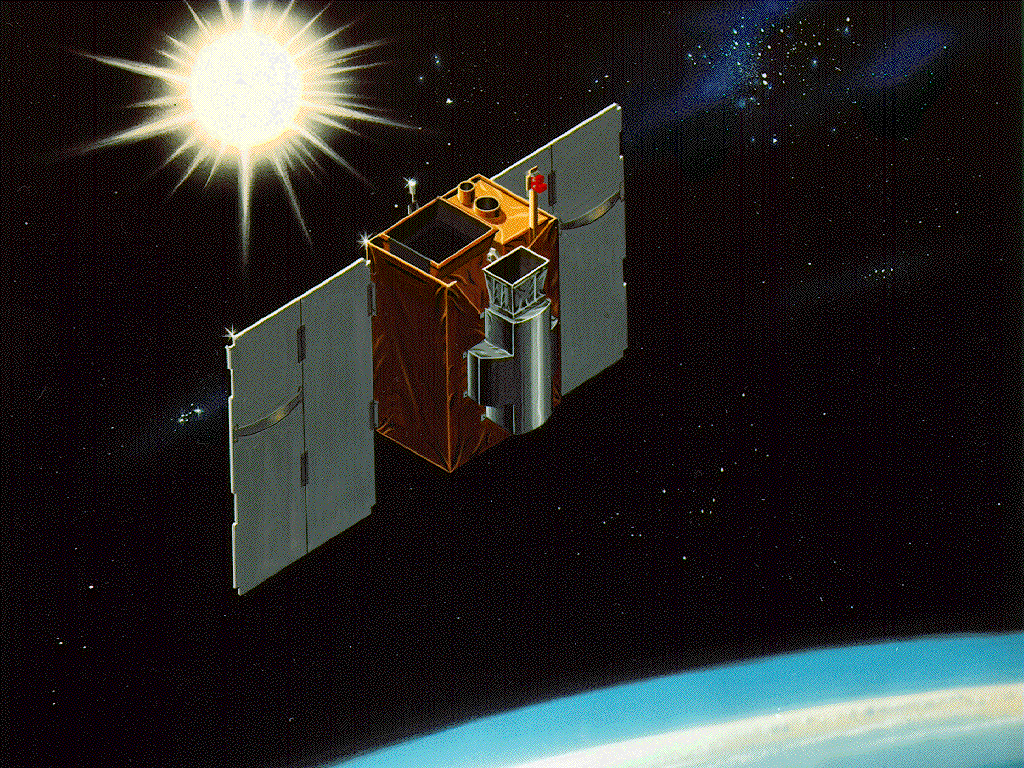
Image above: An artist's rendition of the Solar, Anomalous, and Magnetospheric Particle Explorer or SAMPEX. Credit: NASA.
NASA's very first small explorer, the Solar, Anomalous, and Magnetospheric Particle Explorer or SAMPEX, was launched July 3, 1992 to study the zoo of particles and cosmic rays surrounding Earth. Surviving much longer than its expected mission of three years and providing invaluable observations for those who study space weather, the SAMPEX mission is now almost over. In early November, the spacecraft's orbit will decay enough that it will re-enter Earth's atmosphere, burning up completely on re-entry. When SAMPEX launched, the sun was just finishing the peak of its 11-year solar cycle and beginning to move toward solar minimum. Scientists were eager to watch what happened in near-Earth space in those first few years, as eruptions on the sun shot out energy and solar material and eventually tapered down into a period of quiet. However, those same effects were also predicted to lead to the spacecraft's demise. As the sun once again ramped up to solar maximum around 2000, the sun's output would create enough atmospheric drag that SAMPEX was expected to tumble out of its stable orbit. Contrary to such predictions, SAMPEX is still in orbit having survived that maximum and continuing in orbit long enough to see the sun move toward another solar max, currently predicted for 2013. But time is running out. As the atmosphere near Earth heats and swells in response to the sun's activity, the expansion of the uppermost atmosphere has encased SAMPEX, slowing it down. Soon the 20-year-old spacecraft will succumb to the very space weather it has helped scientists to study. Some time at the end of 2012, the orbit of the five-by-three-foot craft will spiral far enough in that SAMPEX will re-enter Earth's atmosphere, burning up completely and disappearing forever. "SAMPEX was launched on a shoe string budget," says Shri Kanekal, a space weather scientist at NASA's Goddard Space Weather Center in Greenbelt, Md. who has been involved with SAMPEX research since its launch. "It was proposed as a minimum one-year mission with a goal of three years, but it lasted for an unexpectedly long time. It has provided 20 years of high quality data, used by nearly everyone who studies near-Earth space." In its two decades, SAMPEX provided one of the main sources of data on how the radiation environment around Earth changed over time, waxing and waning in response to incoming particles from the sun and galaxy.
Image above: SAMPEX data have provided some of the most useful observations of the Van Allen Belts -- two rings of radiation around Earth. This SAMPEX data shows the belts during what's known as the Halloween Storms in October 2003, a time when the radiation belts around Earth swelled so much that they merged into a single ring. Credit: NASA/Goddard Space Flight Center . 
SAMPEX confirmed earlier theories that cosmic rays streaming in from outer space were being trapped in Earth's own magnetic environment, the magnetosphere, and it helped pinpoint the location where they gathered in a belt around Earth. Another area of research has been to tease out the composition of various particle populations from high-speed and high-energy particles from the sun known as solar energetic particles, to the host of electrons in Earth's middle atmosphere. Also, SAMPEX has been one of our best eyes on the radiation belts – two giant donuts of radiation surrounding Earth that can affect satellites in orbit during their occasional bouts of swelling. Indeed, scientists are eager for SAMPEX data still, eking out the last weeks of observation time to compare with early data from the Radiation Belt Storm Probes (RBSP) mission that launched in August, 2012. When those who study the radiation belts realized how imminent was the demise of SAMPEX, they adjusted the schedule to turn on a SAMPEX-compatible instrument aboard RBSP, an instrument called Relativistic Electron Proton Telescope (REPT), earlier than planned. One of the space phenomena that SAMPEX has helped categorize is something called microbursts, an intense but short lived phase during which electrons drop out of the radiation belts. From its viewpoint under the radiation belts, SAMPEX can still record such microbursts. As part of RBSP, on the other hand, REPT can look at the electron population while traveling through the radiation belts proper. In combination, the data may help show what occurrences in the radiation belts correlate to the rain of electrons, the microbursts. "Since one of the main goals of RBSP is to understand why and how electrons rain down out of the radiation belts, this will be important science," says Kanekal. "It's made all the more impressive that we can do this kind of research despite the fact that SAMPEX's science mission officially ended in 2004." Although the spacecraft has remained in orbit, the official SAMPEX science mission ended in June 2004. New data remained available, however, thanks to The Aerospace Corporation of El Segundo, Calif., which continued to fund costs to download data, and to Bowie State University in Bowie, Md., which operated the spacecraft to maintain the download process as an educational tool for its students. Kanekal was also instrumental in getting a grant to process all the data from 2004 to 2012, so it will be usable by the science community. NASA's first small explorer had an impressive run, far outliving its planned three-year mission. It provided data crucial to understanding how the space around Earth responds to space weather from the sun and will continue to do so up until the moment it re-enters Earth's atmosphere, disappearing forever. NASA's SAMPEX Mission: http://science.nasa.gov/missions/sampex/, The SAMPEX Data Center: http://www.srl.caltech.edu/sampex/DataCenter/, Images (mentioned), Text, Credit: NASA Goddard Space Flight Center / Karen C. Fox., Greetings, Source: Orbiter.ch Space News
Read More........

Lunar orbiter captures huge crater on moon

In this handout picture released late November 14, 2008, shows the surface of the moon taken by Moon Impact Probe shortly before landing after separation from India's Chandrayaan-1 spacecraft.
Hindustan Times, London, ANI: NASA’s Lunar Reconnaissance Orbiter has captured shots of a massive Aristarchus crater on moon, which is even visible to the naked eye. The space probe flew over the moon at just 16.2 miles up to take shots of the crater that was created when a huge comet or asteroid slammed into a plateau on the surface. Sixteen miles up is just over twice the height that jets fly on Earth. The cliffs of the Aristarchus crater are two miles high twice as deep as the Grand Canyon with layers of minerals exposed by the huge impact tumbling into the crater below, the Daily Mail reported. The archaeology of the mammoth crater almost resembles a Strip Mine on earth cutting deep into the layers of minerals on the moon. The planners of Apollo missions had placed Aristarchus crater high on their list of targets for human exploration on the moon. Aristarchus crater is situated on the southeast edge of the Aristarchus Plateau. The floor of Aristarchus crater provides explorers a unique opportunity to study a great variety of lunar rocks and geologic processes, perhaps including how lunar granite forms.Source: Hindustan Times
Read More........

Russian moonshot dream revived

БураМRussia’s Energia Space Corporation has proposed a joint project with Kazakhstan and Ukraine to launch missions to the Moon. It says it could contribute its heavy rocket that launched the Soviet Buran space shuttle. Ukraine could contribute side boosters for this rocket, and Kazakhstan, facilities at its Baikonur spaceport.The proposed system would lift about 70 tons to low Earth orbit. Tags: Energia corporation , Sci-Tech, News, Russia, World, spacecraft, ЧОтать Ўалее, Source: Voice of Russia.
Read More........

India launches GSAT-10 successfully

An Ariane 5 rocket carrying two satellites, ASTRA 2F and GSAT-10, blasts off from the European space centre of Kourou, French Guiana. AFP/CNES/CSG/S Martin
India's advanced communication satellite GSAT-10 that would augment telecommunication, direct-to-home broadcasting and radio navigation services was successfully launched early on Saturday on board Ariane-5 rocket from Europe's spaceport in French Guiana in South America. At the end of a smooth countdown lasting 11 hours and 30 minutes, Ariane-5 ECA rocket injected GSAT-10 into an elliptical Geosynchronous Transfer Orbit (GTO), very close to the intended one, after a flight of 30 minutes and 45 seconds, Indian Space Research Organisation said. At 3,400kg at lift-off, GSAT-10 is the heaviest built by Bangalore-headquartered Isro. GSAT-10 project is a Rs. 750 crore mission that includes the cost of satellite, launch services by the European space consortium Arianespace and insurance. Soon after GSAT-10 was hurtled into space, Isro's Master Control Facility (MCF) at Hassan in Karnataka took over the command and control of the satellite and declared the launch of Indian space agency's 101st space mission a success. "The satellite is in good health," Isro said after checks on various subsystems of the spacecraft, adding all its parameters were satisfactory. Blasting off from the launch pad at 2.48am (IST), Arianespace's rocket first injected European co-passenger ASTRA 2F into orbit followed by GSAT-10. With a 15-year design life, GSAT-10 is expected to be operational by November and will augment telecommunication, DTH and radio navigation services by adding 30 more to the much-in-demand transponder capacity, now hit by a crunch. Isro chairman K Radhakrishnan, who was at MCF at Hassan at the launch, said, "By November 2012, we expect to operationalise GSAT-10 and make it available to the user community. GSAT-10 is fitted with 30 transponders (12 Ku-band, 12 C-band and six Extended C-Band), which will provide vital augmentation to INSAT/GSAT transponder capacity. With a scramble for transponders, India is now managing a significant part of its requirement by leasing foreign transponders to meet the domestic demand. GSAT-10 also has a navigation payload – GAGAN (GPS aided Geo Augmented Navigation) -- that would provide improved accuracy of GPS signals (of better than seven metres) to be used by Airports Authority of India for civil aviation requirements. This is the second satellite in INSAT/GSAT constellation with GAGAN payload after GSAT-8, launched in May 2011. GSAT-10 was originally scheduled for a Sept 22 launch, but was deferred after scientists detected a small glitch --one gram of dust -- in the upper part of the rocket. GSAT-10 project director TK Anuradha, additional secretary of department of Space, S Srinivasan and director of Isro Satellite Centre SK Shivakumar were among key Isro officials who were in French Guiana for the launch. Shivakumar said GSAT-10 would give an impetus to the 'communication revolution' in India.Arianespace chairman & CEO Jean-Yves Le Gall said at the launch base that Isro is a highly loyal customer, as the collaboration with it began more than 30 years ago with its Apple satellite's orbiting by the third flight of an Ariane vehicle – an Ariane 1 version launched in June 1981. In the coming five days, orbit raising manoeuvres will be performed to place the satellite in the Geostationary Orbit with required inclination with reference to the equator, Isro said. The satellite will be moved to the Geostationary Orbit (36,000km above the equator) by using the satellite propulsion system in a three step approach. After the completion of orbit raising operations, the two solar panels and both the dual gridded antenna reflectors of GSAT-10 will be deployed for further tests and operations. It is planned to experimentally turn on the communication payloads in the second week of October, Isro said. After the successful completion of all in-orbit tests, GSAT-10 will be ready for operational use by November. GSAT-10 will be positioned at 83 deg East orbital location along with INSAT-4A and GSAT-12.Source: Hindustan Times
Read More........

Juno's Two Deep Space Maneuvers are 'Back-To-Back Home Runs'

NASA's Juno spacecraft successfully executed a second Deep Space Maneuver, called DSM-2 last Friday, September 14. The 30 minute firing of its main engine refined the Jupiter-bound spacecraft's trajectory, setting the stage for a gravity assist from a flyby of Earth on October 9, 2013. Juno will arrive at Jupiter on July 4, 2016. The maneuver began at 3:30 p.m. PDT (6:30 p.m. EDT), when the Leros-1b main engine began to fire. The burn ended at 4 p.m. PDT (7 p.m. EDT). Based on telemetry, the Juno project team believes the burn was accurate, changing the spacecraft's velocity by about 867 mph (388 meters a second) while consuming about 829 pounds (376 kilograms) of fuel. The burn occurred when Juno was more than 298 million miles (480 million kilometers) from Earth. Juno executed its first deep space maneuver (DSM-1), one of comparable duration and velocity change, on August 30. Together, both maneuvers placed Juno on course for its Earth flyby, which will occur as the spacecraft is completing one elliptical orbit around the sun. The Earth flyby will boost Juno's velocity by 16,330 mph (about 7.3 kilometers per second), placing the spacecraft on its final flight path for Jupiter. The closest approach to Earth, on October 9, 2013, will occur when Juno is at an altitude of about 348 miles (560 kilometers). "It feels like we hit back-to-back home runs here with the near-flawless propulsion system performance seen during both DSM-1 and DSM-2." said Juno Project Manager Rick Nybakken of NASA's Jet Propulsion Laboratory in Pasadena, California. "These successes move us closer to being ready for our most critical mission event, the Jupiter Orbit Insertion main engine burn in July 2016. We're not in the playoffs yet, as that will come in 2016 when we arrive at Jupiter, but it does feel fantastic to have hit both of these DSMs out of the park." Juno was launched on August 5, 2011. Once in orbit, the spacecraft will circle Jupiter 33 times, from pole to pole, and use its collection of eight science instruments to probe beneath the gas giant's obscuring cloud cover. Juno's science team will learn about Jupiter's origins, structure, atmosphere and magnetosphere, and look for a potential solid planetary core. Juno's name comes from Greek and Roman mythology. The god Jupiter drew a veil of clouds around himself to hide his mischief, and his wife, the goddess Juno, was able to peer through the clouds and reveal Jupiter's true nature. Illustration credit: NASA/JPL-Caltech, Source: Minsex
Read More........

NASA to launch another Mars mission in 2016

WASHINGTON: Encouraged by the success of “Curiosity”, NASA has announced to launch a new Mars mission in 2016 to take a better look into the guts of the Red Planet. The mission called “InSight” will investigate why Mars’ crust is not divided into tectonic plates that drift like Earth’s. Detailed knowledge of the interior of Mars in comparison to Earth will help scientists understand better how terrestrial planets form and evolve, the American space agency said. “The exploration of Mars is a top priority for NASA, and the selection of ‘InSight’ ensures we will continue to unlock the mysteries of the Red Planet and lay the groundwork for a future human mission there,” said NASA administrator Charles Bolden. “The recent successful landing of the Curiosity rover has galvanised public interest in space exploration and today’s announcement makes clear there are more exciting Mars missions to come,” he said referring to the success of Curiosity. The 12th selection in NASA’s series of Discovery-class missions, ‘InSight’ is build on spacecraft technology used in the space agency’s highly successful Phoenix lander mission, which was launched to the Red Planet in 2007 and determined water existed near the surface in the Martian polar regions. “Our Discovery Programme enables scientists to use innovative approaches to answering fundamental questions about our solar system in the lowest cost mission category,” said John Grunsfeld, associate administrator for the Science Mission Directorate at NASA Headquarters. “’InSight’ will get to the ‘core’ of the nature of the interior and structure of Mars, well below the observations we’ve been able to make from orbit or the surface,” Grunsfeld said. Source: Punjab News
Read More........

Mapping the Heliosphere

Minsex: Data from NASA's Cassini spacecraft have enabled scientists to create this map of the heliosphere, the bubble of charged particles around our Sun. Charged particles stream out from our Sun in a phenomenon known as solar wind. The solar wind interacts with the matter between stars, which is known as the interstellar medium. The mingling of interstellar medium and solar wind creates particles called energetic neutral atoms, which stream back towards the Sun. The ion and neutral camera on Cassini's magnetospheric imaging instrument detects energetic neutral atoms. This map shows those in the range of 5,200 to 13,500 electron volts. The regions with the highest intensity of particles are red and those with the lowest intensity of particles are blue. Cassini detects a different spectrum of energetic neutral atoms than NASA's Interstellar Boundary Explorer (IBEX) does. The IBEX images show lower-energy particles. NASA's Voyager mission collects data on energetic ions in the region that is the source of the energetic neutral atoms.The area where IBEX found a ribbon of high-intensity particles is outlined in white. The locations of Voyager 1 and Voyager 2 are indicated with the labels "V1" and "V2." The label "nose" indicates the direction that our solar system is traveling through the interstellar medium. The label "tail" indicates the region in the direction opposite the nose. Image credit: NASA/JPL/JHUAPL Source: Minsex
Read More........

Cassini Shows Why Jet Streams Cross-Cut Saturn

Image above: A particularly strong jet stream churns through Saturn's northern hemisphere in this false-color view from NASA's Cassini spacecraft. Image credit: NASA/JPL-Caltech/SSI.
Turbulent jet streams, regions where winds blow faster than in other places, churn east and west across Saturn. Scientists have been trying to understand for years the mechanism that drives these wavy structures in Saturn's atmosphere and the source from which the jets derive their energy. In a new study appearing in the June edition of the journal Icarus, scientists used images collected over several years by NASA's Cassini spacecraft to discover that the heat from within the planet powers the jet streams. Condensation of water from Saturn's internal heating led to temperature differences in the atmosphere. The temperature differences created eddies, or disturbances that move air back and forth at the same latitude, and those eddies, in turn, accelerated the jet streams like rotating gears driving a conveyor belt. A competing theory had assumed that the energy for the temperature differences came from the sun. That is how it works in the Earth's atmosphere. "We know the atmospheres of planets such as Saturn and Jupiter can get their energy from only two places: the sun or the internal heating. The challenge has been coming up with ways to use the data so that we can tell the difference," said Tony Del Genio of NASA's Goddard Institute for Space Studies, N.Y., the lead author of the paper and a member of the Cassini imaging team. The new study was possible in part because Cassini has been in orbit around Saturn long enough to obtain the large number of observations required to see subtle patterns emerge from the day-to-day variations in weather. "Understanding what drives the meteorology on Saturn, and in general on gaseous planets, has been one of our cardinal goals since the inception of the Cassini mission," said Carolyn Porco, imaging team lead, based at the Space Science Institute, Boulder, Colo. "It is very gratifying to see that we're finally coming to understand those atmospheric processes that make Earth similar to, and also different from, other planets." Rather than having a thin atmosphere and solid-and-liquid surface like Earth, Saturn is a gas giant whose deep atmosphere is layered with multiple cloud decks at high altitudes. A series of jet streams slice across the face of Saturn visible to the human eye and also at altitudes detectable to the near-infrared filters of Cassini's cameras. While most blow eastward, some blow westward. Jet streams occur on Saturn in places where the temperature varies significantly from one latitude to another. Thanks to the filters on Cassini's cameras, which can see near-infrared light reflected to space, scientists now have observed the Saturn jet stream process for the first time at two different, low altitudes. One filtered view shows the upper part of the troposphere, a high layer of the atmosphere where Cassini sees thick, high-altitude hazes and where heating by the sun is strong. Views through another filter capture images deeper down, at the tops of ammonia ice clouds, where solar heating is weak but closer to where weather originates. This is where water condenses and makes clouds and rain. In the new study, which is a follow-up to results published in 2007, the authors used automated cloud tracking software to analyze the movements and speeds of clouds seen in hundreds of Cassini images from 2005 through 2012. "With our improved tracking algorithm, we've been able to extract nearly 120,000 wind vectors from 560 images, giving us an unprecedented picture of Saturn's wind flow at two independent altitudes on a global scale," said co-author and imaging team associate John Barbara, also at the Goddard Institute for Space Studies. The team's findings provide an observational test for existing
This figure (above) examines a particularly strong jet stream and the eddies that drive it through the atmosphere of Saturn's northern hemisphere. Image credit: NASA/JPL-Caltech/SSI.
models that scientists use to study the mechanisms that power the jet streams. By seeing for the first time how these eddies accelerate the jet streams at two different altitudes, scientists found the eddies were weak at the higher altitudes where previous researchers had found that most of the sun's heating occurs. The eddies were stronger deeper in the atmosphere. Thus, the authors could discount heating from the sun and infer instead that the internal heat of the planet is ultimately driving the acceleration of the jet streams, not the sun. The mechanism that best matched the observations would involve internal heat from the planet stirring up water vapor from Saturn's interior. That water vapor condenses in some places as air rises and releases heat as it makes clouds and rain. This heat provides the energy to create the eddies that drive the jet streams. The condensation of water was not actually observed; most of that process occurs at lower altitudes not visible to Cassini. But the condensation in mid-latitude storms does happen on both Saturn and Earth. Storms on Earth – the low- and high-pressure centers on weather maps – are driven mainly by the sun's heating and do not mainly occur because of the condensation of water, Del Genio said. On Saturn, the condensation heating is the main driver of the storms, and the sun's heating is not important. Images of one of the strongest jet streams and a figure from the paper can be found at http://www.nasa.gov/cassini ,http://saturn.jpl.nasa.gov and http://ciclops.org . The Cassini-Huygens mission is a cooperative project of NASA, the European Space Agency and the Italian Space Agency. The Jet Propulsion Laboratory, a division of the California Institute of Technology in Pasadena, manages the Cassini-Huygens mission for NASA's Science Mission Directorate, Washington. The Cassini orbiter and its two onboard cameras were designed, developed and assembled at JPL. The imaging team is based at the Space Science Institute in Boulder, Colo. Images (mentioned), Credits: NASA's Goddard Space Flight Center / Bill Steigerwald / Nancy Neal Jones / Space Science Institute / Joe Mason / JPL / Jia-Rui C. Cook.Orbiter.ch Space News: Source: Orbiter Chspace
Read More........

A Surprisingly Bright Superbubble

This composite image shows a superbubble in the Large Magellanic Cloud (LMC), a small satellite galaxy of the Milky Way located about 160,000 light years from Earth. Many new stars, some of them very massive, are forming in the star cluster NGC 1929, which is embedded in the nebula N44, so named because it is the 44th nebula in a catalog of such objects in the Magellanic Clouds. The massive stars produce intense radiation, expel matter at high speeds, and race through their evolution to explode as supernovas. The winds and supernova shock waves carve out huge cavities called superbubbles in the surrounding gas. X-rays from NASA's Chandra X-ray Observatory (blue) show hot regions created by these winds and shocks, while infrared data from NASA's Spitzer Space Telescope (red) outline where the dust and cooler gas are found. The optical light from the 2.2-m Max-Planck-ESO telescope (yellow) in Chile shows where ultraviolet radiation from hot, young stars is causing gas in the nebula to glow. A long-running problem in high-energy astrophysics has been that some superbubbles in the LMC, including N44, give off a lot more X-rays than expected from models of their structure. These models assume that hot, X-ray emitting gas has been produced by winds from massive stars and the remains of several supernovas. A Chandra study published in 2011 showed that there are two extra sources of N44’s X-ray emission not included in these models: supernova shock waves striking the walls of the cavities, and hot material evaporating from the cavity walls. The Chandra observations also show no evidence for an enhancement of elements heavier than hydrogen
Chandra X-ray Observatory
and helium in the cavities, thus ruling out this possibility as a third explanation for the bright X-ray emission. Only with long observations making full use of the capabilities of Chandra has it now become possible to distinguish between different sources of the X-rays produced by superbubbles. The Chandra study of N44 and another superbubble in the LMC was led by Anne Jaskot from the University of Michigan in Ann Arbor. The co-authors were Dave Strickland from Johns Hopkins University in Baltimore, MD, Sally Oey from University of Michigan, You-Hua Chu from University of Illinois and Guillermo Garcia-Segura from Instituto de Astronomia-UNAM in Ensenada, Mexico. NASA's Marshall Space Flight Center in Huntsville, Ala., manages the Chandra program for NASA's Science Mission Directorate in Washington. The Smithsonian Astrophysical Observatory controls Chandra's science and flight operations from Cambridge, Mass. Read more/access all images: http://chandra.harvard.edu/photo/2012/n1929/, Chandra's Flickr photoset: http://www.flickr.com/photos/nasamarshall/sets/72157606205297786/, Images, Text, Credits: Credits: X-ray: NASA/CXC/U.Mich./S.Oey, IR: NASA/JPL, Optical: ESO/WFI/2.2-m. ,Greetings, Orbiter.ch, Source: Orbiter.ch Space News
Read More........

The Large Magellanic Cloud in Infrared

Minsex: This image shows the Large Magellanic Cloud galaxy in infrared light as seen by the Herschel Space Observatory, a European Space Agency-led mission with important NASA contributions, and NASA'sSpitzer Space Telescope. In the instruments' combined data, this nearby dwarf galaxy looks like a fiery, circular explosion. Rather than fire, however, those ribbons are actually giant ripples of dust spanning tens or hundreds of light-years. Significant fields of star formation are noticeable in the center, just left of center and at right. The brightest center-left region is called 30 Doradus, or the Tarantula Nebula, for its appearance in visible light. The colors in this image indicate temperatures in the dust that permeates the Cloud. Colder regions show where star formation is at its earliest stages or is shut off, while warm expanses point to newstars heating surrounding dust. The coolest areas and objects appear in red, corresponding to infrared light taken up by Herschel's Spectral and Photometric Imaging Receiver at 250 microns, or millionths of a meter. Herschel's Photodetector Array Camera and Spectrometer fills out the mid-temperature bands, shown here in green, at 100 and 160 microns. The warmest spots appear in blue, courtesy of 24- and 70-micron data from. Photo credit: ESA/NASA/JPL-Caltech/STScI, Spitzer.Source: Minsex
Read More........

India launches 100th space mission successfully


Making history in its space odyssey, India on Sunday successfully launched its 100th mission with its workhorse PSLV-C21 placing in orbit two foreign satellites in a flawless flight from the spaceport here. The third wholly commercial launch with no Indian satellite was a textbook mission as ISRO's Polar Satellite Launch Vehicle placed in orbit French spacecraft SPOT 6 and Japanese micro satellite Proiteres some 18 minutes after lift-off at 9.53 am.The lift-off was delayed by two minutes at the end of the 51-hour countdown to avoid collision with space debris. The historic mission was described as a 'spectacular success' by Prime Minister Manmohan Singh, who keenly watched the launch sequence at the mission control centre at Satish Dhawan Space Centre here, about 110 km from Chennai. "I warmly congratulate the Department of Space and all members of Indian Space Research Organisation fraternity for this spectacular success," he told the scientists minutes after the successful launch. Describing the mission as a milestone  in  the  nation's space capabilities, he said the launch was 'testimony to the commercial competitiveness of the Indian space industry and is a tribute to Indian innovation and ingenuity'. A beaming ISRO chief K. Radhakrishnan told the post-launch media conference that with today's successful mission the agency has launched 62 satellites, one space recovery module and 37 rockets, making it a grand 100. Each Indian rocket going up is considered a mission as also each Indian satellite being placed in orbit. The 44-metre PSLV took off on its 22nd flight, zoomed into the overcast skies carrying the French satellite with a lift-off mass of 712 kg, the heaviest ever to be launched by India for an international client, and the 15 kg Japanese micro spacecraft. The mission was a historic landmark for ISRO in its five- decade old space programme since beginning on a humble note with the launch of the indigenous 'Aryabhatta' on board a Russian rocket on April 19, 1975. PSLV yet again proved its versatility and robustness scripting its 21st successful mission in a row after its first flight in September 1993 ended in a failure. SPOT-6 is the biggest commercial lift so far since India forayed into the multi-billion dollar global commercial satellite launch market after 350 kg Agile of Italy, put in orbit in 2007 by PSLV. Twelve other foreign commercial satellites launched by ISRO weighed below 300 kg. Significantly, France's five earlier SPOT satellites were launched by European Araine rocket. SPOT-6 is an earth observation satellite, while Proiteres is intended to observe Kansai district of Japan through high-resolution camera. Radhakrishnan said the launch originally scheduled for 9.51 am was adjusted to 9.53 am following analysis of space debris for the past few days. According to American space agency NASA, over 500,000 pieces of debris or 'space junk' are tracked as they orbit the Earth. The debris, which travel at speed up to 17,500 mph, could damage a satellite or a spacecraft. Radhakrishnan declined to divulge the cost of today's mission, saying it was paid by the customers. Mission director Kunhali Krishnan termed the launch a 'grand success' and said all four stages of the rocket performed 'exceedingly well'.  Source: Deccan Chronicle
Read More........

NASA Curiosity Rover Begins Eastbound Trek on Martian Surface

Image above: Soil clinging to the right middle and rear wheels of NASA's Mars rover Curiosity can be seen in this image taken by the Curiosity's Navigation Camera after the rover's third drive on Mars. Image credit: NASA/JPL-Caltech.
NASA's Mars rover Curiosity has set off from its landing vicinity on a trek to a science destination about a quarter-mile (400 meters) away, where it may begin using its drill. The rover drove eastward about 52 feet (16 meters) on Tuesday, its 22nd Martian day after landing. This third drive was longer than Curiosity's first two drives combined. The previous drives tested the mobility system and positioned the rover to examine an area scoured by exhaust from one of the Mars Science Laboratory spacecraft engines that placed the rover on the ground. "This drive really begins our journey toward the first major driving destination, Glenelg, and it's nice to see some Martian soil on our wheels," said mission manager Arthur Amador of NASA's Jet Propulsion Laboratory (JPL) in Pasadena, Calif. "The drive went beautifully, just as our rover planners designed it." Glenelg is a location where three types of terrain intersect. Curiosity's science team chose it as a likely place to find a first rock target for drilling and analysis. "We are on our way, though Glenelg is still many weeks away," said Curiosity Project Scientist John Grotzinger of the
Image above: On Aug. 28, 2012, during the 22nd Martian day, or sol, after landing on Mars, NASA's Curiosity rover drove about 52 feet (16 meters) eastward, the longest drive of the mission so far. Image credit: NASA/JPL-Caltech.
California Institute of Technology (Caltech) in Pasadena. "We plan to stop for just a day at the location we just reached, but in the next week or so we will make a longer stop." During the longer stop at a site still to be determined, Curiosity will test its robotic arm and the contact instruments at the end of the arm. At the location reached Tuesday, Curiosity's Mast Camera (Mastcam) will collect a set of images toward the mission's ultimate driving destination, the lower slope of nearby Mount Sharp. A mosaic of images from the current location will be used along with the Mastcam images of the mountain taken at the spot where Curiosity touched down, Bradbury Landing. This stereo pair taken about 33 feet (10 meters) apart will
Mars Science Laboratory (MSL). Image credit: NASA/JPL-Caltech
provide three-dimensional information about distant features and possible driving routes. Curiosity is three weeks into a two-year prime mission on Mars. It will use 10 science instruments to assess whether the selected study area ever has offered environmental conditions favorable for microbial life. JPL, a division of Caltech, manages the mission for NASA's Science Mission Directorate in Washington.More information about Curiosity is online at: http://www.nasa.gov/msl and http://mars.jpl.nasa.gov/msl You can follow the mission on Facebook and on Twitter at: http://www.facebook.com/marscuriosity andhttp://www.twitter.com/marscuriosity Images (mentioned), Text, Credits: NASA / Dwayne Brown / JPL / Guy Webster / D.C. Agle. Greetings, Orbiter.ch, Source: Orbiter.ch Space News
Read More........

NASA's Kepler Discovers Multiple Planets Orbiting a Pair of Stars

Image above: Sharing the Light of Two Suns: This artist's concept illustrates Kepler-47, the first transiting circumbinary system. Credit: NASA/JPL-Caltech/T. Pyle.
Coming less than a year after the announcement of the first circumbinary planet, Kepler-16b, NASA's Kepler mission has discovered multiple transiting planets orbiting two suns for the first time. This system, known as a circumbinary planetary system, is 4,900 light-years from Earth in the constellation Cygnus. This discovery proves that more than one planet can form and persist in the stressful realm of a binary star and demonstrates the diversity of planetary systems in our galaxy. Astronomers detected two planets in the Kepler-47 system, a pair of orbiting stars that eclipse each other every 7.5 days from our vantage point on Earth. One star is similar to the sun in size, but only 84 percent as bright. The second star is diminutive, measuring only one-third the size of the sun and less than 1 percent as bright. "In contrast to a single planet orbiting a single star, the planet in a circumbinary system must transit a 'moving target.' As a consequence, time intervals between the transits and their durations can vary substantially, sometimes short, other times long," said Jerome Orosz, associate professor of astronomy
Graphic above: Orbiting in the Habitable Zone of Two Suns: This diagram compares our own solar system to Kepler-47, a double-star system containing two planets, one orbiting in the so-called "habitable zone." Credit: NASA/JPL-Caltech/T. Pyle.
at San Diego State University and lead author of the paper. "The intervals were the telltale sign these planets are in circumbinary orbits."The inner planet, Kepler-47b, orbits the pair of stars in less than 50 days. While it cannot be directly viewed, it is thought to be a sweltering world, where the destruction of methane in its super-heated atmosphere might lead to a thick haze that could blanket the planet. At three times the radius of Earth, Kepler-47b is the smallest known transiting circumbinary planet. The outer planet, Kepler-47c, orbits its host pair every 303 days, placing it in the so-called "habitable zone," the region in a planetary system where liquid water might exist on the surface of a planet. While not a world
Image above: The planets Kepler-47b and Kepler-47c: Kepler-47b has three times the radius of earth and orbits the pair of stars in less than 50 days while Kepler-47c is thought to be a gaseous giant, slightly larger than Neptune with an orbital period of 303 days. Credit: NASA/JPL-Caltech/T. Pyle.
hospitable for life, Kepler-47c is thought to be a gaseous giant slightly larger than Neptune, where an atmosphere of thick bright water-vapor clouds might exist. "Unlike our sun, many stars are part of multiple-star systems where two or more stars orbit one another. The question always has been -- do they have planets and planetary systems? This Kepler discovery proves that they do," said William Borucki, Kepler mission principal investigator at NASA's Ames Research Center in Moffett Field, Calif. "In our search for habitable planets, we have found more opportunities for life to exist." To search for transiting planets, the research team used data from the Kepler space telescope, which measures dips in the brightness of more than 150,000 stars. Additional ground-based spectroscopic observations using telescopes at the McDonald Observatory at the University of Texas at Austin helped characterize the
Video above: NASA's Kepler Mission Discovers Multiple Planets Orbiting Twin Suns. Credit: NASA/JPL-Caltech/T. Pyle.
stellar properties.The findings are published in the journal Science. "The presence of a full-fledged circumbinary planetary system orbiting Kepler-47 is an amazing discovery," said Greg Laughlin, professor of Astrophysics and Planetary Science at the University of California in Santa Cruz. "These planets are very difficult to form using the currently accepted paradigm, and I believe that theorists, myself included, will be going back to the drawing board to try to improve our understanding of how planets are assembled in dusty circumbinary disks." Ames manages Kepler's ground system development, mission operations and science data analysis. NASA's Jet Propulsion Laboratory in Pasadena, Calif., managed the Kepler mission development. Ball Aerospace & Technologies Corp. in Boulder, Colo., developed the Kepler flight system and supports mission operations with the Laboratory for Atmospheric and Space Physics at the University of Colorado in Boulder. The Space Telescope Science Institute in Baltimore archives, hosts and distributes Kepler science data. Kepler is NASA's tenth Discovery Mission and funded by NASA's Science Mission Directorate at the agency's headquarters in Washington. For more information about Kepler mission, visit: http://www.nasa.gov/mission_pages/kepler/main/index.html Images (mentioned), Video (mentioned), Text, Credits: NASA / J.D. Harrington / Ames Research Center / Michele Johnson. Best regards, Orbiter.ch, Source: Orbiter.ch Space News
Read More........