Brain Controlled Flight Advancing in Europe

© Brainflight
An EU-funded project has flown a drone controlled from the ground using only a person's brainwaves. The technology could one day make it easier to pilot larger aircraft, such as cargo jets, and result in safer airways, say the project's researchers. The BRAINFLIGHT project’s demonstration of a control system to interpret a humans brain signals and convert them into commands took place at a small airport near Lisbon, Portugal in May 2014. An operator wearing a skin-tight head cap that picks up electric signals from brain activity was able to control the drone's path by thinking about the movements he wanted it to take during the live test. The drone was a specially equipped model of a plane about half the length of a human. Essentially, the electricity flowing through a pilot's brain acts as an input to the drone's control system to follow a flight path, says project coordinator Andre Oliveira, of Tekever in Portugal. The demonstration results suggest that the technology could eventually be used to help pilots fly small aeroplanes and even large cargo jets more efficiently – increasing safety in the air. A more developed system, once authorised for use, could allow pilots to concentrate more than is currently possible on evaluating their current flight situation, while another part of their brain focuses simultaneously on controlling the plane. The system, in effect, transforms thoughts into an additional ‘hand’, or way to control flight. The project suggests that larger jets, such as cargo planes, could even be controlled this way without the need for a crew on board. But a fully developed system would take some time before it could become operational “during this century”, says Oliveira. Much more development work is needed, along with testing and regulatory clearance, before it can be put into commercial use. “This is an amazing high-risk and high-payoff project, with a long-term impact that will require a lot more development,” he adds. “We truly believe that BRAINFLIGHT represents the beginning of a tremendous step change in the aviation field, empowering pilots and reducing risks.” From theory to flight An increasing proportion of a pilot’s workload is related to managing flight, which requires checking instruments, verifying aircraft systems, navigating, observing the surroundings, and carrying out a number of pre-defined procedures – all while flying an aircraft. When pilots have to do both types of activities at the same time, such as when landing or flying in poor visibility, they need to divide their attention and cognitive skills between thosedifferent activities and become more prone to making errors, says Oliveira. BRAINFLIGHT based its research on previous studies that revealed how the brain’s neuron activity is capable of providing enough data to enable the control of electronic devices. The researchers adapted high-performance electroencephalogram (EEG) technology so it could issue instructions to software that can guide an aircraft. The project also investigated the best approaches to train pilots to use the technology. Test subjects were trained to use the system over a number of months until they were able to control a circle on a computer screen, moving it up or down using only their thoughts, simulating steering a drone. The subjects then successfully tested the system in a flight simulator for the Diamond DA42, a four-seat, propeller-driven aircraft. The later demonstration in Portugal using a drone controlled by a pilot on the ground marked the project’s conclusion in May 2014. Tekever is continuing to develop the demonstration system. The company says it believes people will eventually be able to “pilot aircraft just like they perform everyday activities like walking or running”. The technology could be adapted in the short term to enable people with physical disabilities to control aircraft, opening the way for them to become pilots, says Oliveira. The pilot is wearing a white cap with myriad attached cables. His gaze is concentrated on the runway ahead of him. All of a sudden the control stick starts to move, as if by magic. The airplane banks and then approaches straight on towards the runway. The position of the plane is corrected time and again until the landing gear gently touches down. DURING Maneuver the Entire Touches Neither the pilot Pedals nor controls. This is not A scene from A Science Fiction Movie, But rather the rendition of A test at the Institute for Flight System Dynamics of the Technische Universität München (TUM). Scientists working for Professor Florian Holzapfel are researching ways in which brain controlled flight might work in the EU-funded project "Brainflight." "A long-term vision of the project is to make flying accessible to more people," explains aerospace engineer Tim Fricke, who heads the project at TUM. "With brain control, flying, in itself, could become easier. This would reduce the work load of pilots and thereby increase safety. In addition, pilots would have more freedom of movement to manage other manual tasks in the cockpit." Another area of application is advanced prosthetics – the technology could enable people with severe physical disabilities to interact with their surroundings more easily. The project results could also be adapted to control other complex systems, like cars, boats and trains, says Oliveira. Contacts and sources: Research and Innovation: European Commission. Source: Article
Read More........

World’s most lifelike bionic hand will transform the lives of amputees

.Subscribe
A congenital amputee from London has become the first user in the UK to be fitted with a new prosthetic hand that launches this week and sets a new benchmark in small myoelectric hands.
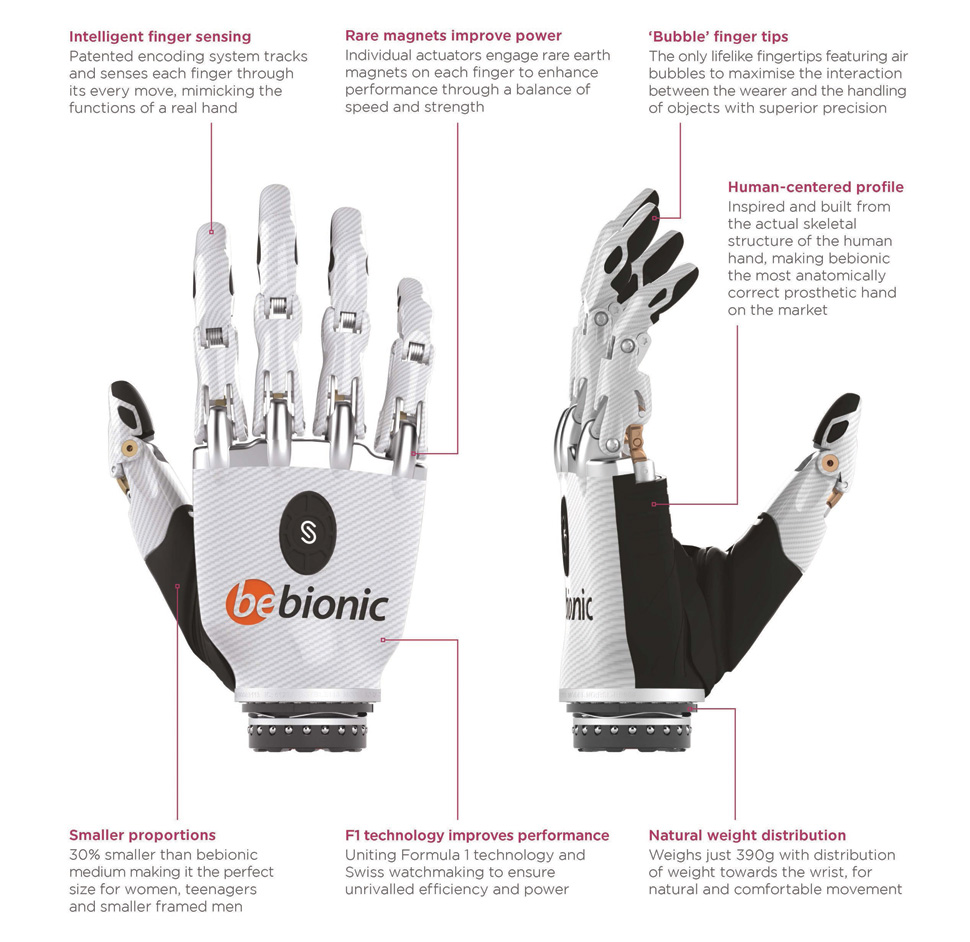
Developed using Formula 1 technology and specifically in scale for women and teenagers, the bebionic small hand is built around an accurate skeletal structure with miniaturised components designed to provide the most true-to-life movements. The bebionic small hand, developed by prosthetic experts Steeper, will enable fundamental improvements in the lives of thousands of amputees across the world. The hand marks a turning point in the world of prosthetics as it perfectly mimics the functions of a real hand via 14 different precision grips. A bionic extension of the arm that enables the utmost dexterity will enable amputees to engage in a range of activities that would have previously been complex and unmanageable. Nicky Ashwell, 29, born without a right hand, received Steeper's latest innovation at a fitting by London Prosthetics Centre, a private facility providing expert services in cutting-edge prosthetics. Before being fitted with the bebionic small hand, Nicky would use a cosmetic hand without movement; as a result, Nicky learned to carry out tasks with one hand. The bebionic small hand has been a major improvement to Nicky's life, enabling her to do things previously impossible with one hand such as riding a bike, gripping weights with both hands, using cutlery and opening her purse. Nicky, who is a Product Manager at an online fashion forecasting and trend service, said: "When I first tried the  bebionic small hand it was an exciting and strange feeling; it immediately opened up so many more possibilities for me. I realised that I had been making life challenging for myself when I didn't need to. The movements now come easily and look natural; I keep finding myself being surprised by the little things, like being able to carry my purse while holding my boyfriend's hand. I've also been able to do things never before possible like riding a bike and lifting weights."  Bebionic small hand works using sensors triggered by the user's muscle movements that connect to individual motors in each finger and powerful microprocessors. The technology comprises a unique system which tracks and senses each finger through its every move – mimicking the functions of a real hand. Development follows seven years of research and manufacturing, including the use of Formula 1 techniques and military technology along with advanced materials including aerograde aluminium and rare Earth magnets. Ted Varley, Technical Director at Steeper said, "Looking to the future, there's a trend of technology getting more intricate; Steeper has embraced this and created a smaller hand with advanced technology that is suitable for women and teenagers. An accurate skeletal structure was firstly developed, with the complex technology then specifically developed to fit within this in order to maintain anatomical accuracy. In other myoelectric hands the technology is developed first, at the expense of the lifelikeness."Bebionic small hand at a glance: (1) Contains 337 mechanical parts (2) 14 grip patterns and hand positions to allow a range of precision movements (3) Weighs approximately 390g – the same as a large bar of Galaxy chocolate (4) 165mm from base to middle fingertip – the size of an average woman's hand (5) Strong enough to handle up to 45kg – around the same as 25 bricks (6) The only multi-articulated hand with patented finger control system using rare Earth magnets (7) Specifically designed with women, teenagers and smaller-framed men in mind, Source: Article
Read More........

Next Tourist Destination to Become Outer Space

Stars over Iceland

.Subscribe
A space hotel built by the Russians in 2016 may be a possibility. It would be built by a commercial firm and would be a space station with an orbit about 350 km above the Earth.
It would be pretty exclusive with only seven passengers living in capsules. To get their two-day trip they 
would be cared for aboard a Soyuz spacecraft. Experienced professionals would accompany them to keep them safe. Windows would obviously have to be installed along with some telescopes and cameras. This I think would be appealing to almost anybody. The cost though is always the problem. It is projected to be $800,000 to get the person from Earth to the space station and five days in space would be $160,000. Virgin Galactic spearheaded by Richard Branson is working towards launching the “SpaceShip 2″ program which would make suborbital flights with a little period of weightlessness costing around $200,000. 500 people have registered for this including Stephen Hawking the renowned physicist. Space tourism does occur today but only for those who have a  large amount of cash. One day it is expected that by 2030 there will be lots of space stations all providing different destinations for tourists. They could be moon settlements, gas stations and near Earth orbit viewing platforms. In the far future there will be living areas built but that is a long way ahead. Source: Article, Image: flickr.com
Read More........

Apple patent paves way for projector powered mobile collaboration

Apple is looking to integrate pico projectors and gesture control tech into future iOS devices according to reports from the company’s blog, Patently Apple. The development will allow users with Apple devices to create projected shared workspaces that can be manipulated by gestures from a number of participants. The developments suggest that Apple is determined to push its already popular iPad further into the enterprise space. The company also details gesture technology that can interpret shadow and silhouette gesturing associated with presentations in darkened environments. The revelation came as the technology giant was granted a patent for an invention that “relates to electronic devices with projected displays that may be in communication with one another to form a shared workspace”. Anthony Fai is credited as the sole inventor of the granted patent which was originally filed in the first quarter of 2010 and published this month by the US Patent and Trademark Office. Source: InAVate
Read More........

The Technogym treadmill controlled by Google Glass

Technogym has announced a new bit of fitness equipment for those who like to go running indoors and wear their Google Glass. The niche product, showcasing at CES this week in Las Vegas, will let Glass wearers tap into the specially enhanced treadmill allowing them to see running data on their headset rather than, look down at the huge tablet-like console directly in front of them. But it's not just Google Glass. The Android-based system, dubbed Unity, comes with an API that allows any app for a third party
to connect to the intelligent treadmill, meaning you can get data tapped straight into your favourite app or on to a device you are wearing. "Unity is part of Wellness on the Go, Technogym’s complete experience that allows users to engage and connect with others on any piece of Technogym equipment, anywhere in the world," explains Technogym, living up to its name. "Moreover Unity is the first and only console in the fitness industry that offers users the ability to communicate with their personal trainer or friends via webcam." Unity is already compatible with MapMyFitness, RunKeeper and Withings. No word however on price or when the treadmill will be available in the UK. Source: SAM Daily Times
Read More........

Spareone's designed a mobile phone with a battery life of 15 years


How long your mobile's Battery wll work for May be maximum of three days or a week. But Spareone's has designed the Mobile phone with battery Life of 15 Years. SpareOne's mobile phone comes with a battery life of 15 years, whether you charge it or not and is designed for emergencies. It runs on one AA battery, and claims to keep its charge for up to 15 years, something unthinkable for feature-laden phones with batteries that last only a few days. The SpareOne can be programmed for instant access to phone numbers of key contacts, including emergency services in any location. As the phone's developer, XPAL Power, says: "It's essentially designed to make and receive the most important calls, no matter what." The SpareOne's is also able to automatically transmit its location via its mobile ID, plus has a built-in torch -- and unlike so many of today's gadgets, it even comes with the AA battery included. The new phone, unveiled at the Consumer Electronics Show in Las Vegas, is designed as a 'backup' phone you can keep in the glove compartment for emergencies. Source: Ananta-Tec
Read More........

Curiosity Rover Celebrates 1 Year on Mars with Dramatic Discoveries

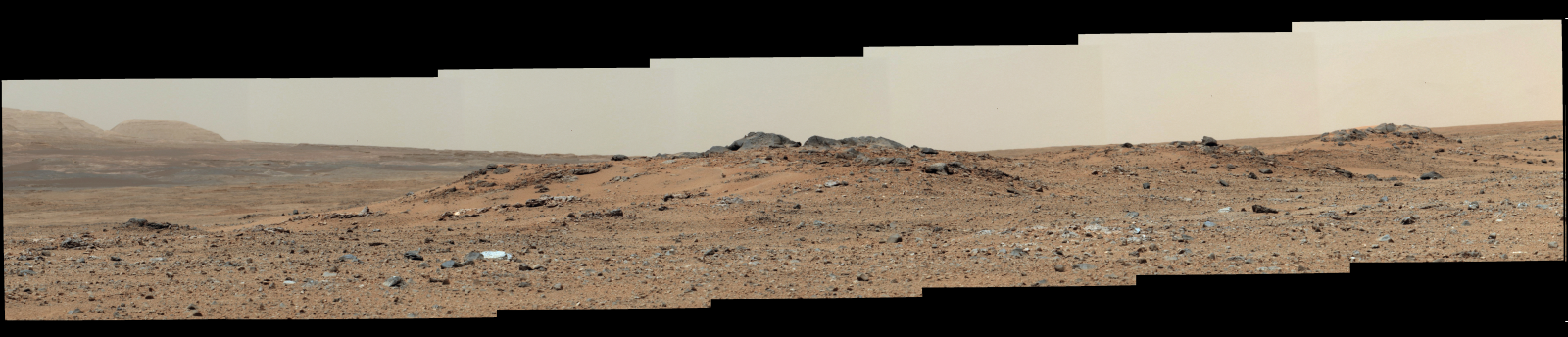
This scene combines seven images from the telephoto-lens camera on the right side of the Mast Camera (Mastcam) instrument on NASA’s Mars rover Curiosity on Sol 343 of the rover’s work on Mars (July 24, 2013). The center of the scene is toward the southwest. Credit: NASA/JPL-Caltech/Malin Space Science Systems Story updated with further details: 
By Ken KremerNASA’s mega Mars rover Curiosity is celebrating 1 Year on the Red Planet since the dramatic landing on Aug. 6, 2012 by reveling in a string of groundbreaking science discoveries demonstrating that Mars could once have supported past life – thereby accomplishing her primary science goal – and with a promise that the best is yet to come! “We now know Mars offered favorable conditions for microbial life billions of years ago,” said the mission’s project scientist, John Grotzinger of the California Institute of Technology in Pasadena. “Curiosity has landed in an ancient river or lake bed on Mars,” Jim Green, Director of NASA’s Planetary Science Division, told Universe Today. Curiosity is now speeding onwards towards Mount Sharp, the huge 3.4 mile (5. 5 km) mountain dominating the center of her Gale Crater landing site – and which is the primary destination of the mission. During Year 1, Curiosity has transmitted over 190 gigabits of data, captured more than 71,000 images, fired over 75,000 laser shots to investigate the composition of rocks and soil and drilled into two rocks for sample analysis by the pair of state-of-the-art miniaturized chemistry labs housed in her belly – SAM & CheMin. “From the sophisticated instruments on Curiosity the data tells us that this region could have been habitable in Mars’ distant past,” Green told me. “This is a major step forward in understanding the history and evolution of Mars.” And just in the nick of time for her 1 year anniversary, the car sized robot just passed the 1 mile (1.6 kilometer) driving mark on Aug. 1, or Sol 351. Mount Sharp still lies roughly 5 miles (8 kilometers) distant – as the Martian crow flies. “We will be on a general heading of southwest to
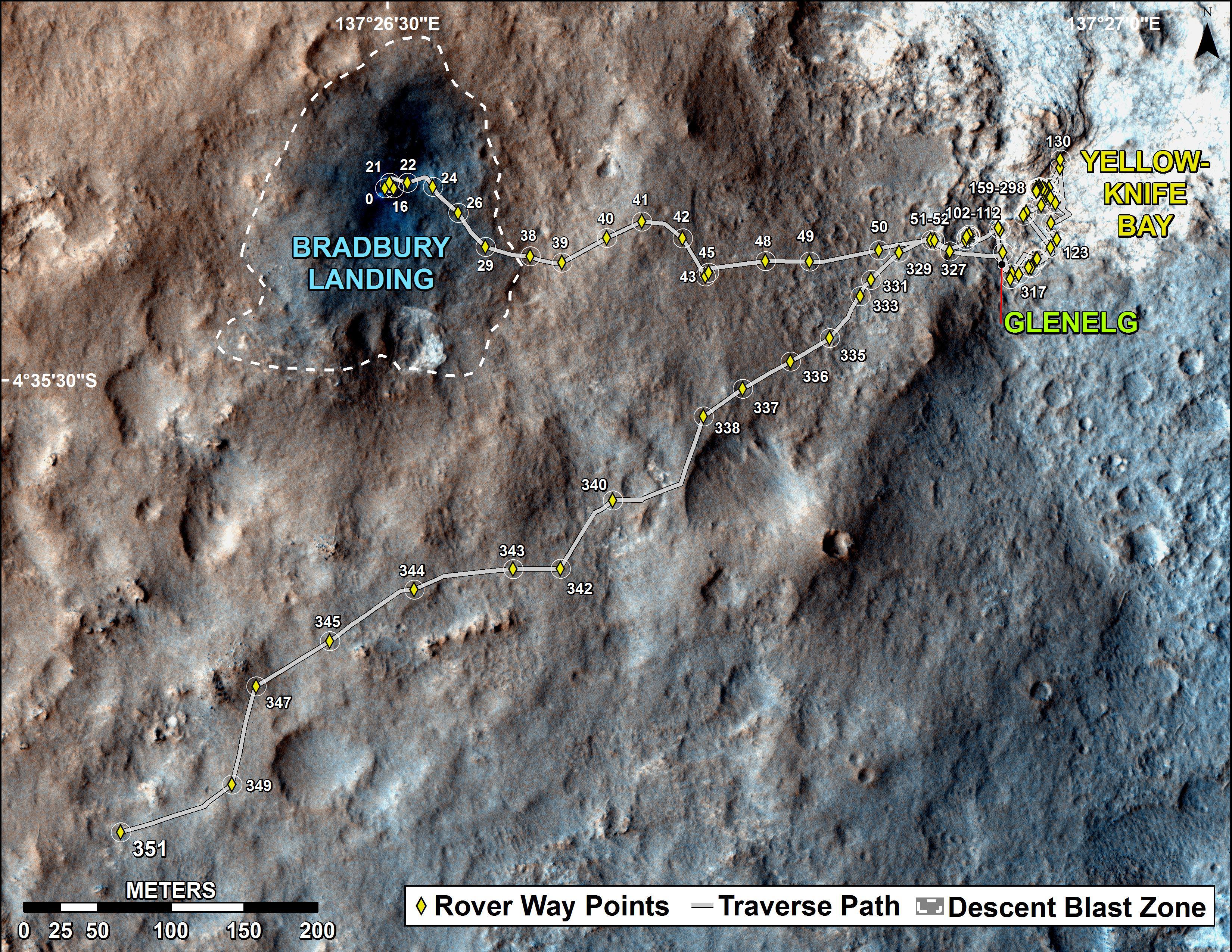
The total distance driven by NASA’s Mars rover Curiosity passed the one-mile mark a few days before the first anniversary of the rover’s landing on Mars. This map traces where Curiosity drove between landing at “Bradbury Landing” on Aug. 5, 2012, PDT, (Aug. 6, 2012 (Universal Time and EDT) and the position reached during the mission’s 351st Martian day, or sol, (Aug. 1, 2013). The Sol 351 leg added 279 feet (85.1 meters) and brought the odometry since landing to about 1.05 miles (1,686 meters). Credit: NASA/JPL-Caltech/Univ. of Arizona
Mount Sharp,” Jim Erickson, Curiosity Project Manager of NASA’s Jet Propulsion Laboratory (JPL), told Universe Today in an exclusive interview. See the NASA JPL route maps below. “We have been going through various options of different planned routes.” How long will the journey to Mount Sharp take? “Perhaps about a year,” Erickson told me. “We have put some new software – called autonav, or autonomous navigation – on the vehicle right after the conjunction period back in March 2013. This will increase our ability to drive.” “We are trying to make that significantly faster by bringing the new autonav online. That will help. But how much it helps really depends on the terrain.” So far the terrain has not been problematical. “Things are going very well and we have a couple of drives under our belt,” said Erickson, since starting the long trek to Mount Sharp about a month ago. The lower reaches of Mount Sharp are comprised of exposed geological layers of sedimentary materials that formed eons ago when Mars was warmer and wetter, and much more hospitable to microscopic life. “It has been gratifying to succeed, but that has also whetted our appetites to learn more,” says Grotzinger. “We hope those enticing layers at Mount Sharp will preserve a broad diversity of other environmental conditions that could have affected habitability.” Indeed, Curiosity’s breakthrough discovery that the surface of Mars possesses the key chemical ingredients required to sustain microbial life in a habitable zone, has emboldened NASA to start mapping out the future of Mars exploration. NASA announced plans to start work on a follow on robotic explorer launching in 2020and develop strategies for returning Martian samples to Earth and dispatching eventual human missions to Mars in the 2030’s using the new Orion capsule and SLS Heavy lift rocket. “NASA’s Mars program is back on track with the 2016 InSight lander and the 2020 rover,” Jim Green, Director of NASA’s Planetary Science Division, told Universe Today in an interview. “Successes of our Curiosity — that dramatic touchdown a year ago and the science findings since then — advance us toward further exploration, including sending humans to an asteroid and Mars,” said NASA Administrator Charles Bolden in a statement. “Wheel tracks now, will lead to boot prints later.” Following the hair-raising touchdown using with the never before used sky-crane descent thrusters, the science team directed the 1 ton robot to drive to a nearby area of interesting outcrops on the Gale crater floor – at a place called Glenelg and Yellowknife Bay. Along the way, barely 5 weeks after landing, Curiosity found a spot laden with rounded pebbles at the Hottah outcrop of concretions that formed in an ancient stream bed where hip deep liquid water once flowed rather vigorously. In February 2013, Curiosity conducted the historic first ever interplanetary drilling into Red Planet rocks at the ‘John Klein’ outcrop inside Yellowknife Bay that was shot through with hydrated mineral veins of gypsum. The Yellowknife Bay basin looks like a dried up 
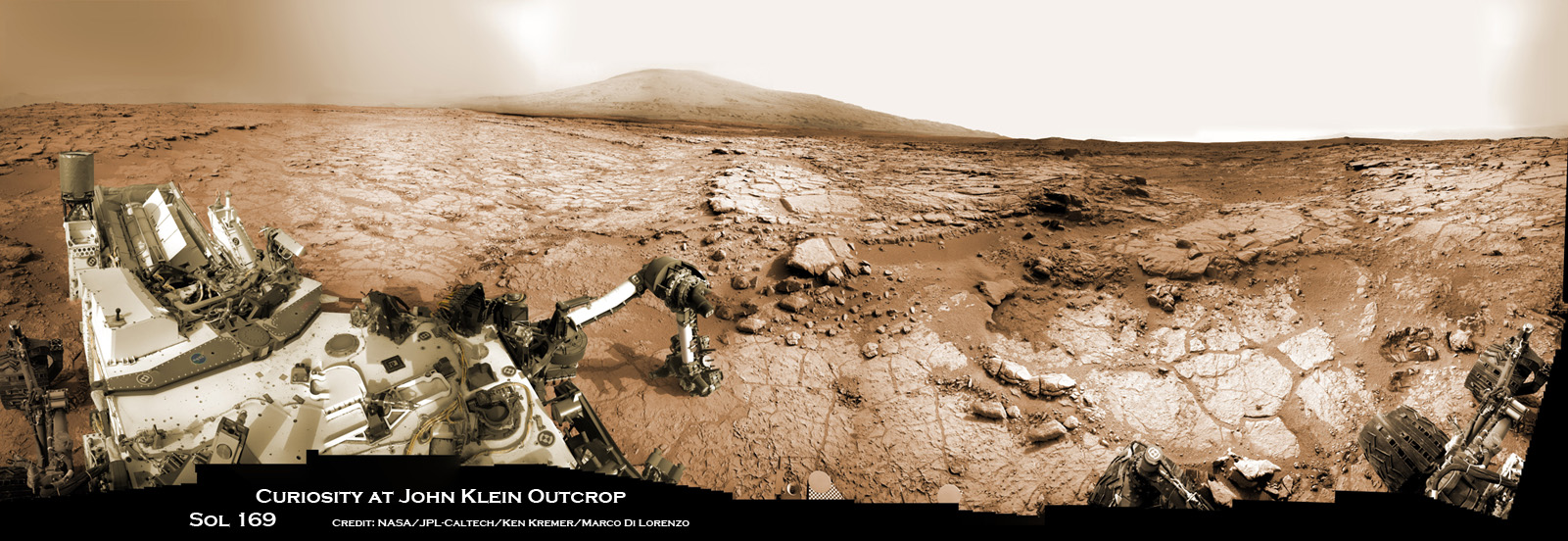
Curiosity accomplished Historic 1st drilling into Martian rock at John Klein outcrop on Feb 8, 2013 (Sol 182), shown in this context mosaic view of the Yellowknife Bay basin taken on Jan. 26 (Sol 169). The robotic arm is pressing down on the surface at John Klein outcrop of veined hydrated minerals – dramatically back dropped with her ultimate destination; Mount Sharp. Credit: NASA/JPL-Caltech/Ken Kremer/Marco Di Lorenzo
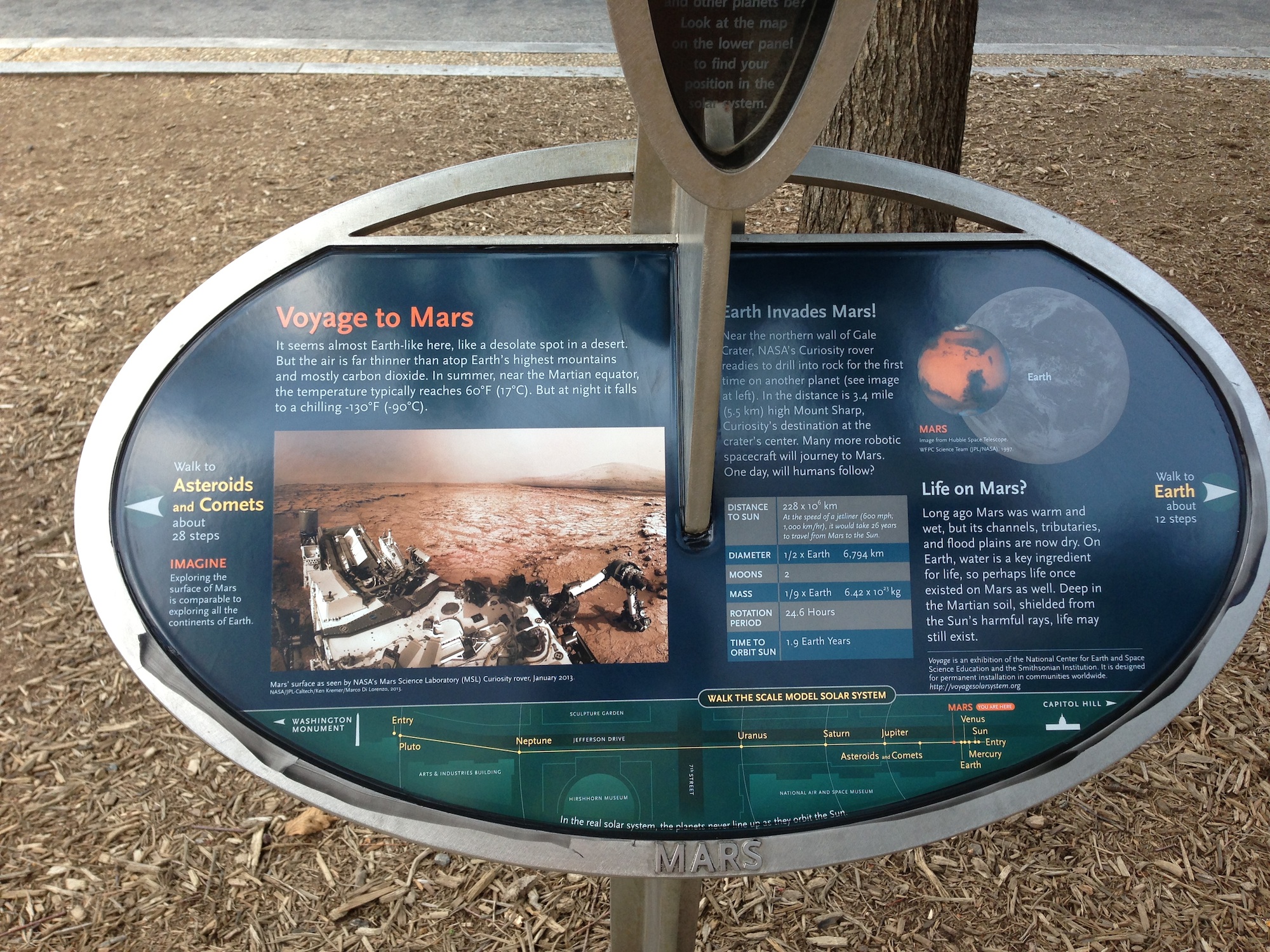
river bed. Analysis of pulverized portions of the gray colored rocky powder cored from the interior of ‘John Klein’ revealed evidence for phyllosilicates clay minerals that typically form in pH neutral water. These starting findings on the crater floor were unexpected and revealed habitable environmental conditions on Mars – thus fulfilling the primary science goal of the mission. See herein our context panoramic mosaic from Sol 169 showing the robotic arm touching and investigating the Martian soil and rocks at ‘John Klein’. And if you take a visit to Washington, DC, you can see our panorama (assembled by Ken Kremer and Marco Di Lorenzo) on permanent display at a newly installed Solar System exhibit at the US National Mall in front of the Smithsonian National Air & Space Museum- details here.
A mosaic by the Mars Science Laboratory Curiosity rover, assembled by Ken Kremer and Marco Di Lorenzo is now part of the permanent Solar System Exhibit outside the National Air and Space Museum on the US National Mall in Washington, D.C. Image courtesy NCESSE.
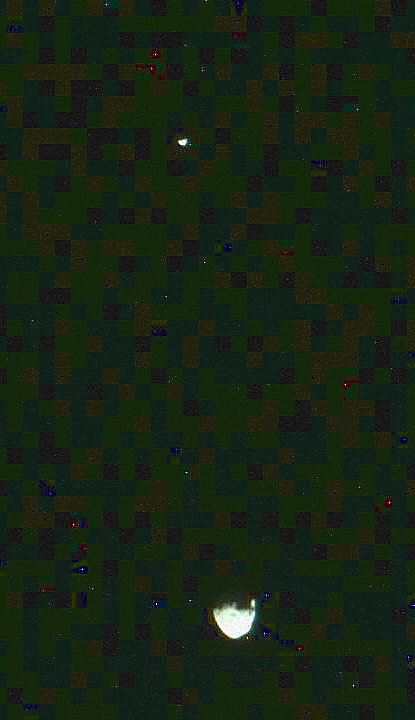
“We have found a habitable environment [at John Klein] which is so benign and supportive of life that probably if this water was around, and you had been on the planet, you would have been able to drink it,” says Grotzinger, summing up the mission. This past week she captured rare sky watching images of the diminutive Martian moons – Phobos and Deimos – together! Meanwhile, Curiosity’s 10 year old sister rover Opportunity Is trundling merrily along and will arrive shortly at her own mountain climbing goal on the opposite of Mars. And NASA’s next Mars orbiter called MAVEN (for Mars Atmosphere and 
Curiosity captured unique and rare view of tiny Martian moons Phobos & Deimos together on Sol 351 (Aug 1, 2013). Look close and see craters on pockmarked Phobos. Credit: NASA/JPL/MSSS, contrast enhanced by Marco Di Lorenzo and Ken KremerOn the long road to Mount Sharp, Curiosity will make occasional stops for science.
Volatile Evolution), has just arrived intact at the Kennedy Space Center after a cross country trip aboard a USAF C-17. Technicians at Kennedy will complete final preparations for MAVEN’s blastoff to the Red Planet on Nov. 18 from the Florida Space Coast atop an Atlas V rocket. On Tuesday, Aug 6, NASA will broadcast a half day of new programming on NASA TV commemorating the landing and discussing the science accomplished so far and what’s coming next. And stay tuned for more astonishing discoveries during ‘Year 2′ on the Red Planet from our intrepid rover Curiosity – Starting Right Now ! Ken Kremer
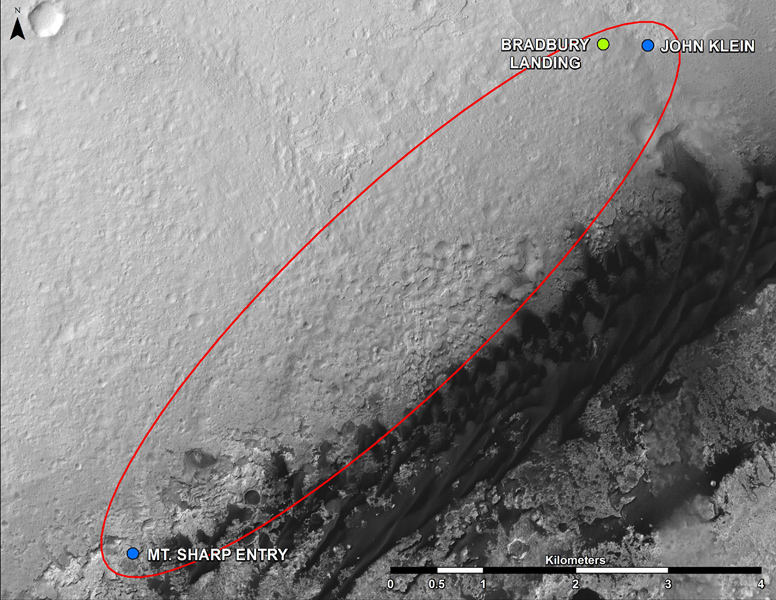
Curiosity Route Map From ‘Glenelg’ to Mount Sharp: This map shows where NASA’s Mars rover Curiosity landed in August 2012 at “Bradbury Landing”; the area where the rover worked from November 2012 through May 2013 at and near the “John Klein” target rock in the “Glenelg” area; and the mission’s next major destination, the entry point to the base of Mount Sharp. Credit: NASA/JPL-Caltech/Univ. of Arizona. Source: Universetoday
Read More........

New Society With Humanoid Robots Says EU Robotics Expert: Replicants Soon A Reality?

Danica Kragic: Credit: KTH Royal Institute of Technology
Is there a replicant in your future? Or at least a very humanoid robot? The 1982 film Blade Runner depicts a dystopian Los Angeles in November 2019 in which genetically engineered organic robots called replicants – visually indistinguishable from adult humans – are manufactured by the powerful Tyrell Corporation as well as by other "mega–manufacturers" around the world. Rutger Hauer as Roy Batty,leader of the renegade Nexus-6 replicants That vision of the future may not be that far off...or at least its beginning. Humanity came one step closer in January to being able to replicate itself, thanks to the EU’s approval of funding for the Human Brain Project. Danica Kragic, a robotics researcher and computer science professor at KTH Royal Institute of Technology in Stockholm, says that while the prospect of living among humanoid robots calls to mind terrifying scenarios from science fiction, the reality of how humans cope with advances in robotics will be more complex, and subtle. “Robots will challenge the way we feel about machines in general,” Kragic says. “A completely different kind of society is on the way.” http://crosstalks.tv/ The Human Brain Project will involve 87 universities in a simulation of the cells, chemistry and connectivity of the brain in a supercomputer, in order to understand the brain’s architecture, organisation, functions and development. The project will include testing brain-enabled robots. “Will we be able to – just by the fact that we can build a brain – build a human? Why not? What would stop you?” Kragic asks. Nevertheless, consumer-grade robots are a long way from reality, says Kragic, who in addition to serving as Director of KTH’s Centre for Autonomous Systems, is also head of the Computer Vision and Active Perception Lab. She says that in order for robots to offer some value to households, researchers and developers will have to overcome some daunting technological challenges. Robots will have to multitask and perhaps even be programmed to have emotional capacities programmed into their logical processes, she says. “Based on the state of the environment and what it is expected of the robot, we want the outcome action to be acceptable to humans,” she says. “Many things that we do are based not just on facts, so should machines somehow have simulated emotions, or not? Either way, it is difficult to predict how that will affect their interaction with humans.” Kragic sees robots making a largely positive contribution to society. But they will also present some novel problems for which humans have few reference points, such as what are the social norms for interacting with robots? “There is a discussion about robot ethics and how we should treat robots,” Kragic says. “It’s difficult to say what’s right and wrong until you are actually in the situation where you need to question yourself and your own feelings about a certain machine – and the big question is how your feelings are conditioned by the fact that you know it’s a machine, or don’t know whether it’s a machine.” Kragic predicts that one of the most popular consumer application of robots will be as housekeepers, performing the chores that free up time for their owners. They could also take over jobs that are repetitive, such as operating buses or working in restaurants. On the other hand, the robot industry will expand and create jobs, she predicts. As for the possibility that one day robots will turn on us – Kragic is skeptical. “A robot rebellion - that’s the ultimate science fiction scenario, right? It’s worth placing some constraints on robots, such as (author Isaac) Asimov’s Three Rules of Robotics. At the same time, we have rules as humans, which we break. No one is 100 percent safe, and the same can happen with machines.” Human rebellion against robots is far more likely, she says, pointing out that even as society’s attitudes toward automation evolve over generations, the debate over whether humans have the right to “play God” will likely continue. “There will be people for and against it,” she says. “But what is wrong with building a human? We have been raised in a society that thinks this is wrong, that this is playing God. “Subsequent generations could have a different view.” Blade Runner is a 1982 American dystopian science fiction action film directed by Ridley Scott and starring Harrison Ford, Rutger Hauer, and Sean Young. The screenplay, written by Hampton Fancher and David Peoples, is loosely based on the novel Do Androids Dream of Electric Sheep? by Philip K. Dick. In the Blade Runner film. Replicants use on Earth is banned and replicants are exclusively used for dangerous, menial or leisure work on off-world colonies. Replicants who defy the ban and return to Earth are hunted down and "retired" by police special operatives known as "Blade Runners". The plot focuses on a brutal and cunning group of recently escaped replicants hiding in Los Angeles and the burnt out expert Blade Runner, Rick Deckard (Harrison Ford), who reluctantly agrees to take on one more assignment to hunt them down. Contacts and sources: Robotics researcher Danica Kragic, KTH Royal Institute of Technology, Source: Nano Patents And Innovation
Read More........

Apple “iWatch” Arriving In 2013

Apple’s stock has recently fallen by almost 30%, down from an all-time high of $703 in late 2012. Despite recording phenomenal earnings, Apple investors are becoming sceptical of Apple’s future plans. Apple is losing their gross margin on the products they sell as components become more expensive and competitors in the industry push Apple to lower their prices. A new report has outlined Apple’s plans to introduce a smart watch in 2013 which would help reintroduce high margins into Apple’s product categories, thus satisfying investors. Oliver Chen, an analyst for Citigroup, has told reuters that Apple has a “$6 billion opportunity” where they could recreate the success of the iPod; reinvent a market that already exists and make it desirable to the general public. In 2013, the entire watch industry is expected to generate $60 billion, which would enable Apple to catch 10%, equivalent to a gross profit of $3.6 billion. Margins on watches are also much higher, with some manufactures getting up to 60%; the iPhone currently nets Apple a 55% margin. Apple is reported to have a 100-person team working on their
“iWatch”, which may replace some of the tasks making currently carried out by the iPhone and iPad. Also Apple is considering the ability for the smart watch to place calls, identify the person an incoming call, check map coordinates as well as act as a pedometer and heart-rate monitor. As of right now, Apple has filed almost 80 patents which include the word “wrist”, one of which includes a flexible screen and a battery charged by kinetic energy. Google is currently developing Glass, which will features a small built-in screen which will be viewable in the right eye of the user. However, Glass does not include a 3G radio, effectively chaining it to a smartphone. If Apple included such a radio in their smart watch, they could open up a new brand of “smart” accessory. Jony Ive, Apple’s lead designer, has an interest in watch. Not only has he owned many high-end brands himself, he also took his team to a Nike factory for a tour. Google Glass will be unveiled at the end of 2013/early 2014, while Apple’s inside source is adamant that Apple’s smart watch will be available during 2013, possibly at Apple’s main WWDC event in June. Another problem Apple faces in regards to a watch is design. People are happy to carry around the same smartphone as everyone else, but a watch is even more of a fashion statement. Apple’s one-size-fits-all mentality may not work in the watch industry where consumers may want different types of straps or different materials. Apple may be forced to offer various models, something they do not like doing. Source: Know Your Destiny
Read More........

New Honda 'Asimo' Robot Now Smarter, Faster

Asimo at Disneyland    
.Subscribe
Honda's human - shaped  robot  can  now run  faster,  balance  itself  on  uneven surfaces, hop on one foot and pour a drink. Some of its technology may even be used to help out with clean-up operations at the stricken Fukushima nuclear plant. Honda's demonstration of the revamped "Asimo" on Tuesday at its Tokyo suburban research facility was not only to prove that the bubble-headed childlike machine was  more  limber and  a  bit  smarter. It was a way to try to answer some critics that Asimo, first shown in 2000, had been of little practical use so far, proving to be nothing more than a glorified toy and cute showcase for the Honda Motor Co. brand. Honda President Takanobu Ito told reporters some of Asimo's technology was used to develop a robotic arm in just six months with the intention of helping with the nuclear crisis in northeastern Japan. The mechanical arm can open and close valves  at  Fukushima Dai - ichi  nuclear  power  plant, which went  into meltdown after the March tsunami, according to Honda. The automaker is working with the utility behind the problem plant, Tokyo Electric Power Co., to try to meet demands to bring the plant under control. Ito acknowledged that the first idea was to send in Asimo to help out, but that was not possible because the robot cannot maneuver in rubble, and its delicate computer parts would malfunction in radiation. But in Tuesday's demonstration, Asimo was able to walk without falling over 2 centimeter (0.8 inch) padded bumps on the floor. It can also now jog faster than itdid in 2005, at 9 kilometers per hour (5.6 mph), instead of the earlier 6 kph (3.7 mph), pushing better with its toes so its run was smoother and not as jerky. Asimo was also able to distinguish the voices of three people spoken at once, using face recognition and analyzing sound, to figure out that one woman wanted hot coffee, another orange juice, and still another milk tea. The new Asimo got improved hands as well, allowing individual movement of each finger, so it could do sign language. "My name is Asimo," it said, making the signs of its words with stubby fingers. It also opened a thermos bottle and gracefully poured juice into a paper cup. Ito said Asimo had developed autonomous artificial intelligence so that it could potentially maneuver itself through crowds of people, without remote control or stopping each time to check on its programming. But he acknowledged that making robotics into a practical business will take more time, meaning Asimo wasn't about to show up in any home soon. "Maybe at the start this was a dream of engineers to make a machine that was close to a human being, like Astro Boy," he said. "We think Asimo is good." Other manufacturers are also developing robots, eager to cash in on the expected needs of Japan's rapidly aging population. Toyota Motor Corp., Japan's top automaker which makes the Prius hybrid and Lexus luxury models, is among those to have jumped on the robotics bandwagon. In the past, it has shown robots that can play the violin and talk like receptionists. Last week, it showed a computerized device that latches on to the body to help old or sick people walk and keep balance. Honda, which makes the Odyssey minivan and Accord sedan, has developed similar brace-like gadgets to help people get about. Neither the Toyota nor Honda product is on sale yet. Still, experts say such research is important to keep up. "Maybe it can't be put to use right away, but it is definitely a technology that we should keep working on to advance," Hiroshi Kobayashi, a mechanical engineering professor at Tokyo University of Science, said of the new Asimo. "It is common for what we achieve in research to turn out later to lead to many products," said Kobayashi, who has developed experimental robots. 
Read More........

By 2018 computers 'will have 5 senses


Some day soon, you'll be able to order a wedding dress on your tablet and feel the fabric and the veil just by touching the screen. When you feel an object, your brain registers the series of vibrations on your skin as being smooth, rough, sharp, etc. Computer sensors are becoming sophisticated enough to do that too.Within the next five years, vibrators within smartphones will be precise enough that they could be designed to mimic the vibrations experienced when your fingers touch a particular surface. Even though you'll  just be touching glass, it will feel like you're touching whatever object is displayed on the screen. Source: The Coming Crisis
Read More........

New member of the exclusive space club

The successful launch of North Korea's Unha-3 rocket on Decembfer 12, 2012 became the top news in the world of cosmonautics. Even the previous day's story of the United States launching, for the third time, its X-37B unmanned experimental OTV-3 (“Orbital Test Vehicle”) was eclipsed by Unha-3. The flight's duration, aims and objectives though have yet to be disclosed. News of the successful North Korean rocket launch provoked heated reactions at all levels, from space fans to high-ranking state officials. If we lay aside the political and economic considerations, launching a satellite is, in any case, an outstanding achievement for any country. However, it should be mentioned that, according to North Korean media, the Kwangmyŏngsŏng-3, put into orbit on December 12, is actually the country's third such satellite: another two were launched in August, 2008 and in April, 2009. But back then, they went unnoticed in orbit; so there was nothing to talk about. But this time the North American Aerospace Defense Command (NORAD) has confirmed the latest satellite launch. The height of its orbit is about 500-580 km with an orbital cycle of around 95 minutes. It is noteworthy that this is the second attempt to put the Kwangmyŏngsŏng-3 into orbit. The first, in April, ended in failure when the carrier rocket exploded over the Yellow Sea. It is interesting that many representatives of the leading mass media from various countries were invited to the launch, but were not allowed to see the start. This time too there was more intrigue, the day before the start, rumours emerged that the rocket, with the satellite aboard, had been removed from the launch pad because of technical problems. The next thing anyone heard were reports of a successful launch. The Kwangmyŏngsŏng-3’s precise purpose has not been disclosed, but, according to North Korean representatives, it is an Earth observation satellite. Even though the satellite is now functioning at a basic level, it will be a few weeks before it is fully operational. However, some experts from the United States are expressing concern that North Korean specialists may have lost control of the satellite, though in the absence of real information, it is impossible to know for certain if this is really so. In general, in the last day or so, the world community's reaction has switched from harsh censure of North Korea's violation of the UN Security Council’s resolutions, to the more reasonable, though no less negative, argument that the launch does not suggest North Korea possesses a large enough arsenal to pose a threat to other countries. Some believe that the rocket's launch is more likely to be an attempt at blackmail aimed at encouraging humanitarian assistance than a real threat. There is also another aspect, which we could call psychological; half a century ago, it was not a great power that was destined to launch the world's first satellite, but the Soviet Union. The Country that was widely considered to be hopelessly out of date in technical and economic terms. Something similar is happening now on the Korean Peninsula, although, of course, on a significantly smaller scale. While South Korea's KSLV rocket is constantly being postponed (the revised launch date, initially scheduled at the end of October, has still not been announced), North Korea has successfully fulfilled its own plan. Of course, one launch does not necessarily mean the existence of a complete space program yet, but the DPRK Foreign Ministry has already announced its intention to continue with its space agenda to launch more satellites for peaceful purposes. However, the details are not made public. Meanwhile, the American X-37B unmanned spacecraft remains in orbit after almost two days, and its goals are almost as mysterious as the North Korean satellite’s. The spacecraft, which has already been in orbit from April to December 2010 for the first OTV mission, is now in space; again. Thus demonstrating the feasibility of a reusable spacecraft, which was one of the objectives of the entire program. It was launched using the Atlas V501 rocket from the Cape Canaveral Air Force base. The duration of the X-37B flight is not specified, but its predecessor remained in orbit for 15 months, six months longer than originally planned. Source: Voice of Russia
Read More........

US scientists turn brain waves into actual words

Mind Reading Device
What will you do if someone will know what you are thinking? The day is closer as scientists are now able to read the minds. A new study conducted in theUniversity of Californiahas enabled scientists to find a way to decipher actual words from human brain waves. A team of neuroscientists worked with a group of epilepsy patients who were under the treatment for difficult curable seizures. They implanted the required electrodes deep in patients' brains to locate the source of seizures and help doctors remove the malfunctioning tissue. “During normal process about a week the patients are just sitting around in their hospital rooms and some of them were generous enough to participate in our experiment,” said study leader Brian Pasley of the Helen Wills Neuroscience Institute at the University of California, Berkeley. While the patients' brain waves were being recorded, researchers chased the waves through a program to translate the brain's electronic signals into actual sounds. “Researchers are still a long way from actually reading people's minds, but it may be possible one day,” said Pasley. Although the new research may sound like scary science fiction, it can have enormous positive uses for patients who have lost their speaking ability. “If we are somehow able to encode someone's thoughts instantaneously that might have great benefits for the thousands of severely disabled people who are unable to communicate right now,” Pasley noted. Source: Ananta-Tec
Read More........

84 Million Stars and Counting

VISTA gigapixel mosaic of the central parts of the Milky Way
Using a whopping nine-gigapixel image from the VISTA infrared survey telescope at ESO’s Paranal Observatory, an international team of astronomers has created a catalogue of more than 84 million stars in the central parts of the Milky Way. This gigantic dataset contains more than ten times more stars than previous studies and is a major step forward for the understanding of our home galaxy. The image gives viewers an incredible, zoomable view of the central part of our galaxy. It is so large that, if printed with the resolution of a typical book, it would be 9 metres long and 7 metres tall.
Wide-field view of the Milky Way, showing the extent of a new VISTA gigapixel image
“By observing in detail the myriads of stars surrounding the centre of the Milky Way we can learn a lot more about the formation and evolution of not only our galaxy, but also spiral galaxies in general,” explains Roberto Saito (Pontificia Universidad Católica de Chile, Universidad de Valparaíso and The Milky Way Millennium Nucleus, Chile), lead author of the study.
Optical/infrared comparison of the central parts of the Milky Way
Most spiral galaxies, including our home galaxy the Milky Way, have a large concentration of ancient stars surrounding the centre that astronomers call the bulge. Understanding the formation and evolution of the Milky Way’s bulge is vital for understanding the galaxy as a whole. However, obtaining detailed observations of this region is not an easy task. “Observations of the bulge of the Milky Way are very hard because it is obscured by dust,” says Dante Minniti (Pontificia Universidad Catolica de Chile, Chile), co-author of the study. “To peer into the heart of the galaxy, we need to observe in infrared light, which is
Colour–magnitude diagram of the Galactic bulge
less affected by dust.”the The large mirror, wide field of view and very sensitive infrared detectors of ESO’s 4.1-metre Visible and Infrared Survey Telescope for Astronomy (VISTA) make it by far the best tool for this job. The team of astronomers is using data from the VISTA Variables in the Via Lactea programme (VVV) [1], one of six public surveys carried out with VISTA. The data have been used to create a monumental 108 200 by 81 500 pixel colour image containing nearly nine billion pixels. This is one of the biggest astronomical images ever produced. The team has now used these data to compile the largest catalogue of the central concentration of stars in the Milky Way ever created [2].
Annotated map of VISTA’s view of the centre of the Milky Way
To help analyse this huge catalogue the brightness of each star is plotted against its colour for about 84 million stars to create a colour–magnitude diagram. This plot contains more than ten times more stars than any previous study and it is the first time that this has been done for the entire bulge. Colour–magnitude diagrams are very valuable tools that are often used by astronomers to study the different physical properties of stars such as their temperatures, masses and ages [3]. “Each star occupies a particular spot in this diagram at any moment during its lifetime. Where it falls depends on how bright it is and how hot it is. Since the new data gives us a snapshot of all the stars in one go, we can now make a census of all the stars in this part of the Milky Way,” explains Dante Minniti. Video above: Infrared/visible light comparison of VISTA’s gigapixel view of the centre of the Milky Way. The new colour–magnitude diagram of the bulge contains a treasure trove of information about the structure and content of the Milky Way. One interesting result revealed in the new data is the large number of faint red dwarf stars. These are prime candidates around which to search for small exoplanets using the transit method [4]. “One of the other great things about the VVV survey is that it’s one of the ESO VISTA public surveys. This means that we’re making all the data publicly available through the ESO data archive, so we expect many other exciting results to come out of this great resource," concludes Roberto Saito. Notes: [1] The VISTA Variables in the Via Lactea (VVV) survey is an ESO public survey dedicated to scanning the southern plane and bulge of the Milky Way through five near-infrared filters. It started in 2010 and was granted a total of 1929 hours of observing time over a five-year period. Via Lactea is the Latin name for the Milky Way. [2] The image used in this work covers about 315 square degrees of the sky (a bit less than 1% of the entire sky) and observations were carried out using three different infrared filters. The catalogue lists the positions of the stars along with their measured brightnesses through the different filters. It contains about 173 million objects, of which about 84 million have been confirmed as stars. The other objects were either too faint or blended with their neighbours or affected by other artefacts, so that accurate measurements were not possible. Others were extended objects such as distant galaxies. The image used here required a huge amount of data processing, which was performed by Ignacio Toledo at the ALMA OSF. It corresponds to a pixel scale of 0.6 arcseconds per pixel, down-sampled from the original pixel scale of 0.34 arcseconds per pixel. [3] A colour–magnitude diagram is a graph that plots the apparent brightnesses of a set of objects against their colours. The colour is measured by comparing how bright objects look through different filters. It is similar to a Hertzsprung-Russell (HR) diagram but the latter plots luminosity (or absolute magnitude) rather than just apparent brightness and a knowledge of the distances of the stars plotted is also needed. [4] The transit method for finding planets searches for the small drop in brightness of a star that occurs when a planet passes in front of it and blocks some of its light. The small size of the red dwarf stars, typically with spectral types K and M, gives a greater relative drop in brightness when low-mass planets pass in front of them, making it easier to search for planets around them. More information: This research was presented in a paper “Milky Way Demographics with the VVV Survey I. The 84 Million Star Colour–Magnitude Diagram of the Galactic Bulge“ by R. K. Saito et al., which was published in the journal Astronomy & Astrophysics (A&A, 544, A147). The team is composed of R. K. Saito (Pontificia Universidad Católica de Chile, Santiago, Chile; Universidad de Valparaíso, Chile; The Milky Way Millennium Nucleus, Chile), D. Minniti (Pontificia Universidad Católica de Chile; Vatican Observatory), B. Dias (Universidade de São Paulo, Brazil), M. Hempel (Pontificia Universidad Católica de Chile), M. Rejkuba (ESO, Garching, Germany), J. Alonso-García (Pontificia Universidad Católica de Chile), B. Barbuy (Universidade de São Paulo), M. Catelan (Pontificia Universidad Católica de Chile), J. P. Emerson (Queen Mary University of London, United Kingdom), O. A. Gonzalez (ESO, Garching, Germany), P. W. Lucas (University of Hertfordshire, Hatfield, United Kingdom) and M. Zoccali (Pontificia Universidad Católica de Chile). The year 2012 marks the 50th anniversary of the founding of the European Southern Observatory (ESO). ESO is the foremost intergovernmental astronomy organisation in Europe and the world’s most productive ground-based astronomical observatory by far. It is supported by 15 countries: Austria, Belgium, Brazil, the Czech Republic, Denmark, France, Finland, Germany, Italy, the Netherlands, Portugal, Spain, Sweden, Switzerland and the United Kingdom. ESO carries out an ambitious programme focused on the design, construction and operation of powerful ground-based observing facilities enabling astronomers to make important scientific discoveries. ESO also plays a leading role in promoting and organising cooperation in astronomical research. ESO operates three unique world-class observing sites in Chile: La Silla, Paranal and Chajnantor. At Paranal, ESO operates the Very Large Telescope, the world’s most advanced visible-light astronomical observatory and two survey telescopes. VISTA works in the infrared and is the world’s largest survey telescope and the VLT Survey Telescope is the largest telescope designed to exclusively survey the skies in visible light. ESO is the European partner of a revolutionary astronomical telescope ALMA, the largest astronomical project in existence. ESO is currently planning a 40-metre-class European Extremely Large optical/near-infrared Telescope, the E-ELT, which will become “the world’s biggest eye on the sky”. Links: Research paper (A&A, 544, A147): http://www.aanda.org/10.1051/0004-6361/201219448, Photos of the VISTA telescope: http://www.eso.org/public/images/archive/search/?adv=&subject_name=Visible%20and%20Infrared%20Survey%20Telescope%20for%20Astronomy, Images taken with the VISTA telescope: http://www.eso.org/public/images/archive/search/?adv=&facility=30, Image, Text, Credits: ESO/VVV Consortium/Acknowledgement: Ignacio Toledo, Martin Kornmesser/Nick Risinger (skysurvey.org)/Videos: ESO/VVV Consortium/Nick Risinger (skysurvey.org)/Music: Delmo -- Acoustic (disasterpeace.com)/Acknowledgement: Ignacio Toledo, Martin Kornmesser., Greetings, Orbiter.ch, Source: Orbiter.ch Space News
Read More........

3D Printing Could Land on the Moon

3d moon printing photo
Bisarbeat: Using 3D printers to make consumer goods—like shoes, housewares, and gadgets—is slowly transitioning from science-fiction to reality. Now, Behrokh Khoshnevis of the University of California, is planning to take it further—by using printers to manufacturing building components. It’s an idea, he says, that is long overdue. And, the innovative approach to building design and construction has far-reaching implications: Khoshnevis believes the technology could be used to build shelters on the Moon. Source: Bisarbeat
Read More........

Interactive, talking newspapers go to press

Screen Shot On Uploaded Video
A new swathe of interactive newspapers and talking posters are poised to hit the streets as Interactive Newsprint, a collective of three UK universities, enters its final phase of development. Academic partners from the University of Dundee, the University of Surrey and the University of Central Lancashire (UCLan) are developing printed electronics that add capacitive touch capability to printed pages.
Interactive Newsprint has scooped funding from the UK’s Digital Economy Programme and is working with interactive print specialist, Novalia to develop prototype devices that access audio content and record
interest in specific bulletins, advertisements and features. Electronics developments mean that speakers, audio players and even colour changing fibres can already be integrated into paper-thin units paving the way for a revolution in the print industry. Source: InAVate
Read More........

On-the-spot AIDS test: S. Africans to get revolutionary smartphone gadget


A smartphone application developed by South Korean and South African scientists will allow users to diagnose AIDS infections. Once complete, the app will be released in rural South Africa, where current tests are both remote and expensive. The new gadget, dubbed the ‘Smartscope,’ consists of a small one-millimeter (0.04-inch) microscope and light that clip over a smartphone's camera, and the accompanying software, AFP reported. A standard chip containing a blood sample slides into the gadget, underneath the microscope. The phone app then photographs the sample and analyses the blood for a T-cell count, ascertaining the overall health of the subject’s immune system. "Our idea was to obtain images and analyze images on this smartphone using applications," Jung Kyung Kim, a professor in biomedical engineering at South Korea’s Kookmin University said. A T-cell (or CD4 cell) count is used to diagnose the immune system’s overall health. T-cells are the white blood cells that help the body fight disease and infection. The HIV virus infects T-cells in the body and uses them to replicate itself. A person carrying the virus will therefore have a lower T-cell count than an uninfected individual, as well as a weakened immune system. The app is being released in South Africa and Swaziland, which have been hit hard by the disease – almost six million South Africans are HIV-positive, and a quarter of adults in Swaziland are infected. Source: Sam Daily Times
Read More........

Gadgets for video thrills, rich kids and fat fingers

 
By JESS MANTELL, Whether you are big, small, active or lazy, here is your monthly round-up with a little something for everyone.  JVC action-video camera: Now to catch the potentially viral video snippets of life, you really need to always have the camera rolling — which can be tough when your hands are full of luggage, coffee or handlebars. JVC has just announced a tiny, yet durable, action camera to catch it all. The new JVC GC-XA1 ADIXXION can be taken anywhere as it is truly palm-sized and weighs a mere 126 grams. The ADIXXION is up for any of your year-round adventures and doesn't require any additional casing to keep it safe as it's ready to go straight out of the box. It's waterproof up to 5 meters, dust-proof (so you can take it to Burning Man), freeze-proof (so it's good for treks up Everest), and it can withstand being dropped from 2 meters, presumably without the weight of a person or other equipment falling on top of it. In addition to its tough construction, the ADIXXION offers a lot of great technical features. It has built-in Wi-Fi, a 1.5-inch LCD screen, image stabilizer, HD recording capabilities, and it can take 5 megapixel stills. All video shot with the ADIXXION is recorded as QuickTime-compatible MP4 files which can be sent directly to a PC, smartphone or cloud service using the the built-in Wi-Fi. It can even be streamed live to Ustream. It comes with a USB cable and battery, two protective lens covers and two mounting devices; one flexible, and one goggle mount. There are other mounts available separately such as a bicycle handlebar mount and a helmet mount. Free iPhone and Android apps makes it easy to link to your phone, in turn making for easy playback and control when the camera is strapped to your head. If you aren't already pumped enough to play rough with this cool little camera, I should also mention the fun capture options such as the time lapse recording function and ultra-wide lens. Very cool camera, kind of unfortunate name, the JVC GC-XA1 ADIXXION will be available in late summer for $349.95. Jess Mantell is a PhD student in the department of Media Design
at Keio University. Follow tweets about design, technology and urbanism @jessmantell on Twitter. LEXUS  for kids: Where the Evergreen touch pen is useful for those with fat fingers, this next product is really just for parents with fat wallets who want to spoil their kids — or teach them about fuel efficiency and emissions while they are young. The sleek one-seater toy LEXUS LS600hL — which, like the Model-T Ford of old, comes only in black — is perfect for tots too posh for tricycles and is made by A-kids (www.a-kids.com). It has really great details in the dashboard, body and rims and even has working headlights and a sound system built into the headrest. It retails for ¥44,100. iPhone dialing
wand: Here is a handy little product  for the digitally well endowed — a smartphone touch-pen that plugs into the device's earphone jack. The audio jack accessory trend has really been taking off lately and it is perhaps the contemporary answer to the keitai (mobile phone) strap craze of the 1990s and early 2000s that saw many a Japanese girl's phone weighed down by dozens of cute trinkets. As smartphones tend not to have the little loop for straps, the new way to personalize your phone — when you aren't listening to tunes — is by jamming a little plug in the phone's audio jack which is topped with a decoration: jewels, flowers, and cartoon characters seem to be pretty popular. The Evergreen touch pen is interesting because it is more function than decoration. If, for whatever reason, you don't want to touch your screen — extreme manicure, past run in with the yakuza, fat fingers — this dialing wand will have you banging out emails with precision and leave no smudges on the screen. It comes in five colors (red, purple, green, black, and silver) and retails for a mere ¥299. And if you pair the touch pen up with an audio-jack splitter, you can still type away while listening to your music. Available online atwww.donya.jpSource: The Japan Times OnlineImage
Read More........

The Daily Protein:An Integrated Online News & Media Gadget

Screen Shot Of daily-protein.blogspot.com,
The Daily Protein "An Integrated Online News And Media Gadget” Provides Authority To Read And Watch Almost All. Now Its Easy To Get Connect With "World’s Renown TV Channels, Lacs Of Daily News Options, Amazing Games, Quizzes, Stock Watch, Astrology, Matrimonial, Wonder Full Videos, Gadgets, Weather Watch, Food Recipes, FM Music Stations, Jobs, Education, Beauty Guide by Amazing Web Links, And Many More Of Your Liking". Site posts are greatly associated with theScreen Shot Of daily-protein.blogspot.com,
following categories,(which are placed inside the header of the site.) Media, Business, Outlook, Entertainment, Space, Lifestyle, Men, Sci-Tec, Nature, Sports, Live, Travel, Honor, Health and their sub categories which provides both live and print based media relate to rest of the world basically connect with the top rated countries as well following issues: Crime, Cultural, Defense, Delight, Editorial, Education, Energy, Event, Fashion, Fruits-Vegetables, Global-Warming, Health, Historical, Hollywood, How-To, Icons, Internet, Invention, Jackpot, Kids, Launch, Life Style, Mobile-Laptop-IPhone, Motivational, Movies, Nature, Outlook, Politics, Research, Reward, Satellite-Radar, Sci-Tec, Space, Sports, Television, Travel, UFO-ALIENS, Videos, Wildlife, Live, How To Use: Just Click on Category or Screen Shot Of daily-protein.blogspot.com,
wait for a while and go for sun section.each category is attached with link which is clearly determined by its name. site is also attached with its other google site, Clean OpinionDaily Protein LiveDaily Protein ScienceDaily Protein LifestyleDaily Protein Entertainment as well youtube site: DP World along with numerous sharing options.How to use this site? for example: if you like to see any video then just click on it an you can watch the same inside the same pages, if any body wants to get in touch with daily
google news reel options then just click on specific keywords in various news bar options and find appropriate news options with respects to the selection of the key word. site is being with so many top rated gadgets those are being with their amazing specialty just click on those and find the amazing pleasure of their uniqueness. Under every you tube channel their are links of world top rated Live
channels just click on it and find live coverage of the related field. In the footer section there are so many links available for the re-known websites of the world. this site is designed for every class of people Screen Shot Of daily-protein.blogspot.com,
which is trying to cover every valuable area of living. if any body wants to search over the site then just press control+F key of the key board and fill-up their desire word then press enter any search
their desire options as well search bar is  also available to search all across the site before using the site its crucial to read its terms. site is being with very special Mobile View which is easily assailable on
any plat-form like, mobile, andriod, I-Phone etc. very importantlyit is believe in its non stop improvement.best view of the site available on google chrome and FireFox.
Read More........

Soon, e-books to let you flip pages like paper-based magazines


Are you adapted to read on your computer? Of course its hard to read e-books than paper books. The problem has now been solved and you are able to read e-books easily in laptop, PCs or smartphone. Researchershave come up with a technology that will make reading on smartphone andtablet PCs easier than it is now. "Smart E-book System", developed by Korea Advanced Institute of Science and Technology (KAIST) headed by Howon Lee from the IT Convergence Research Institute, allows users of smartphones and tablet PCs to effortlessly flip through the pages of an e-book or cross-reference itscontents, just as they would with paper-based books and magazines. Unlike conventional displays and user interface technologies, where users' finger movements are locked within the screen of display, the Smart E-book System recognizes finger touches made beyond the screen. In other words, this algorithm-based conversion technology detects "touch and entry events" on the circumference of smartphones and tablet PCs and connects them with the "events" occurring within the screen, thereby preserving compatibility with traditional e-book interfaces while providing users with new functions. Therefore, users can readily flip the pages of an e-book from the start-upscreen without entering any function keys or touching the screen. Skimming through the pages of a book, a feature that was previously unavailable with e-books, is also possible through 3D rendering of the contentson the pages being flipped. A bookmark function allows users to conveniently go back and forth between pages of interest. In addition, the system has a "multi-touch" function as well as a smart capability of recognizing dragging time, finger pressure, and finger gestures. "I hope that our technology will accelerate the wider use of e-books and contribute to Korea's endeavours to lead the development of software application technology for mobile devices," Howon Lee said. Lee and his research team have filed 11 patents for the Smart E-book System in Korea and abroad.Source: The Ultimate Update
Read More........