The US just returned to the Moon after more than 50 years. How big a deal is it, really?

In the few short years since the COVID pandemic changed our world, China, Japan and India have all successfully landed on the Moon.

Many more robotic missions have flown past the Moon, entered lunar orbit, or crashed into it in the past five years. This includes spacecraft developed by South Korea, the United Arab Emirates, and an Israeli not-for-profit organisation.

Late last week, the American company Intuitive Machines, in collaboration with NASA, celebrated “America’s return to the Moon” with a successful landing of its Odysseus spacecraft.

Recent Chinese-built sample return missions are far more complex than this project. And didn’t NASA ferry a dozen humans to the Moon back when microwaves were cutting-edge technology? So what is different about this mission developed by a US company?

Back to the Moon

The recent Odysseus landing stands out for two reasons. For starters, this is the first time a US-built spacecraft has landed – not crashed – on the Moon for over 50 years.

Secondly, and far more significantly, this is the first time a private company has pulled off a successful delivery of cargo to the Moon’s surface.

NASA has lately focused on destinations beyond the Earth–Moon system, including Mars. But with its Commercial Lunar Payload Services (CLPS) program, it has also funded US private industry to develop Moon landing concepts, hoping to reduce the delivery costs of lunar payloads and allow NASA engineers to focus on other challenges.

Working with NASA, Intuitive Machines selected a landing site about 300 kilometres from the lunar south pole. Among other challenges, landing here requires entering a polar orbit around the Moon, which consumes additional fuel.

At this latitude, the land is heavily cratered and dotted with long shadows. This makes it challenging for autonomous landing systems to find a safe spot for a touchdown.

NASA spent about US$118 million (A$180 million) to land six scientific payloads on Odysseus. This is relatively cheap. Using low-cost lunar landers, NASA will have an efficient way to test new space hardware that may then be flown on other Moon missions or farther afield.

Ten minutes of silence

One of the technology tests on the Odysseus lander, NASA’s Navigation Doppler Lidar experiment or NDL, appears to have proved crucial to the lander’s success.

As the lander neared the surface, the company realised its navigation systems had a problem. NASA’s NDL experiment is serendipitously designed to test precision landing techniques for future missions. It seems that at the last second, engineers bodged together a solution that involved feeding necessary data from NDL to the lander.

Ten minutes of silence followed before a weak signal was detected from Odysseus. Applause thundered through the mission control room. NASA’s administrator released a video congratulating everyone for returning America to the Moon.

It has since become clear the lander is not oriented perfectly upright. The solar panels are generating sufficient power and the team is slowly receiving the first images from the surface.

However, it’s likely Odysseus partially toppled over upon landing. Fortunately, at the time of writing, it seems most of the science payload may yet be deployed as it’s on the side of the lander facing upwards. The unlucky payload element facing downwards is a privately contributed artwork connected to NFTs.

The lander is now likely to survive for at least a week before the Sun sets on the landing site and a dark, frigid lunar night turns it into another museum piece of human technology frozen in the lunar regolith.
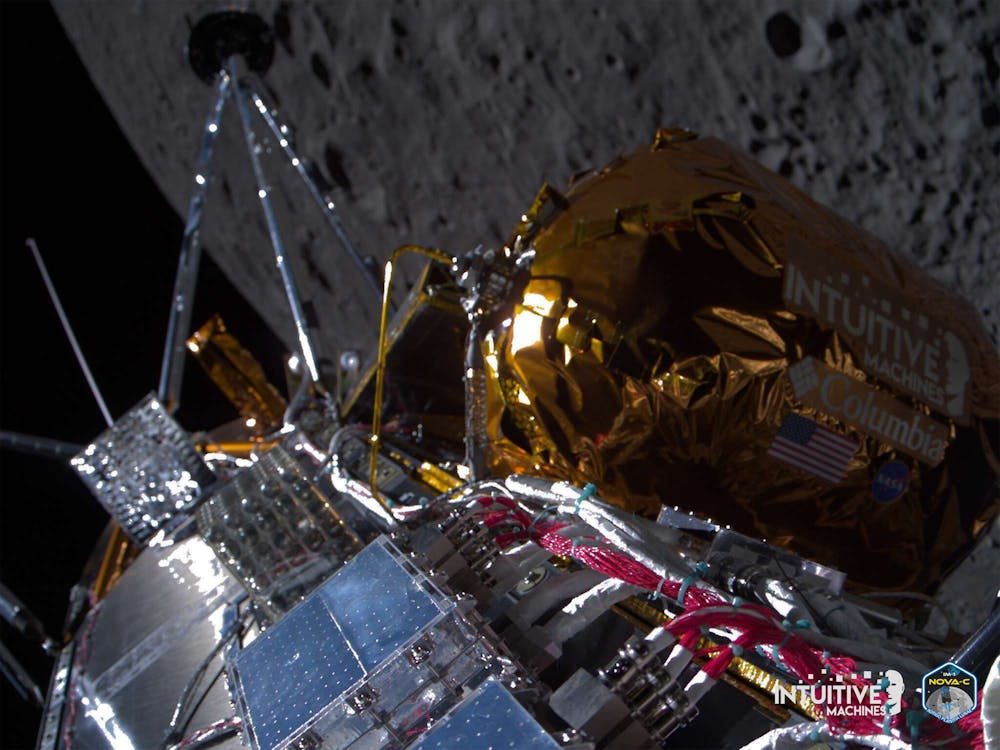
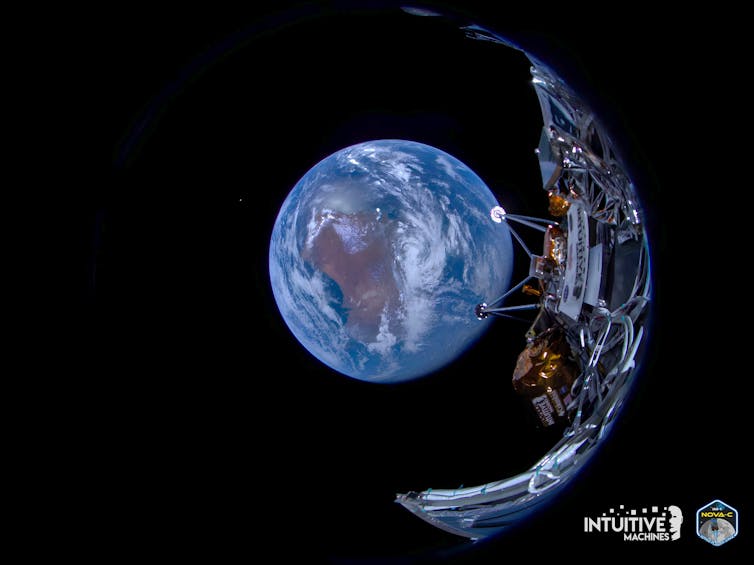
The Moon visible 10km beneath the Odysseus lander after it entered lunar orbit on February 21. Intuitive Machines, CC BY-NC-ND

Win some, lose some

NASA’s commercial approach to stimulating low-cost payload services all but guarantees some failures. But eventually NASA hopes that several commercial launch and landing providers will emerge from the program, along with a few learning experiences.

The know-how accumulated at organisations operating hardware in space is at least as important as the development of the hardware itself.

The market for commercial lunar payloads remains unclear. Possibly, once the novelty wears off and brands are no longer able to generate buzz by, for example, sending a piece of outdoor clothing to the Moon, this source of funding may dwindle.

However, just as today, civil space agencies and taxpayers will continue to fund space exploration to address shared science goals.

Ideally, commercial providers will offer NASA an efficient method for testing key technologies needed for its schedule of upcoming scientific robotic missions, as well as human spaceflight in the Artemis program. Australia would also have the opportunity to test hardware at a reduced price.

It’s worth noting that US budgetary issues, funding cuts and subsequent lay-offs do threaten these ambitions.

Meanwhile, in Australia, we may have nothing to launch anyway. We continue to spend less than the OECD average on scientific research, and only a few Australian universities – who traditionally lead such efforts – have received funding provided by the Australian Space Agency.

If we do support planetary science and space exploration in the future, Australians will need to decide if we want to allocate our limited resources, competing with NASA and US private industry, to supply launch, landing and robotic services to the global space industry.

Alternatively, we could leverage these lower-cost payload providers to develop our own scientific space program, and locally developed space technologies associated with benefits to the knowledge economy, education and national security.The Conversation

David Flannery, Planetary Scientist, Queensland University of Technology

This article is republished from The Conversation under a Creative Commons license. Read the original article.

Read More........

NASA scrubs launch of giant Moon rocket, may try again Friday

NASA scrubs launch of giant Moon rocket, may try again Friday
NASA has scrubbed a test flight of its powerful new rocket, in a setback to its plan to send humans back to the Moon and eventually to Mars, but may shoot for another launch attempt on Friday. "We don't launch until it's right," NASA administrator Bill Nelson said after an engine issue forced a cancellation of Monday's flight from the Kennedy Space Center in Florida. "This is a very complicated machine," Nelson said. "You don't want to light the candle until it's ready to go." The goal of the mission, baptized Artemis 1 after the twin sister of Apollo, is to test the 322-foot (98-meter) Space Launch System (SLS) rocket and Orion crew capsule that sits on top. The mission is uncrewed -- mannequins equipped with sensors are standing in for astronauts and will record acceleration, vibration and radiation levels. Mike Sarafin, mission manager of Artemis 1, said the space agency is hoping to make another launch attempt later this week. "Friday is definitely in play," Sarafin said. NASA would have a better idea of whether a Friday launch is feasible after a meeting on Tuesday of the management team, he said. "We just need a little bit of time to look at the data," Sarafin said. Next Monday, September 5, is an alternative launch date. Blastoff had been planned for 8:33 am (1233 GMT) but was cancelled because a test to get one of the rocket's four RS-25 engines to the proper temperature range for launch was not successful. Delays are "part of the space business," Nelson said, expressing confidence NASA engineers will "get it fixed and then we'll fly." Tens of thousands of people -- including US Vice President Kamala Harris -- had gathered to watch the launch, which comes 50 years after Apollo 17 astronauts last set foot on the Moon. "Our commitment to the Artemis Program remains firm, and we will return to the Moon," Harris tweeted. Veteran NASA astronaut Stan Love told reporters he was disappointed but "not really surprised." "This is a brand new vehicle," Love said. "It has a million parts. All of them have to work perfectly." Extreme temperatures: Overnight operations to fill the orange-and-white rocket with ultra-cold liquid hydrogen and oxygen were briefly delayed by a risk of lightning. A potential leak was detected during the filling of the main stage with hydrogen, causing a pause. After tests, the flow resumed. NASA engineers later detected the engine temperature problem and decided to scrub the launch. The Orion capsule is to orbit the Moon to see if the vessel is safe for people in the near future. At some point, Artemis aims to put a woman and a person of color on the Moon for the first time. During the 42-day trip, Orion will follow an elliptical course around the Moon, coming within 60 miles (100 kilometers) at its closest approach and 40,000 miles at its farthest -- the deepest into space by a craft designed to carry humans. One of the main objectives is to test the capsule's heat shield, which at 16 feet in diameter is the largest ever built. On its return to Earth's atmosphere, the heat shield will have to withstand speeds of 25,000 miles per hour and a temperature of 5,000 degrees Fahrenheit (2,760 degrees Celsius) -- roughly half as hot as the Sun. Crewed mission to Mars: NASA is expected to spend $93 billion between 2012 and 2025 on the Artemis program, which is already years behind schedule, at a cost of $4.1 billion per launch. The next mission, Artemis 2, will take astronauts into orbit around the Moon without landing on its surface. The crew of Artemis 3 is to land on the Moon in 2025 at the earliest. And since humans have already visited the Moon, Artemis has its sights set on another lofty goal: a crewed mission to Mars. The Artemis program aims to establish a lasting human presence on the Moon with an orbiting space station known as Gateway and a base on the surface.Gateway would serve as a staging and refueling station for a voyage to the Red Planet that would take a minimum of several months. Source: https://www.daily-bangladesh.com/
Read More........

Nokia, NASA to install 4G on the Moon

Finnish multinational telecommunications, information technology, and consumer electronics company Nokia announced its expansion into a new market on Monday, winning a deal to install the first cellular network on the Moon.

The Finnish equipment manufacturer said it was selected by NASA to deploy an “ultra-compact, low-power, space-hardened” wireless 4G network on the lunar surface, as part of the US space agency’s plan to establish a long-term human presence on the Moon by 2030, according to a report by AFP.

The $14.1 million contracts, awarded to Nokia’s US subsidiary, is part of NASA’s Artemis program which aims to send the first woman, and next man, to the moon by 2024.

The astronauts will begin carrying out detailed experiments and explorations which the agency hopes will help it develop its first human mission to Mars.

Nokia’s network equipment will be installed remotely on the Moon’s surface using a lunar hopper built by Intuitive Machines in late 2022, Nokia said.

“The network will self-configure upon deployment,” Nokia said in a statement, adding that the wireless technology will allow for “vital command and control functions, remote control of lunar rovers, real-time navigation and streaming of high definition video.”

The 4G equipment can be updated to a super-fast 5G network in the future, Nokia said.

In all, NASA announced last week it would distribute $370 million to 14 companies to supply “Tipping Point” technologies for its mission, which include robotics and new methods of harvesting the resources required for living on the moon, such as oxygen and energy sources.

Among them, Elon Musk’s SpaceX received $53.2 million for a demonstration of the transferring of ten metric tons of liquid oxygen between tanks on a starship vehicle, NASA said.Source: AFP Source: https://www.daily-bangladesh.com
Read More........

Indian-American among 18 astronauts selected for NASA's manned Moon mission


DEC 11, 2020 WASHINGTON: An Indian-American is among the 18 astronauts selected by NASA for its manned mission to the Moon and beyond. NASA on Wednesday named the 18 astronauts -- half of them women -- who will train for its Artemis moon-landing programme. Raja Jon Vurputoor Chari, 43, a graduate of the US Air Force Academy, MIT, and US Naval Test Pilot School, is the only Indian-American in the list. He was selected by NASA to join the 2017 Astronaut Candidate Class. He reported for duty in August 2017 and having completed the initial astronaut candidate training is now eligible for a mission assignment. "My fellow Americans, I give you the heroes of the future who will carry us back to the Moon and beyond: the Artemis Generation," Vice President Mike Pence said at NASA''s Kennedy Space Centre in Florida on Wednesday. "It really is amazing to think that the next man and the first woman on the Moon are among the names that we just read...We started today reflecting on a great hero of the past. The Artemis Generation are the heroes of American space exploration in the future," Pence said after he introduced the members of the Artemis Team during the eighth National Space Council meeting. The astronauts on the Artemis Team come from a diverse range of backgrounds, expertise and experience. Most of the astronauts in the group are in their 30s or 40s. The oldest is 55, the youngest 32. The agency's modern lunar exploration programme will land the first woman and next man on the Moon in 2024 and establish a sustainable human lunar presence by the end of the decade, NASA said. NASA will announce flight assignments for astronauts later, pulling from the Artemis Team. Additional Artemis Team members, including international partner astronauts, will join this group, as needed. "We are incredibly grateful for the president and vice president's support of the Artemis program, as well as the bipartisan support for all of NASA's science, aeronautics research, technology development, and human exploration goals," said NASA Administrator Jim Bridenstine. "As a result, we're excited to share this next step in exploration - naming the Artemis Team of astronauts who will lead the way, which includes the first woman and next man to walk on the lunar surface," he added. The selected astronauts will help NASA prepare for the coming Artemis missions, which begin next year working with the agency's commercial partners as they develop human landing systems; assisting in the development of training; defining hardware requirements; and consulting on technical development. They also will engage the public and industry on NASA''s exploration plans. "There is so much exciting work ahead of us as we return to the moon, and it will take the entire astronaut corps to make that happen," Chief Astronaut Pat Forrester said. "Walking on the lunar surface would be a dream come true for any one of us, and any part we can play in making that happen is an honour," he said. The other members on the list include Christina Koch and Jessica Meir -- the two astronauts who performed the world''s first all-female spacewalk last year. Copyright © Jammu Links News, Source: Jammu Links News
Read More........

Nasa's SOFIA finds water on sunlit surface of Moon

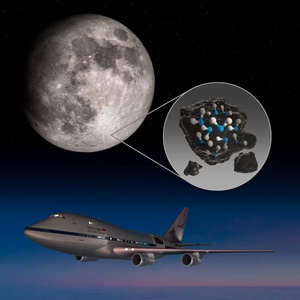
Nasa’s Stratospheric Observatory for Infrared Astronomy (SOFIA) – a telescope operating from an aircraft - has confirmed, for the first time, water on the sunlit surface of the Moon. This discovery indicates that water may be distributed across the lunar surface, and not limited to cold, shadowed places, Nasa revealed today.
SOFIA, a joint project of Nasa and the German Aerospace Centre. has detected water molecules (H2O) in Clavius Crater, one of the largest craters visible from Earth, located in the Moon’s southern hemisphere, the US space agency said. While previous observations of the Moon’s surface had detected some form of hydrogen, Nasa said, they were unable to distinguish between water and its close chemical relative, hydroxyl (OH). 
Data from this location reveal water in concentrations of 100 to 412 parts per million – roughly equivalent to a 12-ounce bottle of water – trapped in a cubic meter of soil spread across the lunar surface. The results are published in the latest issue of Nature Astronomy.
“We had indications that H2O – the familiar water we know – might be present on the sunlit side of the Moon,” said Paul Hertz, director of the Astrophysics Division in the Science Mission Directorate at NASA Headquarters in Washington. “Now we know it is there. This discovery challenges our understanding of the lunar surface and raises intriguing questions about resources relevant for deep space exploration.”
In comparison, the Sahara desert has 100 times the amount of water than what SOFIA detected in the lunar soil. Despite the small amounts, the discovery raises new questions about how water is created and how it persists on the harsh, airless lunar surface.
Since water is a precious resource in deep space and a key ingredient of life, Nasa is using its Artemis programme to study the presence of water on the Moon ahead of sending the first woman and next man to the lunar surface in 2024 with a view to establishing a sustainable human presence there by the end of the decade.
Under SOFIA’s results build on years of previous research examining the presence of water on the Moon. When the Apollo astronauts first returned from the Moon in 1969, it was thought to be completely dry. Orbital and impactor missions over the past 20 years, such as Nasa’s Lunar Crater Observation and Sensing Satellite, confirmed ice in permanently shadowed craters around the Moon’s poles.
Meanwhile, several spacecraft, including the Cassini mission and Deep Impact comet mission, as well as the Indian Space Research Organisation’s Chandrayaan-1 mission, and Nasa’s ground-based Infrared Telescope Facility, looked broadly across the lunar surface and found evidence of hydration in sunnier regions. Yet those missions were unable to definitively distinguish the form in which it was present – either H2O or OH.
“Prior to the SOFIA observations, we knew there was some kind of hydration,” said Casey Honniball, the lead author who published the results from her graduate thesis work at the University of Hawaii at Manoa in Honolulu. “But we didn’t know how much, if any, was actually water molecules – like we drink every day – or something more like drain cleaner.”
Scientists using Nasa’s telescope on an airplane, the Stratospheric Observatory for Infrared Astronomy, discovered water on a sunlit surface of the Moon for the first time. 
SOFIA is a modified Boeing 747SP aircraft that allows astronomers to study the solar system and beyond in ways that are not possible with ground-based telescopes. Molecular water, H2O, was found in Clavius Crater, one of the largest craters visible from Earth in the Moon’s southern hemisphere. This discovery indicates that water may be distributed across the lunar surface, and not limited to cold, shadowed places.
SOFIA offered a new means of looking at the Moon. Flying at altitudes of up to 45,000 feet, this modified Boeing 747SP jetliner with a 106-inch diameter telescope reaches above 99 per cent of the water vapor in Earth’s atmosphere to get a clearer view of the infrared universe. Using its Faint Object infraRed CAmera for the SOFIA Telescope (FORCAST), SOFIA was able to pick up the specific wavelength unique to water molecules, at 6.1 microns, and discovered a relatively surprising concentration in sunny Clavius Crater.
“Without a thick atmosphere, water on the sunlit lunar surface should just be lost to space,” said Honniball, who is now a postdoctoral fellow at Nasa’s Goddard Space Flight Center in Greenbelt, Maryland. “Yet somehow we’re seeing it. Something is generating the water, and something must be trapping it there.”
Several forces could be at play in the delivery or creation of this water. Micrometeorites raining down on the lunar surface, carrying small amounts of water, could deposit the water on the lunar surface upon impact. Another possibility is there could be a two-step process whereby the Sun’s solar wind delivers hydrogen to the lunar surface and causes a chemical reaction with oxygen-bearing minerals in the soil to create hydroxyl. Meanwhile, radiation from the bombardment of micrometeorites could be transforming that hydroxyl into water.
How the water then gets stored – making it possible to accumulate – also raises some intriguing questions. The water could be trapped into tiny beadlike structures in the soil that form out of the high heat created by micrometeorite impacts. Another possibility is that the water could be hidden between grains of lunar soil and sheltered from the sunlight – potentially making it a bit more accessible than water trapped in beadlike structures.
For a mission designed to look at distant, dim objects such as black holes, star clusters, and galaxies, SOFIA’s spotlight on Earth’s nearest and brightest neighbor was a departure from business as usual. The telescope operators typically use a guide camera to track stars, keeping the telescope locked steadily on its observing target. But the Moon is so close and bright that it fills the guide camera’s entire field of view. With no stars visible, it was unclear if the telescope could reliably track the Moon. To determine this, in August 2018, the operators decided to try a test observation.
“It was, in fact, the first time SOFIA has looked at the Moon, and we weren’t even completely sure if we would get reliable data, but questions about the Moon’s water compelled us to try,” said Naseem Rangwala, SOFIA’s project scientist at Nasa's Ames Research Center in California's Silicon Valley. “It’s incredible that this discovery came out of what was essentially a test, and now that we know we can do this, we’re planning more flights to do more observations.”
SOFIA’s follow-up flights will look for water in additional sunlit locations and during different lunar phases to learn more about how the water is produced, stored, and moved across the Moon. The data will add to the work of future Moon missions, such as Nasa’s Volatiles Investigating Polar Exploration Rover (VIPER), to create the first water resource maps of the Moon for future human space exploration.
In the same issue of Nature Astronomy, scientists have published a paper using theoretical models and Nasa's Lunar Reconnaissance Orbiter data, pointing out that water could be trapped in small shadows, where temperatures stay below freezing, across more of the Moon than currently expected. The results can be found here. 
“Water is a valuable resource, for both scientific purposes and for use by our explorers,” said Jacob Bleacher, chief exploration scientist for Nasa’s Human Exploration and Operations Mission Directorate. “If we can use the resources at the Moon, then we can carry less water and more equipment to help enable new scientific discoveries.”SOFIA is a joint project of Nasa and the German Aerospace Center. Ames manages the SOFIA programme, science, and mission operations in cooperation with the Universities Space Research Association, headquartered in Columbia, Maryland, and the German SOFIA Institute at the University of Stuttgart. The aircraft is maintained and operated by Nasa’s Armstrong Flight Research Center Building 703, in Palmdale, California. Source: https://www.domain-b.com/
Read More........

Cosmic lighthouses to help space travellers find ways to Moon, Mars

Washington: Just as lighthouses have helped sailors navigate safely into harbor for centuries, future space travellers may receive similar guidance from the steady signals created by pulsars.

Scientists and engineers are using the International Space Station to develop pulsar-based navigation using these cosmic lighthouses to assist with wayfinding on trips to the Moon under NASA's Artemis programme and on future human missions to Mars, the US space agency said on Wednesday.

Pulsars, or rapidly spinning neutron stars, are the extremely dense remains of stars that exploded as supernovas.

They emit X-ray photons in bright, narrow beams that sweep the sky like a lighthouse as the stars spin.

From a great distance they appear to pulse, hence the name pulsars.

An X-ray telescope on the exterior of the space station, the Neutron star Interior Composition Explorer or NICER, collects and timestamps the arrival of X-ray light from neutron stars across the sky.

Software embedded in NICER, called the Station Explorer for X-ray Timing and Navigation Technology or SEXTANT, is using the beacons from pulsars to create a GPS-like system.

This concept, often referred to as XNAV, could provide autonomous navigation throughout the solar system and beyond.

"GPS uses precisely synchronised signals. Pulsations from some neutron stars are very stable, some even as stable as terrestrial atomic clocks in the long term, which makes them potentially useful in a similar way," said Luke Winternitz, a researcher at NASA's Goddard Space Flight Center in Greenbelt, Maryland.

The stability of the pulses allows highly accurate predictions of their time of arrival to any reference point in the solar system.

Scientists have developed detailed models that predict precisely when a pulse would arrive at, for example, the centre of Earth.

Timing the arrival of the pulse to a detector on a spacecraft, and comparing that to when it is predicted to arrive at a reference point, provides information for navigating far beyond our planet.

"Navigation information provided by pulsars does not degrade by moving away from Earth since pulsars are distributed throughout our Milky Way galaxy," said SEXTANT team member Munther Hassouneh, navigation technologist.

"It effectively turns the ‘G' in GPS from Global to Galactic," added team member Jason Mitchell, Director of the Advanced Communications and Navigation Technology Division in NASA's Space Communication and Navigation Program."

"It could work anywhere in the solar system and even carry robotic or crewed systems beyond the solar system", Mitchell added. Source: https://ummid.com/
Read More........

ISRO releases new photos of moon craters by Chandrayaaan 2

AUG 27, 2019 BENGALURU: Chandrayaan-2, which is currently orbiting the Moon, has captured some more images of the lunar surface showing several craters, the Indian Space Research Organisation (ISRO) said on Monday. Sharing the pictures, the ISRO said in a statement that the photos captured by the lunar spacecraft are those of craters Somerfeld, Kirkwood, Jackson, Mach, Korolev, Mitra, Plaskett, Rozhdestvenskiy and Hermite. These craters have been named after great scientists, astronomers and physicists. Crater Mitra has been named after Prof Sisir Kumar Mitra, an Indian physicist and Padma Bhushan recipient known for his pioneering work in the field of ionosphere and Radiophysics. The space agency said these pictures of the lunar surface were taken on August 23 by the Terrain Mapping Camera-2 of Chandrayaan-2 from an altitude of about 4,375 km. The first picture of Moon captured by Chandrayaan-2 was released by ISRO on August 22. Chandrayaan-2, a three-module spacecraft comprising an orbiter, lander and rover, was launched on July 22. ISRO had on August 21 performed second lunar bound orbit manoeuvre for Chandrayaan-2 and said all spacecraft parameters are normal. There will be three more orbit manoeuvres before the lander''s separation from the Orbiter on September 2 and eventual soft landing in the south polar region of the Moon, planned on September 7. Copyright © Jammu Links News, Source: Jammu Links News
Read More........

Inside a Russian experiment to make life possible on the Moon or Mars

The longest experiment at BIOS lasted 180 days and was held in 1972-1973. Picture: Vera Salnitskaya, The Siberian Times 
By Olga Gertcyk and Vera Salnitskaya: The BIOS-3 closed ecosystem in Siberia sustains human life autonomously by creating a micro-Earth. Begun in the Cold War more than half a century ago, the experiment anticipated the Hollywood dilemma faced in The Martian by Matt Damon when he is stranded on the Red Planet: how to create oxygen, water and food to survive in a hostile environment? Here in a scientific institute in the city of Krasnoyarsk, BIOS-3 is the third generation solution to a problem scientists first began working on in 1965 at the behest of the father of Russian space exploration, Sergei Korolyov. As far away as you could get from the West's prying eyes, it was the subject of intriguing Soviet-era tests, shutting humans inside the closed ecosystem for up to 180 days, in the expectation of future long space missions. 
Inside the BIOS-3 station, Krasnoyarsk. Pictures: Vera Salnitskaya, The Siberian Times 
Senior engineer Nikolai Bugreyev, 74, is nicknamed the 'Siberian Martian' for spending a total of 13 months inside BIOS-3. As a 'bionaut' he twice celebrated New Year in this unique ecosystem. 'I lived in this compartment. It's really small but it was enough, it's just 5 square metres. There was a table, bed, a shelf for clothes, and that was it, you don't really need anything else,' he said. 'You could see outside of the round window, there were colleagues walking there, researchers, they were waving to us. But we couldn't really speak because you couldn't hear anything through the walls. We used a special phone if need was. Relatives would come at the weekends. 'Bionauts were working all day long, there was no time to miss family and home - so we didn't have any conflicts. We went to bed covered with wires, and there was a doctor sitting on the roof of the station. He monitored the devices every night. 'Yet there was no, even tiny, deviations in the health of researchers as a result of the experiment. Quite the opposite - healthy food, routine, favourite job - what else do you need to be happy and healthy? 'If a bionaut wanted to leave the station, he or she could do that even without talking to his colleagues, But no one was even thinking of giving up.'  
Previous experiments at BIOS-3 in 1973 and 1984. Pictures: Nikolay Bugreyev
Having proved the sustainability of an ecosystem to maintain human life, there are hopes of new research as Russia along with the US and other countries start to plan for long distance missions in space. Dr Alexander Tikhomirov, executive director of International Centre for Study of Enclosed Environmental Systems of the Institute of Biophysics, in Krasnoyarsk, gave us a tour of this unique facility. 'BIOS-3 is an autonomous enclosed life-support system,' he said. 'Construction works were completed in Krasnoyarsk in 1972. A hermetic room about 315 cubic meter large (14x9x2.5m) was built in the basement of the institute. 'The room was separated in four equally large spaces that were connected by hermetically sealed doors. One of them was a so-called household compartment where people could have some rest, talk to peers, take measurements, monitor the work of the system. It also had a kitchen and a bathroom. 'Three other compartments were designed to regenerate the environment. Two had plants; wheat, oilseeds and vegetables grew. They provided a balanced diet in terms of biochemical elements. Plants were carefully selected so that you do not get bored of them, on one hand, and to provide all the necessary nutrients, on the other.'
Dr Alexander Tikhomirov. Pictures: Vera Salnitskaya, The Siberian Times 
The diet comprised wheat, soy beans, salad, chufa (cyperus esculentus), carrot, radish, beetroot, potato, cucumbers, cabbage, and onion, which were grown in a greenhouse, with artificial lighting. Not forgetting rumex patientia - also known as 'garden patience' or 'monk's rhubarb'': but all the plants were specially selected. Miniature wheat has shorter stalks allowing a reduction in waste, for example. Chufa, or Central Asian grass, was used to produce oil. BIOS-3 started functioning in 1972 and a number of long-term experiments were conducted here using human guinea pigs. 'The longest experiment was six months long: there were three participants, two men and a woman,' Tikhomirov said. 'They were not simply living there but doing certain tasks. There was an agronomist, an engineer and a doctor among them, all working to support functioning of the system.' 
Inside the BIOS-3 station, Krasnoyarsk. Picture: Vera Salnitskaya, The Siberian Times 
The system worked without livestock so the ecosystem did not involve animal proteins. 'If animals were introduced to the system, we would need to enlarge it. It would be necessary not only to feed them but also to dispose of their waste. Butter and animal proteins were taken in tins. All the rest nutrients were produced in the system. Plants were used not only for food but also to produce oxygen, absorb carbon dioxide and support water cycle. There was a full water cycle, people had enough water.' He explained: 'The last compartment contained chlorella. It is a single-celled type of green algae containing large amounts of chlorophyll. It functions well for a long period, breeds, absorbs carbon dioxide, and participate in the water cycle. It's main disadvantage was that it is not edible.  'Chlorella was building up in the system and it was negatively affecting it, so they got rid of it and replaced it with a compartment with plants. This prevented a build-up of excessive waste.'
BIOS-3 is an autonomous enclosed life-support system. Pictures: Vera Salnitskaya, The Siberian Times 
In all there were ten experiments with between one and three participants, Dr Tikhomirov said.  The longest experiment lasted 180 days and was held in 1972-1973. Gas and water systems were completely enclosed, 80% of demand in food was also met within the system. Nikolay Bugreyev, an engineer at the same institute, spent more time inside than anyone else. 'Most importantly, it was proved that humans can live and work in an enclosed space for a long time with a full cycle,' said Dr Tikhomirov. 'There were attempts to copy us but they failed. There are certain peculiarities in terms of technologies, for example the Americans wouldn't listen to us and tried to make everything themselves but didn't consider nuances of growing plants. It caused a disbalance in terms of oxygen and they were forced to stop the experiment. 'There were other problems, they liked it stylish and decorated everything with plastic, yet there are some emissions from plastic that build up in an enclosed system. It's not only dangerous for people but also for plants which start dying.  'We had everything done in stainless steel. Not very attractive but very practical. 'Our foreign peers didn't consider a lot of factors. I can give you an example: it is necessary to grow plants in rows to ensure balance human breathe and the emission of oxygen by plants. Wheat germs produce some oxygen when they're new and a lot of it when they are mature. As they age, amount of oxygen decreases again. It means that it is necessary to use extra oxygen if you're growing plants all of the same age. 'We told them of it when they were doing their experiment, but they ignored our recommendations and created single-species single-aged systems. 'Initially, they didn't have enough oxygen and later they had too much of it. It was out of balance.' 
'Similar experiments in the West are conducted on rats'. Picture: Nikolay Bugreyev
In Soviet times, there was no hesitation in experimenting with people from an early stage. 'Similar experiments in the West are conducted on rats. It is necessary to sort out lots of things, now there is such a thing as human rights. In Soviet times they were experimenting on people straight away,' - Dr Tikhomirov said. 'Today the Chinese are the closest to repeating our experiment but not completely. They haven't sorted out waste management as yet.' Research here was hit first in the final years of the USSR when budgets tightened. 'Later, the Europeans got interested in developing this subject. Grants from the European Union boosted the modernisation of BIOS. Then there was some extra funding from Russian sources.' Today's experiments here are more limited in scope. 'The aim of current experiments is increasing the sustainability of the system: making the air cleaner, growing more food at BIOS. Generally speaking, the aim is to recreate the Earth in miniature. Now we're slowly refurbishing BIOS, taking into account new technologies. 'But it is not yet clear if long-term experiments at BIOS will continue. It requires a lot of money and the government should get involved. The institute is part of the Siberian branch of the Russian Academy of Sciences. Source: http://siberiantimes.com/
Read More........

NASA camera reveals 'dark side' of moon

Bright and dark side of the moon
Washington: From nearly 1.6 lakh km away, a NASA camera has captured a stunning view of the far side of the moon as it moved in front of the sun-lit side of Earth last month. The images show the fully illuminated “dark side” of the moon that is never visible from Earth. The lunar far side lacks the large and dark basaltic plains (called maria) that are so prominent on the Earth-facing side. A thin sliver of shadowed area of moon is visible on its right side. "It is surprising how much brighter Earth is than the moon. Our planet is a truly brilliant object in dark space compared to the lunar surface,” said said Adam Szabo, project scientist at NASA's Goddard Space Flight Center in Greenbelt, Maryland. The images were captured by NASA's Earth Polychromatic Imaging Camera (EPIC), a four megapixel CCD camera and telescope aboard the Deep Space Climate Observatory (DSCOVR) satellite orbiting 1 million miles (1.6 lakh km) from Earth. EPIC maintains a constant view of the fully-illuminated Earth as it rotates, providing scientific observations of ozone, vegetation, cloud height and aerosols in the atmosphere. The far side of the moon was not seen until 1959 when the Soviet Luna 3 spacecraft returned the first images. Since then, several NASA missions have imaged the lunar far side in great detail. The same side of the moon always faces an earthbound observer because the moon is tidally locked to Earth. That means its orbital period is the same as its rotation around its axis. Once EPIC begins regular observations next month, NASA will post daily colour images of Earth to a dedicated public website. About twice a year, the camera will capture the moon and Earth together as the orbit of DSCOVR crosses the orbital plane of the moon. Source: ummid.comImage: flickr.com
Read More........

Cost of human missions to the Moon and Mars could be shrunk by a factor of ten

Through private and international partnerships, the cost of colonising other worlds could be reduced by 90 percent, according to a joint study released by the National Space Society and the Space Frontier Foundation and reviewed by an independent team of NASA experts.
The National Space Society (NSS) and Space Frontier Foundation (SFF) have announced their support for NASA’s funding of the newly released NexGen Space study, illustrating how to cut the cost of human space exploration by a factor of 10. The study, “Economic Assessment and Systems Analysis of an Evolvable Lunar Architecture that Leverages Commercial Space Capabilities and Public – Private – Partnerships”, finds that public-private partnerships could return humans to the Moon for approximately 90% less than the previously estimated $100 billion, allowing the United States to ensure national security in a new space age. “The Space Frontier Foundation supports and recommends public-private partnerships in all proposed human spaceflight programs in order to reduce costs and enable these missions that were previously unaffordable,” said the Space Frontier Foundation’s Chairman of the Board, Jeff Feige. “This is the way that America will settle the final frontier, save taxpayers money and usher in a new era of economic growth and STEM innovation.” 

NSS and SFF call attention to these conclusions from the study:
  • Through public-private partnerships, NASA could return humans to the surface of the Moon and develop a permanent lunar base with its currenthuman spaceflight budget.
  • Mining fuel from lunar poles and transporting it to lunar orbit for use by other spacecraft reduces the cost of sending humans to Mars and other locations beyond low Earth orbit. These commercial fuel depots in lunar orbit have the potential to cut the cost of sending humans to Mars by more than $10 billion per year.

“NSS congratulates NASA for funding the team at NexGen that discovered how such cost reductions are possible,” said Mark Hopkins, the NSS Executive Committee Chair. “A factor of ten reduction in cost changes everything.” Recent contracts with Boeing and SpaceX are just one example of how partnerships can work and may help with more ambitious projects in the future. The latter spent only $440 million developing its Falcon 9 rocket and Dragon crew capsule, where NASA would have spent $4 billion. SpaceX has also been developing areusable rocket that aims to dramatically cut launch costs. Extracting and refining resources on the Moon, rather than having them delivered up from Earth to the lunar surface, could save a great deal of money too. There are many other examples of cost-saving measures. Click here to read the executive summary andhere to download the full report.Source: Article
Read More........

Largest Solar System Moon Detailed in Geologic Map

Animation of a rotating globe of Jupiter's moon Ganymede, with a geologic map superimposed over a global color mosaic. The 37-second animation begins as a global color mosaic image of the moon then quickly fades in the geologic map. The views incorporate the best available imagery from NASA's Voyager 1 and 2 spacecraft and NASA's Galileo spacecraft. To present the best information in a single view of Jupiter's moon Ganymede, a global image mosaic was assembled, incorporating the best available imagery from NASA's Voyager 1 and 2 spacecraft and NASA's Galileo spacecraft. This image shows Ganymede centered at 200 west longitude. This mosaic (right) served as the base map for the geologic map of Ganymede (left). Video credit (top): USGS Astrogeology Science Center/Wheaton/ASU/NASA/JPL-Caltech; image credit (bottom): USGS Astrogeology Science Center/Wheaton/NASA/JPL-Caltech Note: For more information, see Largest Solar System Moon Detailed in Geologic Map. Source: Article
Read More........

Evidence Of Water Vapor Venting Off Jovian Moon


Illustration Credit: NASAESA, and L. Roth (Southwest Research Institute and University of Cologne, Germany)
Previous scientific findings from other sources already point to the existence of an ocean located under Europa's icy crust. Researchers are not yet certain whether the detected water vapor is generated by water plumes erupting on the surface, but they are confident this is the most likely explanation. This graphic shows the location of water vapor detected over Europa's south pole that provides the first strongevidence of water plumes erupting off Europa's surface, in observations taken by NASA's Hubble Space Telescope in December 2012. Hubble didn't photograph plumes, but spectroscopically detected auroral emissions from oxygen and hydrogen. The aurora is powered by Jupiter's magnetic field. This is only the second moon in the solar system found ejecting water vapor from the frigid surface. The image of Europa is derived from a global surface map generated from combined NASA Voyager and Galileo space probe observations. Should further observations support the finding, it would make Europa the second moon in the solar systemknown to have water vapor plumes. The findings were published in the Thursday, Dec. 12, online issue of Science Express, and reported at the meeting of the American Geophysical Union in San Francisco. "By far the simplest explanation for this water vapor is that it erupted from plumes on the surface of Europa," said lead author Lorenz Roth of Southwest Research Institute in San Antonio, Texas. "If those plumes are connected with the subsurface water ocean we are confident exists under Europa's crust, then this means that future investigations can directly investigate the chemical makeup of Europa's potentially habitable environment without drilling through layers of ice. And that is tremendously exciting." In 2005, NASA's Cassini orbiter detected jets of water vapor and dust spewing off the surface of Saturn's moon Enceladus. Although ice and dust particles subsequently have been found in the Enceladus plumes, only water vapor gases have been measured at Europa so far. Hubble's spectroscopic observations provided the evidence for Europa plumes in December 2012. Time sampling of auroral emissions measured by Hubble's imaging spectrograph enabled the researchers to distinguish between features created by Jupiter's magnetospheric particles and local enhancements of gas, and to also rule out more exotic explanations such as serendipitously observing a rare meteorite impact. The imaging spectrograph detected faint ultraviolet light from an aurora, powered by Jupiter's intense magnetic field, near the moon's south pole. Atomic oxygen and hydrogen produce a variable auroral glow and leave a telltale sign that they are products of water molecules being broken apart by electrons along magnetic fieldlines. "We pushed Hubble to its limits to see this very faint emission. These could be stealth plumes, because they might be tenuous and difficult to observe in the visible light," said Joachim Saur of the University of Cologne in Germany. Saur, who is principal investigator of the Hubble observation campaign, co-wrote the paper with Roth. Roth suggested long cracks on Europa's surface, known as lineae, might be venting water vapor into space. Cassini has seen similar fissures that host Enceladus' jets. The Hubble team found that the intensity of Europa's plumes, like that Enceladus's plumes, varies with the moon's orbital position. Active jets have been seen only when Europa is farthest from Jupiter. But the researchers could not detect any sign of venting when Europa is closer to Jupiter. This is an artist's concept of a plume of water vapor thought to be ejected off of the frigid, icy surface of the Jovian moon Europa, located 500 million miles from the Sun. Hubble Space Telescope spectroscopic measurements lead scientists to calculate that the plume rises to an altitude of 125 miles and then probably rains frost back onto the moon's surface. Previous findings already point to a subsurface ocean under Europa's icy crust.
Artwork Credit: NASA, ESA, and K. Retherford (Southwest Research Institute)
One explanation for the variability is these lineae experience more stress as gravitational tidal forces push and pull on the moon and open vents at larger distances from Jupiter. The vents are narrowed or closed when the moon is closest to the gas giant planet. "The apparent plume variability supports a key prediction that Europa should tidally flex by a significant amount if it has a subsurface ocean," said Kurt Retherford, also of Southwest Research Institute. Europa's and Enceladus' plumes have remarkably similar abundances of water vapor. Because Europa has roughly 12 times more gravitational pull than Enceladus, the vapor, whose temperature is measured at minus 40 degrees Celsius, does not escape into space as it does at Enceladus. Instead, it falls back onto the surface after reaching an altitude of 125 miles, according to the Hubble measurements. This could leave bright surface features near the moon's south polar region, the researchers hypothesize. "If confirmed, this new observation once again shows the power of the Hubble Space Telescope to explore and opens a new chapter in our search for potentially habitable environments in our solar system," said John Grunsfeld, an astronaut who participated in Hubble servicing missions and now serves as NASA's associate administrator for science in Washington, D.C. "The effort and risk we took to upgrade and repair the Hubble becomes all the more worthwhile when we learn about exciting discoveries like this one from Europa." Contacts and sources: Dwayne Brown / J.D. Harrington, NASA Headquarters, Washington, D.C. Joe Fohn, Southwest Research Institute, San Antonio, Texas, Ray Villard, Space Telescope Science Institute, Baltimore, Md. Source: Article
Read More........

NASA-Funded Scientists Detect Water on Moon's Surface that Hints at Water Below


Chandrayaan-1 Moon mission description
NASA-funded lunar research has yielded evidence of water locked in mineral grains on the surface of the 
moon from an unknown source deep beneath the surface. Using data from NASA's Moon Mineralogy Mapper (M3) instrument aboard the Indian Space Research Organization's Chandrayaan-1 spacecraft, scientists remotely detected magmatic water, or water that originates from deep within the moon's interior, on the surface of the moon. The findings, published Aug. 25 in Nature Geoscience, represent the first detection of this form of water from lunar orbit. Earlier studies had shown the existence of magmatic water in lunar samples returned during the Apollo program. M3 imaged the lunar impact crater Bullialdus, which lies near the lunar equator. Scientists were interested in studying this area because they could better quantify the amount of water inside the rocks due to the crater's location and the type of rocks it held. The central peak of the crater is made up of a type of rock that forms deep within the lunar crust and mantle when magma is trapped underground. "This rock, which normally resides deep beneath the surface, was excavated from the lunar depths by the impact that formed Bullialdus crater," said Rachel Klima, a planetary geologist at the Johns Hopkins University
NASA patch / NASA / ISRO - Chandrayaan-1 Moon Mineralogy Mapper (M3) patch's.
Applied Physics Laboratory (APL) in Laurel, Md. "Compared to its surroundings, we found that the central portion of this crater contains a significant amount of hydroxyl - a molecule consisting of one oxygen atom and one hydrogen atom -- which is evidence that the rocks in this crater contain water that originated beneath the lunar surface," Klima said. In 2009, M3 provided the first mineralogical map of the lunar surface and discovered water molecules in the polar regions of the moon. This water is thought to be a thin layer formed from solar wind hitting the moon's surface. Bullialdus crater is in a region with an unfavorable environment for solar wind to produce significant amounts of water on the surface. "NASA missions like Lunar Prospector and the Lunar Crater Observation and Sensing Satellite and instruments like M3 have gathered crucial data that fundamentally changed our understanding of whether water exists on the surface of the moon," said S. Pete Worden, center director at NASA's Ames Research Center in Moffett Field, Calif. "Similarly, we hope that
LADEE Mission poster
upcoming NASA missions such as the Lunar Atmosphere and Dust Environment Explorer, or LADEE, will change our understanding of the lunar sky." The detection of internal water from orbit means scientists can begin to test some of the findings from sample studies in a broader context, including in regions that are far from where the Apollo sites are clustered on the near side of the moon. For many years, researchers believed that the rocks from the moon were bone-dry and any water detected in the Apollo samples had to be contamination from Earth. "Now that we have detected water that is likely from the interior of the moon, we can start to compare this water with other characteristics of the lunar surface," said Klima. "This internal magmatic water also provides clues about the moon's volcanic processes and internal composition, which helps us address questions about how the moon formed, and how magmatic processes changed as it cooled." APL is a not-for-profit division of Johns Hopkins University. Joshua Cahill and David Lawrence of APL and Justin Hagerty of the U.S. Geological Survey's Astrogeology Science Center in Flagstaff, Ariz., co-authored the paper. NASA's Lunar Advanced Science and Engineering Program, the NASA Lunar Science Institute (NLSI) at Ames and the NASA Planetary Mission Data Analysis Program supported the research. NLSI is a virtual organization jointly funded by NASA's Science Mission Directorate and NASA's Human Exploration and Operations Mission Directorate in Washington, to enable collaborative, interdisciplinary research in support of NASA lunar science programs. For more information about NASA programs, visit: http://www.nasa.gov. Images, Text, Credit: NASA / JPL / ISRO. Greetings, Orbiter.ch. Source: Orbiter.ch Space News
Read More........

Russian's Spacecraft Launch to the Moon in 2015


Russia still had ambitions to explore the Moon as the United States. Russian Space Agency (Roscosmos) said it will continue the Moon exploration in 2015 and 2017 Russia will launch the Luna-Resurs and the Luna-Glob lunar missions, using a Soyuz-2.1a and Soyuz-2.1b rocket, respectively, with a Fregat upper stage. Both missions will deliver a lander on the surface of the Moon, carrying similar scientific payload, the main difference being that Luna-Resurs will also comprise an Indian rover and a surface-drilling equipment. According to the Interfax news agency, Director of Roscosmos, Vladimir Popovkin, said the spacecraft called Luna-Glob will be the first rocket took off from a new facility in the far
eastern Amur region. Luna Resurs and Luna Glob misisons scenario. (Picture from: http://lunamissions.wordpress.com/) "We will begin our exploration of the Moon from there," he said of the new space centre that will decrease Russia's reliance of the Baikonur Cosmodrome in the ex-Soviet nation Kazakhstan, which it leases. The Russian space agency officials said Luna-Glob will carry orbital module and spacecraft that will land on the Moon. Rides charge sending back the necessary information about the sample from the surface of the Moon. The Soviet Union never surpassing the United States in the space race when successfully sending spacecraft to the Moon in 1959. Russia also first put the first into space in 1961. However, the United States became the first country to be able to put man on the Moon in 1969, while Russia has not been able to do so. The latest unmanned spacecraft to the Moon which was a success came in 1970. However, since the Russian space program just continues to decline, especially in recent years. Including the failure of satellites and spacecraft launch to Mars in 2011. According to the Russian Defense Ministry, on Tuesday / January 15, 2013 that the rocket launched managed to place three Russian military satellite in orbit. The
architecture of the Luna-Glob lander as of the end of 2010. The soil-samplingrobotic arm can be seen on left. An additional surface-drilling hardware could be included, with the total mass of science payloads onboard the lander reaching 30 kilograms. (Picture from: http://www.russianspaceweb.com/) The Russian Prime Minister Dmitry Medvedev approved a plan last month to spend 2.1 trillion roubles ($70 billion) on space industry development in 2013-2020, to pursue projects to explore the Moon and Mars, among other things. *** [EKA | FROM VAROUS SOURCES | REUTERS | MAHARDIKA SATRIA HADI | KORAN TEMPO 4121], Source: Trussty-Jasmine
Read More........