Microsoft staffers oppose the TikTok deal as ‘Unethical’


The US is currently forcing TikTok to be sold to an American company, saying that the would-be transaction must be completed by 15 September or otherwise the popular video-sharing app used by around 100 million users in the US will be banned in the country; reports Russian news agency Sputnik.

Microsoft staffers don't want their employer to buy out the short video app TikTok, the brainchild of the Chinese firm ByteDance, as revealed by internal message exchanges cited by the Daily Mail.

Writing on a corporate social network called Yammer, they explicitly stated that it feels like a deal and participation in negotiations to this end are not the right thing to do in terms of ethics.

"Especially since Satya [Nadella] became CEO, I've felt nothing but pride to be part of this company", one user posted in a comment thread, adding this is the first time that he has had "doubt gnawing at the pit of my stomach that maybe we're not doing the right thing".

Another portrayed the talks as "unethical from pretty much any perspective".

"That Microsoft would even be considering stepping into this situation is unthinkable", the user asserted.

Separately, in a survey on Yammer, seen by Business Insider, 63 percent of staff said "no" when asked whether they were for Microsoft's potential buyout of TikTok. Another 19 percent of some 250 staffers polled said they "weren't sure" and just 18 percent said "yes".

Trump initially announced he would ban TikTok's Chinese umbrella company from operating in the US on national security grounds, over fears that private data could be harvested through the app upon Beijing’s order - something that China outright denied. The Chinese envoy to the US, Cui Tiankai, said in response that forcing TikTok to sell to Microsoft violated US free market principles. Beijing, for its part, warned the US of "consequences" if it opens "Pandora's Box" with what a Chinese official called "political manipulation" and a crackdown on a Chinese company.

Donald Trump's last-minute decision to allow Microsoft to purchase TikTok, thereby boosting the tech giant’s social media presence, was understood to have been triggered by talks with fellow Republicans and Microsoft CEO Satya Nadella.

"A very substantial portion of that price is going to have to come into the Treasury of the United States, because we're making [the deal] possible", Trump pointed out, sparking a debate about what was taken as a mafia-style arrangement.

The only social network currently owned by Microsoft is LinkedIn - its previous biggest purchase, which cost it $26 billion in 2016.

Neither Facebook nor Google, Microsoft's potential competitors in the social media domain, can enter the running for TikTok, because of anti-trust issues they are facing over allegations of monopoly rights abuse.

The valuation for TikTok by ByteDance, who earlier complained about facing problems when attempting to go global, has climbed above $50 billion, although US pressure to divest it could lower the price, an earlier Reuters report has it. The deal is to be finalised by 15 September.

Now that the deal is in the making, the key task is reportedly separating TikTok's technology from ByteDance's infrastructure, so as to effectively alleviate Washington's mounting concerns about the integrity of personal data.Source: https://www.daily-bangladesh.com
Read More........

Scientists trying to give AI storytelling capabilities

Thinkstock photoNew York, June 5 
Scientists at Microsoft Research and their colleagues are developing an artificial intelligence (AI) system that can tell stories based on photos. The aim is not just to explain what items are in the picture, but also what appears to be happening and how it might potentially make a person feel, US-based website livescience.com quoted the researchers as saying. For example, if a person is shown a picture of a man in a tuxedo and a woman in a long, white dress, instead of saying, “This is a bride and groom,” he or she might say, “My friends got married. They look really happy; it was a beautiful wedding.” “The goal is to help give AIs more human-like intelligence, to help it understand things on a more abstract level and what it means to be fun or creepy or weird or interesting,” Margaret Mitchell, study senior author said in a “With our focus on storytelling, we hope to help AIs understand human concepts in a way that is very safe and beneficial for mankind, rather than teaching it how to beat mankind,” Mitchell, who is also a computer scientist at Microsoft Research, added. To build a visual storytelling system, the researchers used deep neural networks, computer systems that learn by example. The researchers said although everything worked fine, the computerised storyteller needs a lot more tinkering. “The automated evaluation is saying that it’s doing as good or better than humans, but if you actually look at what’s generated, it’s much worse than humans,” Mitchell noted. “There’s a lot the automated evaluation metrics are not capturing and there needs to be a lot more work on them. This work is a solid start, but it is just the beginning.” The scientists will detail their findings in San Diego at the annual meeting of the North American Chapter of the Association for Computational Linguistics later this month. — IANS. Source: http://www.tribuneindia.com
Read More........

Windows 10 may be selling well, how Microsoft are still not satisfied?

Windows 10
Strong demand for Windows 10 surface (also to be the ultimate test of the market) is more the result of its error correction again in the traditional PC market and the value of compromise, rather than a manifestation of the true value, while the market and users for its functionin the mobile space indifference, but also seems to presage Windows 10 in the mobile market than previous Windows 8 will not have too much outstanding performance. Microsoft has been hailed as the mobile market to reverse the decline and transition heavyweight upcoming Windows 10 operating system market. So Windwos 10 can receive favorable for the market, the relationship with Microsoft's future prospects in the mobile market, and "Mobile led the cloud-first" strategy proposed CEO can be implemented. Recently, the results of a recent survey of IT professionals for research institutions Spiceworks released, Microsoft's Windows 10 operating system abnormalities strong potential demand. That plan to install Windows 10 system users in two years the ratio reached 73%, of which about 40% of users plan to install Windows 10 systems within a year. From that perspective, the demand for Windows 10 system is indeed strong, at least compared with its predecessor Windows 8 system is this. It stands to reason such a high market and customer needs, for Microsoft, should be fond of fishes, but in this report we read carefully the user to upgrade or install Windows 10, the main driver ── Strong demand for Microsoft Windows 10 may not be all good, and even worries: In Spiceworks report, Windows 10 system, most attention is the traditional start button return, 64% of respondents believe that, Windows 10 system, the traditional start button back, is one of its most popular feature; secondly, Microsoft for Windows 10 available to Windows 7 andWindows 8 users a free upgrade, got 55 percent of respondents supported, to become the second most popular properties; 51% of respondents believe that the safety performance enhancements, Windows 10 system is the third most popular properties . I do not know the industry see the three main drivers feel? First, from the first drivers to see, so much innovative Windows 10, as it was for the previous generation of Windows 8 errors corrected. Industry know, Windows 8 due to the cancellation of the traditional PC user habits start button and much industry criticism, and become one of the main Windows 8 market performance incompetence. Followed by the so-called free upgrades factors caused. Because smart phones and tablets to the traditional PC and PC impact of highly sophisticated applications, the traditional PC users fromWindows 8 since it has lost the power system upgrade for Windows, so Microsoft on Windows 10 had to take a free market strategy stimulate users to upgrade, so that 55 percent of respondents approved of Microsoft Windows for free, from another perspective, it could be for Windows 10 value (s) of a negative 10. Finally, security.As we all know, security has been paying more attention to the aspects of the Windows system, after all, the majority of enterprises in the current IT system (including PC) running Windows system, so security is a matter of course to do Windows. The above Windows10 upgrade or install three drivers, we believe strong demand for Windows 10 behind, is not a positive driving force for innovation itself due to Windows 10, but for Windows systems prior to correction and change to depreciate the value (from Pay to free) is a market rebound, which is the market and users before the upgrade or install Windows because of its innovative value due to different. It is worth noting that in some innovative features on Windows10 conference was Microsoft deliberately emphasized, such as Cortana, the Edge browser and Continuum drew etc., did not attract the attention of the respondents, that these so-called innovations did not become market and users to upgrade and install Windows 10, the main driving force. Also, I wonder if there is no set term or for other reasons survey, Windows 10 support feature iOS and Android applications, and does not appear in the user is therefore welcomed and select Windows 10, and possession of what proportion of the survey. Perhaps the user does not care about Windows 10 support iOS and Android applications. So the question is, to support iOS and Android applications are Windows10 in the mobile market, the biggest selling point, but gradually marginalized in the PC era, one of the main objectives developed by Microsoft Windows10 is hoping to win the smartphone market, and, ultimately, Microsoft cross-platform, cross-device, unified experience "mobile first" strategy. Industry support for Windows10 iOS and Android applications veiled criticism: First, there will be a "lowest common denominator phenomenon" in the software migration (the most banal metaphor popular product), namely those who are most desirable to use a low-cost means to port software to the people on other platforms, but also the most reluctant in every on a platform that will be the most sophisticated user experience people. The implication is that Windows for iOS and Android compatibility and portability, you can not attract the iOS and Android platforms best software. In addition, compatible Android and iOS versions of software Windows 10, mobile application developers have no reason to think more specially developed Windows versions, which only makes the fragile ecosystems more vulnerable Windows Phone Moreover, if the market and users are more like Android or iOS platform application, then why Windows platform through experience? It seems the market and users do not care for Windows10 compatible Android and iOS applications, or do not become a reason to choose Windows 10 is not unfounded, and this is bound to affect the value and performance of Windows 10 in the mobile market. The above analysis is not difficult to see that the strong demand for Windows10 surface (also to be the ultimate test of the market) is more a result of its error correction again in the traditional PC market and the value of compromise, rather than a manifestation of the true value. While the market and users for their indifference in the mobile space capabilities, but also seems to presage Windows10 have too outstanding performance in the mobile market more compared to the previous Windows 8 will not. It might get higher than the Windows 8 upgrade or install Microsoft is happy to see the amount, but the overall value of Windows and Microsoft cross-platform, cross-device, unified experience "mobile first" strategy from the perspective of Windows 10 in the PC market , it is likely to worry. Because, as may be the last Windows version, in this version of the life cycle of these strategies will be difficult to achieve. Source: Article
Read More........

The Internet is losing its baby teeth

SHUTTERSTOCK
In 2010, Chris Anderson, editor of Wired magazine, wrote “The Web Is Dead.” He argued that the future of the Internet and connectivity wasn’t in the World Wide Web, but in a fragmented collection of many different platforms — people consuming content via mobile devices, native apps and other means outside of a traditional web browser. While Anderson’s sensational claim raised a lot of eyebrows, and sparked enormous debate, I wasn’t sure what to make of his prediction at the time. But four years later, we have a little more perspective. In 2014, ‘the web’ — the means by which we access the Internet using a web browser — is hardly dead, although there certainly has been a significant shift our relationship with the Internet. In its infant stages, going online meant using AOL or Earthlinkto dial up a connection to the web. Today, we use the Internet for different reasons, and our connectivity is better, faster and stronger than ever. The disruptive technology that is the Internet is no longer a baby, it’s more like a toddler learning to walk. When your babies learn to walk, you breathe a sigh of relief at their newfound mobility. But that relief quickly turns to frustration as you realize you’ve only traded one set of problems for another. Your newly mobile child can now get into everything, climb and break everything. The same is true with the Internet. One of the most astonishing ways it's changed our lives, for example, is by changing the way we consume music and videos. It’s severed our ties to old, “hard media” like videotapes, CDs and DVDs — an amazing liberation — but has also introduced a whole new, frustrating labyrinth of alternatives at the same time. Anderson’s prediction of fragmentation is most obvious when you look on top of (or under) your TV. Odds are, where we used to store our DVD cases and video sleeves, most of us now have an assortment of streaming devices. Instead of having one giant VCR, we can now choose from having a cable box, TiVO, DVR, Apple TV, Chromecast, Roku, Amazon Fire TV and much more. But the irony is that with all these choices, we can’t actually choose just one. You can’t stream iTunes media through your Chromecast, and you can’t watch Amazon Prime on your Apple TV. Roku is great, but doesn't work with AirPlay. You can watch Netflix on your Apple TV, but, of course, Netflix doesn’t have half the movies you wish it did available for streaming. If you want voice control on your device, only Amazon Fire TV has it. Are you the old fashioned type who still likes using a remote control? Don’t get Chromecast. Oh and by the way, if you don't want a wallet-sized device cluttering up your living room, you can just switch to Amazon’s new Fire TV Stick, which is about the size of a thumb drive. But that’s only if you don’t already have the Roku Streaming Stick, or if you aren’t waiting for Wal-Mart’s just-announced VUDU Spark Stick. (I can’t wait to see what Microsoft and Blackberry have up their sleeves to try to jump into this game — their product names are bound to be interesting.) I’m old enough to remember watching VHS tapes, but not enough to remember the video format wars in the ‘80s. My dad told me a story of the VHS tape fighting against the smaller, arguably better, Betamax format. As the story goes, VHS ended up with a better selection of videos – today we’d say they had more “content providers” — and ergo won the format war despite downfalls in size and picture quality. There was a similar war in the early 2000s: HD-DVD vs. Blu-Ray. But what this costly war actually proved was that hardware format doesn’t matter anymore. While people were busy upgrading their home video collections from VHS to HD-DVD or Blu-Ray, the Internet was born. Streaming digital media became the new way to watch movies and most of us stopped purchasing movies altogether, opting for monthly subscription fees for on-demand consumption using services like Netflix. The lure of the Internet delivering whatever we wanted, whenever and wherever we wanted and on any device wanted, trumped everything else. Is this all for the better? I still don’t know. I see benefit in no longer needing to spend my hard-earned cash on hardware that’ll become obsolete in five or 10 years, and not being confined to a desktop when I want to access web content. (I'm grateful to be free from lugging my massive CD sleeve around in my car too. However, there’s always the risk that I’ll want to listen to a certain album, or watch a certain movie, only to find out that it's “not available.”) I think we’ve reached an awkward phase for the Internet. It’s beyond the baby stages and learned to walk. It’s still gaining confidence, and smiles a big, toothy grin with several missing teeth. The web isn’t dead; we’re all just impatiently watching it to grow up. Ron is a web guy, IT guy, and Internet marketer living in Colorado Springs with his wife and five children. He can often be overheard saying things like "Get a Mac!" and "Data wins arguments,” wandering around the downtown area at least five days a week. Follow him on Twitter at@ronstauffer or email him at indy@ronstauffer.com. Questions, comments and snide remarks are always welcomeSource: Article
Read More........

Bracelet transforms wrist into a touchscreen

A bracelet that turns skin into a smartphone style interface is on the cusp of mass development after its developers promised a prototype in a matter of weeks. The Cicret bracelet incorporates a pico-projector and eight proximity sensors to display an interface on the back or the front of the user's wrist and support touch interaction.
The video in this story shows multiple consumer applications but the bracelet could also be used to access control interfaces or presentation materials in the professional environment. Cicret says the
product will be available in 16 and 32 GB versions and is durable and waterproof. It is a similar concept to Microsoft’s Sikinput system but demonstrates a product that can be deployed in a small and ergonomic format. Source: InAVate
Read More........

Live map shows cyber-war in real time

Cyber-intelligence firm builds heatmap to show online attacks around the world as they happen
A heat map depicting cyber-warfare as it happens has revealed the extent of the online attacks that ricochet between China and the United States. The mesmerising depiction has been created by Norse Corporation – a company that monitors global spyware and malware. The map is based on 130 terabytes of information gathered from 40 countries and eight million so-called "honeypots" – computers that emulate the kinds of programs cyber-attackers tend to attack, like ATM software and corporate email, BuzzFeed explains. The map shows a range of different information, including which country a cyber attack comes from, where it is aimed, and details about what kind of attack it is. The attacks it displays represent only one per cent of the total data Norse tracks. If the company attempted to display any more than that it would become illegible, it says. Although many of the attacks seem to be emanating from China, that impression may be misleading, NetworkWorld says, as "many attackers are good at masking their real location".  At time of writing, the five most frequently attacked countries appear to be the US, China, Singapore, UK and Thailand. And apart from China, the assaults seem to originate from the US, the Netherlands, Russia and what looks like a small island off the south coast of Ghana labelled "Mil/Gov". Rather than this being a secretive US military base in the Gulf of Guinea, it is in fact a random location on the equator that Norse has selected to represent cyber-attacks committed by and against the American government, where location data is unavailable. The map is "weirdly hypnotic" Quartz's Heather Timmons says, and looks rather "like the vintage video game Missile Command". Another tool that does a similar job is Kaspersky’s stunning interactive cyber threat map. Kaspersky Lab, a provider of anti-virus software has over 60 million users and detects more than 300,000 malicious objects every day. According to Kaspersky, the most infected countries in the world are currently Russia, India, Vietnam, the US and Germany. For further concise, balanced comment and analysis on the week's news, try The Week magazine. Subscribe today and get 6 issues completely free. Source: The Week UK, Image Courtesy: https://pbs.twimg.com/media/BrJK-NACMAERLH6.jpg:large
Read More........

Apple seeking patent for interactive 3D display


Apple has filed a patent application for an Interactive 3D display system which would allow users to manipulate objects in mid-air. The system involves light being projected through a non-linear crystal, for example, which would convert the signal into a floating 3D image that users could interact with. A sensor assembly logs user input such as touches and swipes to manipulate image. According to the document filed with the U.S. Patent and Trademark Office, the system would consist of four main parts, beginning with the display creating a primary 3D image. The optical system within the unit would create a secondary 3D image based upon the first one which the user would interact with. A sensor system would gather information on the user’s interaction with the secondary 3D image and the display would then update the primary image based on user interaction feedback. How far the system has been developed since the patent was filed two years ago is unclear, but it shares many features Vermeer - with a 360-degree viewable tabletop display created  by Microsoft Research in 2011. With non-interactive holographic displays are already creating a buzz in the retail sector as a new era in digital signage, the creation of an interactive model is the next logical step. Contact Details and Archive...AppleSource: InAVate
Read More........

Apple, Microsoft and Google: what does 2014 hold in store?

Will Google Glass see the light of day? Will Surface re-surface? A tech lecturer offers his predictions
WITH Microsoft losing controversial CEO Steve Ballmer, Apple launching new iPads and iPhones and the rise of wearable devices all making headlines, it’s been another huge year for technology. But what will 2014 hold? Apple – a larger tablet? The recent changes to Apple’s professional-level laptops (decreasing weight, adding battery life and reducing cost) have created a degree of overlap with their Macbook Air range. Rumours suggest that Apple may prototype a larger tablet, or a new design of ultra-thin laptops running iOS. This larger form factor with an ARM processor could have 20-30 hours battery life and run iPad/iPhone apps, but not traditional Mac OS X applications, which would be a significant change. The Apple Watch is still missing: perhaps they’ve realised the number of 20 to 30-year-olds wearing watches has significantly decreased, so the market is not worth pursuing. Microsoft – time for a redesign? The new Microsoft CEO will inherit a restructured company that must succeed in the mobile and home market under significant competitive pressure. Hopefully the issues with the XBOX ONE launch (some hardware problems and a limited number of games) will be quickly overcome. The Surface tablet is starting to look tired compared to the sleeker, lighter alternatives available, so a redesign towards the end of 2014 looks likely. A reduction in price may also make these more desirable.There is a vast market eager for Office to run on Android and Apple devices. The problem is that this would remove one of the significant reasons for purchasing a Surface. Google – the Samsung threat 2014 will either see Google roll out Glass or abandon it in favour of some lighter, less intrusive technology. Some restaurants and public spaces in America are already placing restrictions on Glass use because of its video-recording facility, an issue which is only likely to become more prominent with an increasing number of similar style devices. In the mobile sector Samsung has become the dominant seller of Android phones with 60 per cent of the market. The issue for Google is that such dominance allows Samsung the ability to control which features they allow through to their customers, which could bring conflict between the two. The recent Jolla phone may demonstrate the ability of alternative app stores to match Google’s offering - what would happen if Samsung decided it was more profitable to switch their customers away from Google? All in all, 2014 will see many things that were hinted at in 2013 become more mainstream or die off. It’s unlikely we’ll all be looking at our smart watches through our Google Glasses. But who knows, this time next year I could be declaring 2014 the Year of the SmartWig. This is an abridged version of an article originally published at The Conversation. The author, Barry Avery, is Principal Lecturer, Informatics and Operations, at Kingston University. Source: The Week UKImage: flickr.com
Read More........

Angry Birds drains your battery faster

Are You addicted to Games like Angry Bird? If Yes be cautious the Life of The battery of your cell will be decreasing. According to TG Daily Free mobile apps using third party services to display ads are draining users' batteries, researchers from Purdue University and Microsoft say. The team monitored the power use of Android and Windows Phone devices using a tool called Eprof, and found that up to 70 percent of the power used by free apps was caused by downloading advertisements and tracking users. In the case of Angry Birds, just a fifth of the power use was caused by actually playing the game, with almost half accounted for by location services used totarget advertisements. In addition, the team found that the game left 3G connections open for up to ten seconds after downloading information, accounting for over a quarter of the app's total energy consumption. But other apps were almost as bad, with the team finding energy wastage on all 21 apps examined, including browsers, newspaper apps and Twitter. There is a solution, say the researchers. "Most of the energy in smartphone apps is spent in I/O, and I/O events are clustered, often due to a few routines," they say in their report. "This motivates us to propose bundles, a new accounting presentation of app I/O energy, which helps the developer to quickly understand and optimize the energy drain of her app. Using the bundle presentation, we reduced the energy consumption of four apps by 20 percent to 65 percent."Source: Ananta-Tec
Read More........

Clothes of the future: where hi-tech meets high fashion

Photo: EPA
It seems impossible to survive in the modern world without going either “smart” or digital, and clothes are no exception. The fashion industry is now working on technology to bring dressing habits to a completely new level. We're still in the stone age of nano-fibres and networked apparel but, in the not too distant future, you can count on having a coat which tells your mom where you are and having the Encyclopaedia Britannica embedded in your underwear! According to IMS Research, about 14m wearable tech devices were produced in 2011; by 2016, the global market could reach $6bn. Nancy Tilbury, designer to the stars and one of the creators of the futuristic Studio XO, predicts, “Generation Digital are constantly connected and live their lives digitally. Clothes are the next logical step”. Though thought of now as innovation, tampering with textiles and technology has been going on for over a thousand years. Artisans have been wrapping fine golden and silver foil around fabric threads since as early as the reign of Queen Elizabeth I. At the end of the 19th century, with the advent of electric appliances, designers and engineers sought to combine electricity with clothing and jewellery; the so-called Electric Girl Lighting Company hired out young ladies wearing light-adorned evening gowns to brighten up cocktail parties. In 1968, the Body Covering exhibition in New York City presented new fruits of the tech-fashion relationship, that is, clothing that could inflate and deflate, light up, heat and cool itself. In the mid-1990s, a team of MIT researchers led by Steve Mann developed the so-called wearable computers, traditional computer hardware attached to and carried on the body. The baton was later handed over to another MIT group, including Maggie Orth and Rehmi Post, who explored the plausible integration of such devices into clothing. Modern e-textiles are distinguished by either classical electronic devices such as conductors, integrated circuits, LEDs, and conventional batteries embedded in garments or fabrics, or by Internet connectivity. Smart clothes have many virtues: they are universal, customised, and eco-friendly. More than that, designers promise to make their dresses change colour by the mere touch and never wear out; I can see the last quality being debated by fashionistas though. Nanotech fabric will repel stains that normal cloth would absorb, thanks to molecular nano shields against stains, without changing the texture of the fabric. Digitalised and web-enabled apparel in health care, sports, and military service will, and already do, facilitate collecting physiological data and diagnostics. By now, smart textiles and Web-enabled clothing have passed the R&D stage and are on the verge of throwing themselves into mass production. However, many of the finest examples of this symbiosis already wow audiences with their alien hi-tech looks or versatility. Wanda Nylon makes transparent raincoats which can change colour like a bug's wing and are also 90% recyclable and totally nature-friendly. Another eco-friendly project is Orange Power Wellies, created in collaboration with renewable energy experts GotWind. The unique sole of these wellies converts heat from the feet into an electrical current, which can be used to re-charge a mobile phone. The more their owner moves, the more energy they generate. CuteCircuit a couture recruited by stars, specialises on dresses with hundreds of LED lights embedded in the fabric and USB rechargeable. The company made a statement by creating a powered dress which could receive and display tweets in real time. This Twitter Dress contained 2000 LED lights and 3,000 Swarovski crystals. It was introduced at the launch party of EE, the U.K. first 4G mobile network, the commissioner of this wonder-garment. Among wearable tech garments that do serve a purpose is the Hovding bicycle helmet created by Swedish industrial designers. It only inflates at the moment of danger, otherwise stowed around a person's neck in the form of a stylish shawl. The sensors gather data from around the cyclist and should danger present, a futuristic helmet of tough nylon covers the rider's head. Some designers are more hung up on devising ways of incorporating social networking in a dress in the discreetest way possible. Seattle-based Electricfoxy came up with a Ping garment, which can connect to Facebook wirelessly and from anywhere. Functions are performed by lifting a hood, tying a bow, zipping or buttoning. If a friend sends a comment or a message back, the garment will notify its owner with a tap on the shoulder. To surprise and stand out, any technology goes, based on the classic lie detector test, SENSOREE has crafted the so-called "mood sweater" which changes colour depending on mood through a number of sensors on the person's hands. When the sweater's owner is nervous, it lights up red and when calm in blue. The smart use of body heat was discovered by the Netherlands-based company Studio Roosegaarde, its high-tech garments entitled 'Intimacy White' and 'Intimacy Black' are made out of opaque smart e-foils which turn from black or white to transparent when exposed to body heat. Smart garments are not solely designed to turn heads, though, the armed services are one area in need of innovation. Smart uniforms will instantly detect gunshot wounds or even traces of nuclear, biological or chemical attacks in blood and sweat; they can report a fallen soldier's location with GPS coordinates and pass along other critical information for battlefield medics. Sensatex Inc. is already working with the military, emergency workers, and doctors to design what it calls a “smart shirt”; clothing featuring tiny microscopic wires interwoven with the fabric itself. This garment, turned into a communication device, could one day perform remote physiological monitoring or even heat up or cool down depending on the weather. "Throughout society, the ability to unplug from wires and utilise smart textiles to gather information through wireless communication will really be the textile of the future," said Sensatex CEO, Robert Kalik. The use of web-enabled clothing is vastly explored and introduced in areas like medicine and sport where continuity and precision of data are vital. Smart fibres are used to monitor systems in maternal and paediatric units where precise observation is constantly needed. Several companies, like Intelligent Clothing, are already engaging in these activities and create the first tele-monitoring systems, with Internet connectivity, for infants. A group of Ukrainian developers at the Microsoft Imagine Cup competition in 2012 made another smart use of smart fabrics. Their Enable Talk gloves help translate the sign language used by deaf-mute people. The glove sensors read gestures and translate them into words transmitted through bluetooth to a smartphone screen. Electricfoxy has developed the special MOVE technology for sports apparel which focuses on measuring precision in exercises such as yoga or pilates. The sensors transmit information to a mobile app which analyses the position and helps eliminate future errors. Besides, it stores all the information from previous training sessions to keep track of progress. It's clear that one day, while getting dressed in front of the mirror we might catch ourselves thinking how right the Star Wars author was. E-foils, nano cells, glowing LEDs and going online just by, quite literally, lifting your finger. People are however willing to go a long way in revealing their own physiological data; the fact that marketeers may be taking personal data and using it to support their advertising efforts might seem disturbing. When advertisers, and anyone else for that matter, have records of the customers' sleeping and eating habits, daily routine and physical activity and even certain medical conditions they acquire a certain power. Giving away information to strangers through social networks is already an issue, though seemingly inevitable in the modern world of computerised records, it still needs to be treated with caution. Source: Voice Of Russia
Read More........

Now, a solar-toilet to turn human waste into power


The researchers plan to collect the hydrogen in a fuel cell to power a light or possibly even a self-cleaning mechanism, New Scientist reported.(Reuters) 
A scientist, who has been experimenting with solar-powered water treatment on a small scale, is now planning to incorporate the technology into a portable toilet. Michael Hoffmann at the California Institute of Technology found that sunlight powers an electrochemical reaction with human waste in water that generates microbe-killing oxidants and releases hydrogen gas. The researchers plan to collect the hydrogen in a fuel cell to power a light or possibly even a self-cleaning mechanism, New Scientist reported. Hoffmann received a grant this week from the Bill and Melinda Gates Foundation to build a prototype. He says he can build one toilet for 2000 dollars and hopes to reduce the cost through design refinement and mass production.The grant is part of the Gates Foundation's latest global public health initiative to improve sanitation. Source: Indian Express
Read More........

Nanoparticles Loaded With Bee Venom Kill HIV

Credit: Oshua L. Hood, MD, PHD
Nanoparticles (purple) carrying melittin (green) fuse with HIV (small circles with spiked outer ring), destroying the virus’s protective envelope. Molecular bumpers (small red ovals) prevent the nanoparticles from harming the body’s normal cells, which are much larger in size. Nanoparticles carrying a toxin found in bee venom can destroy human immunodeficiency virus (HIV) while leaving surrounding cells unharmed, researchers at Washington University School of Medicine in St. Louis have shown. The finding is an important step toward developing a vaginal gel that may prevent the spread of HIV, the virus that causes AIDS. “Our hope is that in places where HIV is running rampant, people could use this gel as a preventive measure to stop the initial infection,” says Joshua L. Hood, MD, PhD, a research instructor in medicine. The study appears in the current issue of Antiviral Therapy. Bee venom contains a potent toxin called melittin that can poke holes in the protective envelope that surrounds HIV, and other viruses. Large amounts of free melittin can cause a lot of damage. Indeed, in addition to anti-viral therapy, the paper’s senior author, Samuel A. Wickline, MD, the J. Russell Hornsby Professor of Biomedical Sciences, has shown melittin-loaded nanoparticles to be effective in killing tumor cells. Scanning electron micrograph of HIV-1 budding (in green) from cultured lymphocyte. This image has been colored to highlight important
Credit: Wikipedia
features; see PHIL 1197 for original black and white view of this image. Multiple round bumps on cell surface represent sites of assembly and budding of virions. The new study shows that melittin loaded onto these nanoparticles does not harm normal cells. That’s because Hood added protective bumpers to the nanoparticle surface. When the nanoparticles come into contact with normal cells, which are much larger in size, the particles simply bounce off. HIV, on the other hand, is even smaller than the nanoparticle, so HIV fits between the bumpers and makes contact with the surface of the nanoparticle, where the bee toxin awaits. “Melittin on the nanoparticles fuses with the viral envelope,” Hood says. “The melittin forms little pore-like attack complexes and ruptures the envelope, stripping it off the virus.” According to Hood, an advantage of this approach is that the nanoparticle attacks an essential part of the virus’ structure. In contrast, most anti-HIV drugs inhibit the virus’s ability to replicate. But this anti-replication strategy does nothing to stop initial infection, and some strains of the virus have found ways around these drugs and reproduce anyway. “We are attacking an inherent physical property of HIV,” Hood says. “Theoretically, there isn’t any way for the virus to adapt to that. The virus has to have a protective coat, a double-layered membrane that covers the virus.” Beyond prevention in the form of a vaginal gel, Hood also sees potential for using nanoparticles with melittin as therapy for existing HIV infections, especially those that are drug-resistant. The nanoparticles could be injected intravenously and, in theory, would be able to clear HIV from the blood stream. “The basic particle that we are using in these experiments was developed many years ago as an artificial blood product,” Hood says. “It didn’t work very well for delivering oxygen, but it circulates safely in the body and gives us a nice platform that we can adapt to fight different kinds of infections.” Since melittin attacks double-layered membranes indiscriminately, this concept is not limited to HIV. Many viruses, including hepatitis B and C, rely on the same kind of protective envelope and would be vulnerable to melittin-loaded nanoparticles. While this particular paper does not address contraception, Hood says the gel easily could be adapted to target sperm as well as HIV. But in some cases people may only want the HIV protection. “We also are looking at this for couples where only one of the partners has HIV, and they want to have a baby,” Hood says. “These particles by themselves are actually very safe for sperm, for the same reason they are safe for vaginal cells.” While this work was done in cells in a laboratory environment, Hood and his colleagues say the nanoparticles are easy to manufacture in large enough quantities to supply them for future clinical trials Contacts and sources: Julia Evangelou StraitWashington University School of Medicine., Citation: Hood JL, Jallouck AP, Campbell N, Ratner L, Wickline SA. Cytolytic nanoparticles attenuate HIV-1 infectivity. Antiviral Therapy. Vol. 19: 95 - 103. 2013, This work was supported by the Bill & Melinda Gates Foundation Grand Challenges Explorations grant number OPP1024642 ‘Fusogenic nanoparticles for combined anti-HIV/contraception.’Washington University School of Medicine’s 2,100 employed and volunteer faculty physicians also are the medical staff of Barnes-Jewish andSt. Louis Children’s hospitals. The School of Medicine is one of the leading medical research, teaching and patient care institutions in the nation, currently ranked sixth in the nation by U.S. News & World Report. Through its affiliations with Barnes-Jewish and St. Louis Children’s hospitals, the School of Medicine is linked to BJC HealthCareSource: Nano Patents And Innovations
Read More........

Baldur's Gate enhanced: relive the old-school adventure


Classic role-playing video game, with clever iPad update, withstands the test of time
.Subscribe

What you need to know A remake of the popular 1990s role-playing game Baldur's Gate has been released as Baldur's Gate: Enhanced Edition. The new game, the first from the franchise in nine years, has been released for Microsoft Windows and iPad, with Mac OS X and Android versions to follow. Like the original, the enhanced edition takes place in the fantasy setting of the Forgotten Realms and uses a modified version of the rules from the Advanced Dungeons and Dragons game. Players can become characters including a monk, an elf magician and an orc, who explore the countryside around Baldur's Gate (a large and prosperous city). The enhanced edition includes new side-quests and campaigns, while the iPad edition offers improved viewing features and touch-screen functions. What the critics like If you're looking for old-school adventure, this "serves up a veritable banquet", says Daniel Tack in Forbes. It's "light on story, heavy on combat" and offers "back-to-back battles with some of the nastiest creatures around". Perfect for players looking for "that old RPG feel" without all the wizard conversations. Baldur's Gate was - and still is - a "beautiful, enormous, ambitious and seminal RPG that remains without equal", says Paul Dean on Eurogamer. The enhanced edition offers improved resolution and graphics, and the new Black Pits side-quest is a well-written adventure in its own right. The good news is that this complex game "works surprisingly well on a tablet's touchscreen", says John Bedford at Business Insider. The clever iPad edition brings a host of new refinements to "one of RPG gaming's finest moments". What they don't like At times this "enhanced" business feels like a load of hogwash, says Leif Johnson on IGN. Higher resolution and updated animations improve the visual experience to a degree, but "the project still looks its age". Source: The Week UK
Read More........

Microsoft blurs lines between screens and walls with Illumi-Room


Microsoft Research plans to blur the boundaries between on-screen content and a viewer's local environment using a Kinect unit and a projector. The concept system, called IllumiRoom, is designed for gaming applications and is the first confirmation that the company is developing a patent application that InAVate uncovered in September last year.
The system first uses a Kinect for Windows camera to map the geometry of the room and projected content extends visuals across a room to create a fully immersive experience. Whilst Microsoft has
.Subscribe
Click To Know The Latest About Microsoft
gaming applications in its sights, the developments could pave the way for cheaper, more flexible immersive video systems for projects with lower specifications. Microsoft Research intends to present a paper detailing more information on the system at the 2013 ACM SIGCHI Conference on Human Factors in Computing Systems in Paris, April 27 to May 2. Source: InAVate
Read More........

Samsung to launch a Facebook-like Social network next year

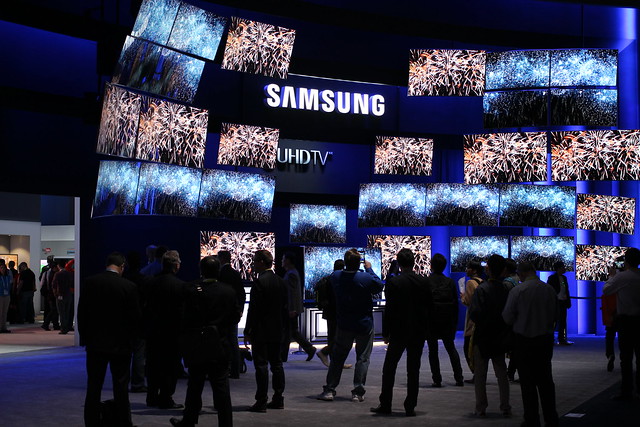
Samsung SUHD TVs Showcased at CES 2015
Are you fed of with facebook , twitter or Google ? If yes then it can be a good News for you all. After Google and Microsoft’s venture into social networking space, now Samsung seems to be working on a social networking service. A recent report from The Korean Times, states that Samsung Electronics is expected to launch a Facebook-like social networking site by early next year.The new social network according to the reports would be accessible on a wide range of devices, including laptops, cameras, televisions etc. To allow users to access the social networking service from any device and at any time, Samsung also plans to integrate the service with Amazon’s cloud computing platform. When asked about the rumors of the upcoming social network, Samsung claimed that the company is just launching an update for Family Story – a social networking service focused on photo sharing, and storing families’ special moments, accessible on a limited number of Samsung smartphones and Web-connected televisions, since February 2012. “By the end of the year, we will have a polished and finished version of Family Story that will be offered first to Samsung device users for free. The new service will become available in the first quarter of next year at the earliest. The eventual goal is to expand our social media service across different devices from different companies across different mobile platforms. That includes cameras, televisions and blue-ray players,”Samsung stated. Source: Ananta TechReference-Image: flickr.com
Read More........

2012 ACM UIST programme takes in the best of interface innovation


This week has seen the 25th ACM Symposium on User Interface Software and Technology take place in Cambridge, Massachusetts in the USA. Every year ACM UIST brings together some of the brightest ideas in interface innovation from around the world.
This year’s field of papers features everything from augmented reality art to collaborative surfaces that can

Spatial augmented reality for drawing by Jeremy Laviole and Martin Hachet

identify different users. It brings together researchers regardless of the background, meaning that a team from

Carpus: A Non-Intrusive User Identification Technique for Interactive Surfaces

Bordeaux university is alongside those from Microsoft Research. Microsoft’s wrist-mounted gesture controller has grabbed many of the headlines this week, but there are plenty of other cool innovations on show, as the

videos demonstrate. If you’re serious about interfaces and interactivity, ACM UIST is really where it’s at..Source: InAVate
Read More........

Microsoft patent reveals whole-room immersion ambitions


A recent Microsoft patent has revealed its ambitions to bring the gaming environment out of the TV and onto the walls of your living room. Patently Apple, which analyses the patent applications of Apple and other technology competitors found the filing from August and has published a detailed overview of the document.
Microsoft apparently plans to use a future version of its Kinect sensor to accurately plot the position of a gamer within a game’s virtual environment and then to allow a games console to project that environment onto the walls of the room. The patent further speculates that both the main display and projected environment could be based on 3D technology to provide an even more immersive experience. Now, whilst this is simply a patent application, not a product plan, the possibilities are pretty exciting. As we’ve already seen its perfectly possible to couple gaming technologies with high resolution imaging systems for some impressive results. It would be perfectly possible to hook a Kinect sensor with a high performance graphics rig to drive a fully immersive cave-style environment. All we need now is solid projected images, and we’ve finally got the holodeck! Source: InAVate
Read More........

London firm lays claim to largest multi-touch wall

Screen Shot On Uploaded Video
The largest multitouch interactive wall in the world has been installed in an office in central London, according to developer Engage Production. The videowall - measuring 9.9m x 2.1m and formed from 24x 55" MultiTouch MultiTaction Cell displays - crowns a new business communications facility which also boasts a projection powered 'business sphere' and two Samsung SUR40 multitouch tables. This huge display, that measures three metres high including the base, is able to function as one unit whilst interacting with tablet devices. The ‘Executive Brand Suite’ also houses ‘business sphere’ that projects content, controlled by a presenter via a tablet, on to a curved surface. Engage created the solution using edge-blending server software and three HD projectors. Engage also supplied and integegrated technical equipment for three distinct working areas, which include two Samsung SUR40 multitouch tables, utilising MicroSoft PixelSense, which is the new brand name for Surface. The company also provided the infrastructure, lighting control, DMX, uninterruptable power supplies, CMS server, show controller, and components necessary for integration. Engage retains an ongoing relationship with this client, with on-site support services and plans in place for upgrades and additions to the business suite in 2013. Source: InAVate
Read More........

New Windows Phone 8 features: screenshots, pinch-to-zoom camera, more

New Windows Phone 8 features: screenshots, pinch-to-zoom camera, moreMicrosoft’s upcoming Windows Phone 8 mobile OS will include the ability to capture screenshots and several new camera functions like panorama setting, the company said on stage at today’s big Nokia event. Microsoft corporate VP Joe Belfiore (pictured) talked about new features for the Windows Phone 8, which will be included on the just-announced Nokia Lumia 920. One of the big features the Lumia 920 includes is a PureView camera that claims to be one of the best smartphone cameras ever made. In tandem, Belfiore decided to show off new camera features for WP8. Here’s what he introduced on stage: Screenshots — Windows Phone 8 will make it much easier to take screenshots, something developers (and phone reviewers) have wanted for a long while. Pressing the home button and power button will take a screenshot of what’s on your screen. Pinch-to-zoom camera support — Inside the native Windows Phone 8 camera app, there is no more zoom bar. Instead, you can pinch-to-zoom like you do on other smartphone OSes. Blink Lens app — This one’s pretty cool. The Blink Lens app, which was written by Microsoft’s research team, lets you get a great picture of someone’s face by snapping a ton of photos at once. It automatically picks the best photo, or you can go back later to modify it and pick one you like more. Deep SkyDrive integration — Full resolution photos will automatically be uploaded to one’s SkyDrive account. Belfiore took a photo and it automatically showed up in the native SkyDrive app on a Windows 8 laptop, showing the connected state of SkyDrive to all devices. (Just Source: VentureBeat
Read More........

Microsoft wants you to animate everyday objects with Kinect


KinÊtre is a new technology demonstration presented by Microsoft Research at SIGGRAPH 2012. Using a kinect sensor a user can first scan any object and then cause it to animate by moving their own body. Rather spookily called "possession", this process realistically deforms the scanned object in response to changes in the possessors posture or movement. The video showcases several rather light-hearted applications involving a chair, step ladder and even two users playing with a virtual pantomime horse, but the applications in more serious realms include role play, training or education. Source: InAVate
Read More........