IBM developing world's smallest computer

Credit: IBM Research
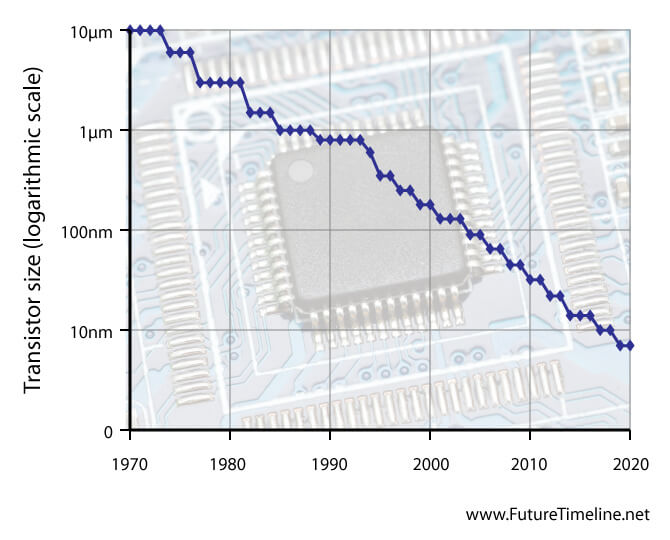
Most people are familiar with Moore's Law, but few have heard of Bell's Law – a related phenomenon coined by U.S. engineer Gordon Bell. This describes how a new class of computing devices tends to emerge about every decade or so, each 100 times smaller than the last. The shrinking volume of machines becomes obvious when you look back at the history of technology.

The 1960s, for example, were characterised by large mainframes that often filled entire rooms. The 1970s saw the adoption of "minicomputers" that were cheaper and smaller. Personal computing emerged in the early 1980s and laptops became popular in the 1990s. This was followed by mobile phones from the 2000s onwards, which themselves became ever thinner and more compact with each passing year, along with tablets and e-readers. More recently there has been rapid growth in wireless sensor networks that is giving birth to the Internet of Things (IoT).

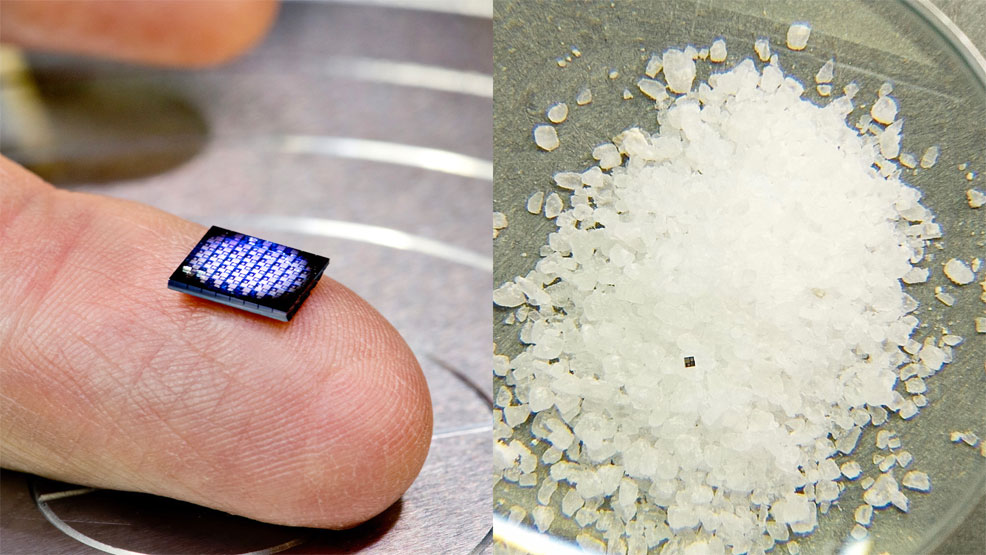
The new computer announced by IBM is just 1mm x 1mm across, making it the smallest machine of its kind to ever be developed. It will feature as many as a million transistors, a solar cell and communications module. The company predicts these devices will be in widespread use within five years, embedded in all manner of everyday objects. So-called "cryptographic anchors" and blockchain technology will ensure a product's authenticity – from its point of origin to the hands of the customer. These high-tech, miniature watermarks will (for example) verify that products have originated from the factory the distributor claims they are from, and are not counterfeits mixed in with genuine items.

In some countries, nearly 70 percent of certain life-saving pharmaceuticals are counterfeit and the overall cost of fraud to the global economy is more than $600bn every year. This new generation of tiny computers will monitor, analyse, communicate and even act on data.

"These [crypto-anchor] technologies pave the way for new solutions that tackle food safety, authenticity of manufactured components, genetically modified products, identification of counterfeit objects and provenance of luxury goods," says IBM research chief, Arvind Krishna.

Looking further into the future – if Bell's Law continues – devices are likely to be small enough to fit inside blood cells within a few decades. The potential applications then will become like science fiction: could we see a merger between humans and machines?

Source: https://www.futuretimeline.net/
Read More........

Smallest Transistor Ever. 1-Nanometer Carbon Nanotube Gate

This is a schematic of a transistor with a molybdenum disulfide channel and 1-nanometer carbon nanotube gate., Credit: Sujay Desai/Berkeley Lab
Berkeley Lab-led research has broken a major barrier in transistor size by creating gate only 1 nanometer long. 

For more than a decade, engineers have been eyeing the finish line in the race to shrink the size of components in integrated circuits. They knew that the laws of physics had set a 5-nanometer threshold on the size of transistor gates among conventional semiconductors, about one-quarter the size of high-end 20-nanometer-gate transistors now on the market. 

Some laws are made to be broken, or at least challenged.

A research team led by faculty scientist Ali Javey at the Department of Energy's Lawrence Berkeley National Laboratory (Berkeley Lab) has done just that by creating a transistor with a working 1-nanometer gate. For comparison, a strand of human hair is about 50,000 nanometers thick.

"We made the smallest transistor reported to date," said Javey, a lead principal investigator of the Electronic Materials program in Berkeley Lab's Materials Science Division. "The gate length is considered a defining dimension of the transistor. We demonstrated a 1-nanometer-gate transistor, showing that with the choice of proper materials, there is a lot more room to shrink our electronics."

The key was to use carbon nanotubes and molybdenum disulfide (MoS2), an engine lubricant commonly sold in auto parts shops. MoS2 is part of a family of materials with immense potential for applications in LEDs, lasers, nanoscale transistors, solar cells, and more.

The findings will appear in the Oct. 7 issue of the journal Science. Other investigators on this paper include Jeff Bokor, a faculty senior scientist at Berkeley Lab and a professor at UC Berkeley; Chenming Hu, a professor at UC Berkeley; Moon Kim, a professor at the University of Texas at Dallas; and H.S. Philip Wong, a professor at Stanford University.

The development could be key to keeping alive Intel co-founder Gordon Moore's prediction that the density of transistors on integrated circuits would double every two years, enabling the increased performance of our laptops, mobile phones, televisions, and other electronics.

"The semiconductor industry has long assumed that any gate below 5 nanometers wouldn't work, so anything below that was not even considered," said study lead author Sujay Desai, a graduate student in Javey's lab. "This research shows that sub-5-nanometer gates should not be discounted. Industry has been squeezing every last bit of capability out of silicon. By changing the material from silicon to MoS2, we can make a transistor with a gate that is just 1 nanometer in length, and operate it like a switch."

When 'electrons are out of control'

Transistors consist of three terminals: a source, a drain, and a gate. Current flows from the source to the drain, and that flow is controlled by the gate, which switches on and off in response to the voltage applied.

Both silicon and MoS2 have a crystalline lattice structure, but electrons flowing through silicon are lighter and encounter less resistance compared with MoS2. That is a boon when the gate is 5 nanometers or longer. But below that length, a quantum mechanical phenomenon called tunneling kicks in, and the gate barrier is no longer able to keep the electrons from barging through from the source to the drain terminals.

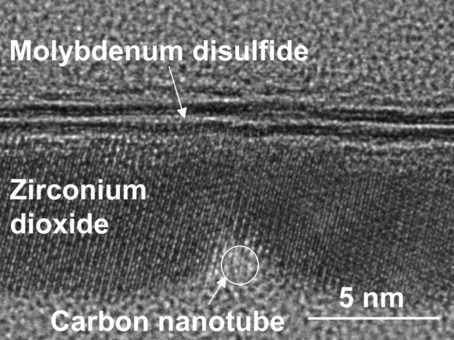
Transmission electron microscope image of a cross section of the transistor. It shows the 1-nanometer carbon nanotube gate and the molybdenum disulfide semiconductor separated by zirconium dioxide, an insulator. 
Credit: Qingxiao Wang/UT Dallas
"This means we can't turn off the transistors," said Desai. "The electrons are out of control."

Because electrons flowing through MoS2 are heavier, their flow can be controlled with smaller gate lengths. MoS2 can also be scaled down to atomically thin sheets, about 0.65 nanometers thick, with a lower dielectric constant, a measure reflecting the ability of a material to store energy in an electric field. Both of these properties, in addition to the mass of the electron, help improve the control of the flow of current inside the transistor when the gate length is reduced to 1 nanometer.

Once they settled on MoS2 as the semiconductor material, it was time to construct the gate. Making a 1-nanometer structure, it turns out, is no small feat. Conventional lithography techniques don't work well at that scale, so the researchers turned to carbon nanotubes, hollow cylindrical tubes with diameters as small as 1 nanometer.

They then measured the electrical properties of the devices to show that the MoS2 transistor with the carbon nanotube gate effectively controlled the flow of electrons.

"This work demonstrated the shortest transistor ever," said Javey, who is also a UC Berkeley professor of electrical engineering and computer sciences. "However, it's a proof of concept. We have not yet packed these transistors onto a chip, and we haven't done this billions of times over. We also have not developed self-aligned fabrication schemes for reducing parasitic resistances in the device. But this work is important to show that we are no longer limited to a 5-nanometer gate for our transistors. Moore's Law can continue a while longer by proper engineering of the semiconductor material and device architecture."

The work at Berkeley Lab was primarily funded by the Department of Energy's Basic Energy Sciences program.

Read More........

Gravitational waves detected for the first time

Credits: R. Hurt/Caltech-JPL
In a historical scientific landmark, researchers have announced the first detection of gravitational waves, as predicted by Einstein's general theory of relativity 100 years ago. This major discovery opens a new era of astronomy.
For the first time, scientists have directly observed "ripples" in the fabric of spacetime called gravitational waves, arriving at the Earth from a cataclysmic event in the distant universe. This confirms a major prediction of Einstein’s 1915 general theory of relativity and opens an unprecedented new window onto the cosmos. The observation was made at 09:50:45 GMT on 14th September 2015, when two black holes collided. However, given the enormous distance involved and the time required for light to reach us, this event actually occurred some 1.3 billion years ago, during the mid-Proterozoic Eon. For context, this is so far back that multicellular life here on Earth was only just beginning to spread. The signal came from the Southern Celestial Hemisphere, in the rough direction of (but much further away than) the Magellanic Clouds. The two black holes were spinning together as a binary pair, turning around each other several tens of times a second, until they eventually collided at half the speed of light. These objects were 36 and 29 times the mass of our Sun. As their event horizons merged, they became one – like two soap bubbles in a bath. During the fraction of a second that this happened, three solar masses were converted to gravitational waves, and for a brief instant the event hit a peak power output 50 times
The gravitational waves were detected by both of the twin Laser Interferometer Gravitational-wave Observatory (LIGO) detectors, located in Livingston, Louisiana, and Hanford, Washington, USA. The LIGO Observatories are funded by the National Science Foundation (NSF), and were conceived, built, and are operated by Caltech and MIT. The discovery was published yesterday in the journal Physical Review Letters.
that of the entire visible universe. Prof. Stephen Hawking told BBC News: "Gravitational waves provide a completely new way of looking at the Universe. The ability to detect them has the potential to revolutionise astronomy. This discovery is the first detection of a black hole binary system and the first observation of black holes merging. Apart from testing General Relativity, we could hope to see black holes through the history of the Universe. We may even see relics of the very early Universe during the Big Bang at some of the most extreme energies possible." "There is a Nobel Prize in it – there is no doubt," said Prof. Karsten Danzmann, from the Max Planck Institute for Gravitational Physics and Leibniz University in Hannover, Germany, who collaborated on the study. In an interview with the BBC, he claimed the significance of this discovery is on a par with the determination of the structure of DNA. "It is the first ever direct detection of gravitational waves; it's the first ever direct detection of black holes and it is a confirmation of General Relativity because the property of these black holes agrees exactly with what Einstein predicted almost exactly 100 years ago." "We found a beautiful signature of the merger of two black holes and it agrees exactly – fantastically – with the numerical solutions to Einstein equations ...

LIGO measurement of gravitational waves at the Hanford (left) and Livingston (right) detectors, compared to the theoretical predicted values.By Abbott et al. [CC BY 3.0]
it looked too beautiful to be true." "Scientists have been looking for gravitational waves for decades – but we’ve only now been able to achieve the incredibly precise technologies needed to pick up these very, very faint echoes from across the universe," said Danzmann. "This discovery would not have been possible without the efforts and the technologies developed by the Max Planck, Leibniz Universität, and UK scientists working in the GEO collaboration." Researchers at the LIGO Observatories were able to measure tiny and subtle disturbances the waves made to space and time as they passed through the Earth, with machines detecting changes just fractions of the width of an atom. At each observatory, the two-and-a-half-mile (4-km) long L-shaped LIGO interferometer uses laser light split into two beams that travel back and forth along tubes kept at a near-perfect vacuum. The beams are used to monitor the distance between mirrors precisely positioned at the ends of the arms. According to Einstein’s theory, the distance between the mirrors will change by an infinitesimal amount when gravitational waves pass by the detector. A change in the lengths of the arms smaller than one-ten-thousandth the diameter of a proton can be detected; equivalent to a human hair's diameter over three light years from Earth. "The Advanced LIGO detectors are a tour de force of science and technology, made possible by a truly exceptional international team of technicians, engineers, and scientists," says David Shoemaker of MIT. "We are very proud that we finished this NSF-funded project on time and on budget." "We spent years modelling the gravitational-wave emission from one of the most extreme events in the universe: pairs of massive black holes orbiting with each other and then merging. And that’s exactly the kind of signal we detected!" says Prof. Alessandra Buonanno, director at the Max Planck Institute for Gravitational Physics in Potsdam. "With this discovery, we humans are embarking on a marvellous new quest: the quest to explore the warped side of the universe – objects and phenomena that are made from warped spacetime," says Kip Thorne, Feynman Professor of Theoretical Physics at Caltech. "Colliding black holes and gravitational waves are our first beautiful examples." Advanced LIGO is among the most sensitive instruments ever built. During its next observing stage, it is expected to detect five more black hole mergers and to detect around 40 binary star mergers each year, in addition to an unknown number of more exotic gravitational wave sources, some of which may not be anticipated by current theory. Source: Futurtimeline.net
Read More........

Driverless cars see fewer crashes than human-driven cars

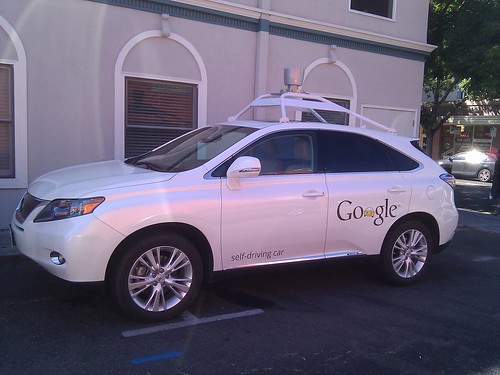
Google self-driving car in Mountain View
domain-b: Self-driving cars are involved in fewer crashes on average than vehicles with a driver behind the wheel, a study released on Friday by the Virginia TechTransportation Institute shows. The study was commissioned by Alphabet Inc's Google unit, which has reported a series of minor crashes involving its self-driving fleet. It looked only at Google's fleet of more than 50 self-driving cars, which has logged 1.3 million miles in Texas and California in self-driving mode. The test fleet has reported 17 crashes over the last six years, although none were the fault of the self-driving cars, Google said. After adjusting for severity and accounting for crashes not reported to police, the study estimated cars with drivers behind the wheel are involved in 4.2 crashes per million miles, versus 3.2 crashes per million miles for self-driving cars in autonomous mode. Crash rates for conventional vehicles at all severity levels were higher
than self-driving crash rates, the study found. A 2015 National Highway Traffic Safety Administration study found about 60 percent of property-damage-only crashes and 24 percent of all injury crashes are not reported to the police. California law requires all crashes involving self-driving vehicles be reported to police. Google spokesman Johnny Luu said the company asked Virginia Tech "to look into the topic given the interest and develop a robust methodology to be able to make meaningful comparison between regular cars on the road as well as our self-driving cars". Luu said the study "will be helpful making apples-to-apples comparisons moving forward". A study released in October by the University of Michigan Transportation Research Institute compared crash rates among Google, Delphi and Audi self-driving cars in 2013 and found they had a higher rate than for conventional cars. But that study noted the low volume of driver-less miles -- 1.2 million compared with 3 trillion miles driven annually on US roads. In December, California proposed state regulations that would require all autonomous cars to have a steering wheel, throttle and brake pedals when operating on California's public roads. A licensed driver would need to be in the driver's seat ready to take over in the event something went wrong. Google, eager to demonstrate its vehicles are safe, criticized the proposed rule, which it said would maintain "the same old status quo and falls short on allowing this technology to reach its full potential, while excluding those who need to get around but cannot drive". Source: domain-b.comImage: @flickr.com/photos/markdoliner/7694478124
Read More........

World's first virtual reality rollercoaster

In a groundbreaking move that could revolutionise the world of theme parks, the UK's Alton Towers Resort announces today it is launching a rollercoaster entirely dedicated to virtual reality.  Set to open in April, Galactica is the world's first rollercoaster entirely customised for the full virtual reality experience, transforming riders into astronauts and plunging them into outer space with a G force of 3.5, which is more powerful than the 3G of a real rocket launch. The exhilarating new ride will combine the physical exertion and adrenaline rush of Alton Towers' iconic flying rollercoaster, with the breathtaking sensation of travelling through space. Cutting edge technology launches riders into a different world, complete with virtual space suits, stunning visuals and an exciting adventure. The visuals have been perfectly synchronised to the thrilling twists, turns and loops of the rollercoaster to recreate the sensation
of hurtling through space. Visitors will ride in a prone position along the 840-metre long (2,760 ft) track, to recreate the feeling of flying. Galactica's epic space theme is set to be hugely popular following  Tim Peake's maiden voyage into space in December 2015. Stunning, high-quality visuals deliver an immersive experience that its designers claim is breathtakingly realistic. Each rider wears a modified Samsung Gear VR headset. Through this, an on-board artificial intelligence guides them from the launch pad up into space – flying and looping beyond the stars, banking through wormholes and speeding across distant galaxies, revealing the wonders of the cosmos in stunning clarity. Commenting on the new attraction, Marketing Director Gill Riley says: "Galactica uses groundbreaking technology to give riders a
breathtaking and completely unique rollercoaster experience. Tim Peake captured the imagination of millions of Brits last year when he set off on his  mission to the International Space Station – and now our visitors can become astronauts too. "There is nowhere else in the world that people can experience the feeling of a flying rollercoaster combined with soaring through the universe. For two minutes, our guests will be transported into space and we believe Galactica showcases the future for theme parks around the world – it's a complete game changer!"World's first virtual reality rollercoaster
Read More........

Researcher Gains Control Of Another Man's Brain Over The Internet

Human To Human Brain Interface Allows Researcher To Control Another Person Hand Motions Over The Internet, Credit: University of Washington
University of Washington researchers have performed what they believe is the first noninvasive human-to-human brain interface, with one researcher able to send a brain signal via the Internet to control the hand motions of a fellow researcher. University of Washington researcher Rajesh Rao, left, plays a computer game with his mind. Across campus, researcher Andrea Stocco, right, wears a magnetic stimulation coil over the left motor cortex region of his brain. Stocco’s right index finger moved involuntarily to hit the “fire” button as part of the first human brain-to-brain interface demonstration. Using electrical brain recordings and a form of magnetic stimulation, Rajesh Rao sent a brain signal to Andrea Stocco on the other side of the UW campus, causing Stocco’s finger to move on a keyboard. While researchers at Duke University have demonstrated brain-to-brain communication between two rats, and Harvard researchers have demonstrated it between a human and a rat, Rao and Stocco believe this is the first demonstration of human-to-human brain interfacing. “The Internet was a way to connect computers, and now it can be a way to connect brains,” Stocco said. “We want to take the knowledge of a brain and transmit it directly from brain to brain.” The researchers captured the full demonstration on video recorded in both labs. The following version has been edited for length. Rao, a UW
professor of computer science and engineering, has been working on brain-computer interfacing in his lab for more than 10 years and just published a textbook on the subject. In 2011, spurred by the rapid advances in technology, he believed he could demonstrate the concept of human brain-to-brain interfacing. So he partnered with Stocco, a UW research assistant professor in psychology at the UW’s Institute for Learning & Brain Sciences. On Aug. 12, Rao sat in his lab wearing a cap with electrodes hooked up to anelectroencephalographymachine, which reads electrical activity in the brain. Stocco was in his lab across campus wearing a purple swim cap marked with the stimulation site for the transcranial magnetic stimulation coil that was placed directly over his left motor cortex, which controls hand movement. The team had a Skype connection set up so the two labs could coordinate, though neither Rao nor Stocco could see the Skype screens. Rao looked at a computer screen and played a simple video game with his mind. When he was supposed to fire a cannon at a target, he imagined moving his right hand (being careful not to actually move his hand), causing a cursor to hit the “fire” button. Almost instantaneously, Stocco, who wore noise-canceling earbuds and wasn’t looking at a computer screen, involuntarily moved his right index finger to push the space bar on the keyboard in front of him, as if firing the cannon. Stocco compared the feeling of his hand moving involuntarily to that of a nervous tic. “It was both exciting and eerie to watch an imagined action from my brain get translated into actual action by another brain,” Rao said. “This was basically a one-way flow of information from my brain to his. The next step is having a more equitable two-way conversation directly between the two brains.” The cycle of the experiment. Brain signals from the “Sender” are recorded. When the computer detects imagined hand movements, a “fire” command is transmitted over the Internet to the TMS machine, which causes an upward movement of the right hand of the “Receiver.” This usually results in the “fire” key being hit.
Credit: University of Washington
The technologies used by the researchers for recording and stimulating the brain are both well-known. Electroencephalography, or EEG, is routinely used by clinicians and researchers to record brain activity noninvasively from the scalp. Transcranial magnetic stimulation is a noninvasive way of delivering stimulation to the brain to elicit a response. Its effect depends on where the coil is placed; in this case, it was placed directly over the brain region that controls a person’s right hand. By activating these neurons, the stimulation convinced the brain that it needed to move the right hand. Computer science and engineering undergraduates Matthew Bryan, Bryan Djunaedi, Joseph Wu and Alex Dadgar, along with bioengineering graduate student Dev Sarma, wrote the computer code for the project, translating Rao’s brain signals into a command for Stocco’s brain. “Brain-computer interface is something people have been talking about for a long, long time,” saidChantel Prat, assistant professor in psychology at the UW’s Institute for Learning & Brain Sciences, and Stocco’s wife and research partner who helped conduct the experiment. “We plugged a brain into the most complex computer anyone has ever studied, and that is another brain.” At first blush, this breakthrough brings to mind all kinds of science fiction scenarios. Stocco jokingly referred to it as a “Vulcan mind meld.” But Rao cautioned this technology only reads certain kinds of simple brain signals, not a person’s thoughts. And it doesn’t give anyone the ability to control your actions against your will. Both researchers were in the lab wearing highly specialized equipment and under ideal conditions. They also had to obtain and follow a stringent set of international human-subject testing rules to conduct the demonstration. “I think some people will be unnerved by this because they will overestimate the technology,” Prat said. “There’s no possible way the technology that we have could be used on a person unknowingly or without their willing participation.” Stocco said years from now the technology could be used, for example, by someone on the ground to help a flight attendant or passenger land an airplane if the pilot becomes incapacitated. Or a person with disabilities could communicate his or her wish, say, for food or water. The brain signals from one person to another would work even if they didn’t speak the same language. Rao and Stocco next plan to conduct an experiment that would transmit more complex information from one brain to the other. If that works, they then will conduct the experiment on a larger pool of subjects. Their research was funded in part by the National Science Foundation’s Engineering Research Center for Sensorimotor Neural Engineering at the UW, the U.S. Army Research Office and the National Institutes ofHealth. Contacts and sources:Doree ArmstrongSource: Article
Read More........

NASA Curiosity rover moves to new location on Mars

Washington, August 20: NASA's Mars Curiosity rover is driving towards the southwest after departing a region where for several weeks it investigated a geological contact zone and rocks that are unexpectedly high in silica and hydrogen. The hydrogen indicates water bound to minerals in the ground, NASA said. In the 'Marias Pass' region, Curiosity successfully used its drill to sample a rock target called 'Buckskin' and then used the camera on its robotic arm for multiple images to be stitched into a self-portrait at the drilling site. The rover finished activities in Marias Pass on August 12 and headed onward up Mount Sharp, the layered mountain it reached in September 2014. In drives on August 12, 13, 14 and 18, it progressed 433 feet (132 meters), bringing Curiosity's total odometry since its August 2012 landing to 11.1 kilometres. Curiosity is carrying with it some of the sample powder drilled from Buckskin. The rover's internal laboratories are analysing the material. The mission's science team members seek to understand why this area bears rocks with significantly higher levels of silica and hydrogen than other areas the rover has traversed. Silica, monitored with Curiosity's laser-firing Chemistry and Camera (ChemCam) instrument, is a rock-forming chemical containing silicon and oxygen, commonly found on Earth as quartz. Hydrogen in the ground beneath the rover is monitored by the rover's Dynamic Albedo of Neutrons (DAN) instrument. It has been detected at low levels everywhere Curiosity has driven and is interpreted as the hydrogen in water molecules or hydroxyl ions bound within or absorbed onto minerals in the rocks and soil. “The ground about 1 meter beneath the rover in this area holds three or four times as much water as the ground anywhere else Curiosity has driven during its three years on Mars," said DAN Principal Investigator Igor Mitrofanov of Space Research Institute, Moscow. DAN first detected the unexpectedly high level of hydrogen using its passive mode. Later, the rover drove back over the area using DAN in active mode, in which the instrument shoots neutrons into the ground and detects those that bounce off the subsurface, but preferentially interacting with hydrogen. The measurements confirmed hydrated material covered by a thin layer of drier material. Curiosity initially noted the area with high silica and hydrogen on May 21 while climbing to a site where two types of sedimentary bedrock lie in contact with each other. Such contact zones can hold clues about ancient changes in environment, from conditions that produced the older rock type to conditions that produced the younger one. — PTI. Source: Article
Read More........

New memory technology is 1,000 times faster

Intel and Micron have unveiled "3D XPoint" – a new memory technology that is 1,000 times faster than NAND and 10 times denser than conventional DRAM.
Intel Corporation and Micron Technology, Inc. have unveiled 3D XPoint technology, a non-volatile memory that has the potential to revolutionise any device, application or service that benefits from fast access to large sets of data. Now in production, 3D XPoint technology is a major breakthrough in memory process technology and the first new memory category since the introduction of NAND flash in 1989. The explosion of connected devices and digital services is generating massive amounts of new data. To make this data useful, it must be stored and analysed very quickly, creating challenges for service providers and system builders who must balance cost, power and performance trade-offs when they design memory and storage solutions. 3D XPoint technology combines the performance, density, power, non-volatility and cost advantages of all available memory technologies on the market today. This technology is up to 1,000 times faster, with up to 1,000 times greater endurance than NAND, and is 10 times denser than conventional memory. "For decades, the industry has searched for ways to reduce the
lag time between the processor and data to allow much faster analysis," says Rob Crooke, senior vice president and general manager of Intel's Non-Volatile Memory Solutions Group. "This new class of non-volatile memory achieves this goal and brings game-changing performance to memory and storage solutions." "One of the most significant hurdles in modern computing is the time it takes the processor to reach data on long-term storage," says Mark Adams, president of Micron. "This new class of non-volatile memory is a revolutionary technology that allows for quick access to enormous data sets and enables entirely new applications." As the digital world balloons exponentially – from 4.4 zettabytes of data created in 2013, to an expected 44 zettabytes by 2020 – 3D XPoint technology can turn this immense amount of data into valuable information in nanoseconds. For example, retailers may use 3D XPoint technology to more quickly identify fraud detection patterns in financial transactions; healthcare researchers could process and analyse much larger data sets in real time, accelerating complex tasks such as genetic analysis and disease tracking. The performance benefits of 3D XPoint technology could
also enhance the PC experience, allowing consumers to enjoy faster interactive social media and collaboration as well as more immersive gaming experiences. The non-volatile nature of this technology also makes it a great choice for a variety of low-latency storage applications, since data is not erased when the device is powered off. Following more than a decade of research and development, 3D XPoint technology was built from the ground up to address the need for non-volatile, high-performance, high-endurance and high-capacity storage and memory at an affordable cost. It ushers in a new class of non-volatile memory that significantly reduces latencies, allowing much more data to be stored close to the processor and accessed at speeds previously impossible for non-volatile storage. The innovative, transistor-less cross point architecture creates a three-dimensional checkerboard where memory cells sit at the intersection of word lines and bit lines, allowing the cells to be addressed individually. As a result, data can be written and read in small sizes, leading to faster and more efficient read/write processes. 3D XPoint technology will sample later this year with select customers, and Intel and Micron are developing individual products based on the technology.  Source: Article

Read More........

World’s most lifelike bionic hand will transform the lives of amputees

.Subscribe
A congenital amputee from London has become the first user in the UK to be fitted with a new prosthetic hand that launches this week and sets a new benchmark in small myoelectric hands.
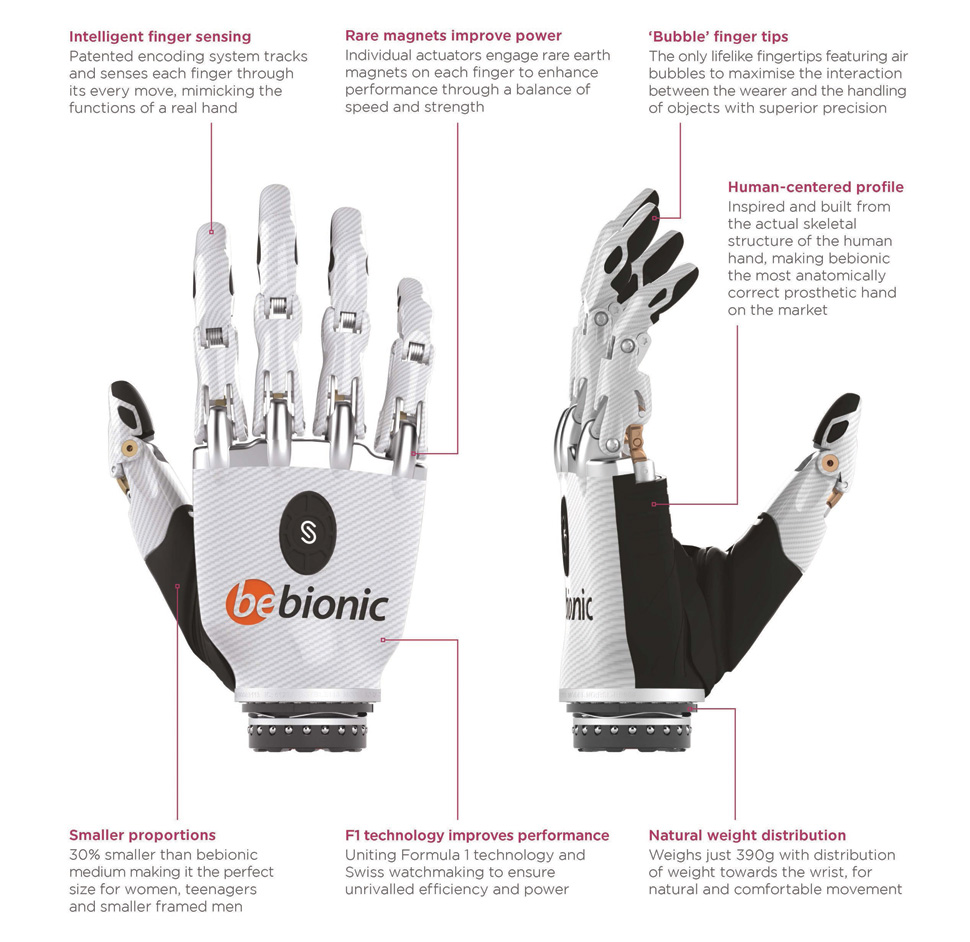
Developed using Formula 1 technology and specifically in scale for women and teenagers, the bebionic small hand is built around an accurate skeletal structure with miniaturised components designed to provide the most true-to-life movements. The bebionic small hand, developed by prosthetic experts Steeper, will enable fundamental improvements in the lives of thousands of amputees across the world. The hand marks a turning point in the world of prosthetics as it perfectly mimics the functions of a real hand via 14 different precision grips. A bionic extension of the arm that enables the utmost dexterity will enable amputees to engage in a range of activities that would have previously been complex and unmanageable. Nicky Ashwell, 29, born without a right hand, received Steeper's latest innovation at a fitting by London Prosthetics Centre, a private facility providing expert services in cutting-edge prosthetics. Before being fitted with the bebionic small hand, Nicky would use a cosmetic hand without movement; as a result, Nicky learned to carry out tasks with one hand. The bebionic small hand has been a major improvement to Nicky's life, enabling her to do things previously impossible with one hand such as riding a bike, gripping weights with both hands, using cutlery and opening her purse. Nicky, who is a Product Manager at an online fashion forecasting and trend service, said: "When I first tried the  bebionic small hand it was an exciting and strange feeling; it immediately opened up so many more possibilities for me. I realised that I had been making life challenging for myself when I didn't need to. The movements now come easily and look natural; I keep finding myself being surprised by the little things, like being able to carry my purse while holding my boyfriend's hand. I've also been able to do things never before possible like riding a bike and lifting weights."  Bebionic small hand works using sensors triggered by the user's muscle movements that connect to individual motors in each finger and powerful microprocessors. The technology comprises a unique system which tracks and senses each finger through its every move – mimicking the functions of a real hand. Development follows seven years of research and manufacturing, including the use of Formula 1 techniques and military technology along with advanced materials including aerograde aluminium and rare Earth magnets. Ted Varley, Technical Director at Steeper said, "Looking to the future, there's a trend of technology getting more intricate; Steeper has embraced this and created a smaller hand with advanced technology that is suitable for women and teenagers. An accurate skeletal structure was firstly developed, with the complex technology then specifically developed to fit within this in order to maintain anatomical accuracy. In other myoelectric hands the technology is developed first, at the expense of the lifelikeness."Bebionic small hand at a glance: (1) Contains 337 mechanical parts (2) 14 grip patterns and hand positions to allow a range of precision movements (3) Weighs approximately 390g – the same as a large bar of Galaxy chocolate (4) 165mm from base to middle fingertip – the size of an average woman's hand (5) Strong enough to handle up to 45kg – around the same as 25 bricks (6) The only multi-articulated hand with patented finger control system using rare Earth magnets (7) Specifically designed with women, teenagers and smaller-framed men in mind, Source: Article
Read More........

Wireless Online Electric Vehicle Charges On The Move, No Need To Stop To Recharge Batteries


OLEV tram, Credit: KAIST
The Online Electric Vehicle (OLEV), developed by the Korea Advanced Institute of Science and Technology (KAIST), is an electric vehicle that can be charged while stationary or driving, thus removing the need to stop at a charging station. Likewise, an OLEV tram does not require pantographs to feed power from electric wires strung above the tram route. Following the development and operation of commercialized OLEV trams (at an amusement park in Seoul) and shuttle buses (at KAIST campus), respectively, the City of Gumi in South Korea, beginning on August 6th, is providing its citizens with OLEV public transportation services. Two OLEV buses will run an inner city route between Gumi Train Station and In-dong district, for a total of 24 km roundtrip. The bus will receive 20 kHz and 100 kW (136 horsepower) electricity at an 85% maximum power transmission efficiency rate while maintaining a 17cm
OLEV tram, Credit: KAIST
air gap between the underbody of the vehicle and the road surface.  OLEV is a groundbreaking technology that accelerates the development of purely electric vehicles as a viable option for future transportation systems, be they personal vehicles or public transit. This is accomplished by solving technological issues that limit the commercialization of electric vehicles such as price, weight, volume, driving distance, and lack of charging infrastructure. OLEV receives power wirelessly through the application of the “Shaped Magnetic Field in Resonance (SMFIR)” technology. SMFIR is a new technology introduced by KAIST that enables electric vehicles to transfer electricity wirelessly from the road surface while moving. Power comes from the electrical cables buried under the surface of the road, creating magnetic fields. There is a receiving device installed on the underbody of the OLEV that converts these fields into electricity. The length of power strips installed under the road is generally 5%-15% of the entire road, requiring only a few sections of the road to be rebuilt with the embedded cables. OLEV has a small battery (one-third of the size of the battery equipped with a regular electric car). The vehicle complies with the international electromagnetic fields (EMF) standards of 62.5 mG, within the margin of safety level necessary for human health. The road has a smart function as well, to distinguish OLEV buses from regular cars—the segment technology is employed to control the power supply by switching on the power strip when OLEV buses pass along, but switching it off for other vehicles, thereby preventing EMF exposure and standby power consumption. As of today, the SMFIR technology supplies 60 kHz and 180 kW of power remotely to transport vehicles at a stable, constant rate. Dong-Ho Cho, a professor of the electrical engineering and the director of the Center for Wireless Power Transfer Technology Business Development at KAIST, said: “It’s quite remarkable that we succeeded with the OLEV project so that buses are offering public transportation services to passengers. This is certainly a turning point for OLEV to become more commercialized and widely accepted for mass transportation in our daily living.” After the successful operation of the two OLEV buses by the end of this year, Gumi City plans to provide ten more such buses by 2015. Contacts and sources: Dong-Ho Cho, Professor of Electrical Engineering Department, KAIST, Director of Center for Wireless Power Transfer Technology Business Development, KAIST (http://smfir.co.kr/) Source: ineffableisland.com
Read More........

Football pitch-sized billboard to open in Times Square

Due to open later today, New York's Times Square is now home to one of the world's largest and most expensive digital billboards in the world. Measuring the length of a football pitch, and running the entire length of one city block, it is situated along the front of the Marriott Marquis Hotel, just outside the intersection of Seventh Avenue and Broadway.
No exact measurements have been announced prior to the launch, but as a guide a football pitch in the U.S. is 110 metres long, it is said to be six to eight stories high. The site is one of the busiest in the U.S, with more than 300,000 pedestrians entering the area on a normal day. Another 115,000 drivers and passengers pass by it every day. The display feature almost 24 million LED pixels. To advertise on the screen will costs more than $2.5 million for four weeks, ranking it as one of the most expensive pieces of outdoor ad real estate on the market. A digital art exhibition by the Universal Everything studio collective will animate the screen from Tuesday night. Google will take over as the exclusive, debut advertiser a week later, on Tuesday 24 November, with a campaign that runs through the New Year. The screen is the biggest and the only one to cover an entire city block, from 5th Street to 46th Street on Broadway, in the Times Square area. Source: InAVate
Read More........

Lab engineered vaginas implanted in patients in US


Scientists reported today the first human recipients of laboratory-grown vaginal organs. A research team led by Anthony Atala, M.D., director of Wake Forest Baptist Medical Center’s Institute for Regenerative Medicine, describes in the Lancet long-term success in four teenage girls who received vaginal organs that were engineered with their own cells. “This pilot study is the first to demonstrate that vaginal organs can be constructed in the lab and used successfully in humans,” said Atala. “This may represent a new option for patients who require vaginal reconstructive surgeries. In addition, this study is one more example of how regenerative medicine strategies can be applied to a variety of tissues and organs.” The girls in the study were born with Mayer-Rokitansky-Küster-Hauser (MRKH) syndrome, a rare genetic condition in which the vagina and uterus are underdeveloped or absent. The treatment could also potentially be applied to patients with vaginal cancer or injuries, according to the researchers. The girls were between 13 and 18 years old at the time of the surgeries, which were performed between June 2005 and October 2008. Data from annual follow-up visits show that even up to eight years after the surgeries, the organs had normal function.  “Tissue biopsies, MRI scans and internal exams using magnification all showed that the engineered vaginas were similar in makeup and function to native tissue, said Atlantida-Raya Rivera, lead author and director of the HIMFG Tissue Engineering Laboratory at the MRKH in Mexico City, where the surgeries were performed. In addition, the patients’ responses to a Female Sexual Function Index questionnaire showed they had normal sexual function after the treatment, including desire and pain-free intercourse. The organ structures were engineered using muscle and epithelial cells (the cells that line the body’s cavities) from a small biopsy of each patient’s external genitals. In a Good Manufacturing Practices facility, the cells were extracted from the tissues, expanded and then placed on a biodegradable material that was hand-sewn into a vagina-like shape. These scaffolds were tailor-made to fit each patient. About five to six weeks after the biopsy, surgeons created a canal in the patient’s pelvis and sutured the scaffold to reproductive structures. Previous laboratory and clinical research in Atala’s lab has shown that once cell-seeded scaffolds are implanted in the body, nerves and blood vessels form and the cells expand and form tissue. At the same time the scaffolding material is being absorbed by the body, the cells lay down materials to form a permanent support structure – gradually replacing the engineered scaffold with a new organ. Followup testing on the lab-engineered vaginas showed the margin between native tissue and the engineered segments was indistinguishable and that the scaffold had developed into tri-layer vaginal tissue. Current treatments for MRHK syndrome include dilation of existing tissue or reconstructive surgery to create new vaginal tissue. A variety of materials can be used to surgically construct a new vagina – from skin grafts to tissue that lines the abdominal cavity. However, these substitutes often lack a normal muscle layer and some patients can develop a narrowing or contracting of the vagina. The researchers say that with conventional treatments, the overall complication rate is as high as 75 percent in pediatric patients, with the need for vaginal dilation due to narrowing being the most common complication. Before beginning the pilot clinical study, Atala’s team evaluated lab-built vaginas in mice and rabbits beginning in the early 1990s. In these studies, scientists discovered the importance of using cells on the scaffolds. Atala’s team used a similar approach to engineer replacement bladders that were implanted in nine children beginning in 1998, becoming the first in the world to implant laboratory-grown organs in humans. The team has also successfully implanted lab-engineered urine tubes (urethras) into young boys. The team said the current study is limited because of its size, and that it will be important to gain further clinical experience with the technique and to compare it with established surgical procedures. Co-researchers were James J. Yoo, M.D., Ph.D., and Shay Soker, Ph.D., Wake Forest Baptist, and Diego R. Esquiliano M.D., Reyna Fierro-Pastrana P.hD., Esther Lopez-Bayghen Ph.D., Pedro Valencia M.D., and Ricardo Ordorica-Flores, M.D.,Children’s Hospital Mexico Federico Gomez Metropolitan Autonomous University, Mexico. Source: Article,
Read More........

History Making Operation Gives Man Two Prosthetic Arms And Hands He Can Control

Baugh completes a task showcasing his control of the MPL.: Image Credit: Johns Hopkins University Applied Physics Laborator
A Colorado man made history at the Johns Hopkins University Applied Physics Laboratory (APL) this summer when he became the first bilateral shoulder-level amputee to wear and simultaneously control two of the Laboratory’s Modular Prosthetic Limbs. Most importantly, Les Baugh, who lost both arms in an electrical accident 40 years ago, was able to operate the system by simply thinking about moving his limbs, performing a variety of tasks during a short training period. Baugh was in town for two weeks in June as part of an APL-funded research effort to further assess the usability of the MPL, developed over the past decade as part of the Revolutionizing Prosthetics Program. Before putting the limb system through the paces, Baugh had to undergo a surgery at Johns Hopkins Hospital known as targeted muscle
reinnervation. “It’s a relatively new surgical procedure that reassigns nerves that once controlled the arm and the hand,” explained Johns Hopkins Trauma Surgeon Albert Chi, M.D. “By reassigning existing nerves, we can make it possible for people who have had upper-arm amputations to control their prosthetic devices by merely thinking about the action they want to perform.” After recovery, Baugh visited the Laboratory for training on the use of the MPLs. First, he worked with researchers on the pattern recognition system. “We use pattern recognition algorithms to identify individual muscles that are contracting, how well they communicate with each other, and their amplitude and frequency,” Chi explained. “We take that information and translate that into actual movements within a prosthetic.”
Baugh completes a task showcasing his control of the MPL. Image Credit: Johns Hopkins University Applied Physics Laboratory
Then Baugh was fitted for a custom socket for his torso and shoulders that supports the prosthetic limbs and also makes the neurological connections with the reinnervated nerves. While the socket got its finishing touches, the team had him work with the limb system through a Virtual Integration Environment (VIE), a virtual-reality version of the MPL. The VIE is completely interchangeable with the prosthetic limbs and through APL’s licensing process currently provides 19 groups in the research community with a low-cost means of testing brain–computer interfaces. It’s being used to test novel neural interface methods and study phantom limb pain, and serves as a portable training system. By the time the socket
Bobby Armiger observes Baugh handing Albert Chi, M.D., a ball., Image Credit: Johns Hopkins University Applied Physics Laboratory
was finished, Baugh said he was more than ready to get started. When he was fitted with the socket, and the prosthetic limbs were attached, he said “I just went into a whole different world.” He moved several objects, including an empty cup from a counter-shelf height to a higher shelf, a task that required him to coordinate the control of eight separate motions to complete. “This task simulated activities that may commonly be faced in a day-to-day environment at home,” said APL’s Courtney Moran, a prosthetist working with Baugh. “This was significant because this is not possible with currently available prostheses. He was able to do this with only 10 days of training, which demonstrates the intuitive nature
APL prosthetist Courtney Moran looks on as Les Baugh tests out the Modular Prosthetic Limbs. , Image Credit: Johns Hopkins University Applied Physics Laboratory
of the control.” Moran said the research team was floored by what Baugh was able to accomplish. “We expected him to exceed performance compared to what he might achieve with conventional systems, but the speed with which he learned motions and the number of motions he was able to control in such a short period of time was far beyond expectation,” she said. “What really was amazing, and was another major milestone with MPL control, was his ability to control a combination of motions across both arms at the same time. This was a first for simultaneous bimanual control.” RP Principal Investigator Michael McLoughlin said “I think we are just getting started. It’s like the early days of the Internet. There is just a tremendous amount of potential ahead of us, and we’ve just started down this road. And I think the next five to 10 years are going to bring phenomenal advancement.” The next step, McLoughlin said, is to send Baugh home with a pair of limb systems so that he can see how they integrate with his everyday life. Baugh is looking forward to that day. “Maybe for once I’ll be able to put change in the pop machine and get pop out of it,” he said. He’s looking forward to doing “simple things that most people don’t think of. And it’s re-available to me.”  Contacts and sources:  Paulette Campbell, The Applied Physics Laboratory, The Johns Hopkins University,, Source: Article
Read More........

World’s First Time-controlled Molecular Self-Organization

Credit: National Institute for Materials Science (NIMS)
Technologies Division) developed a method for preprogramming the timing of molecules to initiate self-organization by mixing molecules with modified side chains.  (a) Previously reported porphyrin molecule 1; (b) two kinds of self-organization in which porphyrin molecule 1 is able to take part. A particulate structure is formed early, but that disappears with time and then a fibrous structure is formed; (c) self-organization involving molecule 1 to form a fibrous structure begins in about four hours The results of this research will be published in the German Chemical Society’s journal “Angewandte Chemie International Edition” in the near future. Molecular self-organization is widely observed in nature, and is a critical phenomenon in terms of developingsystems that perform complex functions as seen in such natural mechanisms as photosynthesis and neurocircuits. Attempts have been made to develop new materials capable of executing advanced functions using the principle behind the phenomenon of molecular self-organization. However, due to the spontaneous nature of molecular self-organization, it is extremely difficult to control the phenomenon by design. In particular, almost no research had been conducted to control the timing of the self-organization phenomenon including control of when to initiate it. Recently, they conducted research using a molecule that can form two types of self-organized structures. One type of the self-organized structures was quickly formed but was energetically unstable; therefore, after a certain period of time elapsed, the other type of the self-organized structures, which was energetically more stable, was eventually formed. By modifying the side chains of the molecule, thereby inverting the energy stability levels between the two types of self-organized structures, researchers were able to synthesize a new type of molecule that only forms the former self-organized structure. By changing the mixing ratios between the original and new molecules, they succeeded for the first time in the world in controlling the timing at which an energetically stable self-organized structure begins to form. Controlling such timing is similar to the mechanism behind the biological clock in organisms from the viewpoint that in both cases, such time-controlling process is carried out by a network of molecules consisting of several chemical species. Self-organization is a vital concept in diverse fields such as materials science, nanotechnology and biotechnology, and is attracting much attention as a new method of synthesizing materials. By applying the method we developed in this research, we intend to develop advanced systems that are capable of emitting light or changing electrical conductivity at desirable timings. In the future, we hope to develop smart materials that autonomously function corresponding to the passing of time, like biomolecular systems do. This research was funded by the Japan Society for the Promotion of Science’s grant-in-aid for scientific research on innovative areas, “dynamical ordering of biomolecular systems for creation of integrated functions” (Koichi Kato, Project Leader, National Institutes of Natural Sciences), and “π-system figuration” (Takanori Fukushima, Project Leader, Tokyo Institute of Technology). Contacts and sources: National Institute for Materials Science (NIMS) Citation: (S. Ogi, T. Fukui, M. L. Jue, M. Takeuchi, K. Sugiyasu, Article title: “Kinetic control over pathway complexity in supramolecular polymerization through modulating the energy landscape by rational molecular design” Angew. Chem. Int. Ed., http://dx.doi.org/10.1002/anie.201407302). Source: http://www.ineffableisland.com/
Read More........

Next stop Mars: Nasa launches new Orion spacecraft, marks new era

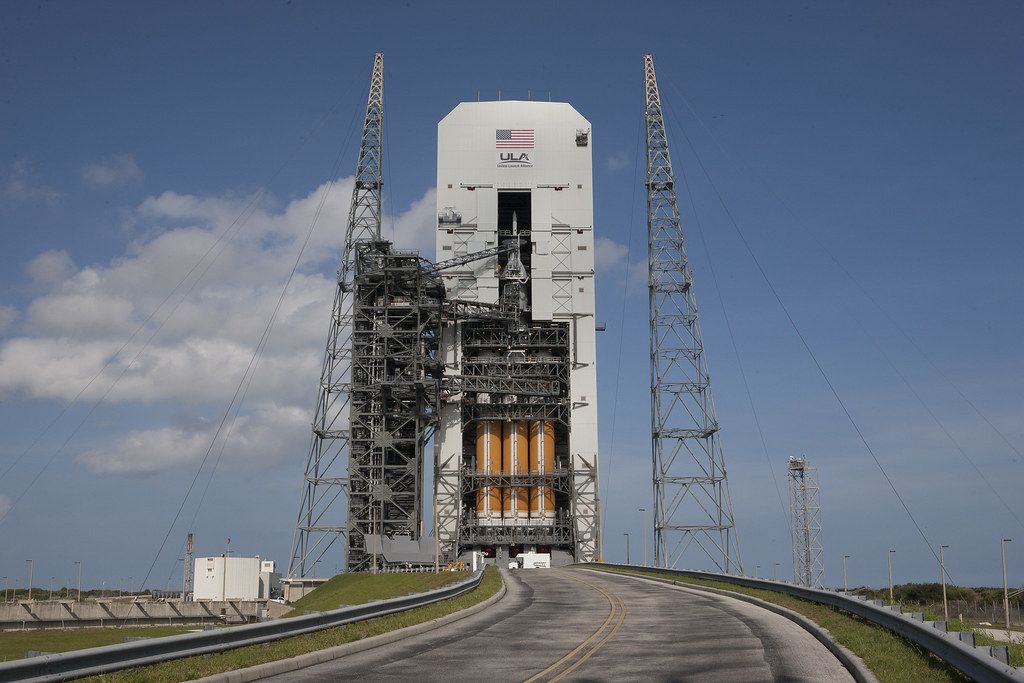
The Delta IV Heavy rocket with the Orion spacecraft lifts off from the Cape Canaveral Air Force Station in Cape Canaveral, Florida. (Reuters/Steve Nesius)
Nasa's new Orion spacecraft streaked toward orbit Friday on a high-stakes test flight meant to usher in a new era of human exploration leading ultimately to Mars. The unmanned orbital journey began with a sunrise liftoff witnessed by thousands of Nasa guests eager to watch what the agency called "history in the making." "The star of the day is Orion," said Nasa Administrator Charles Bolden Jr., back for the second morning in a row. He called it "Day One of the Mars era." Orion's debut will be brief - just 4½ hours from launch to splashdown, with two orbits of Earth. But for the first time in 42 years, Nasa is sending a spacecraft built for humans farther than a couple hundred miles from Earth. The previous time was the Apollo 17 moon shot. And it's Nasa's first new vehicle for space travel since the shuttle. Friday's flight test brings Nasa "one step closer" to putting humans aboard Orion, Bolden said just before liftoff. Sluggish rocket valves and wind halted Thursday's launch attempt. Everything went Nasa's way Friday, and the Delta IV rocket blasted off with Orion as dawn broke. Nasa was aiming for a peak altitude of 3,600 miles (5,800 kilometers)on Orion's second lap around the planet, in order to give the capsule the necessary momentum for a scorchingly high-speed re-entry over the Pacific. Engineers want to see how the heat shield - the largest of its kind ever built - holds up when Orion comes back through the atmosphere traveling 20,000 mph (32,200 kph)and enduring 4,000 degrees (2,200 Celsius). The atmosphere at Kennedy Space Center was reminiscent of the shuttle-flying days. After more than three years since the last shuttle flight, Nasa reveled in all the attention. Roads appeared to be less jammed before dawn for try two, and Nasa was uncertain how many of the estimated 27,000 invited guests returned. Nonetheless, the press site remained jammed, the hotels packed and the excitement level high. "It's a big day for the world, for people who know and like space," Bolden said, observing the crowds. In Houston, Nasa's Mission Control took over the entire operation once Orion was aloft. The flight program was loaded into Orion's computers well in advance, allowing the spacecraft to fly essentially on autopilot. Flight controllers - all shuttle veterans - could intervene in the event of an emergency breakdown. And in the Pacific off the Mexican Baja coast, Navy ships waited for Orion's return. The spacecraft is rigged with 1,200 sensors to gauge everything from heat to vibration to radiation. At 11 feet (3.4 meters) tall with a 16.5-foot (5-meter) base, Orion is bigger than the old-time Apollo capsules and, obviously, more advanced. Nasa deliberately kept astronauts off this first Orion. Managers want to test the riskiest parts of the spacecraft - the heat shield, parachutes, various jettisoning components - beforecommitting to a crew. In addition, on-board computers were going to endure the high-radiation Van Allen belts; engineers wondered whether they might falter. Lockheed Martin Corp. already has begun work on a second Orion, and plans to eventually build a fleet of the capsules. The earliest that astronauts might fly on an Orion is 2021. An asteroid redirected to lunar orbit is intended for the first stop in the 2020s, followed by Mars in the 2030s. The company handled the $370 million test flight for Nasa from the Cape Canaveral Air Force Station, opting for the Delta IV rocket this time given its heft. It's the most powerful unmanned rocket in the US right now. The entire rocket and capsule, topped by a launch abort tower, stretched 242 feet and weighed 1.6 million pounds - an "incredible monster," according to Bolden. To push Orion farther out on future flights, Nasa is developing a megarocket known as Space Launch System or SLS. The first Orion-SLS combo will fly around 2018, again without a crew to shake out the rocket. Nasa's last trip beyond low-Earth orbit in a vessel built for people was the three-man Apollo 17 in December 1972. Orion will be capable of carrying four astronauts on long hauls and as many as six on three-week hikes. Dozens of astronauts, present and past, gathered at Kennedy for the historic send-off. One of them - Bolden - now leads Nasa. He called Mars "the ultimate destination of this generation," but said his three young granddaughters think otherwise, telling him, "Don't get hung up on Mars because there are other places to go once we get there." Source: Hindustan TimesImage: flickr.com
Read More........

Paralysed man walks again after 'historic' cell transplant

Darek Fidyka
Darek Fidyka's recovery described as 'more impressive than man walking on the Moon'
A fireman left paralysed in a stabbing attack has learnt to walk again after undergoing pioneering surgery using cells from his nose. Darek Fidyka, who is believed to be the first person in the world to recover from a completely severed spinal cord, said the experience of walking again was like being reborn. "It's an incredible feeling, difficult to describe," said the 40-year-old. "You're at a certain moment in your life when you think it will never happen again and yet... it's possible." About 1,000 people suffer a spinal cord injury each year in the UK and Ireland, and about 50,000 people are living with paralysis, says The Times. Patients with incomplete spinal injuries often recover, but until now complete spinal cord injuries have been broadly regarded as permanent and incurable. Fidyka, who was paralysed from wounds inflicted by his partner's ex-husband in July 2010, can now walk with a frame and even drive a car. "Spinal cord injury is quite easy to do and utterly devastating for the people who have it," said Geoffrey Raisman, of University College London, who pioneered the technique. "This opens a door that was not open before. I think we're looking at something historic." He described Fidyka's recovery as "more impressive than man walking on the Moon". Scientists in Poland transplanted "olfactory ensheathing" cells (OECs) from his nose to his spine, enabling the ends of severed nerve fibres to grow and join together – a process that was previously believed to be impossible, says the Daily Mail. Raisman compared the technique to motorists finding other routes around a closed section of motorway, adding: "What we're doing is repairing the motorway." The research was funded by the UK Stem Cell Foundation and Nicholls Spinal Injury Foundation, founded by the British hotelier David Nicholls, whose son Daniel was paralysed in a swimming accident at the age of 18. Scientists are now planning to treat ten more paralysed patients in a carefully controlled clinical trial. For further concise, balanced comment and analysis on the week's news, try The Week magazine. Subscribe today and get 6 issues completely free.  Source: The Week UK
Read More........

The first baby born from a womb transplant

Doctors in Sweden have announced the first baby born to a mother with a womb transplant. This pioneering operation offers hope to thousands of couples who are unable to conceive children.
In 2013, researchers at the University of Gothenburg completed a series of nine womb transplants on women in Sweden. Among the patients was an unnamed 36-year-old with Mayer-Rokitansky-Küster-Hauser syndrome (MRKH), a rare condition that prevents the uterus from developing. Her ovaries were intact, however, so she could ovulate. This female became the recipient of a uterus donation from her 61-year-old family friend, the latter having gone through the menopause around seven years earlier. Drugs were needed to suppress the immune system, which otherwise would have resulted in the organ being rejected. Alongside this, IVF was used to produce 11 embryos, frozen and stored for later use. In January 2014, a year after the transplant, doctors successfully implanted one of these embryos into the patient, transferring it to her new womb. There were concerns over how well a transplanted uterus would
Credit: The Lancet
cope with the strains of pregnancy, during which it swells greatly in size. The procedure had been attempted by scientists in the past – but in each case, it led to either a miscarriage or organ failure caused by disease. On this occasion, however, the operation was successful. There were problems in the 31st week of pregnancy – as the mother developed a condition known as pre-eclampsia (characterised by high blood pressure) – but a caesarean section delivered a healthy baby boy weighing 3.9 pounds (1.8 kg); normal for that stage of pregnancy. British medical journal The Lancet has released a photo below and is due to publish a report on the case shortly. This milestone in reproductive medicine – the culmination of more than 10 years' research and surgical training – offers hope to thousands of couples who are unable to conceive children. The doctor who led the work, Prof. Mats Brännström, has issued a note of caution, however. In an interview he stated it will be "many, many years" before this operationbecomes routine. This is partly because of the extremely high cost, but also because it remains a new and somewhat experimental procedure, only performed by certain specialist surgeons in select centres and requiring various further studies. Dr Allan Pacey, of the British Fertility Society says: "I think it is brilliant and revolutionary, and opens the door to many infertile women. The scale of it feels a bit like IVF. It feels like a step change. The question is can it be done repeatedly, reliably and safely." "He’s no different from any other child – but he will have a good story to tell," the father says. "One day, he can look at the newspaper articles about how he was born and know that he was the first in the world to be born this way."Source: Article
Read More........

Nobel Prize in Chemistry for 2014 announced

The Royal Swedish Academy of Sciences has decided to award the Nobel Prize in Chemistry for 2014 to (1) Eric Betzig, Janelia Farm Research Campus, Howard Hughes Medical Institute, Ashburn, VA, USA, (2) Stefan W. Hell, Max Planck Institute for Biophysical Chemistry, Göttingen, and German Cancer Research Center, Heidelberg, Germany (3) William E. Moerner, Stanford University, Stanford, CA, USA, “for the development of super-resolved fluorescence microscopy” --> The Royal Swedish Academy of Sciences announced on Wednesday that for a long time, optical microscopy was held back by a presumed limitation: that it would never obtain a better resolution than half the wavelength of light. --> Helped by fluorescent molecules, the Nobel laureates in Chemistry 2014 ingeniously circumvented this limitation. Their ground-breaking work has brought optical microscopy into the nano dimension. --> In what has become known as nanoscopy, scientists visualize the pathways of individual molecules inside living cells. They can see how molecules create synapses between nerve cells in the brain; they cantrack proteins involved in Parkinson's, Alzheimer's and Huntington's diseases as they aggregate; they follow individual proteins in fertilized eggs as these divide into embryos. --> It was all but obvious that scientists should ever be able to study living cells in the tiniest molecular detail. In 1873, the microscopist Ernst Abbe stipulated a physical limit for the maximum resolution of traditional optical microscopy: it could never become better than 0.2 micrometres. --> Americans Betzig and Moerner and German scientist Hell have been awarded the Nobel prize in chemistry 2014 for having bypassed this limit. Due to their achievements the optical microscope can now peer into the nanoworld. Two separate principles are rewarded. Source: Article
Read More........

Nobel Prize in Physiology / Medicine 2014


The 2014 Nobel Prize in Physiology or Medicine was divided with one half to John O´Keefe and the other half jointly to May-Britt Moser and Edvard I. Moserfor their discoveries of cells that constitute apositioning system in the brain--> Keefe is currently director of the Sainsbury Wellcome Centre in Neural Circuits and Behaviour at University College London. --> This year's Nobel Laureates have discovered a positioning system, an "inner GPS" in the brain that makes it possible to orient ourselves in space, demonstrating a cellular basis for higher cognitive function. In 1971, John O'Keefe discovered the first component of this positioning system. He found that a type of nerve cell in an area of the brain called the hippocampus that was always activated when a rat was at a certain place in a room. Other nerve cells were activated when the rat was at other places. O'Keefe concluded that these "place cells" formed a map of the room. --> More than three decades later, in 2005, May-Britt and Edvard Moser  discovered
another key component of the brain's positioning system. They identified another type of nerve cell, which they called "grid cells", that generate a coordinate system and allow for precise positioning and pathfinding. Their subsequent research showed how place and grid cells make it possible to determine position and to navigate. --> The discoveries of John O'Keefe, May-Britt Moser and Edvard Moser have solved a problem that has occupied philosophers and scientists for centuries — how does the brain create a map of the space surrounding us and how can we navigate our way through a complex environment? -->The Royal Swedish Academy of Sciences announced the first of the many Nobel prizes for 2014 on Monday. Source: Article
Read More........

Nobel Prize for Physics 2014


The Royal Swedish Academy of Sciences has decided to award the Nobel Prize in Physics for 2014 to (1) Isamu Akasaki: Meijo University, Nagoya, Japan and Nagoya University, Japan (2) Hiroshi Amano 
Nagoya:  University, Japan (3) Shuji Nakamura: University of California, Santa Barbara, CA, USA. “for the invention of efficient blue light-emitting diodes which has enabled bright and energy-saving white light sources. --> The invention of an energy source that lights up our computer and/ormobile phone screens and holds promise to brighten up the quality of life of over 1.5 billion people around the world, has been awarded the Nobel prize for physics 2014.--> The laureates were rewarded for having invented a new energy-efficient and environment-friendly light source — the blue light-emitting diode (LED). --> According
to the committee, the laureates' inventions revolutionized the field of illumination technology. --> As about one fourth of world electricity consumption is used for lighting purposes, the LEDs contribute to saving earth's resources. Materials consumption is also diminished as LEDs last up to 100,000 hours, compared to 1,000 for incandescent bulbs and 10,000 hours for fluorescent lights. --> When Isamu Akasaki, Hiroshi Amano and Shuji Nakamura produced bright blue light beams from their semi-conductors in the early 1990s, they triggered a fundamental transformation of lighting technology. Source: Article,
Read More........