Red Panda around the world

The red panda (Ailurus fulgens, or shining-cat), is a small arboreal mammal native to the eastern Himalayas and southwestern China. It is the only extant species of the genus Ailurus. Slightly larger than a domestic cat, it has reddish-brown fur, a long, shaggy tail, and a waddling gait due to its shorter front legs. It feeds mainly on bamboo, but is omnivorous and may also eat eggs, birds, insects, and small mammals. It is a solitary animal, mainly active from dusk to dawn, and is largely sedentary during the
day. The red panda has been classified as Vulnerable by IUCN because its population is estimated at fewer than 10,000 mature individuals. Although red pandas are protected by national laws in their range countries, their numbers in the wild continue to decline mainly due to habitat loss and fragmentation, poaching, and inbreeding depression. The red panda has been previously classified in the families
Procyonidae (raccoons) and Ursidae (bears), but recent research has placed it in its own family Ailuridae, in superfamily Musteloidea along with Mustelidae and Procyonidae. Two subspecies are recognized.ANIMAL WORLD TokTil: Animal World - All about RED PANDA around the worl
Read More........

Saber-Toothed Cats In California Were Not Driven To Extinction By Lack Of Food

Credit: Mauricio Anton Citation: DeSantis LRG, Schubert BW, Scott JR, Ungar PS (2012) Implications of Diet for the Extinction of Saber-Toothed Cats and American Lions. PLoS ONE 7(12): e52453. doi:10.1371/journal.pone.0052453
When prey is scarce, large carnivores may gnaw prey to the bone, wearing their teeth down in the process. A new analysis of the teeth of saber-toothed cats and American lions reveals that they did not resort to this behavior just before extinction, suggesting that lack of prey was probably not the main reason these large cats became extinct. The results, published December 26 in the open access journal PLOS ONE by Larisa DeSantis of Vanderbilt University and colleagues, compares tooth wear patterns from the fossil cats that roamed California 12,000 to 30,000 years ago. Sabertoothed cats were not limited by food in California during the late Pleistocene. The saber-toothed cat and American lion were among the largest terrestrial carnivores that lived during their time, and went extinct along with other large animals approximately 12,000 years ago. Previous studies have suggested many reasons for this extinction, including a changing climate, human activity and competition from humans and other animals for food, which may have grown scarce as a result of these changes. In the current study, the authors found that saber-toothed cats likely consumed carcass bones regularly, but found no differences in bone consumption between older fossils and more recent ones. Based on this, they suggest that the cats' diet did not change significantly near the time they became extinct. In contrast, American lions did not consume much bone even near extinction, and had tooth-wear patterns similar to cheetahs, who actively avoid bone in their prey. "Tooth wear patterns suggest that these cats were not desperately consuming entire carcasses, as was expected, and instead seemed to be living the 'good life' during the late Pleistocene, at least up until the very end," says DeSantis. The study reveals previously unknown differences in the food habits of saber-toothed cats and American lions, and also suggests that though the case of their extinction is still unknown, a lack of food was probably not the main reason. Citation: DeSantis LRG, Schubert BW, Scott JR, Ungar PS (2012) Implications of Diet for the Extinction of Saber-Toothed Cats and American Lions. PLoS ONE 7(12): e52453. doi:10.1371/journal.pone.0052453, Contacts : Jyoti MadhusoodananPublic Library of ScienceSource: Nano Patents And InnovationsSource: Image
Read More........

Does Probability Come From Quantum Physics?

File:Schrodingers cat.svg

Credit: Wikipedia

Ever since Austrian scientist Erwin Schrodinger put his  unfortunate  cat  in  a  box, his  fellow physicists have been using something called quantum theory to explain and understand the nature of waves and particles. Schrödinger's cat: a cat, a flask of poison, and a radioactive source are placed in a sealed box. If an internal monitor detects radioactivity (i.e. a single atom decaying), the flask is shattered, releasing the poison that kills the cat. The Copenhagen interpretation of quantum mechanics implies that after a while, the cat is simultaneously alive and dead. Yet, when one looks in the box, one sees the cat either alive or dead, not both alive and dead. This poses the question of when exactly quantum superposition ends and reality collapses into one possibility or the other. But a new paper by physics professor Andreas Albrecht and graduate student Dan Phillips at the University of California, Davis, makes the case that these quantum fluctuations actually are responsible for the probability of all actions, with far-reaching implications for theories of the universe. Quantum theory is a branch of theoretical physics that strives to understand and predict the properties and behavior of atoms and particles. Without it, we would not be able to build transistors and computers, for example. One aspect of the theory is that the precise properties of a particle are not determined until you observe them and "collapse the wave function" in physics parlance. Schrodinger's famous thought experiment extends this idea to our scale. A cat is trapped in a box with a vial of poison that is released when a radioactive atom randomly decays. You cannot tell if the cat is alive or dead without opening the box. Schrodinger argued that until you open the box and look inside, the cat is neither alive nor dead but in an indeterminate state. For many people, that is a tough concept to accept. But Albrecht says that, as a theoretical physicist, he concluded some years ago that this is how probability works at all scales, although until recently, he did not see it as something with a crucial impact on research. That changed with a 2009 paper by Don Page at the University of Alberta, Canada. "I realized that how we think about quantum fluctuations and probability affects how we think about our theories of the universe," said Albrecht, a theoretical cosmologist. One of the consequences of quantum fluctuations is that every collapsing wave function spits out different realities: one where the cat lives and one where it dies, for example. Reality as we experience it picks its way through this near-infinity of possible alternatives. Multiple universes could be embedded in a vast “multiverse” like so many pockets on a pool table. There are basically two ways theorists have tried to approach the problem of adapting quantum physics to the "real world," Albrecht said: You can accept it and the reality of many worlds or multiple universes, or you can assume that there is something wrong or missing from the theory. Albrecht falls firmly in the first camp. "Our theories of cosmology say that quantum physics works across the universe," he said. For example, quantum fluctuations in the early universe explain why galaxies form as they did — a prediction that can be confirmed with direct observations. The problem with multiple universes, Albrecht said, is that it if there are a huge number of different pocket universes, it becomes very hard to get simple answers to questions from quantum physics, such as the mass of a neutrino, an electrically neutral subatomic particle. "Don Page showed that the quantum rules of probability simply cannot answer key questions in a large multiverse where we are not sure in which pocket universe we actually reside," Albrecht said. One answer to this problem has been to add a new ingredient to the theory: a set of numbers that tells us the probability that we are in each pocket universe. This information can be combined with the quantum theory, and you can get your math (and your calculation of the mass of a neutrino) back on track. Not so fast, say Albrecht and Phillips. While the probabilities assigned to each pocket universe may seem like just more of the usual thing, they are in fact a radical departure from everyday uses of probabilities because, unlike any other application of probability, these have already been shown to have no basis in the quantum theory. "If all probability is really quantum theory, then it can't be done," Albrecht said. "Pocket universes are much, much more of a departure from current theory than people had assumed." The paper is currently posted on the ArXiv.org preprint server and submitted for publication and has already stimulated considerable discussion, Albrecht said. "It forces us to think about the different kinds of probability, which often get confused, and perhaps can help draw a line between them," he said. Contacts and sources: Andy FellUniversity of California - DavisDoes,  Source: Nano Patents And Innovations
Read More........

The Tallest Cat in the World

The Savannah Cat, Scarlett’s Magic is the new Guinness record holder for the world’s tallest cats. She is 18 months old and its length is about 17.1 inches (43.43 cm) from shoulder to toe.
Owner Miss Kim Droper describes her cat as an obedient and smart one. She also said that the Savannahs are the most beautiful companion for the family. She adds that they are active cats and like to play with family members. She owns the Californian-based Savannah Cat Shoppe, with her husband Lee. This Savannah breed is popular in California because of their beautiful appearances and their great learning abilities.Source: icePice
Read More........

Dogs and cats may help kids escape respiratory illnesses

Dogs nad cats
Dogs and cats might offer protection against respiratory illnesses in the first year of an infant’s life, a new study has revealed. Finnish researchers have found that having pets during infancy may actually protect children from respiratory illnesses during the first year of their life. They followed 397 children from the time their mothers were pregnant through age 1. The scientists found that those who were exposed to dogs at home had fewer respiratory illnesses or symptoms compared with children who didn’t have dogs. Children with dogs also had less-frequent ear infections and needed antibiotics less often as compared to those children who were never exposed to dogs. Cats offered similar protective benefits, but to a lesser degree. According to the authors, the findings suggest that early contact with dogs or cats may ramp up infants’ immune systems. “We speculate that animal contacts could help to mature the immunologic system, leading to more composed immunologic response and shorter duration of infections,” ABC News quoted. The amount of time a dog spends inside the home also has an impact on children’s respiratory health. Children who live in houses where dogs are inside less than six hours a day are at lowest risk for respiratory problems. The authors think that it could be because dogs that are inside track less dirt. More exposure to dirt leads to more exposure to different types of bacteria, which can help strengthen the immune system. Other studies also suggest that pets can lower children’s risk of certain illnesses. Research out of the University of California, San Francisco published in June found that dust in homes where there are dogs may protect children against respiratory syncytial virus, a common cause of potentially severe cold-like illnesses. But the Finnish study didn’t include parents with allergies to dogs or cats. Parents with these allergies are more likely to have children with the same allergies, and having pets around very young children who are allergic may not be very safe. “If an infant has an allergic predisposition, their reaction will be more pronounced than an older child’s,” said Dr. Nina Shapiro, director of pediatric otolaryngology at UCLA’s Mattel Children’s Hospital. Dr. Shapiro meant that if an allergic infant is exposed to a dog or cat, it can potentially be dangerous. That’s what kept David Bakke from getting a pet for his son, even though the little boy always wanted one. Bakke, an editor at Money Crashers Personal Finance, is allegic to several animals. “We decided against it because of potential health risks for myself as well as the possibility of long-term respiratory illness for my son,” Bakke said. The study was recently published in the journal Pediatrics.Source: Indian ExpressSource: Image
Read More........

Tomcat challenges

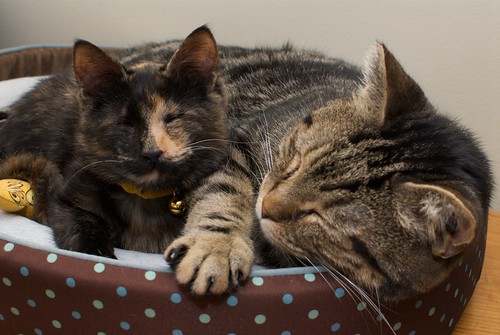
Snuggling
By Sudhersena: Tomcats are vulnerable to fights. Many Tomcats come to the Blue Cross Shelter with severe bite wounds that result from fights with other male cats. These wounds, frequently, develop into abscesses and become infested with maggots. They can also become infested with viral diseases that prove fatal to the cat. Tomcats attain puberty at 6-8 months and develop some undesirable changes in their behaviour. They become territorial in nature and start to mark their territory by spraying urine indoors as well as outdoors. The cat will start enlarging his territory and this would often result in fights with other male cats. An un-neutered male cat will also start roaming to look for female cats in heat. It is believed that a male cat can detect and follow the scent of a female cat for seven miles! You can protect your feline friend from attacks by other male cats by neutering him. Neutering male cats also cuts out the risk of testicular cancer and decreases the incidence of prostate and anal tumours. Shun the myths: Neutering does not alter the basic personality of your cat. He doesn’t suffer any kind of emotional reaction or identity crisis when neutered. On the other hand, he will become more loving and contented. Sudhersena is a contributing writer at Dogs and Pups Magazine. Source: Deccan ChronicleImage: https://www.flickr.com
Read More........

Lions, Tigers & Bears: San Diego sanctuary can be last chance for exotic cats


RTSea: Animal sanctuaries - what role do they play in conservation? Are they the best solution or the last ray of hope for an exotic animal like a lion, tiger or other big cat? I recently had the opportunity to visit Lions, Tigers & Bears, an animal sanctuary in Alpine, near San Diego, California. Speaking with owner Bobbi Brink, I learned more about what a good animal sanctuary does and does not to do for the animals within its care. First, it's important to understand why animal sanctuaries exist in the first place. While I am fascinated by the beauty and grace of exotic cats like tigers and jaguars, I have no desire to keep one as a pet. However, there are others who do for reasons of status or an inflated sense of macho dominance. Whatever the reason, there are black market suppliers who are bringing in wild animals or raising them just below the radar of government officials and selling them to the highest bidder. From there, owners eventually discover that an exotic cat can become a handful, either because of its size as it matures or its nutritional requirements or temperament. Eventually the animal ends up in an abusive situation because of a cramped and confined living space or malnutrition or physical abuse from a sadistic owner. Sometimes these animals are given over freely to an animal sanctuary and sometimes they are offered by law enforcement who have confiscated them but have no means to care for them. In either case, the choices left  when  such  a point  is
reached are two: animal sanctuary or euthanasia. Because of the length of time having been out of the wild (or raised entirely in captivity) and the amount of human interaction these animals have had, reintroducing them back into the wild is out of the question.Somewhat surprisingly, zoos can also be another source of animals bound for a sanctuary. Zoos can find themselves with excess animals through animals naturally mating. If other zoos are not in the market for that particular cat species, then a zoo may have one extra mouth to feed that it can ill afford. Also, there are smaller zoos (and I use the term loosely if you think of a zoo as a properly sanctioned and regulated organization) and circuses that can find themselves economically hard pressed to care for large, exotic animals.Sometimes, in the case of bears or mountain lions in Southern California, man's encroachment into their territory can produce a situation where an animal is no longer afraid of humans or urban environments. When an animal wanders into a neighborhood, is caught by local officials and released back into the wild but, because of its lack of fear or its growing need to find food, it keeps returning - wildlife officials are often faced with having to put the animal down. Unless there is an animal sanctuary available to take it in.In many ways, sanctuary owners would like nothing more than to be put out of business because of a lack of animals who need protection. But, unfortunately, as long as the profit motive is high and the egos of some people are great, combined with the economic realities that zoos and circuses can face like any other business, there will always be a need for the animal sanctuary as a place where these special animals can live out their lives comfortably. At Lions, Tigers & Bears, there are currently three lions, four Bengal tigers, three black bears and several smaller exotic cats on the property. They are provided with large, comfortable cages for eating and sleeping with much larger fenced areas for exercising. To provide stimulus, the cages are interlinked so that the cats' access to the larger exercise areas can change every couple of days. Having suitable space is important. Bobbi's latest addition to the sanctuary is the bear enclosure which is nearly the size of a football field for just three bears. About ten feet out from all the cages and surrounding the animal pens is a secondary fence nearly 20 feet high. While Bobbi has a full veterinary facility and a staff of volunteers who prepare and feed the animals a balanced and nutritious diet, contact with the animals is kept to a minimum. No one on the staff, including Bobbi herself, ever attempt to engage in physical contact with the animals. The animals may recognize members of the staff and approach them within their enclosures, but you won't see Bobbi or her staff throwing their arms around a tiger and giving it a
belly rub. Most sanctuaries frown on that kind of human contact. Having gushed to Bobbi about my love of tigers, she agreed to take me and the film producer I was with inside the outer perimeter fence to get a closer look. One of the female tigers approached, expecting a treat which Bobbi had in the form of some cut up chicken. I remembered all of my big cat rules: no cologne or after shave, no sudden moves, and no staring eye-to-eye. I was absolutely amazed at the manner in which this beautiful 300-pound tiger moved, but she barely tolerated my presence and several times let me know with a hiss and a healthy roar. Visitors are limited at Lions, Tigers & Bears to small, supervised groups that must be arranged in advance and people are normally kept at a distance, outside the tall perimeter fence. This still affords visitors to opportunity to see these animals in a more relaxed and comfortable setting, different from what one sees at many zoos or commercial animal parks. By limiting the number of visitors as a revenue generator, as a non-profit organization, Bobbi is always on the prowl (pardon the pun) for funding. Lions, Tiger & Bears will be holding an annual fund raising event in May, but right now Bobbi is on the road, working with other animal sanctuary owners in promoting changes to existing legislation - in particular, HR 4122, an Amendment to the 1981 Lacey Act - to tighten the rules and regulations regarding the private and commercial ownership and care of exotic animals. I will bring you more information on the planned fundraiser and an interview with Bobbi that she and I talked about as soon as she is back from the road. Properly run animals sanctuaries like Lions, Tigers & Bears (the sanctuary is accredited by two leading national and international animal sanctuary organizations) provide animals, who have been unfortunately stripped of their connection with the wild, with the opportunity to live out their lives in dignity, good health, and peace. Passionately committed people like Bobbi Brinks wish it didn't have to be so, but the alternative would be abuse or a premature death for an innocent and magnificent animal. "To animals born in captivity, and fated to be ignored and abused, we dedicate this organization." - Bobbi Brinks Source: RTSea
Read More........

Strawberry" Leopard Discovered

Bisarbeat: A First Rare animal that might have genetic condition that changes fur pigment. The pink-hued leopard: A leopard can't change its spots, but apparently it can change its color. African leopards normally have tawny coats with black spots. But a male leopard with a strawberry-colored coat has been spotted in South Africa's Madikwe Game Reserve, conservationists announced this week.Tourists in the reserve had occasionally seen the unusual animal. But it wasn't until recently that photographer and safari guide Deon De Villiers sent a photograph to experts at Panthera, a US-based wild cat-conservation group, to ask them about the leopard's odd coloration. Panthera President Luke Hunter suspects the pale leopard has erythrism, a little-understood genetic condition that's thought to cause either an overproduction of red pigments or an
underproduction of dark pigments.It's really rare—I don't know of another credible example in leopards," said Hunter, whose group collaborates with National Geographic's Big Cats Initiative. Hunter added, "it's surprising that didn't come out sooner, because he's relatively used to vehicles." Strawberry Leopard Still Successful Erythrism is very unusual in carnivores, and the condition appears most often in raccoons, Eurasian badgers, and coyotes, Hunter noted. "There are some spotted leopard skins and melanistic specimens—black panthers—in museums with red undertones, but fading probably contributes to that," he said. Melanism is an unusual development of black or nearly black color in an animal's skin, fur, or plumage. The strawberry leopard seems healthy and likely suffers no ill consequences from his pinkish hue, Hunter said: "He's obviously a successful animal."  For instance, the leopard's coat still offers him some camouflage—leopards rely on their spotted fur to sneak up on prey and ambush them from as close as 13 feet (4 meters) away. More worrisome for the strawberry leopard are the game farms that surround the Madikwe reserve, Hunter said. If the animal were to leave the reserve, he'd lose the strict protection offered by Madikwe and become fair game for legal trophy hunting, Hunter said. "It's the fate of a lot of leopards."Source: Bisarbeat
Read More........

Italian cat inherits 10 million pounds after owner dies: Report


Deccan Chronicle, PTI, London: Believe it or not, an Italian cat has inherited a fortune of 10 million pounds after her owner died aged 94, reportedly making her the third richest pet in the world. Maria Assunta died last month and according to lawyers entrusted with her estate, she left the fortune in property to Tommasino, a stray cat she had found and looked after because of her love for animals, the Daily Mail reported. Assunta had a large property portfolio with homes and villas across the country, as well as several bulging bank accounts and share portfolios but no living relatives. Lawyers Anna Orecchioni and Giacinto Canzona who are representing her say that she left the fortune to Tommasino in a will she wrote and deposited with them in their office in Rome in October 2009. Orecchioni explained that under Italian law Tommassino is not entitled to inherit the money directly and the will also asked for the money to be given to a ‘worthy animal association, if one could be found’. She added: "We had requests from several organisations but in the end we didn't find any that we thought suitable. "Then earlier this year Maria told us about her nurse called Stefania who looked after her and who like her had a love of animals and in particular cats. In the end we decided that Stefania was the most suitable person to administer the money that Maria had left in her will." The world's richest animal is thought to be Gunter, a German shepherd who received more than 90 million pounds after his wealthy and slightly barking heiress owner Karlotta Liebenstien died and left him her fortune. Sourse: Deccan ChronicleSource: Image
Read More........