Asteroid claims to have destroyed dinosaurs in African seas

An asteroid from space slammed into the Earth's surface 66 million years ago, leaving a massive crater underneath the sea and wreaking havoc with the planet.
No, it's not that asteroid, the one that doomed the dinosaurs to extinction, but a previously unknown crater 248 miles off the coast of West Africa that was created right around the same time. Further study of the Nadir crater, as it's called, could shake up what we know about that cataclysmic moment in natural history. Uisdean Nicholson, an assistant professor at Heriot-Watt University in Edinburgh, happened on the crater by accident -- he was reviewing seismic survey data for another project on the tectonic split between South America and Africa and found evidence of the crater beneath 400 meters of seabed sediment. "While interpreting the data, I (came) across this very unusual crater-like feature, unlike anything I had ever seen before," he said. It had all the characteristics of an impact crater. To be absolutely certain the crater was caused by an asteroid strike, he said that it would be necessary to drill into the the crater and test minerals from the crater floor. But it has all the hallmarks scientists would expect: the right ratio of crater width to depth, the height of the rims, and the height of the central uplift -- a mound in the center created by rock and sediment forced up by the shock pressure. The journal Science Advances published the study on Thursday. "The discovery of a terrestrial impact crater is always significant, because they are very rare in the geologic record. There are fewer than 200 confirmed impact structures on Earth and quite a few likely candidates that haven't yet been unequivocally confirmed," said Mark Boslough, a research professor in Earth and Planetary Sciences at the University of New Mexico. He was not involved in this research but agreed that it was probably caused by an asteroid. Boslough said the most significant aspect of this discovery is that it was an example of a submarine impact crater, for which there are only a few known examples. "The opportunity to study an underwater impact crater of this size would help us understand the process of ocean impacts, which are the most common but least well preserved or understood." The crater is 8 kilometers (5 miles) wide, and Nicholson believes it was was likely caused by an asteroid more than 400 meters (1,300 feet) wide hurtling into the Earth's crust. While much smaller than the city-sized asteroid that caused the 100-mile-wide Chicxulub crater that hit off the coast of Mexico that led to the mass extinction of much of life on the planet, it's still a pretty sizable space rock. "The (Nadir) impact would have had severe consequences locally and regionally -- across the Atlantic Ocean at least," Nicholson explained via email. "There would have been a large earthquake (magnitude 6.5 - 7), so significant ground shaking locally. The air blast would have been heard across the globe, and would have itself caused severe local damage across the region.DailyBangladesh/RAH Source: https://www.daily-bangladesh.com
Read More........

Apollo 11 astronaut Michael Collins dies at 90

American astronaut Michael Collins, who flew the Apollo 11 command module while his crewmates became the first people to land on the Moon in 1969, died on Wednesday after battling cancer, his family said.

“Mike always faced the challenges of life with grace and humility, and faced this, his final challenge, in the same way,” Collins’ family tweeted on his official Twitter account.

Often described as the "forgotten" third astronaut on the historic mission, Collins remained alone for more than 21 hours until his two colleagues returned in the lunar module. He lost contact with mission control in Houston each time the spacecraft circled the dark side of the moon.

"Not since Adam has any human known such solitude as Mike Collins," the mission log said, referring to the biblical figure.

Collins wrote an account of his experiences in his 1974 autobiography, "Carrying the Fire," but largely shunned publicity."I know that I would be a liar or a fool if I said that I have the best of the three Apollo 11 seats, but I can say with truth and equanimity that I am perfectly satisfied with the one I have," Collins said in comments released by NASA in 2009. Source: https://www.daily-bangladesh.com/
Read More........

Japan begins space capsule analysis hoping for asteroid sample

Scientists in Japan on Tuesday began analysing a capsule sent back to Earth by a probe, hoping to find asteroid material that could offer clues on how the universe was formed.

Officials from Japan’s space agency said they were jubilant about the successful return of the capsule, which landed in Australia on Sunday after separating from the Hayabusa-2 probe.

“I’m genuinely appreciative of the fact that the capsule came back, after a 5.24 billion-kilometre round-trip,” project manager Yuichi Tsuda told reporters.

Scientists hope it will yield up to 0.1 grams of material collected from the asteroid Ryugu some 300 million kilometres from Earth — though they won’t know for sure until they look inside.

“I’m really looking forward to seeing (the samples) with my own eyes,” Tsuda said.

But that isn’t expected to happen before at least next week, with a series of steps required first to ensure the material is not contaminated.

For now, the capsule is “in a secure location” at a space centre in Sagamihara, south of Tokyo, agency director general Hitoshi Kuninaka said.

“Now we move to the matter-analysis phase,” he said. The samples — collected last year — are hoped to include both surface dust and pristine material stirred up when Hayabusa-2 fired an “impactor” into Ryugu.

Scientists hope they can shed light on how the formation of the universe unfolded, as well as on the origins of life on Earth.

The space agency has begun carefully processing the capsule, beginning by collecting gas inside. It will be opened later under strict conditions, including a nitrogen-filled box for the capsule.

“The key is that samples will not be polluted by Earth’s environment… so they can be provided to researchers around the world,” said Tomohiro Usui, leader of the extraterrestrial matter-analysis group.

“If we see something black inside the capsule, which is itself made of aluminium and whiteish, it’s near-certain it is from Ryugu,” he added. “But that is just supporting evidence, and we’ll not be able to say something for sure until we do chemical analysis.”

The nature of the gas extracted from the capsule also needs to be clarified, though officials said they believe it too was collected from the asteroid.

Half of Hayabusa-2’s samples will be shared between the Japanese space agency and other international organisations, while the rest will be kept for future study as advances are made in technology.The probe’s mission has been extended for more than a decade, with two new asteroids now being targeted for observation. Source: https://www.daily-bangladesh.com
Read More........

Japan begins space capsule analysis hoping for asteroid sample

Japan begins space capsule analysis hoping for asteroid sample

Scientists in Japan on Tuesday began analysing a capsule sent back to Earth by a probe, hoping to find asteroid material that could offer clues on how the universe was formed.

Officials from Japan’s space agency said they were jubilant about the successful return of the capsule, which landed in Australia on Sunday after separating from the Hayabusa-2 probe.

“I’m genuinely appreciative of the fact that the capsule came back, after a 5.24 billion-kilometre round-trip,” project manager Yuichi Tsuda told reporters.

Scientists hope it will yield up to 0.1 grams of material collected from the asteroid Ryugu some 300 million kilometres from Earth — though they won’t know for sure until they look inside.

“I’m really looking forward to seeing (the samples) with my own eyes,” Tsuda said.

But that isn’t expected to happen before at least next week, with a series of steps required first to ensure the material is not contaminated.

For now, the capsule is “in a secure location” at a space centre in Sagamihara, south of Tokyo, agency director general Hitoshi Kuninaka said.

“Now we move to the matter-analysis phase,” he said. The samples — collected last year — are hoped to include both surface dust and pristine material stirred up when Hayabusa-2 fired an “impactor” into Ryugu.

Scientists hope they can shed light on how the formation of the universe unfolded, as well as on the origins of life on Earth.

The space agency has begun carefully processing the capsule, beginning by collecting gas inside. It will be opened later under strict conditions, including a nitrogen-filled box for the capsule.

“The key is that samples will not be polluted by Earth’s environment… so they can be provided to researchers around the world,” said Tomohiro Usui, leader of the extraterrestrial matter-analysis group.

“If we see something black inside the capsule, which is itself made of aluminium and whiteish, it’s near-certain it is from Ryugu,” he added. “But that is just supporting evidence, and we’ll not be able to say something for sure until we do chemical analysis.”

The nature of the gas extracted from the capsule also needs to be clarified, though officials said they believe it too was collected from the asteroid.

Half of Hayabusa-2’s samples will be shared between the Japanese space agency and other international organisations, while the rest will be kept for future study as advances are made in technology.The probe’s mission has been extended for more than a decade, with two new asteroids now being targeted for observation. Source: https://www.daily-bangladesh.com
Read More........

Asteroid over 22 metres in diameter to pass by Earth on Sept 1: NASA

WASHINGTON: An asteroid with diameters between 22 and 49 metres will shoot pass Earth in a distance closer than Earth from the Moon on September 1, according to the National Aeronautics and Space Administration (NASA). "Will asteroid 2011 ES4 hit Earth? No! 2011 ES4's close approach is 'close' on an astronomical scale but poses no danger of actually hitting Earth. Planetary defence experts expect it to safely pass by at least 45,000 miles (792,000 football fields) away on Tuesday, September 1," NASA Asteroid Watch tweeted on Saturday. NASA estimates the asteroid's relative speed at around 8.16 kilometres per second. The last time asteroid 2011 ES4 fly by the Earth was visible from ground for four days. This time, it will be closer to our planet than before with an estimated distance of 1.2 lakh kilometres, closer than that of the Moon, which is 3.84 lakh kilometres away from the Earth. The asteroid, listed as a potentially hazardous asteroid, was first discovered in the spring of 2011 and passes by Earth every nine years. A "potentially hazardous asteroid" is currently defined based on parameters that measure the asteroid's potential to make threatening close approaches to the Earth, according to NASA. Copyright © Jammu Links News. Source: Jammu Links News
Read More........

Russian scientists break ground in new asteroid discovery

A new name has appeared in the registry of minor planets. Researchers at the Ussuriysky Astrophysics Observatory of the Far Eastern chapter of the Russian Academy of Scientists have discovered a new asteroid. The Russian scientists claim that they were lucky to have found such a discovery. The unique discovery was made possible thanks to the Hamilton system telescope, the most powerful in the Far East. That equipment was installed at the observatory last fall. For the Ussuriysky scientists the discovery of the asteroid is a real joy, as it was the first time that specialists of that observatory have discovered a new space object among other objects in the Asteroid Belt. "We studied the space guest for several nights before coming to the sensational conclusion that that asteroid was unknown to the world", said Alexey Matkin, one of the authors of the discovery, in his interview to the Voice of Russia. "An asteroid is a common object which poses no threat to our civilization. At present time the orbital data regarding that asteroid is being studied in order to map a more precise orbit. It is the first asteroid to be discovered in the Far East and specifically at our astrophysics observatory". The size of the new asteroid does not exceed hundreds of meters. The Harvard International Minor Planet Center has already confirmed its discovery. The space stranger has received its own number in the catalogue, which has a registry of four and a half thousand minor space objects. Based on the unique number which contains numbers and letters of the Latin alphabet, one can easily determine when this or that asteroid was discovered, explains Sergey Smirnov, a researcher at the main astronomical observatory in Pulkovo and vice-president of the Astro-geodetic Union of Russia. "First of all a preliminary serial number is obtained. Its first four digits represent the calendar year. In our case it is 2014. Then follow Latin letters that reflect a two-week period during the year. The entire year is divided into 24 such time intervals. That is followed by digits that reflect the serial number inside that time interval. Only after this preliminary serial number an asteroid is assigned its permanent name. By that time a few decades can pass by. The majority of asteroids only have preliminary serial numbers and have no permanent name". Today, scientists discover up to 200 minor planets per year and only a small fraction of those discoveries are made by Russian researchers. The fact that the discovery was made in the Ussuriysky observatory is somewhat unexpected. Until recently the researchers at the observatory dealt with completely different issues, continues Sergey Smirnov. "The Ussuriysky observatory was initially set up to observe the sun and the influence of the solar radiation on life on our planet. It is good that the subjects covered by the observatory were extended and astro-metric research was added. That was why the fact that it was at that observatory that the new asteroid was discovered is such a big joy for our entire scientific community". The new asteroid could possibly allow us to solve more mysteries of our Universe. The Russian scientist believes that it is necessary to determine what family that specific asteroid belongs to. "Sometimes asteroid families are formed as a result of space catastrophes when various objects of the solar system clash with each other. Otherwise, if an asteroid passes closely to a large space object, such as Jupiter or Mars, dramatic changes in the orbit or even destruction can take place. In the distant past, billions of years ago in the early days of the history of our Solar system, such formation of asteroid families was especially powerful. But today we can often see the details of that stone-crushing in the gradual drifting apart of the objects of the same family". By the way, today the world astrophysics community is fighting to resolve another space mystery. The astronomers of the European Southern Observatory have managed to literally dissect the body of the Itokawa asteroid discovered in 1998. Thanks to extra-precise measurements the scientists have discovered that its various segments have different a density and structure. Despite the fact that the research continues, very few discoveries still have a great practical meaning, including the issue of fighting a potential asteroid threat. Milena FaustovaSource: Article
Read More........

Herschel Discovers Water Vapor Around Dwarf Planet Ceres

Dwarf planet Ceres is located in the main asteroid belt, between the orbits of Mars and Jupiter, as illustrated in this artist's conception. Observations by the Herschel space observatory between 2011 and 2013 find that the dwarf planet has a thin water vapor atmosphere. This is the first unambiguous detection of water vapor around anobject in the asteroid belt. Illustration credit: ESA/ATG medialab, Note: For more information, see PIA17831: Water Detection on Ceres, Herschel Telescope Detects Water on Dwarf Planet and Herschel Discovers Water Vapor Around Dwarf Planet CeresSource: Article
Read More........

Curiosity Rover Celebrates 1 Year on Mars with Dramatic Discoveries

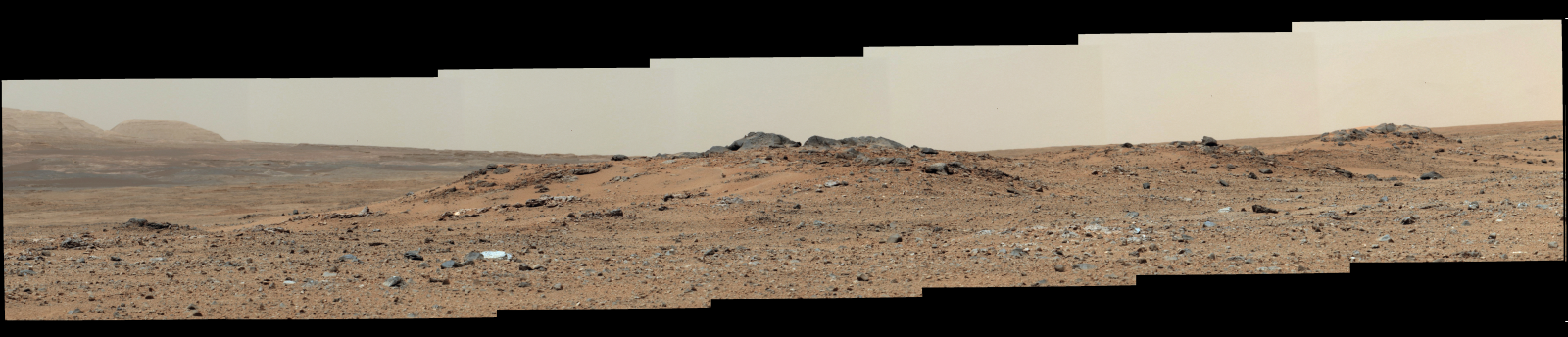
This scene combines seven images from the telephoto-lens camera on the right side of the Mast Camera (Mastcam) instrument on NASA’s Mars rover Curiosity on Sol 343 of the rover’s work on Mars (July 24, 2013). The center of the scene is toward the southwest. Credit: NASA/JPL-Caltech/Malin Space Science Systems Story updated with further details: 
By Ken KremerNASA’s mega Mars rover Curiosity is celebrating 1 Year on the Red Planet since the dramatic landing on Aug. 6, 2012 by reveling in a string of groundbreaking science discoveries demonstrating that Mars could once have supported past life – thereby accomplishing her primary science goal – and with a promise that the best is yet to come! “We now know Mars offered favorable conditions for microbial life billions of years ago,” said the mission’s project scientist, John Grotzinger of the California Institute of Technology in Pasadena. “Curiosity has landed in an ancient river or lake bed on Mars,” Jim Green, Director of NASA’s Planetary Science Division, told Universe Today. Curiosity is now speeding onwards towards Mount Sharp, the huge 3.4 mile (5. 5 km) mountain dominating the center of her Gale Crater landing site – and which is the primary destination of the mission. During Year 1, Curiosity has transmitted over 190 gigabits of data, captured more than 71,000 images, fired over 75,000 laser shots to investigate the composition of rocks and soil and drilled into two rocks for sample analysis by the pair of state-of-the-art miniaturized chemistry labs housed in her belly – SAM & CheMin. “From the sophisticated instruments on Curiosity the data tells us that this region could have been habitable in Mars’ distant past,” Green told me. “This is a major step forward in understanding the history and evolution of Mars.” And just in the nick of time for her 1 year anniversary, the car sized robot just passed the 1 mile (1.6 kilometer) driving mark on Aug. 1, or Sol 351. Mount Sharp still lies roughly 5 miles (8 kilometers) distant – as the Martian crow flies. “We will be on a general heading of southwest to
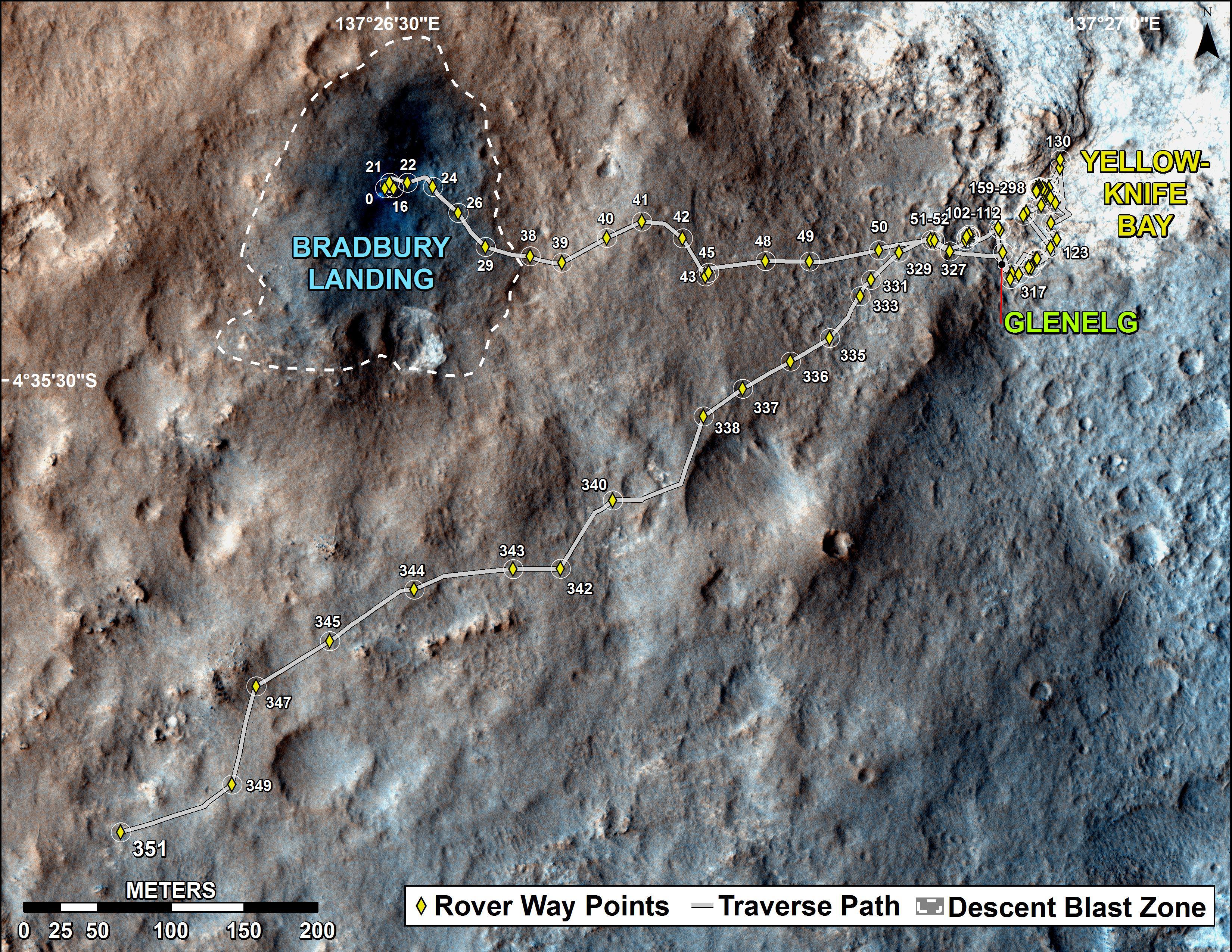
The total distance driven by NASA’s Mars rover Curiosity passed the one-mile mark a few days before the first anniversary of the rover’s landing on Mars. This map traces where Curiosity drove between landing at “Bradbury Landing” on Aug. 5, 2012, PDT, (Aug. 6, 2012 (Universal Time and EDT) and the position reached during the mission’s 351st Martian day, or sol, (Aug. 1, 2013). The Sol 351 leg added 279 feet (85.1 meters) and brought the odometry since landing to about 1.05 miles (1,686 meters). Credit: NASA/JPL-Caltech/Univ. of Arizona
Mount Sharp,” Jim Erickson, Curiosity Project Manager of NASA’s Jet Propulsion Laboratory (JPL), told Universe Today in an exclusive interview. See the NASA JPL route maps below. “We have been going through various options of different planned routes.” How long will the journey to Mount Sharp take? “Perhaps about a year,” Erickson told me. “We have put some new software – called autonav, or autonomous navigation – on the vehicle right after the conjunction period back in March 2013. This will increase our ability to drive.” “We are trying to make that significantly faster by bringing the new autonav online. That will help. But how much it helps really depends on the terrain.” So far the terrain has not been problematical. “Things are going very well and we have a couple of drives under our belt,” said Erickson, since starting the long trek to Mount Sharp about a month ago. The lower reaches of Mount Sharp are comprised of exposed geological layers of sedimentary materials that formed eons ago when Mars was warmer and wetter, and much more hospitable to microscopic life. “It has been gratifying to succeed, but that has also whetted our appetites to learn more,” says Grotzinger. “We hope those enticing layers at Mount Sharp will preserve a broad diversity of other environmental conditions that could have affected habitability.” Indeed, Curiosity’s breakthrough discovery that the surface of Mars possesses the key chemical ingredients required to sustain microbial life in a habitable zone, has emboldened NASA to start mapping out the future of Mars exploration. NASA announced plans to start work on a follow on robotic explorer launching in 2020and develop strategies for returning Martian samples to Earth and dispatching eventual human missions to Mars in the 2030’s using the new Orion capsule and SLS Heavy lift rocket. “NASA’s Mars program is back on track with the 2016 InSight lander and the 2020 rover,” Jim Green, Director of NASA’s Planetary Science Division, told Universe Today in an interview. “Successes of our Curiosity — that dramatic touchdown a year ago and the science findings since then — advance us toward further exploration, including sending humans to an asteroid and Mars,” said NASA Administrator Charles Bolden in a statement. “Wheel tracks now, will lead to boot prints later.” Following the hair-raising touchdown using with the never before used sky-crane descent thrusters, the science team directed the 1 ton robot to drive to a nearby area of interesting outcrops on the Gale crater floor – at a place called Glenelg and Yellowknife Bay. Along the way, barely 5 weeks after landing, Curiosity found a spot laden with rounded pebbles at the Hottah outcrop of concretions that formed in an ancient stream bed where hip deep liquid water once flowed rather vigorously. In February 2013, Curiosity conducted the historic first ever interplanetary drilling into Red Planet rocks at the ‘John Klein’ outcrop inside Yellowknife Bay that was shot through with hydrated mineral veins of gypsum. The Yellowknife Bay basin looks like a dried up 
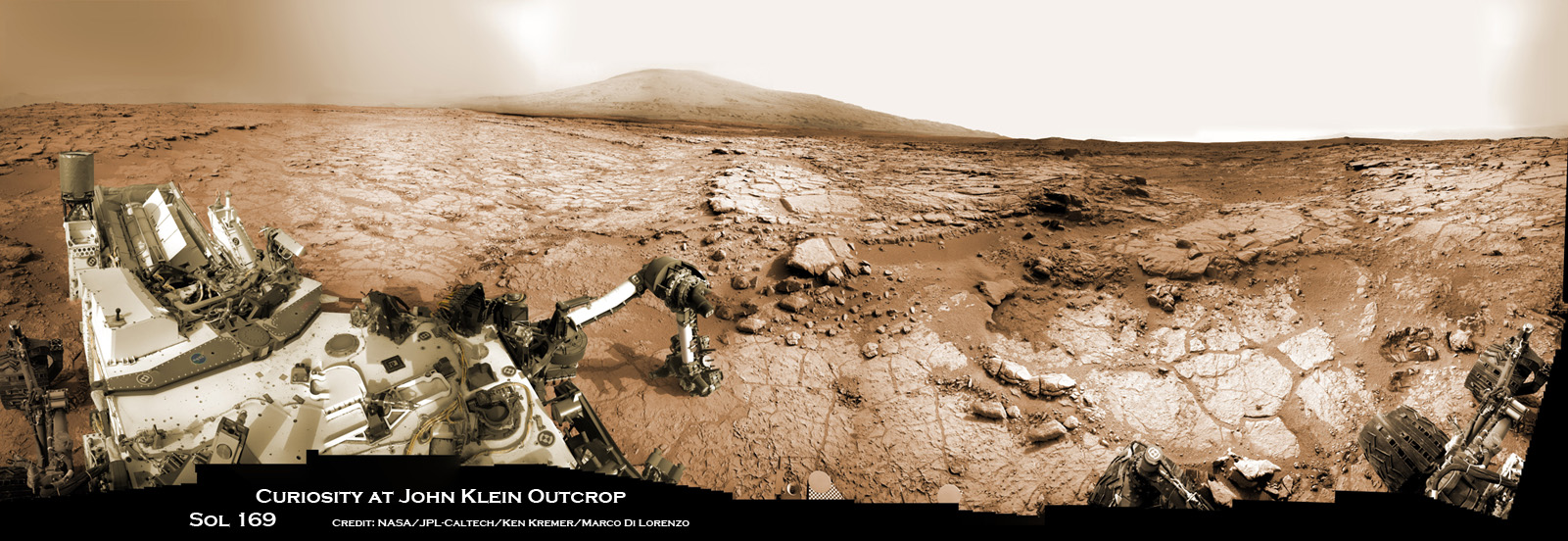
Curiosity accomplished Historic 1st drilling into Martian rock at John Klein outcrop on Feb 8, 2013 (Sol 182), shown in this context mosaic view of the Yellowknife Bay basin taken on Jan. 26 (Sol 169). The robotic arm is pressing down on the surface at John Klein outcrop of veined hydrated minerals – dramatically back dropped with her ultimate destination; Mount Sharp. Credit: NASA/JPL-Caltech/Ken Kremer/Marco Di Lorenzo
river bed. Analysis of pulverized portions of the gray colored rocky powder cored from the interior of ‘John Klein’ revealed evidence for phyllosilicates clay minerals that typically form in pH neutral water. These starting findings on the crater floor were unexpected and revealed habitable environmental conditions on Mars – thus fulfilling the primary science goal of the mission. See herein our context panoramic mosaic from Sol 169 showing the robotic arm touching and investigating the Martian soil and rocks at ‘John Klein’. And if you take a visit to Washington, DC, you can see our panorama (assembled by Ken Kremer and Marco Di Lorenzo) on permanent display at a newly installed Solar System exhibit at the US National Mall in front of the Smithsonian National Air & Space Museum- details here.
A mosaic by the Mars Science Laboratory Curiosity rover, assembled by Ken Kremer and Marco Di Lorenzo is now part of the permanent Solar System Exhibit outside the National Air and Space Museum on the US National Mall in Washington, D.C. Image courtesy NCESSE.
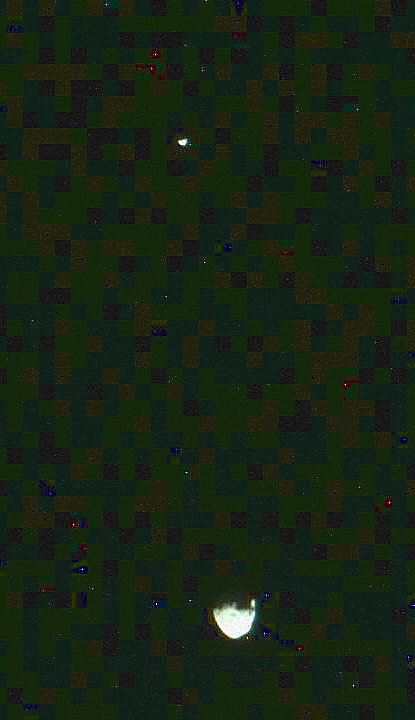
“We have found a habitable environment [at John Klein] which is so benign and supportive of life that probably if this water was around, and you had been on the planet, you would have been able to drink it,” says Grotzinger, summing up the mission. This past week she captured rare sky watching images of the diminutive Martian moons – Phobos and Deimos – together! Meanwhile, Curiosity’s 10 year old sister rover Opportunity Is trundling merrily along and will arrive shortly at her own mountain climbing goal on the opposite of Mars. And NASA’s next Mars orbiter called MAVEN (for Mars Atmosphere and 
Curiosity captured unique and rare view of tiny Martian moons Phobos & Deimos together on Sol 351 (Aug 1, 2013). Look close and see craters on pockmarked Phobos. Credit: NASA/JPL/MSSS, contrast enhanced by Marco Di Lorenzo and Ken KremerOn the long road to Mount Sharp, Curiosity will make occasional stops for science.
Volatile Evolution), has just arrived intact at the Kennedy Space Center after a cross country trip aboard a USAF C-17. Technicians at Kennedy will complete final preparations for MAVEN’s blastoff to the Red Planet on Nov. 18 from the Florida Space Coast atop an Atlas V rocket. On Tuesday, Aug 6, NASA will broadcast a half day of new programming on NASA TV commemorating the landing and discussing the science accomplished so far and what’s coming next. And stay tuned for more astonishing discoveries during ‘Year 2′ on the Red Planet from our intrepid rover Curiosity – Starting Right Now ! Ken Kremer
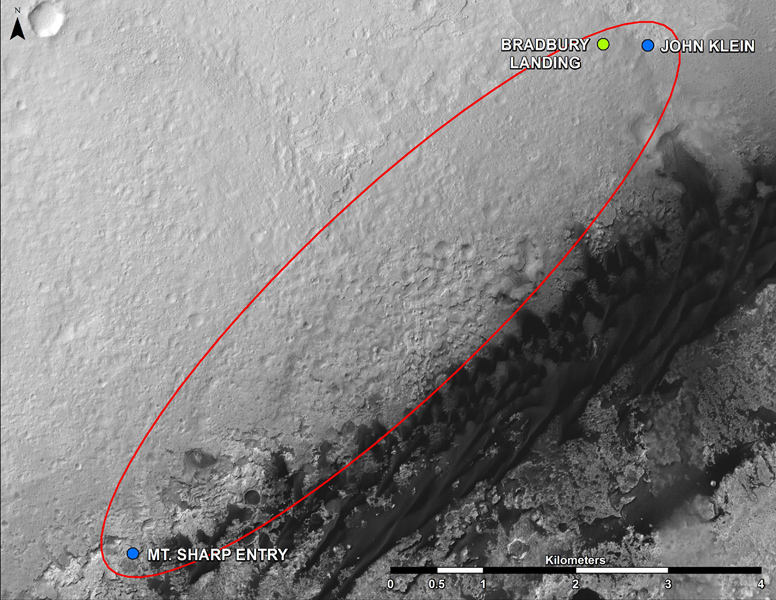
Curiosity Route Map From ‘Glenelg’ to Mount Sharp: This map shows where NASA’s Mars rover Curiosity landed in August 2012 at “Bradbury Landing”; the area where the rover worked from November 2012 through May 2013 at and near the “John Klein” target rock in the “Glenelg” area; and the mission’s next major destination, the entry point to the base of Mount Sharp. Credit: NASA/JPL-Caltech/Univ. of Arizona. Source: Universetoday
Read More........

Comets deposited building blocks of life on Earth?

Washington,Planetary scientists have claimed that comets or "dirty snowballs" may have deposited the building blocks of life on Earth billions of years ago. A team at the Bay Area Environmental Research Institute NASA/Ames Research Centre in California says its research has shown that comets bombarding Earth some billions of years ago deposited key ingredients for life to spring up on the planet. Jennifer G Blank, who led the team, described experiments that recreated with powerful laboratory "guns" and computer models the conditions that existed inside comets when these celestial objects hit Earth's atmosphere at almost 25,000 miles per hour and crashed down upon the surface. The research is part of a broader scientific effort to understand how amino acids and other ingredients for the first living things appeared on a planet that billions of years ago was barren and desolate, say the planetary scientists. Amino acids make up proteins, which are the workhorses of all forms of life, ranging from microbes to people. "Our research shows that the building blocks of life could, indeed, have remained intact despite the tremendous shock wave and other violent conditions in a comet impact," Blank said in a release by the American Chemical Society. "Comets really would have been the ideal packages for delivering ingredients for the chemical evolution thought to have resulted in life. We like the comet delivery scenario because it includes all of the ingredients for life – amino acids, water and energy," she added. Comets are chunks of frozen gases, water, ice, dust and rock. These orbit the sun in a belt located far beyond the most distant planets in the solar system. Periodically, comets break loose and hurtle inward, where they may become visible. In their research, Blank and colleagues set out to check whether amino acids could remain intact after a comet's descent through Earth's atmosphere. In one set of experiments, they used gas guns to simulate the enormous temperatures and powerful shock waves that amino acids in comets would experience on upon entering the Earth's atmosphere. The gas guns, devices that weigh thousands of pounds, hit objects with high-pressure blasts of gas moving at supersonic speeds. They shot the gas at capsules filled with amino acids, water and other materials. The amino acids did not break down due to the heat and shock of the simulated crash. Indeed, they began forming the so-called "peptide bonds" that link amino acids together into proteins. The pressure from the impact of the crash apparently offset the intense heat and also supplied the energy needed to create the peptides, she explained. In other experiments, Blank's team used sophisticated computer models to simulate conditions as comets collided with Earth. The scientists suggested that there may well have been multiple deliveries of seedlings of life through the years from comets, asteroids and meteorites. Source: Indian Express
Read More........

Meteorites: the secret signs

Meteorites fall on the Earth (Artist's view)
The international expedition to study meteorite catastrophes of the past - a joint Russian-American mission, headed by world-renowned scientist - Dallas Abbott. It belongs to her discovery of a number of such craters on the planet and the hypothesis about the impact of meteorites on Earth evolution. At this time, the scientists are going to dot the "i" in the origin of the two Russian lakes. "Smerdyache" - the most enigmatic and mysterious lake in the Moscow region, near the Shatura. Even the name is scary. It is said that once there was a church. She went into the water together with the priest. Truth or fiction, is not known. However, the landscape around adds mystique ... and unusual shape of the lake - a perfect
Smerdyache lake
circle. "This lake is the most suspicious of 30-40 lakes in Shatura, - said Vyacheslav Gusiakov, head of the Laboratory of the Institute of Computational Mathematics and Mathematical Geophysics SB RAS. - The origin of the remaining lakes are more or less clear. And here is flat terrain and suddenly there is a ring structure, surrounded by a rampart and further reduction ... " But it is almost perfectly round shape of the lake and attracted fans of extraterrestrial stories. Their version: Lake meteorite origin. Formed ten thousand years from the fall of 20 meter outer body. Evidence of this hypothesis, a lot. However, he has not yet found a meteorite. A joint Russian-American expedition just to dot the "i" in the origin of this water body. Vyacheslav Gusiakov believes that the main thing - to find the right place and to take samples under the ground, to see if there are rocks ejected from the depths, to study the geological section of the
Depression Svetloyar Lake - Crater meteorite origin
site at a depth of 50-60 meters. But the first round of the lake, and the most cursory examination of his right brings some interesting finds. "There is a set of stones that just amazed how all of this - says a leading researcher at the Institute of Geography, Russian Academy of Sciences Alexander Maccabees. - In some places there are pebbles on which surprisingly smooth parallel cracks. But these cracks occur when the subject put a lot of pressure and suddenly take it off. " The task of scientists to take as many samples and conduct laboratory research to say for sure whether the Moscow region in the past undergone a meteoric bombardment. "As part of any meteorite is metal, nickel - sure researcher Dallas Abbott, leader of the expedition. - On the ground, the soil is very little nickel. And if we find it in large numbers, it could be argued that it was the fall of the cosmic body. This is one way to prove that the lake
Image above: As part of an international expedition took part: Professor Dallas Abbott, a member of the Observatory-Doherty Earth Lomond, a researcher micrographs Dee Breger.
appeared as a direct result of a meteorite. "Renowned scholar American Dallas Abbott for the first time in the Russian outback. It belongs to her discovery of several craters on Earth. The most famous - underwater crater Mahuika near New Zealand. It was formed in 1447. Then, according to Abbott, fell into the ocean a huge meteorite, which caused a mega-tsunami, the wave height of over 100 meters. In 2009, she made a sensational new report: Little Ice Age in the 6th century, which lasted four years on Earth, too, caused by the fall of a large meteorite. It was followed by volcanic eruptions, dust emission in the atmosphere, crop failure, famine. The result - a global epidemic of plague. Dallas does not exclude that the Flood could also arise due to the fall of the celestial body. In the history of mankind are many myths and legends about the raging elements. But not knowing how to explain the disaster, people attributed their otherworldly forces. A striking example - Lake Svetloyar in the Nizhny Novgorod region. From this
Alexey Kiselev long held the view of meteoritic origin of the lake Svetloyar
place connects the mysterious disappearance of Kitezh City, according to the legend of the past into the water together with the people, not willing to surrender to the army of Batu. There are earlier - Mari myth. Lecturer of the Department of Astronomy of the University Mininskogo Alexey Kiselev retells it: "According to legend, there lived a tribe pans. Goddess Turk angry with the tribe and sent fiery horse, and this horse has destroyed the rebellious lords ... " But, there to have spoken, and the fall of meteorites - the phenomenon is not rare in our lives. But unlike a dead moon, where craters all at a glance, everything on Earth "space wounds" quickly tightened the winds and the rain. Search craters - this is one way to revive the memories of the past. Even after a century, the modern world reflect the cosmic threat not yet in force. ROSCOSMOS Press Release: http://www.federalspace.ru/main.php?id=2&nid=20141, Images, Text, Credits: Roscosmos TV studio (ROSCOSMOS PAO) / Dmitry Karabelnikov (images) / Translation: Orbiter.ch Aerospace. Greetings, Source: Orbiter.ch Space News
Read More........

Earth threatened by 6,200 asteroids


The Coming Crisis: As many as 6,200 potentially hazardous asteroids (PHAs) are orbiting close to Earth, a new survey by NASA has revealed. The PHAs are considered robust enough to survive the passage through Earth's atmosphere. If they were to collide with Earth they could cause damage on a large scale, experts warn. In the most detailed study of PHAs yet researchers used infrared scans from Nasa's 16-inch WISE telescope to identify 4,700 asteroids – plus or minus 1500 – that come within five million miles of Earth's orbit. An image released by NASA shows the distribution of the PHAs - with every orange dot representing an asteroid measuring 330 feet (100 metres) or more that is in orbit. Only 20% to 30% of these objects have previously been charted. Although there is no cause for immediate alarm, Nasa said the information could prepare us for future disasters. Source: The Coming Crisis
Read More........

Asteroid To Give Earth A Record Setting Close Shave On February 15

Credit: NASA
Talk about a close shave. On Feb. 15th an asteroid about half the size of a football field will fly past Earth only 17,200 miles above our planet's surface. There's no danger of a collision, but the space rock, designated 2012 DA14, has NASA's attention. Since regular sky surveys began in the 1990s, astronomers have never seen an object so big come so close to our planet. "This is a record-setting close approach," says Don Yeomans of NASA's Near Earth Object Program at JPL. "Since regular sky surveys began in the 1990s, we've never seen an object this big get so close to Earth." Earth's neighborhood is littered with asteroids of all shapes and sizes, ranging from fragments smaller than beach balls to mountainous rocks many kilometers wide. Many of these objects hail from the asteroid belt, while others may be corpses of long-dead, burnt out comets. NASA's Near-Earth Object Program helps find and keep track of them, especially the ones that come close to our planet. 2012 DA14 is a fairly typical near-Earth asteroid. It measures some 50 meters wide, neither very large nor very small, and is probably made of stone, as opposed to metal or ice. Yeomans estimates that an asteroid like 2012 DA14 flies past Earth, on average, every 40 years, yet actually strikes our planet only every 1200 years or so. The impact of a 50-meter asteroid is not cataclysmic--unless you happen to be underneath it. Yeomans points out that a similar-sized object formed the mile wide Meteor Crater in Arizona when it struck about 50,000 years ago. "That asteroid was made of iron," he says, "which made it an especially potent impactor." Also, in 1908, something about the size of 2012 DA14 exploded in the atmosphere above Siberia, leveling hundreds of
square miles of forest. Researchers are still studying the "Tunguska Event" for clues to the impacting object. "2012 DA14 will definitely not hit Earth," emphasizes Yeomans. "The orbit of the asteroid is known well enough to rule out an impact." In this oblique view, the path of near-Earth asteroid 2012 DA14 is seen passing close to Earth on Feb. 15, 2013. Even so, it will come interestingly close. NASA radars will be monitoring the space rock as it approaches Earth closer than many man-made satellites. Yeomans says the asteroid will thread the gap between low-Earth orbit, where the ISS and many Earth observation satellites are located, and the higher belt of geosynchronous satellites, which provide weather data and telecommunications. "The odds of an impact with a satellite are extremely remote," he says. Almost nothing orbits where DA14 will pass the Earth. NASA's Goldstone radar in the Mojave Desert is scheduled to ping 2012 DA14 almost every day from Feb. 16th through 20th. The echoes will not only pinpoint the orbit of the asteroid, allowing researchers to better predict future encounters, but also reveal physical characteristics such as size, spin, and reflectivity. A key outcome of the observing campaign will be a 3D radar map showing the space rock from all sides. During the hours around closest approach, the asteroid will brighten until it resembles a star of 8thmagnitude. Theoretically, that’s an easy target for backyard telescopes. The problem, points out Yeomans, is speed. “The asteroid will be racing across the sky, moving almost a full degree (or twice the width of a full Moon) every minute. That’s going to be hard to track.” Only the most experienced amateur astronomers are likely to succeed. Those who do might experience a tiny chill when they look at their images. That really was a close shave. For more information about 2012 DA14 and other asteroids of interest, visit NASA’s Near-Earth Object Program web site: http://neo.jpl.nasa.gov, Author: Dr. Tony Phillips |Production editor: Dr. Tony Phillips | Credit: Science@NASAAsteroid To Give , Source: Nano Patents And Innovations
Read More........

Russian astronomers discover new huge comet

Russian astronomers discover new huge comet
Last year, Russian astronomers Vitaly Nevsky and Artyom Novichonok discovered a new gigantic comet that is currently approaching Earth. The ISON comet, which is expected to become brighter than the full moon, will be visible to the naked eye by late 2013. The astronomers say that given the comet’s unique orbit, its origin may be the Oort Cloud, a cluster of frozen rocks and ices surrounding the solar system, located almost a light-year from the Sun.
The comet is currently passing outside Jupiter, gaining speed and becoming brighter by the day. In September 2012, the Russian astronomers spotted what appeared to be a comet in images taken by a telescope that is part of the worldwide International Scientific Optical Network, or ISON, from which the object draws its name. Thanks to ISON, astronomers can get images taken by remote telescopes in other countries, including in New Mexico, where a Russian automatic observatory is located. The ISON comet never plunged into the inner solar system, and its surface darkened because of the impact of galactic particles. At the same time, the comet avoided being damaged by the so-called solar wind, which is not the case for the Moon, for example. Sergei Smirnov, press secretary of the Pulkovo Astronomical Observatory in Russia, says that studying surface of the ISON comet may shed more light on evolution of the Universe. "In the future, it would be good to have special space vehicles on standby so that they can approach such celestial objects, something that may finally come true given the ongoing development of air navigation," Smirnov says. Thus far, Comet ISON has only been visible through powerful telescopes. In November 2013, heat from the sun will vaporize ices in the comet’s body, creating what could be a spectacular tail that will be visible in Earth’s night sky without telescopes or even binoculars from about October 2013 through January 2014. Another scenario is that Comet ISON could break apart as it nears the sun, failing to produce a tail of ice particles by the end of November. In December, the comet will be growing dimmer, but, assuming it is intact, it will be visible from both hemispheres of Earth. January 2014 may see a meteor shower produced by streams of debris from the ISON comet. Source: Voice of Russia
Read More........

Deep space fly-by: Incredible pictures taken by Chinese probe passing asteroid show giant rock 4.5 million miles from Earth

The Chang'e-2 probe successfully conducted the mission to scan the surface of the potato-shaped asteroid Toutatis (inset left). It happened on December 13 at 16.30om Beijing Time, the State Administration of Science, Technology and Industry for National Defense announced today. The flyby was the first time an unmanned spacecraft launched from Earth has taken such a close viewing of the asteroid, named after a Celtic god. Source: The Coming Crisis
Read More........

Recovery of comet 26P/Grigg: Skjellerup

Comet 26P/Grigg–Skjellerup - December 05, 2012, by E. Guido & N. Howes
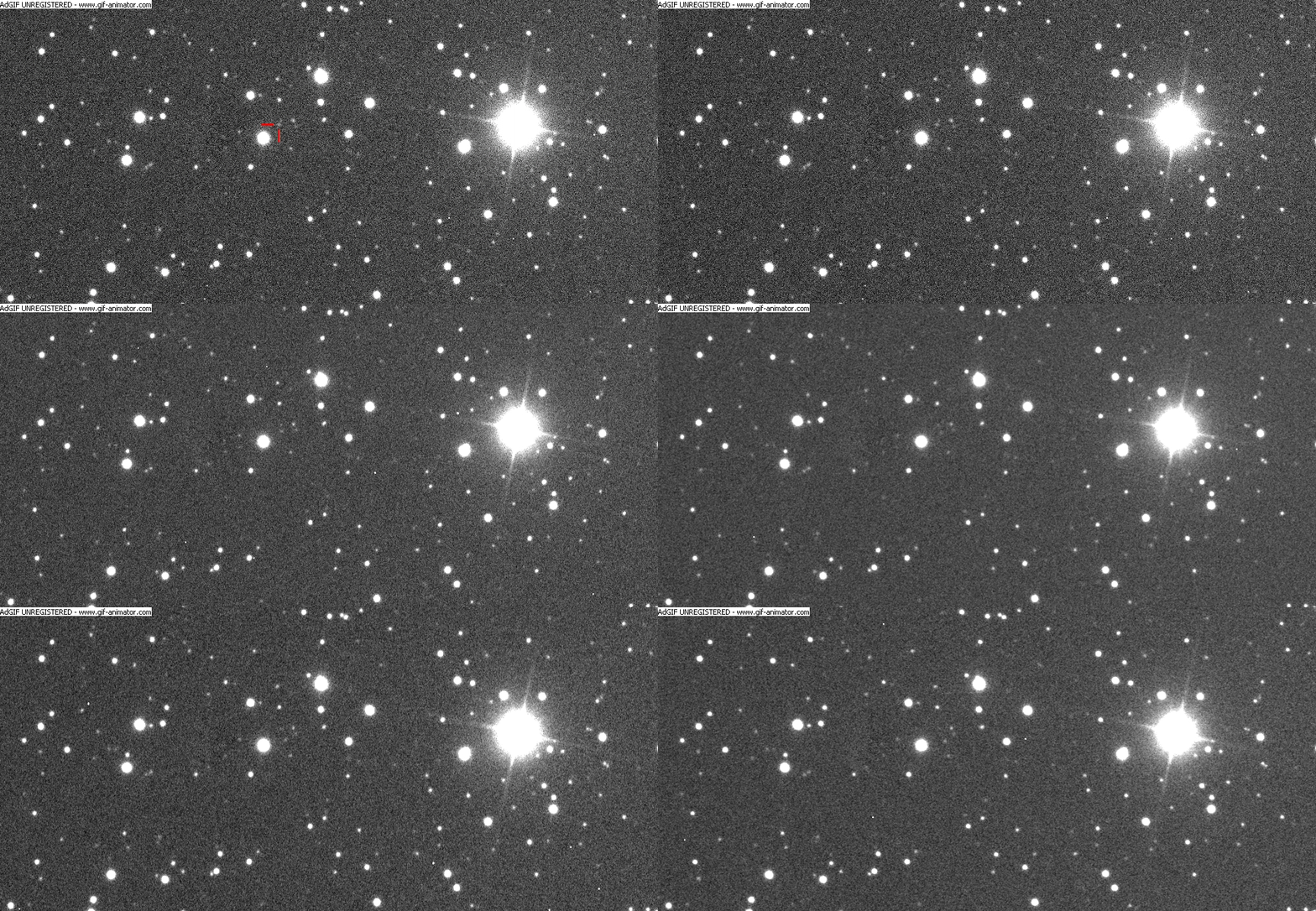
An animation showing the movement of the comet (7 frames x 30 seconds each). North is up, East is to the left (click here or on the thumbnail for a bigger version):
By Nick Howes & Ernesto Guido, MPEC 2012-Y30, issued 2012 December 26, reports our recovery of comet 26P/Grigg–Skjellerup. We found the comet on 2012 December 05.6 and December 14.5 at about magnitude 20. We imaged it remotely with the 2.0-m f/10 from the Siding Spring-Faulkes Telescope South. This comet is named after the singing teacher and amateur astronomer John Grigg and after J. Frank Skjellerup, an Australian telegraphist working at the Cape of Good Hope in South Africa. On July 10, 1992, comet 26P was visited by Giotto spacecraft after its successful close encounter with comet Halley. The Giotto camera has been damaged in the Halley flyby and there are no pictures of the nucleus. In 1972 the comet was discovered to produce a meteor shower (first predicted by Harold Ridley), the Pi Puppids, and its current orbit makes them peak around April 23, for observers in the southern
hemisphere, best seen when the comet is near perihelion. Comet 26P/Grigg–Skjellerup was last observed (before our recovery) on August 09, 2008 by mpc code 204 (Schiaparelli Observatory). While there is also a single night observation by F51 – Pan-STARRS 1, Haleakala dated November 25, 2011, a comet recovery requires 2 nights of observations, "as it is not possible to unambiguously identify a comet by position and rate alone without a second night of data to verify the orbit." (Hainaut et al. A&A 1997). Source: Remanzacco Observatory
Read More........

New asteroid could hit earth in 2040: NASA

A new asteroid, identified by NASA, could potentially hit the earth on February 5, 2040, even though it is much smaller than the one - nine miles across - which wiped out the dinosaurs 65 million years ago. The UN Action Team on near-Earth objects, which has taken note of the 460-ft asteroid, placed the odds of its hitting the earth at one-in-625, though that could change nearer the time. Scientists have not yet been able to work out much more about it than its size as they have only been able to observe it for half its orbit. But between 2013 and 2016 they will be able to monitor from the ground and will make a moredetailed assessment. In 2023 the rock will make a 'keyhole pass' of Earth, which is an area it passes through on the orbit before it would hit Earth. This will be within a mere 0.02 astronomical units of our planet, or 1.86 million miles, according to NASA's Jet Propulsion Lab. NASA's infrared sky-scans track space objects such as asteroids. A recent scan with the NeoWISE instruments found that there were 19,000 'mid-sized' asteroids within 120 million miles of Earth, the Daily Mail reports. According to NASA, among the ways of deflecting it are putting a probe onto the rock and using the extra gravity the craft generates to steer the asteroid away over millions of light years. Another option would be sending a probe into it so that the impact has the same effect. Nuclear weapons have also been discussed, but this would create a shower of rocks instead of just one. Mid-sized refers to asteroids in a size range between 330 and 3,300 feet wide, which could destroy a city-sized area were they to hit Earth. Source: Ananta-Tec
Read More........

Comets & Neo: Follow-up on 168P/Hergenrother bright phase

(click on the image for a bigger version)
According to reports issued by a number of observers to several astro-forums, comet 168P/Hergenrother is currently experiencing a bright phase: over the course of several nights, it increased in brightness by several magnitudes, reaching a total visual magnitude of approximately 8. We performed some follow-up on it remotely, on 2012 Sept. 26 and Oct. 3, through the 2.0-m f/10.0 Ritchey-Chretien + CCD + Bessel R filter of the Faulkes Telescope South, at Siding Spring Inspecting our stacked images obtained on Sept. 26, the comet shows an obvious central condensation, measuring nearly 3" across; the total coma was traced to a diameter of about 1.7'. On Oct. 3, the central condensation grew to 8" and the total coma diameter was nearly 3'. It's interesting to notice how, apart the growing of the central condensation size, also its appearance changed, appearing pretty sharp on Sept. 26, and a bit "fluffy" on Oct. 3. Subtracting the two images (after normalization of the stackings) of Sept. 26 from Oct. 3, the evolution of the central condensation became obvious. To some extent, the difference might be due to a slight change in the perspective angles (e.g. its phase angle passed from 10 to 13 deg), however we consider that a part of what we see in the panel, is a genuine evolution of the central condensation due to its active phase (click
on the image below for a bigger version). The photometric data supports the observed evolution: our afrho data on Sept. 26 shows a peak of about 670 +/- 100 cm at 2230 km from the photocenter, while on Oct. 3 we measured an afrho of 1210 +/- 150 cm peaking at a radius of about 3000 km from the photocenter. This seems to indicate a two-fold increase of the afrho activity within the central condensation in a matter of a week, as well the apparent recession of the activity peak from the central condensation. A change in the photometric profile of the coma is also obvious, from the comparison of the two panels, with the Oct. 3
graph significantly wider and less steep, compared to that of Sept. 23. So our follow-up confirms and adds scientific data to the previous reports: currently comet 168P/Hergenrother is alive and rather active. Giovanni Sostero, Nick Howes, Alison Trip and Ernesto Guido. Source: Eemanzacco Observatory
Read More........

'Nuke won't save us from asteroid'

WHEN Bruce Willis used a nuclear bomb to save Earth from a giant asteroid in the movie Armageddon, the scenario had little science and a lot of fiction, physicists have said. Willis' nuke would have had as much impact on the rock as a cheap firecracker and was used so late that the planet would have been doomed anyway, they said. "Our current level of technology is simply nowhere near sufficient to protect Earth from such an asteroid by this specific means of asteroid defence," according to a paper published by students at the University of Leicester, central England. In the 1998 close-call blockbuster, Willis plays a deep-core driller sent by NASA to stop a Texas-sized rogue rock on collision course with Earth. He lands on the asteroid and embeds a nuclear device that once detonated splits the projectile into two pieces that shave past on either side of Earth. The research team said blowing up an asteroid of that size, about 1000 kilometres in diameter, would require a bomb a billion times stronger than the biggest one ever detonated on Earth - the Soviets' "Big Ivan" that was exploded at a test site in 1961. In any case, the asteroid would have to be detected much, much sooner than in the film, the team writes in the university's Journal of Special Physics Topics. The 18-day headstart in Armageddon "would leave no time for Bruce to travel to the asteroid and drill into its centre, let alone share any meaningful moments with Ben Affleck or Liv Tyler along the way", says the study, entitled "Could Bruce Willis Save the World?" Tyler plays Willis' onscreen daughter and Affleck her love interest. In reality, the asteroid would have to be detected and blown up 13 billion kilometres from Earth - thus on the outer reaches of the Solar System - to give the two halves enough time to alter their course and miss the planet. It is not all bad news, though. If the end of the world is pencilled for December 21, 2012 - the date said to be indicated by the Mayan calendar - that does give us some months to do something about it. "One possible alternative method would be moving the asteroid via propulsion methods attached to it," said 22-year-old co-author Ben Hall. "What is certain is that most methods would require very early detection of such an asteroid and very careful planning in deriving a solution."Source: Sam Daily Times
Read More........

New Comet: P/2012 O2 (MCNAUGHT)


Cbet nr. 3189, issued on 2012, July 23, announces the discovery of a new comet (discovery magnitude 18.3) by R. H. McNaught on CCD images obtained with the 0.5-m Uppsala Schmidt telescope at Siding Spring on July 20.7. The new comet has been designated P/2012 O2 (MCNAUGHT). We performed some follow-up measurements of this object, while it was still on the neocp. Stacking of 13 R-filtered exposures, 10-sec each, obtained remotely, from the Haleakala-Faulkes Telescope Northon 2012, July 23.5, through a 2.0-m f/10.0 Ritchey-Chretien + CCD, shows that this object appears "soft" compared to the nearby field stars of similar brightness (stellar FWHM of 1.0") and elongated toward PA 260. Our confirmation
image in false color to enhance the coma and its elongation. M.P.E.C. 2012-O27 (including previously unpublished prediscovery Mount Lemmon observations acquired by A. Gibbs on May 20) assigns the following preliminary elliptical orbital elements to comet P/2012 O2: T 2012 June 25.09; e= 0.54; Peri. = 183.05; q = 1.66 AU; Incl.= 24.53. by Ernesto Guido, Giovanni Sostero & Nick Howes. Source: Remanzacco Observatory
Read More........

Asteroid crashes delivered water on Earth

Meteorites
Asteroids from the inner solar system may be the source of the majority of Earth's water, a new study has claimed, contradicting the belief that most of our planet's water originated in the outer solar system.  The prevailing theories suggest that water was delivered on Earth from outer solar system by comets that coalesced beyond Jupiter's orbit, then migrated inward. "Our results provide important new constraints for the origin of volatiles in the inner solar system, including the Earth," said lead researcher Conel Alexander of the Carnegie Institution of Washington. "And they have important implications for the current models of the formation and orbital evolution of the planets and smaller objects in our solar system," Alexander was quoted as saying by SPACE.com. For their study, published in the journal Science, the researchers analysed samples from 86 carbonaceous chondrites. The primitive meteorites are thought to be key sources of the early Earth's volatile elements like hydrogen and nitrogen. The team measured the abundance of different hydrogen, nitrogen and carbon isotopes in the chondrite samples. Isotopes are versions of an element that have different numbers of neutrons in their atomic nuclei. For example, the isotope deuterium -- also known as heavy hydrogen -- contains one neutron, while normal hydrogen has none. The amount of deuterium in celestial bodies water ice sheds light on where the objects formed in the solar system's early days. In general, bodies that took shape farther from the sun have relatively higher concentrations of deuterium, the researchers said. The 86 chondrite samples' deuterium content -- which the team gleaned from clays, the remnants of water ice -- suggest the meteorites' parent bodies formed relatively close to Sun, perhaps in the main asteroid belt between Mars and Jupiter. Comets, by contrast, have much higher deuterium ratios. As a result, scientists think most of them were born in the solar system's frigid outer reaches. The isotopic composition of the bulk Earth appears to be more consistent with chondrites than with comets, they said. There are many different types of chondrites and no single group is a perfect match. So our planet probably accreted its water and other volatiles from a variety of chondrite parent asteroids, they added. Source: Hindustan Times
Read More........