European Space Agency's Euclid telescope launches from Florida, US

An artist's impression of Euclid. Image: ESA.
Yesterday, a SpaceX Falcon 9 rocket, with the European Space Agency's (ESA) Euclid space telescope aboard, launched at 11:12 AM EDT (1512 UTC) from Cape Canaveral Space Launch Complex 40 in Florida, US. Euclid was to study dark matter, dark energy, and the expansion of the universe. Costing 1.4 billion, Euclid was to spend about a month traveling around 1,500,000 kilometers (932,057 mi) to the Lagrange point L2 between the Earth and the Sun, the area of the James Webb Space Telescope. There, it would observe about a third of the sky beyond the Milky Way for six years. NASA designed and built Euclid's Near Infrared Spectrometer and Photometer, and NASA's Nancy Grace Roman Space Telescope, with a tentative launch date of May 2027, was to provide more refined data scientists could use to correct Euclid's. IPAC senior research scientist Yun Wang stated Euclid and Roman would "add up to much more than the sum of their parts [...] Combining their observations will give astronomers a better sense of what's actually going on in the universe." Before the Russian invasion of Ukraine, Euclid was scheduled for launch from French Guiana on a Russian Soyuz rocket in March 2023. Source: https://en.wikinews.org, available under the terms of the Creative Commons Attribution 2.5 License
Read More........

Hubble captures the start of a new 'spoke' season of Saturn: NASA

FEB 14, 2023 In a latest image of Saturn captured by National Aeronautics and Space Administration's (NASA's) Hubble Space Telescope, the appearance of spokes on the planet's rings heralded the start of a new 'spoke' season, according to a statement by NASA. Scientists will be looking for clues to explain the cause and nature of the spokes, the statement said. The suspected culprit for the spokes is the planet's variable magnetic field, the statement said. Planetary magnetic fields interact with the solar wind, creating an electrically charged environment. On Earth, when those charged particles hit the atmosphere this is visible in the northern hemisphere as the aurora borealis, or northern lights, NASA said. Scientists think that the smallest, dust-sized icy ring particles can become charged as well, which temporarily levitates those particles above the rest of the larger icy particles and boulders in the rings, NASA said. Like Earth, Saturn is tilted on its axis and therefore has four seasons, though because of Saturn's much larger orbit, each season lasts approximately seven Earth years, the space agency said. Equinox occurs when the rings are tilted edge-on to the Sun. The spokes disappear when it is near summer or winter solstice on Saturn, which is when the Sun appears to reach either its highest or lowest latitude, respectively, in the northern or southern hemisphere of a planet, the space agency said. As the autumnal equinox of Saturn's northern hemisphere on May 6, 2025, draws near, the spokes are expected to become increasingly prominent and observable, the statement said. The latest image captured by Hubble is heralded the start of Saturn's "spoke season" with the appearance of two smudgy spokes in the B ring, one of the rings, of Saturn, the statement said. The ephemeral features don't last long, but as the planet's autumnal equinox approaches, more will appear, the statement said. The ring spokes were first observed by NASA's Voyager mission in the early 1980s. The transient, mysterious features can appear dark or light depending on the illumination and viewing angles, the statement said. NASA senior planetary scientist Amy Simon, head of the Hubble Outer Planet Atmospheres Legacy (OPAL) program said, "Thanks to Hubble's OPAL program, which is building an archive of data on the outer solar system planets, we will have longer dedicated time to study Saturn's spokes this season than ever before." NASA's Hubble Space Telescope has observation time devoted to Saturn each year, thanks to the OPAL program, and the dynamic gas giant planet always showed something new, said the space agency. Saturn's last equinox occurred in 2009, while NASA's Cassini spacecraft was orbiting the gas giant planet for close-up reconnaissance, the agency said in the statement. With Cassini's mission completed in 2017, and the Voyager spacecrafts long gone, Hubble is continuing the work of long-term monitoring of changes on Saturn and the other outer planets, the space agency said. "Despite years of excellent observations by the Cassini mission, the precise beginning and duration of the spoke season is still unpredictable, rather like predicting the first storm during hurricane season," Simon said. While our solar system's other three gas giant planets also have ring systems, nothing compares to Saturn's prominent rings, making them a laboratory for studying spoke phenomena, the statement said. Whether spokes could or do occur at other ringed planets is currently unknown, NASA said. "It's a fascinating magic trick of nature we only see on Saturn for now at least," Simon said. Hubble's OPAL program will add both visual and spectroscopic data, in wavelengths of light from ultraviolet to near-infrared, to the archive of Cassini observations, NASA said. Scientists are anticipating putting these pieces together to get a more complete picture of the spoke phenomenon, and what it reveals about ring physics in general, the statement said.Copyright © Jammu Links News, Source: Jammu Links News
Read More........

Baffling radio signal coming from inside Milky Way Galaxy

Astronomers detect mysterious bursts of radio signals from distant galaxy; Photo: cbsnews

A mysterious intense blast of radio energy has been detected inside our own galaxy, astronomers have said in a new study published in the journal Nature.

The Independent reported that the detected signals are Fast Radio Bursts (FRBs) that last only a small fraction of a second, however, it can possess more than the sun itself. Despite the intensity of FRBs, their causal origin remains largely unknown.

In the new study, however, astronomers observed a fast radio burst in our own Milky Way Galaxy for the first time – which is closer than any FRBs that was previously detected and might help astronomers understand their origin.

Scientists have long struggled to uncover the origin of these intense blasts because they are so short, unpredictable and originate far away. But the consensus is they are formed within some of the most extreme conditions possible in our universe — with potential explanations ranging from dying stars to alien technology. 

The bursts of radio energy appear to have come from a magnetar, or a star with a very powerful magnetic field, the scientists who discovered the new FRBs said. 

“This great mystery as to what would produce these great outbursts of energy, which until now we’ve seen coming from halfway across the universe,” said Kiyoshi Masui, assistant professor of physics at MIT, who led the team’s analysis of the FRB’s brightness, adding: “This is the first time we’ve been able to tie one of these exotic fast radio bursts to a single astrophysical object.”

The detection began on 27 April when researchers using two space telescopes – multiple X-ray and gamma-ray emissions – coming from a magnetar at the other end of our galaxy. The next day, researchers used two North American telescopes to observe that patch of sky and picked up the blast that came to be known as FRB 200428.

Pragya Chawla, one of the co-authors on the study and a senior Ph.D. student in the Physics Department at McGill, said they calculated such an intense burst coming from another galaxy which would be indistinguishable from some fast radio bursts. “This really gives weight to the theory suggesting that magnetars could be behind at least some FRBs,” he added.FRBs were first discovered in 2007, immediately gave speculation on what could be able to cause such intense blasts of energy. The new study is the first to provide evidence linking the FRBs with magnetars. At the very least, that could be a valuable clue to the origin of at least some of those FRBs. Source: https://www.daily-bangladesh.com/
Read More........

China operates world's biggest radio telescope to discover 'laws of universe'

World's largest radio telescope has become operational in southwestern China, with officials in Beijing saying that the project will help scientists search for alien life.
Since the early 1930s, when the first primitive radio telescopes began operating in an attempt to hunt for alien radio signals, astronomers have been busy sifting through the data collected from the immensity of the space to detect the faintest radio signals transmitted from a supposed alien civilization and to help the mankind feel, at last, that its loneliness in the incomprehensible universe is finally eased. The latest of such scientific endeavors is the world’s biggest radio telescope made by Chinese scientists and unveiled on Sunday.
The Aperture Spherical Telescope (FAST), measuring 500 meters in diameter, is erected in a scenic karst valley in Pingtang county, a mountainous area in the southeastern province of Guizhou in China.
The gigantic telescope, which took five years and devoured some $180 million to complete, clearly demonstrates China's growing ambitions in outer space explorations and its vigorous pursuit of global scientific prestige. 
The new Chinese telescope, whose massive dish is made of 4,450 panels, dwarfs the half-a-century old Arecibo Observatory in Puerto Rico as the world's largest single-dish radio telescope, since its sensitivity is twice as the old pal with a reflector as big as 30 football fields. The speed of FAST in surveying is also five to 10 times more than that of the Arecibo Observatory.
The 500-meter Aperture Spherical Telescope (FAST) is seen at the final stage of construction, in the mountains in Pingtang county, Guizhou province, China. (Photo by Reuters)
“The ultimate goal of FAST is to discover the laws of the development of the universe,” said Qian Lei, an associate researcher with the National Astronomical Observatories of the Chinese Academy of Sciences, in remarks broadcast by state broadcaster CCTV on Sunday.
“In theory, if there is civilization in outer space, the radio signal it sends will be similar to the signal we can receive when a pulsar (spinning neutron star) is approaching us,” Qian added.
The huge Chinese cosmic ear requires a radio silence within a five-kilometer radius, therefore the 8,000 residents of the eight villages in the vicinity of the telescope site were forced to abandon their homes.
According to state media, the displaced villagers would be compensated, in the form of cash or new houses, from a budget of $269 million.
The CCTV report said that FAST managed to receive radio signals from a pulsar as far as 1,351 light years from the Earth during its recent test. Source: http://www.jokpeme.com
Read More........

First detection of super-Earth atmosphere

Credit: ESA/Hubble, M. Kornmesser
NASA's Hubble Space Telescope has detected hydrogen and helium, but no water vapour, in the atmosphere of 55 Cancri e – the first time the atmosphere of a "super-Earth" has been analysed successfully. For the first time, astronomers were able to analyse the atmosphere of an exoplanet in the class known as super-Earths. Using data gathered with the NASA/ESA Hubble Space Telescope and new analysis techniques, the exoplanet 55 Cancri e is revealed to have a dry atmosphere without any indications of water vapour. The results, to be published in the Astrophysical Journal, indicate that the atmosphere consists mainly of hydrogen and helium. The international team, led by scientists from University College London (UCL), took measurements of the nearby exoplanet 55 Cancri e, a super-Earth with a mass of eight Earths. It is located in the planetary system of 55 Cancri, a star about 40 light-years from Earth. Using observations made by the Wide Field Camera 3 (WFC3) on board the NASA/ESA Hubble Space Telescope, the scientists were able to analyse the atmosphere in detail. The results were only made possible by exploiting a newly-developed processing technique. "This is a very exciting result,
because it's the first time that we have been able to find the spectral fingerprints that show the gases present in the atmosphere of a super-Earth," explains Angelos Tsiaras, a PhD student at UCL, who developed the analysing technique, along with his colleagues Ingo Waldmann and Marco Rocchetto. "The observations of 55 Cancri e's atmosphere suggest that the planet has managed to cling on to a significant amount of hydrogen and helium from the nebula from which it originally formed." Super-Earths like 55 Cancri e are thought to be the most common type of planet in our galaxy. They acquired the name 'super-Earth' because they have a mass larger than that of the Earth, but are still much smaller than the gas giants in the Solar System. The WFC3 instrument on Hubble has already been used to probe the atmospheres of two other super-Earths, but no spectral features were found in those previous studies. 55 Cancri e, however, is an unusual super-Earth, as it orbits very close to its parent star. A year on the exoplanet lasts for only 18 hours and temperatures on the surface are thought to reach around 2000 degrees Celsius. Because the planet orbits its bright parent star at such a small distance, the team was able to use their new technique to extract key information about the planet, during its transits in front of the host star. Observations were made by scanning the WFC3 very quickly across the star to create a number of spectra. By combining these observations and processing them through analytic software, the researchers were able to retrieve the spectrum of 55 Cancri e embedded in the light of its parent star. "This result gives a first insight into the atmosphere of a super-Earth. We now have clues as to what the planet is currently like and how it might have formed and evolved, and this has important implications for 55 Cancri e and other super-Earths," said Giovanna Tinetti, also from UCL. Intriguingly, the data also contain hints of the presence of hydrogen cyanide, a marker for carbon-rich atmospheres. "Such an amount of hydrogen cyanide would indicate an atmosphere with a very high ratio of carbon to oxygen," said Olivia Venot, KU Leuven, who developed an atmospheric chemical model of 55 Cancri e that supported the analysis of the observations. "If the presence of hydrogen cyanide and other molecules is confirmed in a few years time by the next generation of infrared telescopes, it would support the theory that this planet is indeed carbon rich and a very exotic place," concludes Jonathan Tennyson, UCL. "Although hydrogen cyanide, or prussic acid, is highly poisonous, so it is perhaps not a planet I would like to live on!"Source: http://www.futuretimeline.net/
Read More........

New microscope is 2,000 times faster

A new atomic force microscope developed by MIT can scan images 2,000 times faster than existing commercial models. This allows it to capture near-real-time video of nanoscale processes.
State-of-the-art atomic force microscopes (AFMs) are designed to capture images of structures as small as a fraction of a nanometre – a million times smaller than the width of a human hair. In recent years, AFMs have produced desktop-worthy close-ups of atom-sized structures, from DNA strands to individual bonds changing between molecules. But scanning these images is a meticulous, time-consuming process. AFMs have therefore been used mostly for static samples as they are too slow to capture active, changing environments. Now engineers at MIT have designed an atomic force microscope that scans images 2,000 times faster than existing commercial models. With this new high-speed instrument, the team produced images of chemical processes taking place at the nanoscale, at a rate that is close to real-time video. In one demonstration of the instrument’s capabilities, the researchers scanned a 70- by-70-micron sample of calcite as it was first immersed in deionised water and later exposed to sulphuric acid. Zooming into an area of interest, they observed the acid eating away at the calcite, expanding existing nanometre-sized pits in the material that quickly merged and led to a layer-by-layer removal of calcite along the material’s crystal pattern, over a period of several seconds.
Calcite immersed in deionised water.
 
Sulphuric acid creating pits in the calcite.
Professor of Mechanical Engineering at MIT, Kamal Youcef-Toumi, says the instrument’s sensitivity and speed will enable scientists to watch atomic-sized processes play out as high-resolution “movies.” “People can see, for example, condensation, nucleation, dissolution, or deposition of material, and how these happen in real-time – things that people have never seen before,” he says. “This is fantastic to see these details emerging. And it will open great opportunities to explore all of this world that is at the nanoscale.” The MIT researchers' achievement was made possible through an innovative new technique. This involved controlling the movement of the needle over the sample surface with two actuators (a small, fast scanner and a larger, slower one) in combination with a set of algorithms to ensure they never interfered with each other. At present, this method provides scans at eight to 10 frames per second, but further research is underway to increase this. “We want to go to real video, which is at least 30 frames per second,” Youcef-Toumi says. “Hopefully we can work on improving the instrument and controls so that we can do video-rate imaging while maintaining its large range and keeping it user-friendly. That would be something great to see.” The team's design and images, which are based on the PhD work of Iman Bozchalooi – now a postdoc in the Department of Mechanical Engineering – appear in the journal Source: Article
Read More........

NASA set to replace Hubble with James Webb telescope in three years

Washington: The US space agency has successfully installed the first of 18 flight mirrors onto the James Webb Space Telescope, beginning a critical piece of the observatory's construction to replace the Hubble Space Telescope by 2018. After being pieced together, the 18 primary mirror segments will work together as one large 21.3-foot mirror. The full installation is expected to be complete early next year. "The James Webb Space Telescope will be the premier astronomical observatory of the next decade," said John Grunsfeld, astronaut and associate administrator of the Science Mission Directorate at NASA headquarters in Washington, DC, in a statement. This first-mirror installation milestone symbolises all the new and specialised technology that was developed to enable the observatory to study the first stars and galaxies, provide answers to the evolution of our own solar system and make the next big steps in the search for life beyond Earth on exoplanets. Several innovative technologies have been developed for the Webb Telescope that is targeted for launch in 2018. Webb will study every phase in the history of our universe, including the cosmos' first luminous glows, the formation of solar systems capable of supporting life on planets like Earth, and the evolution of our own solar system. The 18 separate segments unfold and adjust to shape after launch. The mirrors are made of ultra-lightweight beryllium chosen for its thermal and mechanical properties at cryogenic temperatures. Each segment also has a thin gold coating chosen for its ability to reflect infrared light. The telescope's biggest feature is a tennis court sized five-layer sunshield that attenuates heat from the sun more than a million times. The mirrors must remain precisely aligned in space in order for Webb to successfully carry out science investigations. While operating at extraordinarily cold temperatures, the backplane must not move more than 38 nanometers, approximately one thousandth the diameter of a human hair. — IANS. Source: Article
Read More........

NASA camera reveals 'dark side' of moon

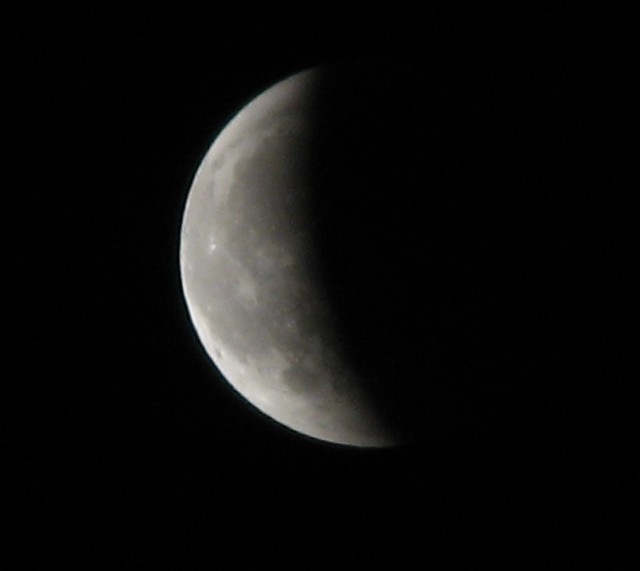
Bright and dark side of the moon
Washington: From nearly 1.6 lakh km away, a NASA camera has captured a stunning view of the far side of the moon as it moved in front of the sun-lit side of Earth last month. The images show the fully illuminated “dark side” of the moon that is never visible from Earth. The lunar far side lacks the large and dark basaltic plains (called maria) that are so prominent on the Earth-facing side. A thin sliver of shadowed area of moon is visible on its right side. "It is surprising how much brighter Earth is than the moon. Our planet is a truly brilliant object in dark space compared to the lunar surface,” said said Adam Szabo, project scientist at NASA's Goddard Space Flight Center in Greenbelt, Maryland. The images were captured by NASA's Earth Polychromatic Imaging Camera (EPIC), a four megapixel CCD camera and telescope aboard the Deep Space Climate Observatory (DSCOVR) satellite orbiting 1 million miles (1.6 lakh km) from Earth. EPIC maintains a constant view of the fully-illuminated Earth as it rotates, providing scientific observations of ozone, vegetation, cloud height and aerosols in the atmosphere. The far side of the moon was not seen until 1959 when the Soviet Luna 3 spacecraft returned the first images. Since then, several NASA missions have imaged the lunar far side in great detail. The same side of the moon always faces an earthbound observer because the moon is tidally locked to Earth. That means its orbital period is the same as its rotation around its axis. Once EPIC begins regular observations next month, NASA will post daily colour images of Earth to a dedicated public website. About twice a year, the camera will capture the moon and Earth together as the orbit of DSCOVR crosses the orbital plane of the moon. Source: ummid.comImage: flickr.com
Read More........

Beyond Pluto: New Horizons targets identified

pluto kuiper belt new horizons mission
NASA has announced finding several Kuiper Belt Objects that may be targeted by the New Horizons spacecraft, following its flyby of the Pluto system in July 2015.
Peering into the dim, outer reaches of our Solar System, NASA's Hubble Space Telescope has uncovered three Kuiper Belt Objects (KBOs) that the agency's New Horizons spacecraft could potentially visit after it flies by Pluto in July 2015. The KBOs were detected by a search team who were awarded telescope time for this purpose, following a committee recommendation earlier this year. "This has been a very challenging search, and it's great that in the end Hubble could accomplish a detection — one NASA mission helping another," said Alan Stern of the Southwest Research Institute (SwRI) in Boulder, Colorado, principal investigator of the New Horizons mission. The Kuiper Belt is a vast rim of primordial debris encircling our Solar System. KBOs belong to a unique class of Solar System objects that has never been visited by spacecraft and which contain clues to the origin of our Solar System. The KBOs that Hubble found are each about 10 times larger than typical comets, but only about 1-2 percent ofthe size of Pluto. Unlike asteroids, KBOs have not been heated by the Sun, and are thought to represent a pristine, well preserved, deep-freeze sample of what the outer Solar System was like following its birth 4.6 billion years ago. The KBOs found in the Hubble data are thought to be the building blocks of dwarf planets such as Pluto. The New Horizons team started to look for suitable KBOs in 2011 using some of the largest ground-based telescopes on Earth. They found several dozen KBOs, but none were reachable within the fuel supply available aboard the New Horizons spacecraft. "We started to get worried that we could not find anything suitable – even with Hubble – but in the end, the space telescope came to the rescue," said team member John Spencer of SwRI. "There was a huge sigh of relief when we found suitable KBOs; we are 'over the moon' about this detection." Source: Article
Read More........

Monkey Head Nebula Target For Hubble Space Telescopes 24th Anniversary

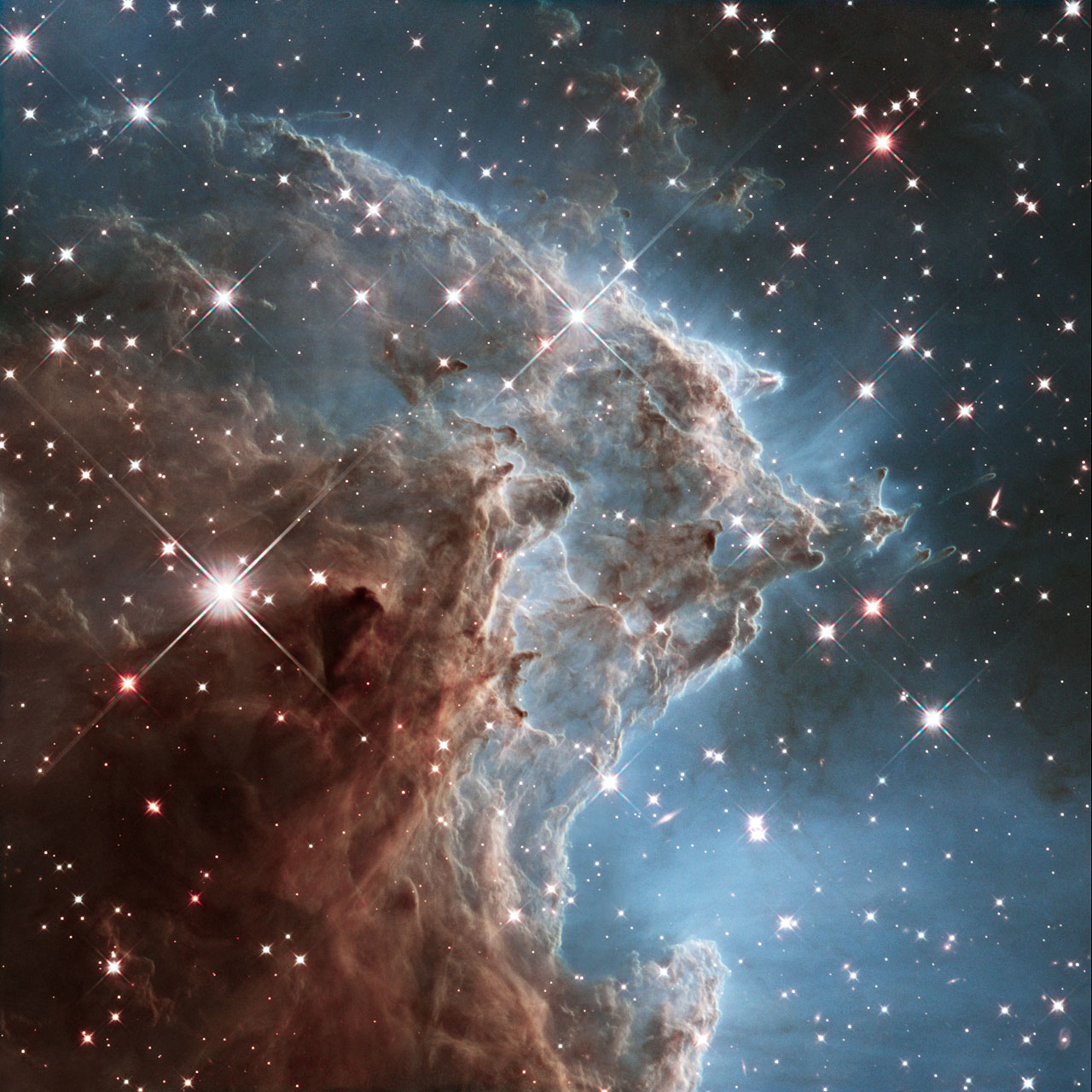
Credit: NASA, ESA, and the Hubble Heritage Team (STScI/AURA), This portion of the Monkey Head Nebula was imaged in the infrared using Hubble'sWide Field Camera 3. Credit: ESA/Hubble
To celebrate its 24th year in orbit, the NASA/ESA Hubble Space Telescope has released a beautiful new image of part of NGC 2174, also known as the Monkey Head Nebula. This colourful region is filled with young stars embedded within bright wisps of cosmic gas and dust. NGC 2174 lies about 6400 light-years away in the constellation of Orion (The Hunter). Hubble previously viewed this part of the sky back in 2001, creating a stunning image released in 2011, and the space telescope has now revisited the region to celebrate its 24th year of operation. Nebulae are a favourite target for Hubble. Their colourful plumes of gas and fiery bright stars create ethereally beautiful pictures. Some of the most famous of Hubble's images have been of nebulae — for example, the telescope's 22nd and 23rd anniversary images of the Tarantula (heic1206) and Horsehead (heic1307) nebulae, and its festive 2012 image of planetary nebula NGC 5189 (heic1220). In April of this year, the NASA/ESA Hubble Space Telescope will be celebrating 24 years of observing. To celebrate this milestone, the observatory is releasing a brand new image of part of NGC 2174, otherwise known as the Monkey Head nebula. This new Hubblecast episode showcases this beautiful image, which views a colourful region filled with young stars embedded within

Credit: ESA/Hubble
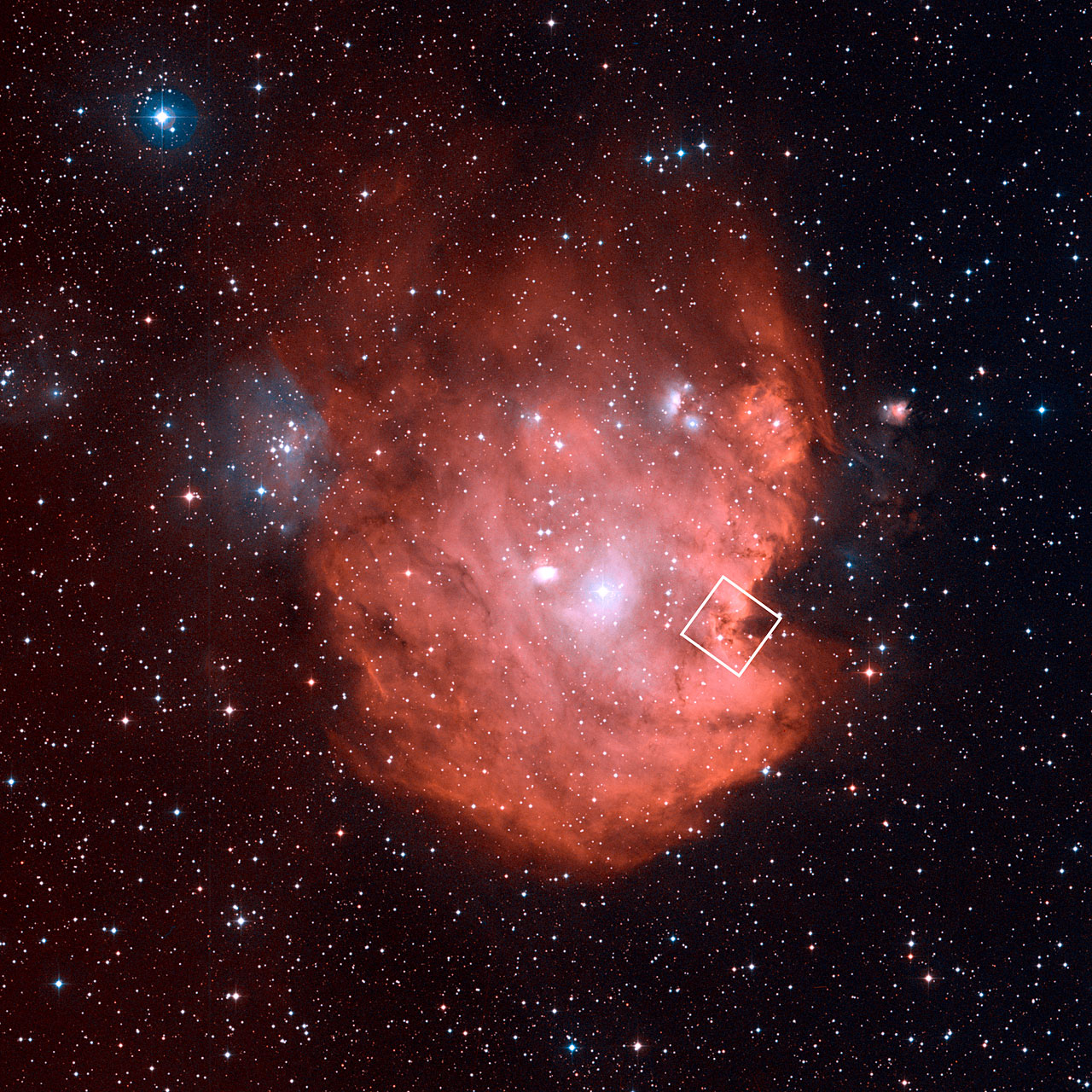
bright wisps of cosmic gas and dust. The nebula is a violent stellar nursery, packed with the ingredients needed for star formation. However, the recipe for cooking up new stars isn't very efficient and most of the ingredients are wasted as the cloud of gas and dust disperses. This process is accelerated by the presence of fiercely hot young stars which trigger high velocity winds that help to blow the gas outwards. This image, a composite of red and blue exposures from the Digitized Sky Survey 2, shows the region of sky surrounding NGC 2174, more popularly known as the Monkey Head Nebula. To celebrate its 24th year observing Hubble revisited the Monkey Head Nebula and a brand new image was released of one of its breathtaking pillars. The small square near the centre of this image is where the pillar can be found. A vibrant palette of colours can be seen  in this new image of NGC 2174. Dark brown and rust-coloured dust clouds billow outwards, framed against a background of bright blue gas. These striking hues are formed by combining several Hubble images taken with different coloured filters, to reveal a broad range of colours not normally visible to the human eye.
Credit: NASA, ESA, Digitized Sky Survey (DSS), STScI/AURA, Palomar/Caltech
The icing on this cosmic birthday cake takes the form of young white and pink stars sprinkled amongst the glowing clouds, pushing away the dark stellar nurseries in which they formed. The key ingredient in NGC 2174 is hydrogen gas, which is ionised by the ultraviolet radiation emitted by the young stars. As a result, this region is also known as an HII region — a large cloud of ionised gas. This video sequence begins by zooming through the constellation of Orion (The Hunter), finishing on new NASA/ESA Hubble Space Telescope observations of part of NGC 2174, also known as the Monkey Head Nebula. NGC 2174 lies about 6400 light-years away. Hubble previously viewed this part of the sky back in 2011, and the space telescope has now revisited the region to celebrate its 24th year of operation. This image was created using infrared observations from Hubble's Wide Field Camera 3.
Credit: NASA, ESA, and G. Bacon (STScI) 
This image marks 24 years of Hubble. This milestone will be further celebrated by a conference being held in Rome, Italy, in March of this year. The conference, entitled Science with the Hubble Space Telescope IV, will highlight and celebrate the scientific breakthroughs that Hubble has made over the last two decades and look into the future at the topics and key questions that will shape the field of astrophysics in the next decade. This video sequence pans across new NASA/ESA Hubble Space Telescope observations of part of NGC 2174, also known as the Monkey Head Nebula. NGC 2174 lies about 6400 light-years away. Hubble previously viewed this part of the sky back in 2011, and the space telescope has now revisited the region to celebrate its 24th year of operation. This image was created using infrared observations
Credit: NASA, ESA, and the Hubble Heritage Team(STScI/AURA) 
from Hubble's Wide Field Camera 3. This portion of the Monkey Head Nebula was imaged in the infrared using Hubble's Wide Field Camera 3. Hubble's earlier Wide Field Planetary Camera 2 image from 2011 inspired its choice as the telescope's 24th anniversary image. A processed version of the WFPC2 dataset was entered into the Hubble's Hidden Treasures image processing competition by Yurij Tukachev. Contacts-sources: Georgia Bladon, ESA/Hubble, Public Information Officer. Source: Article
Read More........

Deceased--Halton C. Arp

"Halton C. Arp, Astronomer Who Challenged Big Bang Theory, Dies at 86"
By: Dennis Overbye, January 6th, 2014, The New York Times: Halton C. Arp, a prodigal son of American astronomy whose dogged insistence that astronomers had misread the distances to quasars cast doubt on the Big Bang theory of the universe and led to his exile from his peers and the telescopes he loved, died on Dec. 28 in Munich. He was 86. The cause was pneumonia, said his daughter Kristana Arp, who said he also had Parkinson’s disease. As a staff astronomer for 29 years at Hale Observatories, which included the Mount Wilson and Palomar Mountain observatories in Southern California, Dr. Arp was part of their most romantic era, when astronomers were peeling back the sky and making discovery after discovery that laid the foundation for the modern understanding of the expansion of the universe. But Dr. Arp, an artist’s son with a swashbuckling air, was no friend of orthodoxy. A skilled observer with regular access to a 200-inch telescope on Palomar Mountain, he sought out unusual galaxies and collected them in “The Atlas of Peculiar Galaxies” (1966), showing them interacting and merging with loops, swirls and streamers that showed the diversity and beauty of nature. But these galaxies also revealed something puzzling and controversial. In the expanding universe, as discovered by Edwin Hubble in 1929, everything is moving away from us. The farther away it is, the faster it is going, as revealed by its redshift, a stretching of light waves — like the changing tone of an ambulance siren as it goes past — known as a Doppler shift. Dr. Arp found that galaxies with radically different redshifts, and thus at vastly different distances from us, often appeared connected by filaments and bridges of gas. This suggested, he said, that redshift was not always an indication of distance but could be caused by other, unknown physics. The biggest redshifts belonged to quasars — brilliant, pointlike objects that are presumably at the edge of the universe. Dr. Arp found, however, that they were often suspiciously close in the sky to relatively nearby spiral galaxies. This suggested to him that quasars were not so far away after all, and that they might have shot out of the nearby galaxies. If he was right, the whole picture of cosmic evolution given by the Big Bang — of a universe that began in a blaze of fire and gas 14 billion years ago and slowly condensed into stars, galaxies and creatures over the eons — would have to go out the window. A vast majority of astronomers dismissed Dr. Arp’s results as coincidences or optical illusions. But his data appealed to a small, articulate band of astronomers who supported a rival theory of the universe called Steady State and had criticized the Big Bang over the decades. Among them were Fred Hoyle, of Cambridge University, who had invented the theory, and Geoffrey Burbidge, a witty and acerbic astrophysicist at the University of California, San Diego. Dr. Arp survived both of them. “When he died, he took a whole cosmology with him,” said Barry F. Madore, a senior research associate at the Carnegie Observatories in Pasadena, Calif. Halton Christian Arp was born on March 21, 1927, in New York City, the only son of August and Anita Arp. His father was an artist and his mother ran institutions for children and adolescents. Halton grew up in Greenwich Village and various art colonies and did not go to school until fifth grade. After bouncing around public schools in New York, he was sent to Tabor Academy, on Buzzards Bay in Massachusetts, a prep school for the United States Naval Academy. After a year in the Navy, he attended Harvard, where he majored in astronomy. He graduated in 1949 and went on to obtain a Ph.D. in 1953 at the California Institute of Technology, which had started an astronomy graduate program to prepare for the advent of the 200-inch telescope. At Harvard, he became one of the best fencers in the United States, ultimately competing in world championship matches in Paris in 1965. Cutting a dashing figure, he would adopt a fencer’s posture when giving talks. “He would strut across the stage and then strut back, as if he were dueling,” Dr. Madore said. Dr. Arp married three times. He is survived by his third wife, Marie-Helene Arp, an astronomer in Munich; four daughters, Kristana, Alissa, Andrice and Delina Arp; and five grandchildren. Dr. Arp became a staff astronomer at the Hale Observatories after stints as a postdoctoral fellow at the Carnegie Institution for Science and Indiana University. His breakthrough occurred, as he recalled, on a rainy night at Palomar in 1966, when he decided to investigate a chance remark by a colleague that a lot of his peculiar galaxies had radio sources near them in the sky. Looking them up in the Palomar library, he realized that many of those radio sources were quasars that could have been shot out of a nearby galaxy, an idea first explored by the Armenian astronomer Victor Ambartsumian a decade earlier. “It is with reluctance that I come to the conclusion that the redshifts of some extragalactic objects are not due entirely to velocity causes,” Dr. Arp wrote in a paper a year later. He combed the sky for more evidence that redshifts were not ironclad indicators of cosmic distance, knowing that he was striking at the heart of modern cosmology. He turned out to be an expert at finding quasars in suspicious places, tucked under the arm of a galaxy or at the end of a tendril of gas. One of the most impressive was a quasarlike object known as Markarian 205, which had a redshift corresponding to a distance of about a billion light years but appeared to be in front of a galaxy only 70 million light years away. The redshift controversy came to a boil in 1972, when Dr. Arp engaged in a debate, arranged by the American Association for the Advancement of Science, with John N. Bahcall, a young physicist at the Institute for Advanced Study. Timothy Ferris described the event in his book “The Red Limit” (1977): “When the debate was over, it was difficult not to be impressed with Arp’s sincerity and his love for the mysterious galaxies he studied, but it was also difficult to feel that his case had suffered anything short of demolition.” As Dr. Arp’s colleagues lost patience with his quest, he was no longer invited to speak at major conferences, and his observing time on the mighty 200-inch telescope began to dry up. Warned in the early 1980s that his research program was unproductive, he refused to change course. Finally, he refused to submit a proposal at all on the grounds that everyone knew what he was doing. He got no time at all. Dr. Arp took early retirement and joined the Max Planck Institute for Astrophysics near Munich, where he continued to promote his theories. He told his own side of the redshift story in a 1989 book, “Quasars, Redshifts and Controversies.”  Halton C. Arp [Wikipedia]Halton C. Arp - The Official WebsiteArp Peculiar Galaxy Club IntroductionATLAS OF PECULIAR GALAXIESSource: Article
Read More........

NASA's Kepler Provides Insights on Enigmatic Planets


Artist's view of a Earth-size rocky exoplanet. Image credit: NASA/JPL-Caltech
More than three-quarters of the planet candidates discovered by NASA's Kepler spacecraft have sizes ranging from that of Earth to that of Neptune, which is nearly four times as big as Earth. Such planets dominate the galactic census but are not represented in our own solar system. Astronomers don't know how they form or if they are made of rock, water or gas. The Kepler team today reports on four years of ground-based follow-up observations targeting Kepler's exoplanet systems at the American Astronomical Society meeting in Washington. These observations confirm the numerous Kepler discoveries are indeed planets and yield mass measurements of these enigmatic worlds that vary between Earth and Neptune in size. Included in the findings are five new rocky planets ranging in size from 10 to 80 percent larger than Earth. Two of the new rocky worlds, dubbed Kepler-99b and Kepler-406b, are both 40 percent larger in size than Earth and have a density similar to lead. The planets orbit their host stars in less than five and three days respectively, making these worlds too hot for life as we know it. A major component of these follow-up observations was Doppler measurements of the planets' host stars. The team measured the reflex wobble of the host star, caused by the gravitational tug on the star exerted by the orbiting planet. That measured wobble reveals the mass of the planet: the higher the mass of the planet, the greater the gravitational tug on the star and hence the greater the wobble. "This marvelous avalanche of information about the mini-Neptune planets is telling us about their core-envelope structure, not unlike a peach with its pit and fruit," said Geoff Marcy, professor of astronomy at the University of California, Berkeley, who led the summary analysis of the high-precision Doppler study. "We now face daunting questions about how these enigmas formed and why our solar system is devoid of the most populous residents in the galaxy." Using one of the world's largest ground-based telescopes at the W. M. Keck Observatory in Hawaii, scientists confirmed 41 of the exoplanets discovered by Kepler and determined the masses of 16. With the mass and diameter in hand, scientists could immediately determine the density of the planets, characterizing them as rocky or gaseous, or mixtures of the two. The density measurements dictate the possible chemical composition of these strange, but ubiquitous planets. The density measurements suggest that the planets smaller than Neptune -- or mini-Neptunes -- have a rocky core but the proportions of hydrogen, helium and hydrogen-rich molecules in the envelope surrounding that core vary dramatically, with some having no envelope at all. The ground-based observation research validates 38 new planets, six of which are non-transiting planets only seen in
Chart of Kepler planet candidates as of January 2014. Image Credit: NASA Ames
the Doppler data. The paper detailing the research is published in the Astrophysical Journal today. A complementary technique used to determine mass, and in turn density of a planet, is by measuring the transit timing variations (TTV). Much like the gravitational force of a planet on its star, neighboring planets can tug on one another, causing one planet to accelerate and another planet to decelerate along its orbit. Ji-Wei Xie of the University of Toronto used TTV to validate 15 pairs of Kepler planets ranging from Earth-sized to a little larger than Neptune. Xie measured masses of the 30 planets, thereby adding to the compendium of planetary characteristics for this new class of planets. The result also was published in the Astrophysical Journal in Dec. 2013. "Kepler's primary objective is to determine the prevalence of planets of varying sizes and orbits. Of particular interest to the search for life is the prevalence of Earth-sized planets in the habitable zone," said Natalie Batalha, Kepler mission scientist at NASA's Ames Research Center in Moffett Field, Calif. "But the question in the back of our minds is: are all planets the size of Earth rocky? Might some be scaled-down
Artist's concept of NASA's Kepler space telescope. Image credit: NASA/JPL-Caltech
versions of icy Neptunes or steamy water worlds? What fraction are recognizable as kin of our rocky, terrestrial globe?" The dynamical mass measurements produced by Doppler and TTV analyses will help to answer these questions. The results hint that a large fraction of planets smaller than 1.5 times the radius of Earth may be comprised of the silicates, iron, nickel and magnesium that are found in the terrestrial planets here in the solar system. Armed with this type of information, scientists will be able to turn the fraction of stars harboring Earth-sizes planets into the fraction of stars harboring bona-fide rocky planets. And that's a step closer to finding a habitable environment beyond the solar system. Ames is responsible for the Kepler mission concept, ground system development, mission operations and science data analysis. NASA's Jet Propulsion Laboratory in Pasadena, Calif., managed Kepler mission development. Ball Aerospace & Technologies Corp. in Boulder, Colo., developed the Kepler flight system and supports mission operations with the Laboratory for Atmospheric and Space Physics at the University of Colorado in Boulder. The Space Telescope Science Institute in Baltimore archives, hosts and distributes Kepler science data. Kepler is NASA's 10th Discovery mission and was funded by the agency's Science Mission Directorate. For more information about the Kepler space telescope, visit: http://www.nasa.gov/kepler . The California Institute of Technology in Pasadena manages JPL for NASA. Images (mentioned), Text, Credits: NASA / J.D. Harrington / JPL / Michele Johnson / Ames Research Center / Michele Johnson. Best regards, Orbiter.ch, Source: Orbiter.ch Space NewsSource: Image1-2
Read More........

Birth Of Black Hole Kills The Radio Star

Astronomers led by a Curtin University researcher have discovered a new population of exploding stars that “switch off” their radio transmissions before collapsing into a Black Hole. These exploding stars use all of their energy to emit one last strong beam of highly energetic radiation – known as a gamma-ray burst – before they die. Up until now, it was thought all gamma-ray bursts were followed by a radio afterglow – a premise that a team of Australian astronomers of the Centre for All-sky Astrophysics (CAASTRO) at Curtin University and theUniversity of Sydney originally set out to prove correct. “But we were wrong. After studying an ultra-sensitive image of gamma-ray bursts with no afterglow, we can now say the theory was incorrect and our telescopes have not failed us,” lead researcher and Curtin research fellow Dr Paul Hancock said. The technique used to create the ultra-sensitive image was recently published in The Astrophysical Journal. It allowed for the stacking of 200 separate observations on top of each other to re-create the image of a gamma-ray burst in much better quality – yet, no trace of a radio afterglow was found. “In our research paper we argue that there

must be two distinct types of gamma-ray burst, likely linked to differences in the magnetic field of the exploding star,” Dr Hancock said. “Gamma-ray bursts are thought to mark the birth of a Black Hole or Neutron Star – both of which have super-dense cores. But Neutron Stars have such strong magnetic fields (a million times stronger than those of Black Holes) that producing gamma-rays are more difficult. “We think that those stars that collapse to form a Neutron Star have energy left over to produce the radio afterglow whereas those that become Black Holes put all their energy into one final powerful gamma-ray flash.” New work is underway to test the team’s theory and to see if there are other subtle ways in which the two types of bursts differ. “We now have to take a whole new look at gamma-ray bursts – so far this work has shown that being wrong is sometimes more interesting than being right,” Dr Hancock said. Telescope facilities such as the Australia Telescope Compact Array in northern New South Wales and the Karl Jansky Very Large Array in the US both have observing programs to search for gamma-ray burst afterglows and have been recently upgraded to increase their sensitivity. The research report can be found at http://arxiv.org/abs/1308.4766 Contacts and sources: Megan MeatesCurtin UniversitySource: ArticleImage
Read More........

Evidence Of Water Vapor Venting Off Jovian Moon


Illustration Credit: NASAESA, and L. Roth (Southwest Research Institute and University of Cologne, Germany)
Previous scientific findings from other sources already point to the existence of an ocean located under Europa's icy crust. Researchers are not yet certain whether the detected water vapor is generated by water plumes erupting on the surface, but they are confident this is the most likely explanation. This graphic shows the location of water vapor detected over Europa's south pole that provides the first strongevidence of water plumes erupting off Europa's surface, in observations taken by NASA's Hubble Space Telescope in December 2012. Hubble didn't photograph plumes, but spectroscopically detected auroral emissions from oxygen and hydrogen. The aurora is powered by Jupiter's magnetic field. This is only the second moon in the solar system found ejecting water vapor from the frigid surface. The image of Europa is derived from a global surface map generated from combined NASA Voyager and Galileo space probe observations. Should further observations support the finding, it would make Europa the second moon in the solar systemknown to have water vapor plumes. The findings were published in the Thursday, Dec. 12, online issue of Science Express, and reported at the meeting of the American Geophysical Union in San Francisco. "By far the simplest explanation for this water vapor is that it erupted from plumes on the surface of Europa," said lead author Lorenz Roth of Southwest Research Institute in San Antonio, Texas. "If those plumes are connected with the subsurface water ocean we are confident exists under Europa's crust, then this means that future investigations can directly investigate the chemical makeup of Europa's potentially habitable environment without drilling through layers of ice. And that is tremendously exciting." In 2005, NASA's Cassini orbiter detected jets of water vapor and dust spewing off the surface of Saturn's moon Enceladus. Although ice and dust particles subsequently have been found in the Enceladus plumes, only water vapor gases have been measured at Europa so far. Hubble's spectroscopic observations provided the evidence for Europa plumes in December 2012. Time sampling of auroral emissions measured by Hubble's imaging spectrograph enabled the researchers to distinguish between features created by Jupiter's magnetospheric particles and local enhancements of gas, and to also rule out more exotic explanations such as serendipitously observing a rare meteorite impact. The imaging spectrograph detected faint ultraviolet light from an aurora, powered by Jupiter's intense magnetic field, near the moon's south pole. Atomic oxygen and hydrogen produce a variable auroral glow and leave a telltale sign that they are products of water molecules being broken apart by electrons along magnetic fieldlines. "We pushed Hubble to its limits to see this very faint emission. These could be stealth plumes, because they might be tenuous and difficult to observe in the visible light," said Joachim Saur of the University of Cologne in Germany. Saur, who is principal investigator of the Hubble observation campaign, co-wrote the paper with Roth. Roth suggested long cracks on Europa's surface, known as lineae, might be venting water vapor into space. Cassini has seen similar fissures that host Enceladus' jets. The Hubble team found that the intensity of Europa's plumes, like that Enceladus's plumes, varies with the moon's orbital position. Active jets have been seen only when Europa is farthest from Jupiter. But the researchers could not detect any sign of venting when Europa is closer to Jupiter. This is an artist's concept of a plume of water vapor thought to be ejected off of the frigid, icy surface of the Jovian moon Europa, located 500 million miles from the Sun. Hubble Space Telescope spectroscopic measurements lead scientists to calculate that the plume rises to an altitude of 125 miles and then probably rains frost back onto the moon's surface. Previous findings already point to a subsurface ocean under Europa's icy crust.
Artwork Credit: NASA, ESA, and K. Retherford (Southwest Research Institute)
One explanation for the variability is these lineae experience more stress as gravitational tidal forces push and pull on the moon and open vents at larger distances from Jupiter. The vents are narrowed or closed when the moon is closest to the gas giant planet. "The apparent plume variability supports a key prediction that Europa should tidally flex by a significant amount if it has a subsurface ocean," said Kurt Retherford, also of Southwest Research Institute. Europa's and Enceladus' plumes have remarkably similar abundances of water vapor. Because Europa has roughly 12 times more gravitational pull than Enceladus, the vapor, whose temperature is measured at minus 40 degrees Celsius, does not escape into space as it does at Enceladus. Instead, it falls back onto the surface after reaching an altitude of 125 miles, according to the Hubble measurements. This could leave bright surface features near the moon's south polar region, the researchers hypothesize. "If confirmed, this new observation once again shows the power of the Hubble Space Telescope to explore and opens a new chapter in our search for potentially habitable environments in our solar system," said John Grunsfeld, an astronaut who participated in Hubble servicing missions and now serves as NASA's associate administrator for science in Washington, D.C. "The effort and risk we took to upgrade and repair the Hubble becomes all the more worthwhile when we learn about exciting discoveries like this one from Europa." Contacts and sources: Dwayne Brown / J.D. Harrington, NASA Headquarters, Washington, D.C. Joe Fohn, Southwest Research Institute, San Antonio, Texas, Ray Villard, Space Telescope Science Institute, Baltimore, Md. Source: Article
Read More........

The Deepest Look Into The Universe Ever


Credit: NASA, ESA, and Z. Levay (STScI/AURA)
NASA's Hubble, Spitzer and Chandra space telescopes are teaming up to look deeper into the universe than ever before. With a boost from natural "zoom lenses" found in space, they should be able to uncover galaxies that are as much as 100 times fainter than what these three great observatories typically can see. In an ambitious collaborative program called The Frontier Fields, astronomers will make observations over the next three years of six massive galaxy clusters, exploiting a natural phenomenon known as gravitational lensing, to learn not only what is inside the clusters but also what is beyond them. The clusters are among the most massive assemblages of matter known, and their gravitational fields can be used to brighten and magnify more distant galaxies so they can be observed. "The Frontier Fields program is exactly what NASA's great observatories were designed to do; working together to unravel the mysteries of the Universe" said John Grunsfeld, associate administrator for NASA's Science Mission Directorate in Washington. "Each observatory collects images using different wavelengths of light with the result that we get a much deeper understanding of the underlying physics of these celestial objects."
MACS J1149.5+2223, Credit: NASA, ESA, and M. Postman (STScI), and the CLASH team
The first object they will view is Abell 2744, commonly known as Pandora's Cluster. The giant galaxy cluster appears to be the result of a simultaneous pile-up of at least four separate, smaller galaxy clusters that took place over a span of 350 million years. Astronomers anticipate these observations will reveal populations of galaxies that existed when the universe was only a few hundred million years old, but have not been seen before. "The idea is to use nature's natural telescopes in combination with the great observatories to look much deeper than before and find the most distant and faint galaxies we can possibly see," said Jennifer Lotz, a principal investigator with the Space Telescope Science Institute (STScI) in Baltimore, Md. Data from the Hubble and Spitzer space telescopes will be combined to measure the galaxies' distances and masses more accurately than either observatory could measure alone, demonstrating their synergy for such studies.
MACS J0717.5+3745, Credit: NASA, ESA, and H. Ebeling (University of Hawaii)
"We want to understand when and how the first stars and galaxies formed in the universe, and each great observatory gives us a different piece of the puzzle," said Peter Capak, the Spitzer principal investigator for the Frontier Fields program. "Hubble tells you which galaxies to look at and how many stars are being born in those systems. Spitzer tells you how old the galaxy is and how many stars have formed." The Chandra X-ray Observatory also will peer deep into the star fields. It will image the clusters at X-ray wavelengths to help determine their mass and measure their gravitational lensing power, and identify background galaxies hosting supermassive black holes. 
MACS J0416.1-2403, Credit: NASA, ESA, and M. Postman (STScI), and the CLASH team
High-resolution Hubble data from the Frontier Fields program will be used to trace the distribution of dark matter within the six massive foreground clusters. Accounting for the bulk of the universe's mass, dark matter is the underlying invisible scaffolding attached to galaxies.
Abell 2744, Credit: NASA, ESA, and R. Dupke (Eureka Scientific, Inc.), et al.
Hubble and Spitzer have studied other deep fields with great success. The Frontier Fields researchers anticipate a challenge because the distortion and magnification caused by the gravitational lensing phenomenon will make it difficult for them to understand the true properties of the background galaxies. Contact and sources" NASA, Hubble Space Telescope, Source: Nano Patents And Innovation
Read More........

SO's Very Large Telescope Celebrates 15 Years of Succes

This selection of images — one per year in the life of the VLT — gives a taste of its huge scope and scientific productivity since first light in May 1998. The images are as follows: 1998: NGC 1232 (eso9845), 1999: NGC 3603 (eso9946), 2000: Messier 104, the Sombrero Galaxy (eso0007), 2001: Messier 16 in the infrared (eso0142), 2002: the Horsehead Nebula (eso0202), 2003: NGC 613 (eso0338), 2004: first candidate exoplanet image (eso0428), 2005: NGC 1097 center (eso0534), 2006: NGC 1313 (eso0643), 2007: ESO 593-IG 008 (eso0755), 2008: center of the Milky Way (eso0846), 2009: the Jewel Box cluster (eso0940), 2010: Messier 17 in the infrared (potw1044a), 2011: the Eyes galaxies (eso1131), 2012: the Carina Nebula in the infrared (eso1208) and 2013: IC 2944 (eso1322). Image credits: ESO/P.D. Barthel/M. McCaughrean/M. Andersen/S. Gillessen et al./Y. Beletsky/R. Chini/T. Preibisch, Note: For more information, see ESO's Very Large Telescope Celebrates 15 Years of Success. Source: Article
Read More........

How Scientists Search For Habitable Planets

Image credit: NASA/JPL-Caltech/Ames
There is only one planet we know of, so far, that is drenched with life. That planet is Earth, as you may have guessed, and it has all the right conditions for critters to thrive on its surface. Do other planets beyond our solar system, called exoplanets, also host life forms? This artist's concept shows a Super Venus planet on the left, and a Super Earth on the right. Astronomers still don't know the answer, but they search for potentially habitable planets using a handful of criteria. Ideally, they want to find planets just like Earth, since we know without a doubt that life took root here. The hunt is on for planets about the size of Earth that orbit at just the right distance from their star – in a region termed the habitable zone. NASA's Kepler mission is helping scientists in the quest to find these worlds, sometimes called Goldilocks planets after the fairy tale because they orbit where conditions are "just right" for life. Kepler and other telescopes have confirmed a handful so far, all of which are a bit larger than Earth -- the Super Earths. The search for Earth's twin, a habitable-zone planet as small as Earth, is ongoing. An important part of this research is the continuing investigation into exactly where a star's habitable zone starts and stops. The habitable zone is the belt around a star where temperatures are ideal for liquid water -- an essential ingredient for life as we know it -- to pool on a planet's surface. Earth lies within the habitable zone of our star, the sun. Beyond this zone, a planet would probably be too cold and frozen for life (though it's possible life could be buried underneath a moon's surface). A planet lying between a star and the habitable zone would likely be too hot and steamy. That perfect Goldilocks planet within the zone wouldn't necessarily be home to any furry creatures. But it would have the potential for some type of life to abound, if even microbes. In one new study, researchers based at NASA's Exoplanet Science Institute at the California Institute of Technology, in Pasadena, Calif., carefully analyzed the location of both a planet called Kepler-69c and its habitable zone. Their analysis shows that this planet, which is 1.7 times the size of Earth, lies just outside the inner edge of the zone, making it more of a Super Venus than a Super Earth, as previous estimates indicated. "On the way to finding Earths, Kepler is telling us a lot about the frequency of Venus-like planets in our galaxy," said Stephen Kane, lead author of the new paper on Kepler-69c appearing in the Astrophysical Journal Letters. To determine the location of a star’s habitable zone, one must first learn how much total radiation it emits. Stars more massive than our sun are hotter, and blaze with radiation, so their habitable zones are farther out. Similarly, stars that are smaller and cooler sport tighter belts of habitability than our sun. For example, the Super Earth planet called Kepler-62f, discovered by Kepler to orbit in the middle of a habitable zone around a cool star, orbits closer to its star than Earth. The planet takes just 267 days to complete an orbit, as compared to 365 days for Earth. Knowing precisely how far away a habitable zone needs to be from a star also depends on chemistry. For example, molecules in a planet's atmosphere will absorb a certain amount of energy from starlight and radiate the rest back out. How much of this energy is trapped can mean the difference between a turquoise sea and erupting volcanoes. Researchers led by Ravi kumar Kopparapu of Penn State University, University Park, Pa., used this type of chemical information to nudge the habitable zone out a bit farther than previously thought. The team's 2013 Astrophysical Journal study is the current gold standard in determining how a star's total radiation output relates to the location of its habitable zone. Kane and his colleagues used this information to fine-tune the boundaries of Kepler-69c's habitable zone, in addition to careful measurements of the star's total energy output and the orbit of the planet. "Understanding the properties of the star is critical to determining planetary properties and calculating the extent of the habitable zone in that system," said Kane. But before you purchase real estate in a habitable zone, keep in mind there are other factors that dictate whether a world develops lush greenery and beaches. Eruptions from the surfaces of stars called flares, for example, can wreak havoc on planets. "There are a lot of unanswered questions about habitability," said Lucianne Walkowicz, a Kepler science team member based at Princeton University, N.J., who studies flaring stars. "If the planet gets zapped with radiation all the time by flares from its parent star, the surface might not be a very pleasant place to live. But on the other hand, if there's liquid water around, that makes a really good shield from high-energy radiation, so maybe life could thrive in the oceans." Flares can also scrape off the atmospheres of planets, complicating the picture further. This is particularly true for the smaller, cooler stars, which tend to be more hyperactive than stars like our sun. Ideally, astronomers would like to know more about the atmosphere of potentially habitable planets. That way they could look at the planet's molecular makeup for signs of runaway greenhouse gases that could indicate an inhospitable Venus-like planet. Or, future space telescopes might even be able to pick up signatures of oxygen, water, carbon dioxide and methane -- indicators that the planet might be somebody's home. NASA's upcoming James Webb Space Telescope will bring us closer to this goal, by probing the atmospheres of planets, some of which may lie in habitable zones. The mission won't be able to examine the atmospheres of planets as small as Earth, so we'll have to wait for another future telescope to separate out the Venuses from the Earths. NASA Ames manages Kepler's ground system development, mission operations and science data analysis. NASA's Jet Propulsion Laboratory in Pasadena, Calif., managed Kepler mission development. Ball Aerospace & Technologies Corp. in Boulder, Colo., developed the Kepler flight system and supports mission operations with JPL at the Laboratory for Atmospheric and Space Physics at the University of Colorado in Boulder. The Space Telescope Science Institute in Baltimore archives, hosts and distributes the Kepler science data. Kepler is NASA's 10th Discovery Mission and is funded by NASA's Science Mission Directorate at the agency's headquarters in Washington. More information about the Kepler mission is at http://www.nasa.gov/kepler . More information about exoplanets and NASA's planet-finding program is athttp://planetquest.jpl.nasa.gov . Contacts and sources: Whitney Clavin, Jet Propulsion Laboratory- Michele Johnson, Ames Research Center, Source: Nano Patents And Innovations
Read More........

View Of Earth From Saturn And Saturn As Never Seen Before

Image credit: NASA/JPL-Caltech 
NASA's Cassini spacecraft, now exploring Saturn, will take a picture of our home planet from a distance of hundreds of millions of miles on July 19. NASA is inviting the public to help acknowledge the historic interplanetary portrait as it is being taken. This simulated view from NASA's Cassini spacecraft shows the expected positions of Saturn and Earth on July 19, 2013, around the time Cassini will take Earth's picture. Cassini will be about 898 million miles (1.44 billion kilometers) away from Earth at the time. That distance is nearly 10 times the distance from the sun to Earth. Earth will appear as a small, pale blue dot between the rings of Saturn in the image, which will be part of a mosaic, or multi-image portrait, of the Saturn system Cassini is composing. "While Earth will be only about a pixel in size from Cassini's vantage point 898 million (1.44 billion kilometers) away, the team is looking forward to giving the world a chance to see what their home looks like from Saturn," said Linda Spilker, Cassini project scientist at NASA's Jet Propulsion Laboratory (JPL) in Pasadena, Calif. "We hope you'll join us in waving at Saturn from Earth, so we can commemorate this special opportunity." Cassini will start obtaining the Earth part of the mosaic at 5:27 p.m. EDT (2:27 p.m. PDT or 21:27 UTC) and end about 15 minutes later, all while Saturn is eclipsing the sun from Cassini's point of view. The spacecraft's unique vantage point in Saturn's shadow will provide a special scientific opportunity to look at the planet's rings. At the time of the photo, North America and part of the Atlantic Ocean will be in sunlight. With giant Saturn hanging in the blackness and sheltering Cassini from the sun's blinding glare, the spacecraft viewed the rings as never before, revealing previously unknown faint rings and even glimpsing its home world. This marvelous panoramic view was created by combining a total of 165 images taken by the Cassini wide-angle camera over nearly three hours on Sept. 15, 2006. The full mosaic consists of three rows of nine wide-angle camera footprints; only a portion of the full mosaic is shown here. Color in the view was created by digitally compositing ultraviolet, infrared and clear filter images and was then adjusted to resemble natural color. The mosaic images were acquired as the spacecraft drifted in the darkness of Saturn's shadow for about 12
Credit: NASA/JPL/Space Science Institute
hours, allowing a multitude of unique observations of the microscopic particles that compose Saturn's faint rings. Unlike two previous Cassini eclipse mosaics of the Saturn system in 2006, which captured Earth, and another in 2012, the July 19 image will be the first to capture the Saturn system with Earth in natural color, as human eyes would see it. It also will be the first to capture Earth and its moon with Cassini's highest-resolution camera. The probe's position will allow it to turn its cameras in the direction of the sun, where Earth will be, without damaging the spacecraft's sensitive detectors. "Ever since we caught sight of the Earth among the rings of Saturn in September 2006 in a mosaic that has become one of Cassini's most beloved images, I have wanted to do it all over again, only better," said Carolyn Porco, Cassini imaging team lead at the Space Science Institute in Boulder, Colo. "This time, I wanted to turn the entire event into an opportunity for everyone around the globe to savor the uniqueness of our planet and the preciousness of the life on it." Porco and her imaging team associates examined Cassini's planned flight path for the remainder of its Saturn mission in search of a time when Earth would not be obstructed by Saturn or its rings. Working with other Cassini team members, they found the July 19 opportunity would permit the spacecraft to spend time in Saturn's shadow to duplicate the views from earlier in the mission to collect both visible and infrared imagery of the planet and its ring system. "Looking back towards the sun through the rings highlights the tiniest of ring particles, whose width is comparable to the thickness of hair and which are difficult to see from ground-based telescopes," said Matt Hedman, a Cassini science team member based at Cornell University in Ithaca, N.Y., and a member of the rings working group. "We're particularly interested in seeing the structures within Saturn's dusty E ring, which is sculpted by the activity of the geysers on the moon Enceladus, Saturn's magnetic field and even solar radiation pressure." This latest image will continue a NASA legacy of space-based images of our fragile home, including the 1968 "Earthrise" image taken by the Apollo 8 moon mission from about 240,000 miles (380,000 kilometers) away and the 1990 "Pale Blue Dot" image taken by Voyager 1 from about 4 billion miles (6 billion kilometers) away. The Cassini-Huygens mission is a cooperative project of NASA, the European Space Agency and the Italian Space Agency. JPL manages the Cassini-Huygens mission for NASA's Science Mission Directorate in Washington, and designed, developed and assembled the Cassini orbiter and its two onboard cameras. The imaging team consists of scientists from the United States, the United Kingdom, France and Germany. The imaging operations center is based at the Space Science Institute in Boulder, Colo. To learn more about the public outreach activities associated with the taking of the image, visit: http://saturn.jpl.nasa.gov/waveatsaturn, For more information about Cassini, visit, http://www.nasa.gov/cassiniSource: Nanopatents And Innovations
Read More........

Galaxy zoom

Abell S1077
Bright arcs are smeared around the heart of galaxy cluster Abell S1077 in this image taken by the NASA/ESA Hubble space telescope. The arcs are stretched images of distant galaxies distorted by the cluster’s enormous gravitational field. Galaxy clusters are large groupings of galaxies, each hosting millions of stars. They are the largest existing structures in the Universe, bound by the gravitational attraction between them. The amount of matter condensed in such groupings is so high that their gravity is enough to warp even the fabric of space-time, distorting the path that light takes when it travels through the cluster. In some cases, this phenomenon produces an effect somewhat like a magnifying lens, allowing us to see objects that are aligned behind the cluster and that would otherwise be undetectable from Earth. In this image, stretched stripes that look like scratches on a lens are in fact galaxies whose light is heavily distorted by the gravitational field of the cluster. Astronomers use the effects of gravitational lensing to peer far back in time and space to see the furthest objects located in the early Universe. One of the record holders is galaxy MACS0647-JD, whose light was magnified by galaxy cluster MACS J0647+7015 and has been travelling for 13.3 billion years to reach Earth. Notes: The Hubble Space Telescope is a project of international cooperation between ESA and NASA. ESA Hubble website: http://www.spacetelescope.org/, NASA Hubble website: http://hubblesite.org/, Related link: Hubble overview: http://www.esa.int/Our_Activities/Space_Science/Hubble_overview, Image, Text, Credits: ESA / Hubble & NASA; Acknowledgement: N. Rose. Greetings, Source: Orbiter.Space News
Read More........

Earth threatened by 6,200 asteroids


The Coming Crisis: As many as 6,200 potentially hazardous asteroids (PHAs) are orbiting close to Earth, a new survey by NASA has revealed. The PHAs are considered robust enough to survive the passage through Earth's atmosphere. If they were to collide with Earth they could cause damage on a large scale, experts warn. In the most detailed study of PHAs yet researchers used infrared scans from Nasa's 16-inch WISE telescope to identify 4,700 asteroids – plus or minus 1500 – that come within five million miles of Earth's orbit. An image released by NASA shows the distribution of the PHAs - with every orange dot representing an asteroid measuring 330 feet (100 metres) or more that is in orbit. Only 20% to 30% of these objects have previously been charted. Although there is no cause for immediate alarm, Nasa said the information could prepare us for future disasters. Source: The Coming Crisis
Read More........