Bigfoot’s lair discovered in Arizona forest

Photo: EPA
An abandoned nest-like structure was found covered by branches and grass in the remote forests of Arizona, in the Southwest United States. The discovered lair is believed to be a possible home of the legendary Bigfoot. Researcher and Bigfoot expert Mitch Waite and his wife discovered and filmed the nest. With a narrow entrance and hollowed inside, the lair is buried halfway underground in the deep woods of the Tonto National Forest on the Mogollon Rim. The nest is reported as belonging to a big-foot type creature called the Mogollon Monster. The Mogollon Monster is described as standing seven to ten feet tall, with mostly brown and red hair. The creature is also described as having a strong musky odor. Waite has collected footprints, hair samples and feces and claims to have put together a series of photographs and videos which back up his claims that he discovered the nest where the creature used to sleep. The first reported sightings were in the early 1900s and continue to this day. The legend of the "Big Hairy Man" or "The Old Man of the Mountain" has been passed down by Apache and Navajo Native American tribes for hundreds of years. Source: Voice of Russia
Read More........

Search for ape man continues against the odds

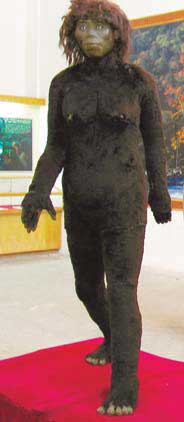
An imagined recreation of the disputed ape-like creature, Bigfoot, stands in a museum in Shennongjia, Hubei province. [File photo/For China Daily]
That ever elusive figure known as Bigfoot, or Yeren (wild man) to the Chinese, is bouncing back to life as a group of Chinese scientists and explorers scout around for international help to mount a new search for it - even though the debate over its existence has lingered for decades. Bigfoot, also known elsewhere as the  abominable snowman, in this case refers to a half-man, half-ape creature in the Shennongjia Nature Reserve, in a remote, mountainous part of Hubei province, in Central China. Back in the 1970s and 1980s, authorities organized three high-profile expeditions to search for signs of Bigfoot, but came up empty handed. In view of the large amount of expenditure required for these expeditions, the government decided to put a stop to them. Nonetheless, curiosity about the mysterious man-like creature still lingered among experts and ordinary folk alike. Then, last November, the Wild Man Research Association was founded in Hubei, pulling in more than 100 members interested in the search for Yeren, including a number of scientists and experts. These included the 75-year-old Wang Shancai, of the Hubei Relics and Archaeology Institute, who is vice-president of the association, and happens to be a strong believer in Bigfoot. One of Wang's reasons for his passion: "Over 30 years, I've collected a large amount of data." In spite of the fact that while those expeditions in the 1970s and 1980s yielded little other than some hair, a footprint, and some excrement suspected of belonging to Yeren, there was no conclusive proof, but Wang is undeterred. He said there were more than 400 people who claimed to have seen Bigfoot in the Shennongjia area over the last century. To him, "that's strong proof". And he's gotten support from a local "witness", Zhang Jiahong, a sheep rancher in the town of Muyu in the nature reserve, who says he saw two wild men as recently as September 2005. What did they look like? Zhang told China Daily on Monday that they had "hairy faces, eyes like black holes, prominent noses, faces that resembled both a man and a monkey, disheveled hair, and stood more than 2 meters tall". But that does not hold water with everyone, for example, Hu Hongxing. He is a 75-year-old Wuhan University professor who thinks that the search is nonsense and just a bunch of hype. Hu's field is ornithology and he has been studying animals in the Shennongjia area for a long time. His reasoning goes like this: "That location is not consistent with that of ape man. There's a basic standard for judging whether it exists, for example, the species grouping and area of distribution. There's no area for wild man's activity in Shennongjia." He concludes by pointing to the failure of the 1970s and 1980s expeditions. Wang, pressing ahead, thinks it is normal to have different opinions. "Thirty years ago when we discovered golden monkeys in Shennongjia, some zoologists said it was impossible. It turned out that there were more than 500 of them living there," he concludes. As for the new expedition, he has new ideas and blames the failure of the previous searches on their "unscientific" nature. "It's difficult and expensive getting all the technology to cover a 3,200-square-kilometer range of mountains, a large part of which is primeval forest." So, the association is looking for volunteers from around the world to join this latest high-tech search for Yeren. What kind of people should apply? "We want devoted team members," said Luo Baosheng, vice-president of the group, "since it will involve a lot a hard work." The search area has been broken up into target areas, Luo explained - especially caves that the creature would most likely inhabit. According to Wang, the team's first hurdle is to come up with about 10 million yuan ($1.5 million), so they are talking to companies and other organizations about funding. There's no timetable yet for when they might start out on their trek. Lest you think that China is a stranger to all this crypto-zoology, do not be so sure. After all, tales abound of mysterious, Loch Ness monster-like creatures inhabiting the remote reaches of the country's lakes. And, Tibetans have long talked about the existence of the yeti, up there somewhere in the high snowy mountains of the Tibet Autonomous Region. Source: Image, Source: China.org.cn
Read More........

American geneticist claims Bigfoot is real after sequencing his genomes in a DNA study

American geneticist claims Bigfoot is real after sequencing his genomes in a DNA study
Last November team of American scientists led Dr Melba Ketchum of DNA diagnostics in Nacogdoches, Texas, announced that they have found proof that the legendary ‘Sasquatch’ or ‘Bigfoot’ actually exists. After sequencing three Bigfoot genomes the team concluded that Sasquatch is extant in North America and is a human relative that arose approximately 13 thousand years ago as a hybrid cross of modern Homo Sapiens with some unknown primate species. The Voice of Russia contacted Dr Ketchum to ask her for the details of one of the most controversial projects of the decade.
Voice of Russia: Before we get into details, I would like to ask you how you came up with the idea to study bigfoot. At the very least, this is a very unusual choice of study for a serious geneticist. Dr Melba Ketchum: Well, I must say that it came to me, I did not choose it. What we do in our laboratory is we perform species identification mostly for forensic use. However, over the years we have also been receiving samples that supposedly contained DNA of a Bigfoot or a Sasquatch. Five years ago one of the TV show production companies asked us to identify some samples one of which was allegedly a yeti sample. At the same time I also received the samples from North America Bigfoot Search Organization. We did not have enough DNA to go far with neither of the samples but we still got marginally interesting results. When the TV show aired we got a huge amount of calls from people who wanted to submit DNA samples to us, and, out of curiosity, we agreed. When we started testing them we realized that something might come out from this research. To tell you the truth, I did not believe in the existence of Sasquatch before we began our tests. Voice of Russia: In your previous interviews you said that when you submitted your project for peer-review you encountered the worst scientific bias which you called the ‘Galileo Effect’. Some journals would not even read your manuscript when you sent them a pre-submission enquiry. In your opinion, why were you rejected by the mainstream scientific journals? Is it because the modern science is not yet ready for such ground-breaking research? Dr Melba Ketchum: Yes, the modern science is not yet ready for it. There is so much hype surrounding it that the scientific community feels that the research cannot be credible. For most of the scientific world, the results of our study cannot be valid because they know that yeti does not exist and thus the project is merely a hoax, an ad campaign. As a result, the scientists did not even want to look through it. Their unwillingness to even consider the possibility that a mythical creature might actually be real might leads them to invent the reasons why our research was invalid. Another reason why most of the scientific world turned their backs on our research is that the existence of hybrid DNA is a very unpopular theory, even though it is a proven scientific fact that most Caucasian individuals have at least two to three percent Neanderthal genes as well as a lot of South-East Asian people have up to five percent of Denisova genes. Those reviewers who finally agreed to read the paper then came back to me asking for the information that was already in the manuscript, so I knew they did not even read it. Moreover, when the reviewers failed to find any errors in our research they simply asserted that it was ‘contaminated’. Given that most of our project team consisted of forensic scientists we are sure that there is no contamination in our research. In this sense, it seems to me that contamination is the only excuse that the reviewers can come up with to prevent the publication of our study. More generally, one might recall that nearly all major breakthroughs in science have been met with great skepticism or immediately rejected as invalid. This why I call the situation in which we know find ourselves a ‘Galilio Effect’. Every-so-often innovative research projects are not accepted by the scientific community up until the scientist passes away. Voice of Russia: Oh, I am sure this will not be the case with your research! So, your 5-year long DNA study confirms the existence of a novel hominin hybrid species that reside in North America. Is there a possibility that these hybrids can be found somewhere else? In Russia, for example? Dr Melba Ketchum: We actually have some Russian samples which we are currently studying. We are just at the beginning of the sequencing process but we believe that these DNA samples will have the same makeup as North American ones. In this sense, we think that Russian hybrids and North American Sasquatch are all related individuals. More generally, we believe that Bigfoot species can be found all over the world. Only in the United States there are over 30 thousand documented sightings of Sasquatch and probably three times more undocumented eyewitness testimonies. According to my Russian colleague Dr Igor Burtsev there are also numerous documented yeti sightings in Siberia. Voice of Russia: Tell us a bit more about your methods of research. I heard that you used mitochondrial DNA that you obtained from leftover blueberry bagels eaten by a family of 10 bigfoot’s who live in Michigan. Dr Melba Ketchum: Oh, this is not true! Admittedly, one can obtain a DNA sample from anything that an individual ate or chewed because saliva is a very good source of DNA, but we did not use any bagels. We made plastic containers where we placed a piece of food, such as chocolate. This way, we could ensure that only a creature that had ‘hands’ could gain access to the food. We then used food remnants as our DNA samples. This is one of the very few methods that we can use to study Sasquatch. It is almost impossible, for example to get any photographic record or a body. Although, I must say that there is now a photographic record that will soon be released. Voice of Russia: In your statement published last November you suggested that the government at all levels must recognize Sasquatch as an indigenous people and immediately protect their human and Constitutional rights against those who would see in their physical and cultural differences a ‘license’ to hunt, trap, or kill them. Can you elaborate on this? Dr Melba Ketchum: Basically, Bigfoot are a particular type of people, so we do not want them hunted, harassed, or being chased through the woods. The wood is their home. They have a right to privacy. People should leave them alone. We are not asking the government to give them large areas of land or anything like that. Sasquatch do not need them – they live right under our noses and we do not see them. Also, people should be aware that an encounter with a Sasquatch might not be as pleasant as they think. People should not be afraid of them but, at the same time, they should realize that if harassed, a Sasquatch can fight back. So, you might need to think twice before you argue with someone who is twice your size. Voice of Russia: Taking into consideration all the obstacles that stand on your way in publishing your research, do you intend to continue your project? Dr Melba Ketchum: First of all, the DNA sequencing is a very complicated technique and it might take years to go through it in full. So, yes, we do continue our research. Second of all, we intend to do a cultural assessment of Sasquatch. We aim to learn how Sasquatch behave and whether they have any specific rituals. Source: Voice of Russia
Read More........

Dr. Melba Ketchum To Be Interviewed By George Knapp On Coast to Coast AM Tonight

Two and a half years ago, George Knapp sat down with Dr. Melba Ketchum and David Paulides to talk about the Bigfoot DNA project they were working on. Knapp said that in order to peek at Ketchum's research material, he was required to sign a Non-Disclosure Agreement. For two years, he kept his silence and was not allowed to talk about what he had learned. Last December, Knapp wrote a blog post titled, "I’m dreaming of a Bigfoot Christmas", explaining the dilemma Ketchum would face if she tried to publish her "scientific paper": 
The well-meaning Dr. Ketchum naively assumed that the world of science would welcome her data with open arms and open minds. Her initial draft of a scientific paper unwisely referred to the existence of a Bigfoot-like creature, and she was certain the information from her study would receive a fair hearing from the scientific world. My friend the microbiologist gave her the sad-but-true news that no mainstream science journal in the world would ever publish a paper, or allow for an honest peer review, of any paper that mentioned Bigfoot or Sasquatch by name. Unlike my TV prediction, that one proved prescient in the extreme.Tonight (2/17) on Coast to Coast AM, George Knapp will sit down with Ketchum again, probably to discuss the backlash from not only the Bigfoot community, but also the scientific community. Ketchum posted on Facebook this morning: "Will be on Coast to Coast tomorrow night. I have sent documentation to George Knapp as supporting evidence."Source: : Bigfoot-Evidence
Read More........

China to explore virgin forest home of 'Bigfoot'

Shennongjia region in China's Hubei province. [File photo]
Researchers will start exploring large areas of primitive forest this month in the Shennongjia region of central China's Hubei province, local authorities said Sunday. A group of 38 experts from several universities and research institutions will begin the expedition on July 8, according to a statement from the Shennongjia Nature Reserve's management bureau. The trip is scheduled to last through August, the statement said. The group will focus on studying the region's animals, plants and land features and will publish its research results later, it said. Located deep in the remote mountains of Hubei, the Shennongjia Nature Reserve has long been rumored to be the home of an elusive creature known in China as the "Yeren," or "Wild Man" in English. It is also referred to as "Bigfoot" after the legendary North American ape-man. More than 400 people have claimed to have seen the Yeren in the Shennongjia area over the past century, but no hard evidence has been found to prove the creature's existence. With abundant rain and water resources, Shennongjia is home to more than 3,700 species of plants and at least 1,050 kinds of animals. At least 40 of its plant species and 70 of its animal species are under state protection. The region is also home to the rare golden monkey, which is on the verge of extinction and was first spotted in Shennongjia in the 1960s. The United Nations Educational, Scientific and Cultural Organization (UNESCO) added Shennongjia to its World Network of Biosphere Reserves in 1990. Source: China.org.cn
Read More........

Chinese to hunt for 'Bigfoot' search team members

Chinese to hunt for "Bigfoot" search team members.[File photo]
A "Bigfoot" research association in central China's Hubei Province said Saturday it plans to launch a global recruitment drive seeking members of a high-profile search team for the ape-like creature in the Shennongjia Forest Region. The association, made up of more than 100 scientists and explorers, is hoping the expedition could end the long-running debate on the existence of the legendary half-human, half-ape figure, nearly 30 years after the last organized expedition to seek the mysterious beast in the early 1980s, said Luo Baosheng, vice president of the Hubei Wild Man Research Association. Altogether more than 400 people have claimed to have seen Bigfoot in the Shennongjia area, but no hard evidence has been found to prove its existence. According to witnesses, the creature walks upright, is more than 2 meters tall as an adult and has a gray, red or black hairy body. The team members should be between 25 and 40 years old. With good physical health, they should also have a basic knowledge of biology and know how to use a camera, said Luo. Preference would be given to those who have outdoor experience. "Most importantly, we want the team members to be devoted, as there will be a lot a hard work in the process," he said. However, there is no specific timetable yet for the expedition as the association is still in talks with several companies and institutions about the funding of the expedition which will cost at least 10 million yuan (about 1.5 million U.S. dollars), said Wang Shancai, an archaeologist with the Hubei Provincial Institute of Cultural Relics and Archaeology, who is also a member of the association. Located deep in the remote mountains in Hubei, Shennongjia Nature Reserve has long been rumored to be the home of the elusive creature known in China as the "Yeren," or "Wild Man." China organized three high-profile scientific expeditions for Bigfoot through the 1970s and 1980s. Researchers found hair, a footprint, excrement and a sleeping nest that were said to be Bigfoot's, but none of which could conclusively prove its existence. Source: China.org.cn
Read More........

Are 'Yetis' migrating North?

As it seems, a very hot Siberian summer has made the Kuzbass Yetis, which are often referred to as Abominable Snowmen, to migrate to Mountain Shoria (Gornaya Shoriya) in Southern Siberia. The Yetis have appeared more than once in the upper reaches of the Mras-Su River that runs in the Mountain Shoria in the southern part of the Kemerovo Region, north of the Azas Cave, which journalists call the “home of the Yetis”. To believe this or not people decide for themselves. The fishermen of the taiga Village of Toz said that they had seen 2 Yetis drinking water on the bank of the Mras-Su River. They did not answer our greeting, one of the eye-witnesses, Vitaly Vershinin, said. Hominologists believe that the heat might have served as a reson for the migration of the Yetis north of the Azas Cave that was considered to be their home. The Director of the International Centre of Hominology in Moscow Igor Burtsev has been studying the Yetis for nearly half a century now. He has been cooperating with thousands of volunteer researchers all over the world: as you know, there is an opinion that there is no such science as hominologyin the world today. The Yetis live everywhere but most of them live in Mountain Shoria, Igor Burtsev says. "We have come to the conclusion that a Yeti is actually a human being since it can talk and communicate with people. And this is the main criteria for making such a statement. But the fact that they do not resemble people is quite another matter. They are well adapted to nature, and they lead the life of an animal. They use neither instruments of labour nor clothes or fire, but they are sufficiently intellectual. Besides, they are well known for their paranormal capabilities. And another thing of importance here. They live in almost inaccessible areas." Last October an international expedition led by Igor Burtsev that included scientists from the USA, Canada, Sweden, Estonia, and Russia, visited the Azas Cave in the Kuzbass Region. Although they met no Yetis, they discovered a 45-centimetre-long trace of an unknown creature on the clay floor. The examination of the found wool with the help of the scanning electron microscope that was carried out at the Zoological Institute of the Russian Academy of Sciences in St. Petersburg confirmed that the Kuzbass Yeti was not a myth. His wool was identical to the wool of the Snowmen that were discovered in many parts of the world. The famous geneticist Professor Bryan Sikes from the Wolfson College, at Oxford University plans to put a full stop in the many-year dispute over the existence of the Yeti. Using advanced technologies, he has already started to study the remains of the inhabitants of the inaccessible areas. Bryan Sikes plans to make his results public this December. Source: Voice of RussiaImage
Read More........

The Truth Behind Bigfoot On National-Geographic

If Bigfoot exists, where are the bodies and the bones? On NatGeo's, "The Truth Behind Bigfoot", Dr. Jeff Meldrum of Idaho State University will attempt to answer this question. For those who missed the original airing, it's coming back on again on November 16th at 4 A.M. Here's the preview clip. Sasquatch. The Wild Man. Bigfoot. Believers in the massive creature claim he's half man, half primate and roams the Pacific Northwest. Join a team of experts as they use advanced scientific analysis to investigate the phenomenon to reveal what's science, and what's science fiction. Follow along as we break down one of the most controversial pieces of evidence... a 40-year-old film that many believe is actual video of the apelike being. Source: Bigfoot Evidence
Read More........

Do yetis exist after all?

Fresh footprints of a yeti have recently been found in the region of Gornaya Shoria in Siberia. This picturesque mountainous area is sometimes dubbed a “Siberian Switzerland”. A group of Italian scientists plans to visit Gornaya Shoria to look for more evidence that yetis really exist. This is not the first time that footprints which are believed to belong to these mysterious creatures have been discovered in this region. Some local residents claim that they have seen yetis with their own eyes. As a rule, yetis’ footprints are
found in the vicinity of the Azasskaya Cave and the Karatag Mountain. Yetis’ footprints are bigger than those of humans – they can reach 45 cms in length. That’s why yetis are also called “Bigfoot”. Gornaya Shoria has already become to be associated with claims of evidence that yetis exist. Every year, the tourist season in the local mountains opens with a celebration of ‘Yeti Day’, when tourists can find yeti souvenirs all over Shoria. Local hunters call Bigfoot “the spirit of the taiga”. In October 2011, a delegation of US, Canadian, Swedish, Estonian and Russian scientists explored the Azasskaya Cave. They didn’t find a yeti, but discovered a large footprint and small samples of hair inside it. The hairs were up to 8 cms long, curly, gray along the whole length except at the root which was black. The hair samples were taken to St. Petersburg and thoroughly examined at a local zoological institute. It turned out that they were identical to which was thought to be yetis’ hairs found earlier in California in the US, as well as outside St. Petersburg and in the Ural Mountains in Russia. One of the members of the expedition, a member of St. Petersburg and New York academies, Valentin Sapunov says: “These hairs are very similar to the other hairs which were found in 4 different parts of the world and are believed to be yeti hairs. The results from the tests conducted by the scientists indicate that these hair samples are very likely to belong to creatures of one and the same species. A scientific mistake would be highly unlikely.” However, only genetic testing can prove or disprove that yetis are related to the Homo Sapiens. An attempt made by Russian scientists to examine the DNA of yetis’ hair samples found near St. Petersburg and in the Urals was unsuccessful due to lack of appropriate equipment. But when US scientists announced that the results of their testing apparently proved that the DNA of the yeti’s hair from California was in no way different to that of the Homo Sapiens, very few people actually believed them. At present, Russian scientists are trying to extract DNA from the hair samples believed to be those of a yeti, which were found in the Azasskaya Cave. In the meantime, a well-known genetic Professor Bryan Sykes from Oxford University is concluding his own tests. Using equipment of the latest generation, Professor Sykes is trying to prove that yetis really exist. As a sample, he uses what is believed to be yeti remains, which are held at the Museum of Zoology in the Swiss city of Lausanne. Professor Sykes has posted a request on the museum website, which asks everyone, who may possess what they believe to be yeti remains, to send them to Professor Sykes for testing. He promises to announce the results of the testing in December. Source: Voice of RussiaSource: Image
Read More........

If Gorillas Can Do This, Imagine What Bigfoot Can Do

Editor’s Note: I'm Joe Murray. I'm interested in anything & everything Bigfoot. If you're a researcher, a believer, or merely interested in the subject, please follow me onTwitter @BigfootStudent About 7 months ago (November 19, 2011), this Blog posted an article, a portion of which discussed a Bigfoot who allegedly had destroyed a 330 conibear trap. Whether or not this actually occurred, it does beg the question, “Could it happen?” If the conventional wisdom that Bigfoot is, intellectually, somewhere between man and ape holds true, the answer is apparently a resounding “Yes!” An article last week on Africa Geographic Magazine detailed how several young gorillas went about destroying snares set by poachers, just two days after a fellow gorilla had been caught in one and died. If gorillas can do this, imagine what Bigfoot can do. While disabling/destroying a 330 conibear trap would certainly require a greater strength and skill set than would the poachers snares discussed above, would not a stronger and more advanced creature likely be able to destroy a stronger and more advanced snare? Significant are the words of Veronica Vecellio, gorilla program coordinator at the Karisoke Research Center, who noted that the gorillas “worked together to deactivate two snares” and “demonstrated an impressive cognitive skill.” Cognitive skills refer to the mental processes of perception, memory, judgment, and reasoning. If a juvenile gorilla can demonstrate such skills, imagine those a Bigfoot might possess. Did a Bigfoot destroy a conibear trap? Could he? Further, is it possible that one reason it has been so difficult to procure a definitive photograph of Sasquatch is because Sasquatch is aware of the placement of and purpose for the cameras and thus deliberately avoids them? With such impressive cognitive skills, what else might a Bigfoot do or be able to do that we may have neither learned nor yet considered? Source: Bigfoot Evidence
Read More........

The Oldest Modern Human DNA Found In 7,000 Year Old Cavemen Bones


The skeleton of an ancient caveman dubbed Brana 1 yielded the oldest DNA found in a modern human.
Scientists have recently extracted the oldest human genome fragments from remains found in a cavern located in the Cantabrian Mountain Range in northern Spain. Until this discovery, Otzi the Iceman was the oldest at 5,300 years but the Cantabrian skeletons clocked in at 7,000 years old. An even more fascinating discovery is that they appear to not be related to people currently living in the region: Analyses revealed that current populations of the Iberian Peninsula, which includes Spain, Portugal and Andorra, are not genetically linked with these ancient hunter-gatherers. Instead, these cavemen were closer genetically to the current 
The remains of two cavemen, yielding the oldest DNA yet of modern humans, were discovered at La Brana Aritero site in Leon, Spain.
populations of northern Europe. Though older remains have been found with mitochondrial DNA, this finding is still significant because this is dealing with nuclear DNA, which is from both parents rather than just the mother. Read more about this find Source: Bigfoot Evidence
Read More........

The Clearest Photo Of Bigfoot Since Patterson-Gimlin Released By Melissa Hovey?


The Patterson-Gimlin footage is/was the most important piece of evidence of Bigfoot in history, until now. This latest trail cam photo of Bigfoot taken by a person who chose not to reveal himself was handed over to a blogger named Melissa Hovey. Melissa "struggled" with releasing the photo to the Bigfoot community as she made a promise to the person that he can trust her. Is this photo real? You be the judge, because this photo will definitely be scrutinized and photo-enhanced six ways to Sunday. Is this photo from Melissa Hovey the new Patterson-Gimlin?  It was at Bluff Creek, around 44 years ago --- on October 20, 1967 -- Yakima, Washington resident Roger Patterson, then 34, and his tracking assistant Bob Gimlin, then 36, emerged from the woods with a strip of colored 16mm film of what many have taken to be a female Bigfoot. Since then, the P/G film has been the Gold Standard in Bigfootery. Click Here To Read The Full Story
Read More........

Oliver The Famous Upright Walking Chimp (Humanzee) Died On June 2nd at Age 55


.Subscribe
Bigfoot Evidence: Sad news over the weekend everyone. Oliver, also known as "Humanzee" on the 2006 Discovery Channel documentary died last Saturday. He was 55 years old (which is remarkable compared to most chimps in captivity). The chimp was famous for walking upright, which is something that most chimps are capable of-- but Oliver was different, he did it almost all the time. Many thought he was a hybrid or a missing link of some sort. The DNA test results featured on the Discovery Channel documentary confirmed that he was just a normal chimpanzee. Although Oliver's his DNA confirmed him normal, "something" was different in his chromosomal structure differing him from all other primates -- but what, exactly, was not specified. From www.mysanantonio.comOliver, the chimpanzee who spent much of his life as part of circus shows or in research labs, was found dead Saturday in his bedroom at Primarily Primates, the sanctuary where he spent his last 14 years. He was at least 55 years old, while the average lifespan for a male chimp in captivity is 35. Oliver's girlfriend, Raisin, was by his side when caretakers found him, said Stephen Rene Tello, executive director of the sanctuary. He came to Primarily Primates from a research lab in Pennsylvania in 1998. Tello said the lab didn't perform any studies on him during his decade there because the staff could tell he was special: “He was just on a different level; he had very humanlike traits.” For one, Oliver walked upright almost all the time. His unique qualities drew international attention, and he was dubbed the “Humanzee,” touted as a missing link. Oliver was the subject of a Discovery Channel documentary in 2006, and the character Caesar in last year's “Rise of the Planet of the Apes” was said to be based on him. “But for the last part of his life, he got to live in a safe haven — a nonexploitive, noncommercialized world where he was surrounded by people who love him and in companionship with others of his kind,” Tello said. Shelly Ladd, enrichment coordinator at the sanctuary, said part of her job was to keep life interesting for the aging chimp, who was mostly blind, had no teeth and suffered from arthritis. “He loved coconut sorbet — that got the biggest hoots and hollers,” she said. “But if he didn't like something, he'd hand the bowl back to you,” like the time he tried sugar-free pistachio pudding. Tello said a “dignified final ceremony” has been planned. Oliver's body will be cremated, and the ashes spread over the sanctuary's grounds. And Raisin will be reintroduced to some old friends. Source: Bigfoot Evidence
Read More........

The Terror of the Men in Black


I was eleven years old when I was introduced to the menacing and macabre world of the enigmatic Men in Black. It was a typically bleak and windswept English evening in the late autumn of 1976 when they first darkened my door. On the night in question – wide of eye and full of youthful excitement and anticipation – I eagerly began reading the disturbing pages of John Keel’s classic title, The Mothman Prophecies, which told of distinctly strange goings-on at Point Pleasant, West Virginia in the mid-to-late 1960s. Strange goings-on? Hell, outright supernatural foulness and malignancy would be far more apt terminology! A glowing-eyed, winged-monster, surreal reports of contact with enigmatic alien intelligences on lonely, moonlit, tree-shrouded roads, occult phenomena plaguing the town, and lives manipulated and transformed in ways near-unimaginable were the order of the day – as was the brooding, predatory, and repeated manifestation of the dreaded MIB. For reasons that I have never truly been able to fathom, from that very day onwards I became particularly fascinated by the Men in Black, their silencing of UFO witnesses, their near-ethereal presence in our world, and, of course, their overwhelming and mysterious elusiveness. Who, or what, were they? From where did they originate? What did they want of us? Why were they so deeply intent on preventing Flying Saucer-seekers from learning the truth about UFOs?  Even as a child, such questions plagued and tormented my mind. And, the further and deeper I dug into the world of Forteana, the more I found myself attempting to penetrate the veil of unsettling darkness and hostility that seemed to forever surround the MIB.In the immediate years that followed my reading of John Keel’s legendary study of Mothman, I sought out just about as many works on the MIB as was conceivably possible. And, at the absolute top of my list – in joint first-place – were Gray Barker’s 1956 title They Knew Too Much about Flying Saucers and a small, overwhelmingly bizarre book titled Flying Saucers and the Three Men. It was penned in 1962 by a curious and undeniably paranoid character named Albert Bender, without who there simply would be no MIB puzzle – period. Barker, a skilled, atmospheric writer with a flair for all-things dramatic, Gothic, dark and stormy, was the perfect person to address the MIB mystery. But, he would never have been in a position to do so had it not been for the eccentric Bender – who, in 1953, was allegedly silenced by a trio of black-garbed, glowing-eyed entities from some strange netherworld after getting too close to the truth about Flying Saucers. For someone now just barely in their teens, I found both Barker’s and Bender’s books and tales to be even more captivating than those of Keel. Of course, as my teens became my twenties, and then my thirties, my views on the MIB phenomenon changed, in some ways subtly, but in other ways far less so. But there was one thing that never did alter: My earnest wish to solve the puzzle of the true nature, origin and intent of the Men in Black.Since those now-gone days of my childhood, I have pursued the MIB on a scale that has far exceeded my quests for Bigfoot, the Chupacabra, and the truth about Roswell combined. My first book, A Covert Agenda, which was published in 1997, detailed a number of curious MIB-style encounters in the British Isles from the 1950s onwards. My 2003 title, Strange Secrets, included a chapter on the little-known issue of government files on the Men in Black. Three years later, I penned On the Trail of the Saucer Spies, which was a full-length study of the secret surveillance of certain elements of the UFO research community by MIB-type characters in government. Then, in 2011, my The Real Men in Black hit the bookshelves. This latter title specifically addressed the paranormal side of the MIB phenomenon, with a great deal of page-space focused upon the possibility that the darkly-clad ones might be time-travelers, energy-sucking vampires, Tulpas, Trickster-style entities, or even demons from Hell – or maybe all of the above! And, in that same year, I was very pleased to be asked to write a new Foreword to an updated edition of Gray Barker’s 1983 book: M.I.B.: The Secret Terror Among Us. In other words, while I have never been fortunate enough to have received a late-night visit from the MIB (Yes, I would consider such a visit to be fortunate, as I might then be able to finally answer the riddle of who they really are!), they have certainly got their grips into me in other ways. Having written about, and pondered so extensively on, the Men in Black, would I consider my research in this area to be a full-blown obsession? Maybe so; I can’t really deny such a possibility, as much as I would dearly prefer to. But, if an obsession it is, then I’m certainly not the first – nor will I probably be the last – to be pulled, magnet-like, into the eye of the MIB hurricane. Bender, Barker, Keel: they all came before me, and all three became truly enveloped by MIB high-strangeness. And doubtless there will be those Men in Black seekers who will follow me. Maybe you will be one of them. You have been warned, Source: Mac's UFO News
Read More........