A Blazar in the Early Universe: Details Revealed in Galaxy's Jet 12.8 Billion Light-Years from Earth

Credit: Spingola et al.; Bill Saxton, NRAO/AUI/NSF.

The supersharp radio "vision" of the National Science Foundation's Very Long Baseline Array (VLBA) has revealed previously unseen details in a jet of material ejected at three-quarters the speed of light from the core of a galaxy some 12.8 billion light-years from Earth. The galaxy, dubbed PSO J0309+27, is a blazar, with its jet pointed toward Earth, and is the brightest radio-emitting blazar yet seen at such a distance. It also is the second-brightest X-ray emitting blazar at such a distance. 

In this image, the brightest radio emission comes from the galaxy's core, at bottom right. The jet is propelled by the gravitational energy of a supermassive black hole at the core, and moves outward, toward the upper left. The jet seen here extends some 1,600 light-years, and shows structure within it.

At this distance, PSO J0309+27 is seen as it was when the universe was less than a billion years old, or just over 7 percent of its current age.

An international team of astronomers led by Cristiana Spingola of the University of Bologna in Italy, observed the galaxy in April and May of 2020. Their analysis of the object's properties provides support for some theoretical models for why blazars are rare in the early universe. The researchers reported their results in the journal Astronomy & Astrophysics.

The National Radio Astronomy Observatory is a facility of the National Science Foundation, operated under cooperative agreement by Associated Universities, Inc.

Contacts and sources: 
Dave Finley
The National Radio Astronomy Observatory i

Read More........

Baffling radio signal coming from inside Milky Way Galaxy

Astronomers detect mysterious bursts of radio signals from distant galaxy; Photo: cbsnews

A mysterious intense blast of radio energy has been detected inside our own galaxy, astronomers have said in a new study published in the journal Nature.

The Independent reported that the detected signals are Fast Radio Bursts (FRBs) that last only a small fraction of a second, however, it can possess more than the sun itself. Despite the intensity of FRBs, their causal origin remains largely unknown.

In the new study, however, astronomers observed a fast radio burst in our own Milky Way Galaxy for the first time – which is closer than any FRBs that was previously detected and might help astronomers understand their origin.

Scientists have long struggled to uncover the origin of these intense blasts because they are so short, unpredictable and originate far away. But the consensus is they are formed within some of the most extreme conditions possible in our universe — with potential explanations ranging from dying stars to alien technology. 

The bursts of radio energy appear to have come from a magnetar, or a star with a very powerful magnetic field, the scientists who discovered the new FRBs said. 

“This great mystery as to what would produce these great outbursts of energy, which until now we’ve seen coming from halfway across the universe,” said Kiyoshi Masui, assistant professor of physics at MIT, who led the team’s analysis of the FRB’s brightness, adding: “This is the first time we’ve been able to tie one of these exotic fast radio bursts to a single astrophysical object.”

The detection began on 27 April when researchers using two space telescopes – multiple X-ray and gamma-ray emissions – coming from a magnetar at the other end of our galaxy. The next day, researchers used two North American telescopes to observe that patch of sky and picked up the blast that came to be known as FRB 200428.

Pragya Chawla, one of the co-authors on the study and a senior Ph.D. student in the Physics Department at McGill, said they calculated such an intense burst coming from another galaxy which would be indistinguishable from some fast radio bursts. “This really gives weight to the theory suggesting that magnetars could be behind at least some FRBs,” he added.FRBs were first discovered in 2007, immediately gave speculation on what could be able to cause such intense blasts of energy. The new study is the first to provide evidence linking the FRBs with magnetars. At the very least, that could be a valuable clue to the origin of at least some of those FRBs. Source: https://www.daily-bangladesh.com/
Read More........

Earth Collects 5 to 300 Tons of Cosmic Dust a Day

Image credit: ESO/Y. Beletsky
Currently, estimates of the Earth's intake of space dust vary from around five tons to as much as 300 tons every day. A €2.5 million international project, led by Professor John Plane from the University's School of Chemistry, will seek to address this discrepancy. Scientists at the University of Leeds are looking to discover how dust particles in the solar system interact with the Earth's atmosphere. Currently, estimates of the Earth's intake of space dust vary from around five tons to as much as 300 tons every day. A € 2.5 million international project, led by ERC Advanced grantee John Plane from the University's School of Chemistry, will seek to address this discrepancy. The Cosmic Dust in the Terrestrial Atmosphere (CODITA) project will investigate what happens to the dust from its origin in the outer solar system all the way to the earth's surface. The work, funded by the European Research Council, will also explore whether cosmic dust has a role in the Earth's climate and how it interacts with the ozone layer in the stratosphere. "People tend to think space is completely empty, but if all the dust between the Sun and Jupiter was compressed it would create a moon 16 miles across. It's surprising that we aren't more certain how much of this comes to Earth" said Professor Plane. "If the dust input is around 300 tons per day, then the particles are being transported down through the atmosphere considerably faster than generally believed; if the 5-ton figure is correct, we will need to revise substantially our understanding of how dust evolves in the Solar System and is transported from the edge of space around 50 miles high to the surface," added Professor Plane. Over the next five years, the scientists at Leeds, and visiting
Zodiacal Light Seen from Paranal, Credit: ©ESO/Y.Beletsky
colleagues from Germany and the United States, will replicate in the laboratory the chemical processes that dust particles undergo as they enter and filter through the atmosphere."Our work in the lab will look at the nature of cosmic dust evaporation and the formation of meteoric smoke particles, which play a role in ice nucleation and the freezing of polar stratospheric clouds," said Professor Plane. In the atmosphere, the dust particles undergo very rapid heating through collisions with air molecules, reaching temperatures well in excess of 1600 degrees Celsius. At this point they melt and evaporate. The larger particles can be seen as "shooting stars", whilst the electrons produced from ionizing collisions with air enable smaller dust particles to be detected using specialist high-powered radar equipment. By replicating this heating in the lab, it is hoped that radar measurements of meteors can be better understood and used to make accurate measurements of the dust input. The metallic vapours recondense in the atmosphere to form nanometre-sized particles known as meteor smoke. In 2014, the team will be involved in a Norwegian rocket experiment to measure meteor smoke in ice particles in the upper atmosphere. "Cosmic dust and meteor smoke are both believed to interact with the clouds which play a key role in causing stratospheric ozone depletion - most notably the formation of the Antarctic Ozone Hole," said Professor Martyn Chipperfield, from the University's School of Earth and Environment. "We will use the lab data in a detailed chemistry-climate model of the whole atmosphere. This will make it possible, for the first time, to model the effects of cosmic dust consistently from the outer reaches of the Solar System all the way down to the Earth's surface," said Professor Chipperfield. "It has been suggested that to combat global warming sulphate aerosol could be released into the atmosphere to reflect some of the Sun's heat. Understanding the quantity of cosmic dust and the potential chemical reactions which may occur is crucial to moving this idea forward," said Professor Chipperfield. CODITA is funded by the European Research Council (ERC). The climate model which will be used in the project is supported at Leeds by the Natural Environment Research Council (NERC), and is a flagship model produced by the US National Center for Atmospheric Research (NCAR). Contacts and sources: University of Leeds, Cosmic Dust in the Terrestrial Atmosphere. Source: Article
Read More........

Carbon Glow of Galaxies At 'Cosmic Dawn' Observed

When galaxies first assembled, during a period often referred to as 'Cosmic Dawn,' most of the space between the stars was filled with a mixture of hydrogen and helium produced in the Big Bang. As subsequent generations of massive stars ended their brief but brilliant lives as supernovas, they seeded the interstellar medium with a fine dust of heavy elements, mostly carbon, silicon, and oxygen, which are forged in their nuclear furnaces. Astronomers study the elements scattered between the stars to learn about the internal workings of galaxies, their motion and chemistry. To date, however, attempts to detect the telltale radio signature of carbon in the very early Universe have been thwarted, perhaps -- as some have speculated -- by the need to allow a few billion years more for stars to manufacture sufficient quantities to be observed across such vast cosmic distances. New observations with the Atacama Large Millimeter/submillimeter Array (ALMA), however, readily detected the first faint traces of carbon atoms permeating the interstellar atmospheres of so-called normal galaxies, seen only one billion years after the Big Bang. This suggests that even though normal galaxies in the very early Universe were already brimming with carbon, they were not nearly as chemically evolved as similar galaxies observed just a few billion years later. In these later galaxies most of the ionized carbon has condensed into dust grains -- simple organic molecules like carbon monoxide (CO). The ALMA data for four of these galaxies is show in relation to objects in the COSMOS field taken with the Hubble Space Telescope shown above. 'Astronomers are trying to better understand how we went from the primordial gas of the Big Bang to the heavy atoms and complex molecules we see in galaxies throughout the Universe today,' said Peter Capak, an astronomer with the California Institute of Technology in Pasadena and lead author on a study appearing in the journal Nature. 'Before ALMA, there was no way to directly sample these very young, very distant galaxies because any radio emission from carbon would have simply been too weak to detect.' ALMA, with its unprecedented sensitivity, was able to detect the faint millimeter 'glow' of ionized carbon in the interstellar atmospheres of nine very distant, very young galaxies seen when the Universe was only seven percent of its current age. Atoms like carbon can become ionized by the powerful ultraviolet radiation emitted by bright, massive stars. 'The particular spectral signature of ionized carbon has long been considered a potentially powerful tool to study the enrichment of galaxies with elements heavier than hydrogen and helium. It's also a unique probe of early galaxy dynamics,' said co-author Chris Carilli with theNational Radio Astronomy Observatory in Socorro, N.M. 'The results from this paper clearly demonstrate this potential and portend a great future for these kinds of studies.' Since carbon has an affinity for other elements, binding to make simple and complex organic molecules, it doesn't remain in an unbound, ionized state for very long. It is therefore typically found in much lower concentrations when compared with other heavy elements in the interstellar medium. This makes ionized carbon an excellent tracer of relatively young unevolved galaxies. 'The fact that we see carbon in this peculiar state reveals that the concentrations of other heavier elements in the interstellar medium are relatively low,' said Capak. 'This is in stark contrast to galaxies just two billion years later, which are teeming with a dust of heavy elements and present a much lower concentration of ionized carbon.' The astronomers also used the data in these same observations as an intergalactic speed camera, and were able to clock the interstellar gas in these galaxies careening up to 380 kilometers per second. 'This is a measurement that was previously impossible for such distant galaxies,' noted Capak. 'It opens up a new window into understanding how the first galaxies assembled and evolved.' The velocities observed by ALMA are similar to those seen in normal, star-forming galaxies a few billion years later and even today in the nearby Universe. The ALMA data also show that the mass of each of these distant galaxies is between 10-100 billion times the mass of the Sun, which is comparable to the mass of the Milky Way. These results surprised astronomers because they had assumed normal galaxies in the early Universe would be less energetic and have lower masses than those observed at later epochs. Instead, the ALMA data reveal that the early Universe was capable of creating what we now consider to be normal-size galaxies. The difference in chemistry and the conspicuous lack of dust, however, indicate that they are in a very immature stage of evolution. For their research, the astronomers selected nine typical star-forming galaxies about 13 billion light-years away. The galaxies were selected from the Cosmic Evolution Survey (COSMOS) and their distances were determined with the Deep Extragalactic Imaging Multi-Object Spectrograph (DEIMOS) on the W. M. Keck-II Observatory in Hawaii. ALMA, located in the Atacama Desert of Chile, is able to detect the faint millimeter-wavelength radiation emitted by atoms and molecules in space. Earlier studies of galaxies at this extreme distance failed to detect this same signature because they focused on atypical galaxies undergoing merger, which may have masked the faint signal from ionized carbon. The new ALMA observations, which were achieved with only a portion of the array in less than 20 minutes of observations on each source, offer promise that subsequent observations with ALMA's full complement of antennas will present an even clearer picture of the assembly of galaxies and their chemical compositions. The Daily Galaxy via National Radio Astronomy Observatory, Image credit: ALMA (NRAO/ESO/NAOJ), P. Capak; B. Saxton (NRAO/AUI/NSF), NASA/ESA Hubble , Source: Article
Read More........

The Council Of Giants And Earth's Place In The Universe


Credit: Marshall McCall / York University
We live in a galaxy known as the Milky Way – a vast conglomeration of 300 billion stars, planets whizzing around them, and clouds of gas and dust floating in between. Though it has long been known that the Milky Way and its orbiting companion Andromeda are the dominant members of a small group of galaxies, the Local Group, which is about 3 million light years across, much less was known about our immediate neighbourhood in the universe. An animation that illustrates the positions of the nearby galaxies, including those in the "Council of Giants, " in three dimensions. 

Now, a new paper by York University Physics & Astronomy Professor Marshall McCall, published today in the Monthly Notices of the Royal Astronomical Society, maps out bright galaxies within 35-million light years of the Earth, offering up an expanded picture of what lies beyond our doorstep. "All bright galaxies within 20 million light years, including us, are organized in a 'Local Sheet' 34-million light years across and only 1.5-million light years thick," says McCall. "The Milky Way and Andromeda are encircled by twelve large galaxies arranged in a ring about 24-million light years across – this 'Council of Giants' stands in gravitational judgment of the Local Group by restricting its range of influence." This is a diagram showing the brightest galaxies within 20 million light years of the Milky Way, as seen from above. The largest galaxies, here shown in yellow at different points around the dotted line, make up the "Council of Giants." McCall says twelve of the fourteen giants in the Local Sheet, including the Milky Way and Andromeda, are "spiral galaxies" which have highly flattened disks in which stars are forming. The remaining two are more puffy "elliptical galaxies", whose stellar bulks were laid down long ago. Intriguingly, the two ellipticals sit on opposite sides of the Council. Winds expelled in the earliest phases of their development might have shepherded gas towards the Local Group, thereby helping to build the disks of the Milky Way and Andromeda. McCall also examined how galaxies in the Council are spinning. He comments: "Thinking of a galaxy as a screw in a piece of wood, the direction of spin can be described as the direction the screw would move (in or out) if it were turned the same way as the galaxy rotates. Unexpectedly, the spin directions of Council giants are arranged around a small circle on the sky. This unusual alignment might have been set up by gravitational torques imposed by the Milky Way and Andromeda when the universe was smaller." This is a diagram showing the brightest galaxies within 20 million light years of the Milky Way, this time viewed from the side. 

Credit: Marshall McCall / York University
The boundary defined by the Council has led to insights about the conditions which led to the formation of theMilky Way. Most important, only a very small enhancement in the density of matter in the universe appears to have been required to produce the Local Group. To arrive at such an orderly arrangement as the Local Sheetand its Council, it seems that nearby galaxies must have developed within a pre-existing sheet-like foundation comprised primarily of dark matter. "Recent surveys of the more distant universe have revealed that galaxies lie in sheets and filaments with large regions of empty space called voids in between," says McCall. "The geometry is like that of a sponge. What the new map reveals is that structure akin to that seen on large scales extends down to the smallest." Contacts and sources: Robin HeronYork UniversitySource: ArticleImage Source1-2
Read More........

NASA's Kepler Provides Insights on Enigmatic Planets


Artist's view of a Earth-size rocky exoplanet. Image credit: NASA/JPL-Caltech
More than three-quarters of the planet candidates discovered by NASA's Kepler spacecraft have sizes ranging from that of Earth to that of Neptune, which is nearly four times as big as Earth. Such planets dominate the galactic census but are not represented in our own solar system. Astronomers don't know how they form or if they are made of rock, water or gas. The Kepler team today reports on four years of ground-based follow-up observations targeting Kepler's exoplanet systems at the American Astronomical Society meeting in Washington. These observations confirm the numerous Kepler discoveries are indeed planets and yield mass measurements of these enigmatic worlds that vary between Earth and Neptune in size. Included in the findings are five new rocky planets ranging in size from 10 to 80 percent larger than Earth. Two of the new rocky worlds, dubbed Kepler-99b and Kepler-406b, are both 40 percent larger in size than Earth and have a density similar to lead. The planets orbit their host stars in less than five and three days respectively, making these worlds too hot for life as we know it. A major component of these follow-up observations was Doppler measurements of the planets' host stars. The team measured the reflex wobble of the host star, caused by the gravitational tug on the star exerted by the orbiting planet. That measured wobble reveals the mass of the planet: the higher the mass of the planet, the greater the gravitational tug on the star and hence the greater the wobble. "This marvelous avalanche of information about the mini-Neptune planets is telling us about their core-envelope structure, not unlike a peach with its pit and fruit," said Geoff Marcy, professor of astronomy at the University of California, Berkeley, who led the summary analysis of the high-precision Doppler study. "We now face daunting questions about how these enigmas formed and why our solar system is devoid of the most populous residents in the galaxy." Using one of the world's largest ground-based telescopes at the W. M. Keck Observatory in Hawaii, scientists confirmed 41 of the exoplanets discovered by Kepler and determined the masses of 16. With the mass and diameter in hand, scientists could immediately determine the density of the planets, characterizing them as rocky or gaseous, or mixtures of the two. The density measurements dictate the possible chemical composition of these strange, but ubiquitous planets. The density measurements suggest that the planets smaller than Neptune -- or mini-Neptunes -- have a rocky core but the proportions of hydrogen, helium and hydrogen-rich molecules in the envelope surrounding that core vary dramatically, with some having no envelope at all. The ground-based observation research validates 38 new planets, six of which are non-transiting planets only seen in
Chart of Kepler planet candidates as of January 2014. Image Credit: NASA Ames
the Doppler data. The paper detailing the research is published in the Astrophysical Journal today. A complementary technique used to determine mass, and in turn density of a planet, is by measuring the transit timing variations (TTV). Much like the gravitational force of a planet on its star, neighboring planets can tug on one another, causing one planet to accelerate and another planet to decelerate along its orbit. Ji-Wei Xie of the University of Toronto used TTV to validate 15 pairs of Kepler planets ranging from Earth-sized to a little larger than Neptune. Xie measured masses of the 30 planets, thereby adding to the compendium of planetary characteristics for this new class of planets. The result also was published in the Astrophysical Journal in Dec. 2013. "Kepler's primary objective is to determine the prevalence of planets of varying sizes and orbits. Of particular interest to the search for life is the prevalence of Earth-sized planets in the habitable zone," said Natalie Batalha, Kepler mission scientist at NASA's Ames Research Center in Moffett Field, Calif. "But the question in the back of our minds is: are all planets the size of Earth rocky? Might some be scaled-down
Artist's concept of NASA's Kepler space telescope. Image credit: NASA/JPL-Caltech
versions of icy Neptunes or steamy water worlds? What fraction are recognizable as kin of our rocky, terrestrial globe?" The dynamical mass measurements produced by Doppler and TTV analyses will help to answer these questions. The results hint that a large fraction of planets smaller than 1.5 times the radius of Earth may be comprised of the silicates, iron, nickel and magnesium that are found in the terrestrial planets here in the solar system. Armed with this type of information, scientists will be able to turn the fraction of stars harboring Earth-sizes planets into the fraction of stars harboring bona-fide rocky planets. And that's a step closer to finding a habitable environment beyond the solar system. Ames is responsible for the Kepler mission concept, ground system development, mission operations and science data analysis. NASA's Jet Propulsion Laboratory in Pasadena, Calif., managed Kepler mission development. Ball Aerospace & Technologies Corp. in Boulder, Colo., developed the Kepler flight system and supports mission operations with the Laboratory for Atmospheric and Space Physics at the University of Colorado in Boulder. The Space Telescope Science Institute in Baltimore archives, hosts and distributes Kepler science data. Kepler is NASA's 10th Discovery mission and was funded by the agency's Science Mission Directorate. For more information about the Kepler space telescope, visit: http://www.nasa.gov/kepler . The California Institute of Technology in Pasadena manages JPL for NASA. Images (mentioned), Text, Credits: NASA / J.D. Harrington / JPL / Michele Johnson / Ames Research Center / Michele Johnson. Best regards, Orbiter.ch, Source: Orbiter.ch Space NewsSource: Image1-2
Read More........

Alien space probes visited Earth many times


Arwen Nicholson and DuncanForgan of the University of Edinburgh (UK) used computer simulations to prove that if representatives of extraterrestrial civilizations were able to travel from one planet to another, they would fly across our entire galaxy in a relatively short period of time and visit our planet. Voyager 1 spacecraft was able to move away from the Earth at a distance of less than one light day in 36 years of its mission. So far, according to scientists, it has not left the solar system. However, according to Nicholson and Forgan, it takes an alien spaceship only ten million years to explore the whole Milky Way. The ship would need to travel at the speed of one-tenth the speed of light, if accelerated due to the gravitational field of stars. During the 1960s, a theory appeared about "smart" space probes capable of replicating themselves. American astronomer Ronald Bracewell believed that mankind should do its best to invent such probes, rather than catch radio signals of artificial origin, as suggested by SETI program. In 1949, John von Neumann developed a mathematical model of the device that was cloning itself. According to current calculations made by Nicholson and Forgan, there are three possible scenarios for such probes to operate. This includes flying with running engines, the use of gravitational acceleration and, finally, "jumping" from star to star. Even the Voyager is capable of "bouncing" from gravitational fields of the solar system. Thus, green aliens are unlikely to be found on Earth, the scientists believe. If aliens ever visited our planet, it was robotic vehicles, rather than living creatures. Famous science fiction writer Arthur C. Clarke gives a description of such visits in his novel "Rendezvous with Rama." In the book, a group of terrestrial astronauts gets inside a giant cylinder stuffed with electronic equipment, approaching the Sun. Nicholson and Forgan believe that alien probes are able to run their own course. They scan the planets of star systems, searching for signs of life there, and create their own copies, which, in turn, search for new stars. To crown it all, it is quite possible that such probes are created by several highly-developed extraterrestrial civilizations. It is also possible that some clone ships may attack other ships as a result of technical failures and destroy them. In any case, such stories can be found in science fiction literature. One can also assume that such ships communicate with each other to carry out their tasks more efficiently - not to explore one and the same object repeatedly, for instance. However, we should not delude ourselves about the contacts of alien robots with earthlings. It is possible that alien probes are equipped with special systems to determine the level of intelligence of the living creatures within range of their activities. Aliens are not interested in establishing communication with intelligent beings. The purpose of robotic devices is the collection of information about the planets, not making contact. Moreover, in all probability, alien space vehicles are programmed to attract as little attention as possible. There is no reliable information, for the time being, to prove that UFOs, or flying saucers, are vessels from other civilizations. One can only build theories, like Nicholson and Forgan do, and wait for brothers in mind, if they do exist, to show themselves to us. Source: Article
Read More........

NASA Received An SOS Call From Another Galaxy

NASA detected, intercepted, and decoded a mathematically-based distress signal from a purportedly doomed planetoid outside our own galaxy. The article was written by two journals. NASA simply managed to not get much publicity. At that time the newspapers wrote very little about this issue. When after thirteen years managed to decrypt the message fails to hide from the media The signal was detected in January of 1998 but, however and as it might be expected, it took many years to properly
decode the message. NASA experts claim to have intercepted an intergalactic distress call from an alien civilization that had already peaked and was actually dying when saber-tooth tigers still roamed the earth.  Russian superior officer in ex-Soviet Union’s army Dr. Victor Kulakov told “Universe” that the signal emanated from a point beyond the galaxy nearest to our own, Andromeda, and was sent by beings that had apparently achived a civilization no more advanced than our here on Earth. ” The simple fact that we received and decoded the message proves beyond any doubt that their knowledge and technology were,
at the very best , within our reach ” Dr. Kulakov explained. “And while there are years of study ahead of us, i can say with certainty that the death of their civilization was not the result of some cosmic catastrophe. It was the result of the civilization turning on itself, possibly with devastating nuclear weaponry “.  Dr. Kulakov flatly refused to provide either of the magazines with a transcript of the message, but he did say it began with the plea, “Help us,” and went on to give data pinpointing the exact position of the doomed planet. “There was a quite lucid account of apocalyptic devastation, hellish explosions, widespread death and terminal illnesses ” he said. ” A shower of meteors ? Perhaps. But
what strikes me and this is just a feeling, is an underlying acceptance of guilt. It’s if the senders of the message are acknowledging blame for what happened .” “Whatever it was, they apparently had no means to evacuate the remaining population. Interplanetary space travel was available to them, but only in a very limited level. The message makes it very clear that they were trapped on their world ” said Dr. Kulakov. Source: Article
Read More........

Shapley Supercluster

While scanning the sky for the oldest cosmic light, ESA’s Planck satellite has captured snapshots of some of the largest objects populating the Universe today: galaxy clusters and superclusters. Several hundred galaxies and the huge amounts of gas that permeate them are depicted in this view of the core of the Shapley Supercluster, the largest cosmic structure in the local Universe. The supercluster was discovered in the 1930s by American astronomer Harlow Shapley, as a remarkable concentration of galaxies in the Centaurus constellation. Boasting more than 8000 galaxies and with a total mass more than ten million billion times the mass of the Sun, it is the most massive structure within a distance of about a billion light-years from our Milky Way Galaxy. The hot gas pervading galaxy clusters shines brightly in X-rays, but it is also visible at microwave wavelengths, which Planck sees as a distinctive signature in the Cosmic Microwave Background – the afterglow of the Big Bang. Looking for this signature – called the Sunyaev–Zel’dovich effect – Planck has already spotted more than 1000 galaxy clusters, including several superclusters and pairs of interacting clusters. This composite image of the core of the Shapley Supercluster combines the gas detected with Planck at large scales between the members of the supercluster (shown in blue) with that detected in X-rays within the galaxy clusters of Shapley using the Rosat satellite (pink), as well as a view of its rich population of galaxies as observed at visible wavelengths in the Digitised Sky Survey. The largest pink blobs of X-rays identify the two galaxy clusters Abell 3558 on the right and Abell 3562 on the left, as well as a couple of smaller groups between them. The image measures 3.2 x 1.8 square degrees and shows the central portion of the Shapley Supercluster. It was produced by reconstructing the Sunyaev–Zel’dovich effect from the Planck frequency maps, and was first published in a Planck Collaboration paper in March 2013. Image credit: ESA & Planck Collaboration / Rosat/ Digitised Sky SurveySource: Article
Read More........

Colossus In Coma Cluster One Of Largest Structures In Universe, Enormous Arms Of Hot Gas Stretch Half A Million Light Years

Coma Cluster                                                                                                                                                                                                                                                                                           Credit: Chandra
A team of astronomers has discovered enormous arms of hot gas in the Coma cluster of galaxies by using NASA's Chandra X-ray Observatory and ESA's XMM-Newton. These features, which span at least half a million light years, provide insight into how the Coma cluster has grown through mergers of smaller groups and clusters of galaxies to become one of the largest structures in the Universe held together by gravity. A new composite image, with Chandra data in pink and optical data from the Sloan Digital Sky Survey appearing in white and blue, features these spectacular arms (mouse over the image for their location). In this image, the Chandra data have been processed so extra detail can be seen. The X-ray emission is from multimillion-degree gas and the optical data shows galaxies in the Coma Cluster, which contain only about 1/6 the mass in hot gas. Only the brightest X-ray emission is shown here, to emphasize the arms, but the hot gas is present over the entire field of view. Researchers think that these arms were most likely formed when smaller galaxy clusters had their gas stripped away by the head wind created by the motion of the cluster through the hot gas, in much the same way that the headwind created by a roller coaster blows the hats off riders. Coma is an unusual galaxy cluster because it contains not one, but two giant elliptical galaxies near its center. These two giant elliptical galaxies are probably the vestiges from each of the two largest clusters that merged with Coma in the past. The researchers also uncovered other signs of past collisions and mergers in the data. X-Ray Image of Coma Cluster
Credit: Chandra
From their length, and the speed of sound in the hot gas (~4 million km/hr), the newly discovered X-ray arms are estimated to be about 300 million years old, and they appear to have a rather smooth shape. This gives researchers some clues about the conditions of the hot gas in Coma. Most theoretical models expect that mergers between clusters like those in Coma will produce strong turbulence, like ocean water that has been churned by many passing ships. Instead, the smooth shape of these lengthy arms points to a rather calm setting for the hot gas in the Coma cluster, even after many mergers. Large-scale magnetic fields are likely responsible for the small amount of turbulence that is present in Coma. Estimating the amount of turbulence in a galaxy cluster has been a challenging problem for astrophysicists. Researchers have found a range of answers, some of them conflicting, and so observations of other clusters are needed. Two of the arms appear to be connected to a group of galaxies located about two million light years from the center of Coma. One or both of these arms connects to a larger structure seen in the XMM-Newton data, and spans a distance or at least 1.5 million light years. A very thin tail also appears behind one of the galaxies in Coma. This is probably evidence of gas being stripped from a single galaxy, in addition to the groups or clusters that have merged there. These new results on the Coma cluster, which incorporate over six days worth of Chandra observing time, are available online will appear in the September 20, 2013, issue of the journal Science. The first author of the paper is Jeremy Sanders from the Max Planck Institute for Extraterrestrial Physics in Garching, Germany. The co-authors are Andy Fabian from Cambridge University in the UK; Eugene Churazov from the Max Planck Institute for Astrophysics in Garching, Germany; Alexander Schekochihin from University of Oxford in the UK; Aurora Simionescu from the Institute of Space and Astronautical Science in Sagamihara, Japan; Stephen Walker from Cambridge University in the UK and Norbert Werner from Stanford University in Stanford, CA. NASA's Marshall Space Flight Center in Huntsville, Ala., manages the Chandra Program for NASA's Science Mission Directorate in Washington. The Smithsonian Astrophysical Observatory controls Chandra's science and flight operations from Cambridge, Mass. Source: Nano Patents And Innovations
Read More........

Galaxy zoom

Abell S1077
Bright arcs are smeared around the heart of galaxy cluster Abell S1077 in this image taken by the NASA/ESA Hubble space telescope. The arcs are stretched images of distant galaxies distorted by the cluster’s enormous gravitational field. Galaxy clusters are large groupings of galaxies, each hosting millions of stars. They are the largest existing structures in the Universe, bound by the gravitational attraction between them. The amount of matter condensed in such groupings is so high that their gravity is enough to warp even the fabric of space-time, distorting the path that light takes when it travels through the cluster. In some cases, this phenomenon produces an effect somewhat like a magnifying lens, allowing us to see objects that are aligned behind the cluster and that would otherwise be undetectable from Earth. In this image, stretched stripes that look like scratches on a lens are in fact galaxies whose light is heavily distorted by the gravitational field of the cluster. Astronomers use the effects of gravitational lensing to peer far back in time and space to see the furthest objects located in the early Universe. One of the record holders is galaxy MACS0647-JD, whose light was magnified by galaxy cluster MACS J0647+7015 and has been travelling for 13.3 billion years to reach Earth. Notes: The Hubble Space Telescope is a project of international cooperation between ESA and NASA. ESA Hubble website: http://www.spacetelescope.org/, NASA Hubble website: http://hubblesite.org/, Related link: Hubble overview: http://www.esa.int/Our_Activities/Space_Science/Hubble_overview, Image, Text, Credits: ESA / Hubble & NASA; Acknowledgement: N. Rose. Greetings, Source: Orbiter.Space News
Read More........

A spiral galaxy with a secret

Hubble view of M 106
The NASA/ESA Hubble Space Telescope – with a little help from an amateur astronomer – has produced one of the best views yet of nearby spiral galaxy Messier 106. Located a little over 20 million light-years away, practically a neighbour by cosmic standards, Messier 106 is one of the brightest and nearest spiral galaxies to our own. Despite its appearance, which looks much like countless other galaxies, Messier 106 hides a number of secrets. Thanks to this image, which combines data from Hubble with observations by amateur astronomers Robert Gendler and Jay GaBany, they are revealed as never before. At its heart, as in most spiral galaxies, is a supermassive black hole, but this one is particularly active. Unlike the black hole at the centre of the Milky Way, which pulls in wisps of gas only occasionally, Messier 106’s black hole is actively gobbling up material. As the gas spirals towards the black hole, it heats up and emits powerful radiation. Part of the emission from the centre of Messier 106 is produced by a process that is somewhat similar to that in a laser - although here the process produces bright microwave radiation [1]. The anomalous arms of M 106, As well as this microwave emission from Messier 106’s heart, the galaxy has another startling feature - instead of two spiral arms, it appears to have four. Although the second pair of arms can be seen in visible light images as ghostly wisps of gas, as in this image, they are even more prominent in observations made outside of the visible spectrum, such as those using X-ray or radio waves. Unlike the normal arms, these two extra arms are made up of hot gas rather than stars, and their origin remained unexplained until recently. Astronomers think that these, like the microwave emission from the galactic centre, are caused by the black hole at Messier 106’s heart, and so are a totally different phenomenon from the galaxy’s normal, star-filled arms. The extra arms appear to be an indirect result of jets of material produced by the violent churning of matter around the black hole. As these jets travel through the galactic matter they disrupt and heat up the surrounding gas, which in turn excites the denser gas in the galactic plane and causes it to glow brightly. This denser gas closer to the centre of the galaxy is tightly-bound, and so the arms appear to be straight. However, the looser disc gas further out is blown above or below the disc in the opposite direction from the jet, so that the gas curves out of the disc — producing the arching red arms seen here. Despite carrying his name, Messier 106 was neither discovered nor catalogued by the renowned 18th century astronomer Charles Messier. Discovered by his assistant, Pierre Méchain, the galaxy was never added to the catalogue in his lifetime. Along with six other objects discovered but not logged by the pair, Messier 106 was posthumously added to the Messier catalogue in the 20th century. Zoom on M 106 Amateur astronomer Robert Gendler retrieved archival Hubble images of M 106 to assemble a mosaic of the centre of the galaxy. He then used his own and fellow astrophotographer Jay GaBany’s observations of M 106 to combine with the Hubble data in areas where there was less coverage, and finally, to fill in the holes and gaps where no Hubble data existed. The centre of the galaxy is composed almost entirely of Hubble data taken by the Advanced Camera for Surveys, Wide Field Camera 3, and Wide Field and Planetary Camera 2 detectors. The outer spiral arms are predominantly HST data colourised with ground-based data taken by Gendler’s and GaBany’s 12.5-inch and 20-inch telescopes, located at very dark remote sites in New Mexico, USA. Gendler was a prizewinner in the recent Hubble’s Hidden Treasures image processing competition. Another prizewinner, André van der Hoeven, entered a different version of Messier 106, combining Hubble and NOAO data. Hubblecast 62: A spiral galaxy with a secret: http://www.spacetelescope.org/videos/heic1302a/, Notes: The Hubble Space Telescope is a project of international cooperation between ESA and NASA. [1] Lasers work when light stimulates emission of more light from a cloud of excited gas, with the original light in effect being amplified (the word laser is an acronym for light amplification by the stimulated emission of radiation). The centre of M106 harbours a similar phenomenon called a maser (short for microwave amplification by the stimulated emission of radiation), in which microwave radiation, which is at longer wavelengths than visible light, is emitted. Note that unlike man-made lasers, which are designed to produce a narrow beam, astronomical masers shine in all directions.Links:  Images of Hubble: http://www.spacetelescope.org/images/archive/category/spacecraft/, Robert Gendler: http://www.robgendlerastropics.com/, Image, Text, Credit: NASA, ESA, the Hubble Heritage Team (STScI/AURA), and R. Gendler (for the Hubble Heritage Team). Acknowledgment: J. GaBany, A van der Hoeven / Videos: NASA, ESA, L. Calçada / Digitzed Sky Survey 2, R. Gendler, J. GaBany, G. Bacon. Greetings, Orbiter.ch, Source: Orbiter.ch Space News
Read More........

Vampire stars suck life from their neighbours

Light Echoes Red Supergiant Star V838 Monocerotis oct02
Star V838 Monocerotis's (V838 Mon) light echo, which is about six light years in diameter, is seen from the Hubble space telescope in this in this February 2004 handout photo released by NASA. It became the brightest star in the Milky Way Galaxy in January 2002 when its outer surface greatly expanded suddenly. 
An international team of astronomers has spotted a strange phenomena called as vampire stars, where a smaller companion star sucks matter off the surface of its larger neighbour using the very large telescope in Chile. They looked at what are known as O-type stars, which have very high temperature, mass and brightness. These stars have short and violent lives and play a key role in the evolution of galaxies. “These stars are absolute behemoths. They have 15 or more times the mass of our Sun and can be up to a million times brighter. These stars are so hot that they shine with a brilliant blue-white light and have surface temperatures over 30,000C,” the Daily Mail quoted Hugues Sana, from the University of Amsterdam, Netherlands, who is the lead author of the study, as saying. The astronomers studied a sample of 71 O-type single stars and stars in pairs (binaries) in six nearby young star clusters in the Milky Way. Most of the observations in their study were obtained using ESO telescopes, including the VLT. By analysing the light coming from these targets in greater detail than before, the team discovered that 75 per cent of all O-type stars exist inside binary systems, a higher proportion than previously thought, and the first precise determination of this number. Mergers between stars, which the team estimates will be the ultimate fate of around 20-30 per cent of O-type stars, are violent events. But even the comparatively gentle scenario of vampire stars, which accounts for a further 40-50 per cent of cases, has profound effects on how these stars evolve. Until now, astronomers mostly considered that closely-orbiting massive binary stars were the exception, something that was only needed to explain exotic phenomena such as X-ray binaries, double pulsars and black hole binaries. The new study shows that to properly interpret the Universe, this simplification cannot be made: these heavyweight double stars are not just common, their lives are fundamentally different from those of single stars. For instance, in the case of vampire stars, the smaller, lower-mass star is rejuvenated as it sucks the fresh hydrogen from its companion. Its mass will increase substantially and it will outlive its companion, surviving much longer than a single star of the same mass would. The victim star, meanwhile, is stripped of its envelope before it has a chance to become a luminous red super giant. Instead, its hot, blue core is exposed. As a result, the stellar population of a distant galaxy may appear to be much younger than it really is: both the rejuvenated vampire stars, and the diminished victim stars become hotter, and bluer in colour, mimicking the appearance of younger stars. Knowing the true proportion of interacting high-mass binary stars is therefore crucial to correctly characterise these faraway galaxies. The only information astronomers have on distant galaxies is from the light that reaches our telescopes. Without making assumptions about what is responsible for this light we cannot draw conclusions about the galaxy, such as how massive or how young it is. According to Sana, this study shows that the frequent assumption that most stars are single can lead to the wrong conclusions. Source: Hindustan TimesImage: flickr.com
Read More........

Astronomers Witness Possible Birth Of A Quasar

Image credit: NASA 
Scientists in Australia believe they've identified a quasar in the process of lighting up, for the very first time. This discovery could help scientists answer lingering questions about how these exceptionally bright
334204_The best prices on thousands of health supplements with free home delivery.celestial bodies form, and how they helped the ancient universe shape today's galaxies. "I don't think we've really seen one of these objects in this stage," said Ray Norris, an astrophysicist at the Australia Telescope National Facility and leader of the research team. "We don't understand how they evolve or form." An artist's impression of an active quasar. Quasars are mostly found in far reaches of the ancient universe. Some formed only a few hundred million years after the Big Bang, making it difficult to observe their creation. Though quasars shine, they're not stars. They're intensely bright spots near the edge of a supermassive black hole. While no light can escape from the black hole itself, its accretion disk -- the churning mass of dust and gas spiraling down into the black hole -- can shine brightly. As dust and gas fall into the black hole, the mass speeds up, like water draining down a whirlpool. Simultaneously, matter smashes against other matter also falling into the black hole and heats up due to friction. Once the hot material is corkscrewing downward near the speed of light, it reaches millions of degrees and energized charged particles shoot off in enormous jets perpendicular to the spiraling disk. These jets can be hundreds of thousands of light years long, and emit powerful radio signals that can be heard by receivers billions of light years away. Norris and his team think that they've found two quasar jets just starting up after the collision of two galaxies. These "new" quasars actually formed about 3.2 billion years ago. Their radio signals are just now reaching Earth. "These two spiral galaxies are crashing into each other, there's all this debris going everywhere and right down at the middle is this black hole with these enormously powerful jets which are blowing their way up," Norris said of the radio source located in the Southern Hemisphere constellation Tucana the Toucan. The jets are still relatively small, only a few thousand light years long, and remain completely enveloped by the dust and debris from the two galaxies. The dust and gas keep their source mostly obscured from visual and infrared telescopes, but their radio signatures are making it through. That dust and gas won't be there for long. The two jets are burrowing through their gaseous envelopes, dispersing them in the process. "What we have here is the very early stages," Norris said. "When it bursts out it will indeed unearth the fully fledged quasar." Henrik Spoon, an astrophysicist at Cornell University in Ithaca, N.Y. wasn't part of Norris's team, but studies colliding galaxies and interstellar dust. "Usually these very deeply obscured galaxies are not associated with having radio jets," Spoon said "To actually see a galaxy that is still deeply buried, where the collision is ongoing, where the jets are still buried, that may be unique at this point." Spoon said that it was also remarkable because of its relative proximity to Earth -- for a quasar. "These kind of sources are so rare in the local universe, we are happy that this one exists," Spoon said. "Collisions between galaxies occurred much more frequently in the early universe." Astrophysicists are intrigued by Norris's results, however they are also cautious. "It's really not a slam dunk yet, but it looks exciting," said Martin Elvis, a scientist at the Harvard-Smithsonian Center for Astrophysics in Cambridge, Mass. "They really need better data." Norris and his team are working on getting more data about the burgeoning quasar. He applied for time on the Atacama Large Millimeter/submillimeter Array radio telescope in Chile hoping to get a better picture of the two jets, and has presented his results at several scientific conferences. Understanding how a quasar grows and matures could answer lingering questions about how the universe began to take shape billions of years ago. In 2005, scientists at the Max Planck Institute in Germany, developed a supercomputer-based simulation to recreate the evolution of the universe. "It was actually successful; it reproduced many of the main futures of the universe," Norris said. "But some things didn't work, and in particular it shows galaxies much more massive than we see, they grow more quickly and there should be more of them than we're seeing. Something is slowing down the process of galaxy formation." Astrophysicists now think that the gigantic plumes from quasars heated up the swirling dust and gas in primordial galaxies. Hot gas can't coalesce into stars as efficiently as cold gas, slowing star formation as a result. Norris hopes that by observing the formation of a quasar and its jets, they can better understand whether quasars first helped to form galaxies or vice versa. "Hopefully we'll find many more examples of these," Norris said, "If we get enough objects, all at different stages, we can then see how one evolves into another." These results are described in a paper posted on the arXiv website. Contacts and sources: By Mike Lucibella, ISNS Contributor, Inside Science News Servicea, Source: Nano Patents And Innovations
Read More........

A hidden treasure in the Large Magellanic Cloud

LHA 120-N11 in the Large Magellanic Cloud
Nearly 200 000 light-years from Earth, the Large Magellanic Cloud, a satellite galaxy of the Milky Way, floats in space, in a long and slow dance around our galaxy. Vast clouds of gas within it slowly collapse to form new stars. In turn, these light up the gas clouds in a riot of colours, visible in this image from the NASA/ESA Hubble Space Telescope. The Large Magellanic Cloud (LMC) is ablaze with star-forming regions. From the Tarantula Nebula, the brightest stellar nursery in our cosmic neighbourhood, to LHA 120-N 11, part of which is featured in this Hubble image, the small and irregular galaxy is scattered with glowing nebulae, the most noticeable sign that new stars are being born. The LMC is in an ideal  position
Overview of the Large Magellanic Cloud (ground-based image)
for astronomers to study the phenomena surrounding star formation. It lies in a fortuitous location in the sky, far enough from the plane of the Milky Way that it is neither outshone by too many nearby stars, nor obscured by the dust in the Milky Way’s centre. It is also close enough to study in detail (less than a tenth of the distance of the Andromeda Galaxy, the closest spiral galaxy), and lies almost face-on to us [1], giving us a bird’s eye view. LHA 120-N 11 (known as N11 for short) is a particularly bright region of the LMC, consisting of several adjacent pockets of gas and star formation. NGC 1769 (in the centre of this image) and NGC 1763 (to the right, see heic1011) are among the brightest parts.  In the centre of this
Zoom into LHA 120-N11
image, a dark finger of dust blots out much of the light. While nebulae are mostly made of hydrogen, the simplest and most plentiful element in the Universe, dust clouds are home to heavier and more complex elements, which go on to form rocky planets like the Earth. Much finer than household dust (it is more like smoke), this interstellar dust consists of material expelled from previous generations of stars as they died. The data in this image were identified by Josh Lake, an astronomy teacher at Pomfret School in Connecticut, USA, in the Hubble’s Hidden Treasures image processing competition. The competition invited members of the public to dig out unreleased scientific data from Hubble’s vast archive, and to
Pan across LHA 120-N11
process them into stunning images. Josh Lake won first prize in the competition with an image contrasting the light from glowing hydrogen and nitrogen in N11. The image above combines the data he identified with additional exposures taken in blue, green and near infrared light. Notes: The Hubble Space Telescope is a project of international cooperation between ESA and NASA. [1] Although the Large Magellanic Cloud is generally classified as an irregular galaxy, it shares some features with spiral galaxies, including a clearly visible bar, and a single spiral-arm-like structure. It is thought that the LMC may be a small spiral galaxy that was pulled out of shape by the Milky Way. Links: Hidden Treasures: http://www.spacetelescope.org/hiddentreasures/, Josh Lake's image of N11: http://www.spacetelescope.org/projects/fits_liberator/fitsimages/josh_lake_ngc_1763/, ESA Hubble website: http://www.spacetelescope.org/, Images, Text, Credits: NASA, ESA. Acknowledgement: Josh Lake / ESO / Digitized Sky Survey 2. Acknowledgment: Davide De Martin/Video: NASA, ESA, Digitized Sky Survey 2 / Acknowledgement: Josh Lake. Best regards, Orbiter.ch, Source: Orbiter.ch Space News
Read More........

In a galaxy far far away, astronomers make stellar discovery

Credit: NASA/JPL-Caltech/UCLA
Andromeda is the nearest 'large' galaxy to the Milky Way, at 2.5 million light years away. Its size and disc-like structure is similar to the Milky Way, and it's often referred to as our companion galaxy. The next closest large galaxy is 10 million light years away. This new study observes 13 smaller satellite galaxies orbiting around the immense Andromeda galaxy in a way similar to how the planets in our solar system orbit around the sun. The galaxies are orbiting on a thin, pancake-like plane at a scale 900 million times larger than our own solar system. The immense Andromeda galaxy, also known as Messier 31 or simply M31, is captured in full in this new image from NASA's Wide-field Infrared Survey Explorer, or WISE. The mosaic covers an area equivalent to more than 100 full moons, or five degrees across the sky. WISE used all four of its infrared detectors to capture this picture (3.4- and 4.6-micron light is colored blue; 12-micron light is green; and 22-micron light is red). Blue highlights mature stars, while yellow and red show dust heated by newborn, massive stars. "These dwarf galaxies appear to have formed together in the structure, and our analysis is showing their stars seem to have formed at a similar epoch in the early universe," says Peter Smith, a Dalhousie University graduate student who works on follow up research. The Lambda-Cold Dark Matter (Lambda-CDM) model struggles to explain the formation of these thirteen satellite galaxies orbiting around Andromeda. The Lambda-CDM is a standard model in
Credit: NASA/JPL-Caltech/Univ. of Arozona 
astrophysics that assumes galaxies collide and merge with one another to grow mass. The infrared Spitzer image reveals new insight into Andromeda's well-known ring of star formation. This ring appears to be split into two pieces, forming the hole to the lower right. These asymmetrical features may have been caused by interactions with satellite galaxies around Andromeda "This tells us that this hierarchical buildup that gravitational simulations predict isn't quite right—as structures like this 'andromeda pancake' never happen in the simulations. We may not understand gravity as well as many would like to believe. It's very hard to test gravity in the very weak field limit," explains Dr. Scott Chapman, a co-author of the study and a professor at Dalhousie University. The discovery also lends support to theories on how satellite galaxies are orbiting around the Milky Way, which is a much harder activity to observe given the earth's position within it—the galaxy itself blocks our view. The researchers are working on a followup study that will explore how the orbital system formed the way that it did, working on the hypothesis that all thirteen galaxies must have formed at the same time within the same structure billions of years ago. Source: Dalhousie University, Source: Nano Patents And Innovations
Read More........

Galaxy Cluster IDCS J1426.5 3508

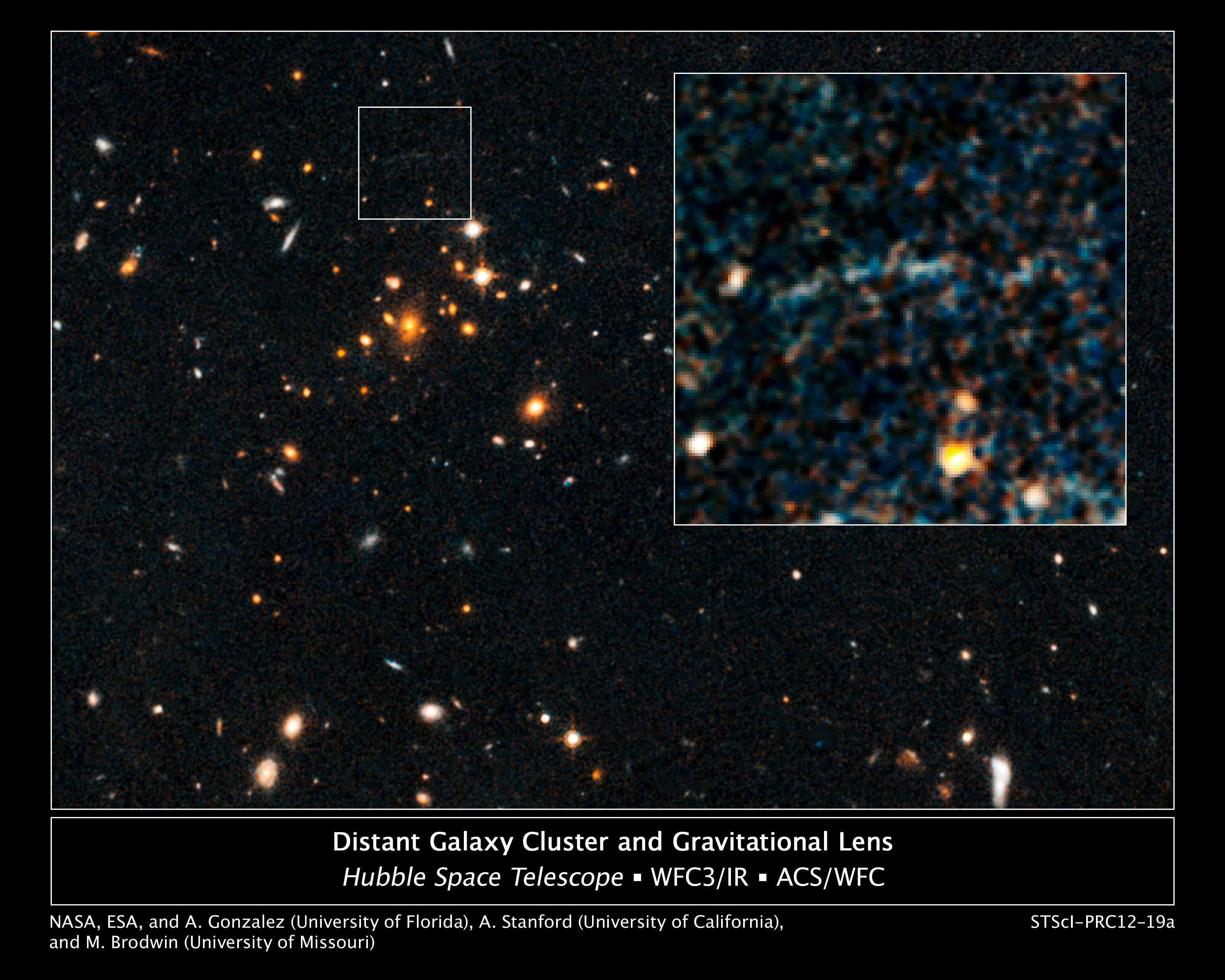
This image, taken by NASA's Hubble Space Telescope, show an arc of blue light behind an extremely massive cluster of galaxies residing 10 billion light-years away. The giant arc is the stretched shape of a more distant star-forming galaxy whose light is distorted by the monster cluster's powerful gravity, an effect called gravitational lensing. The "lensed" galaxy existed 10 billion to 13 billion years ago. The arc, locatedwithin the small box, is barely visible in the Hubble image of the cluster, named IDCS J1426.5+3508. A close-up image of the arc is shown in the inset in Figure 1. The images were taken by Hubble's Advanced Camera for Surveys and Wide Field Camera 3 in 2010. The cluster is the most massive found at that epoch, weighing as much as 500 trillion suns. The assemblage is 5 to 10 times larger than other clusters found at such an early time in the universe's history. This unique system constitutes the most distant cluster known to "host" a giant gravitationally lensed arc. Photo credit: NASA/ESA/University of Florida, Gainsville/University of Missouri-Kansas City/UC Davis, Source: Minex
Read More........

Dark Galaxies Spotted for the First Time

This deep image shows the region of the sky around the quasar HE0109-3518. The quasar is labeled with a red circle near the center of the image. The energetic radiation of the quasar makes dark galaxies glow, helping astronomers to understand the obscure early stages of galaxy formation. The faint images of the glow from 12 dark galaxies are labeled with blue circles. Dark galaxies are essentially devoid of stars, therefore they don’t emit any light that telescopes can catch. This makes them virtually impossible to observe unless they are illuminated by an external light source like a background quasar. This image combines observations from the Very Large Telescope, tuned to detect the fluorescent emissions produced by the quasar illuminating the dark galaxies, with color data from the Digitized Sky Survey 2. Photo credit: ESO, Digitized Sky Survey 2 and S. Cantalupo (UCSC), Source: Minsex
Read More........

Spiral galaxy has seen TWO supernovae in the last 30 years

It may look like a peaceful, tranquil place, but in fact the spiral galaxy below, known as 'The River' has been the scene of two two violent supernovae in the last 30 years, scientists said today. Called NGC 1187, the new images released today show the galaxy, which lies about 60 million light-years from Earth and was discovered by English astronomer William Herschel in 1784, in unprecedented detail. The apparently peaceful spiral galaxy pictured above in the constellation Eridanus -- the River -- has hosted two violent supernovae in the last 30 years, belying its tranquillity, astronomers said. Supernovae can occur at the end of a massive star's lifetime when its nuclear fuel is exhausted and gravity causes it to collapse on itself, producing a violent explosion that outshines a galaxy. Alternatively, they can also occur in a binary star system when a carbon-oxygen white dwarf pulls so much matter from a higher-mass companion star that the larger star collapses on itself. Source: The Coming Crisis
Read More........

Messier 31, the Andromeda Galaxy in Ultraviolet

Minsex: Hot stars burn brightly in this new image from NASA's Galaxy Evolution Explorer, showing the ultravioletside of a familiar face. At approximately 2.5 million light-years away, the Andromeda galaxy, or M31, is our Milky Way's largestgalactic neighbor. The entire galaxy spans 260,000 light-years across -- a distance so large, it took 11 different image segments stitched together to produce this view of the galaxy next door. The bands of blue-white making up the galaxy's striking rings are neighborhoods that harbor hot, young,massive stars. Dark blue-grey lanes of cooler dust show up starkly against these bright rings, tracing the regions where star formation is currently taking place in dense cloudy cocoons. Eventually, these dusty lanes will be blown away by strong stellar winds, as the forming stars ignite nuclear fusion in their cores. Meanwhile, the central orange-white ball reveals a congregation of cooler, old stars that formed long ago. When observed in visible light, Andromeda's rings look more like spiral arms. The ultraviolet view shows that these arms more closely resemble the ring-like structure previously observed in infraredwavelengths with NASA's Spitzer Space Telescope. Astronomers using Spitzer interpreted these rings as evidence that the galaxy was involved in a direct collision with its neighbor, M32, more than 200 million years ago. Andromeda is so bright and close to us that it is one of only ten galaxies that can be spotted from Earthwith the naked eye. This view is two-color composite, where blue represents far-ultraviolet light, and orange is near-ultraviolet light.Messier 31, the Source: Minsex
Read More........