Scientists in Japan Develop Non-Toxic Plastic That Dissolves in Seawater Within Hours


Japanese scientists were thrilled to receive significant interest from the packaging industry over their new seawater-degradable plastic.

Breaking apart into nutritious compounds for ocean-borne bacteria in just 2 to 3 hours depending on the size and thickness, the invention could be a major solution to reducing plastic waste in the environment.

GNN has previously reported that the amount of plastic waste in the ocean is currently overestimated by 3,000%, making the remaining total a much-more addressable challenge.

To that end, researchers at a lab in Wako city near Tokyo used two ionic monomers to form a salt bond for the basis of the polymer plastic. Despite being strong and flexible like normal petroleum-based plastics, the material is highly vulnerable to salt and immersion in salty ocean water dissolves the plastic in short order.

Researchers from the RIKEN Center for Emergent Matter Science and the University of Tokyo who developed the plastic don’t have any detailed plans for commercialization, but they have been contacted by members of the packaging industry with significant interest.

The plastic is non-toxic, non-flammable, and doesn’t emit CO2. It won’t leach chemicals and microplastics into one’s body as is the case with normal plastic water bottles, packaging, take-away containers, and so on.

Additionally, because there are small amounts of sodium in most of the world’s soils, the plastic will break down in a matter of weeks if buried.“Children cannot choose the planet they will live on. It is our duty as scientists to ensure that we leave them with best possible environment,” said the research team leader Takuzo Aida. Scientists in Japan Develop Non-Toxic Plastic That Dissolves in Seawater Within Hours
Read More........

World's First Diamond Battery Could Power Spacecraft and Pacemakers for Thousands of Years

GNN-created image

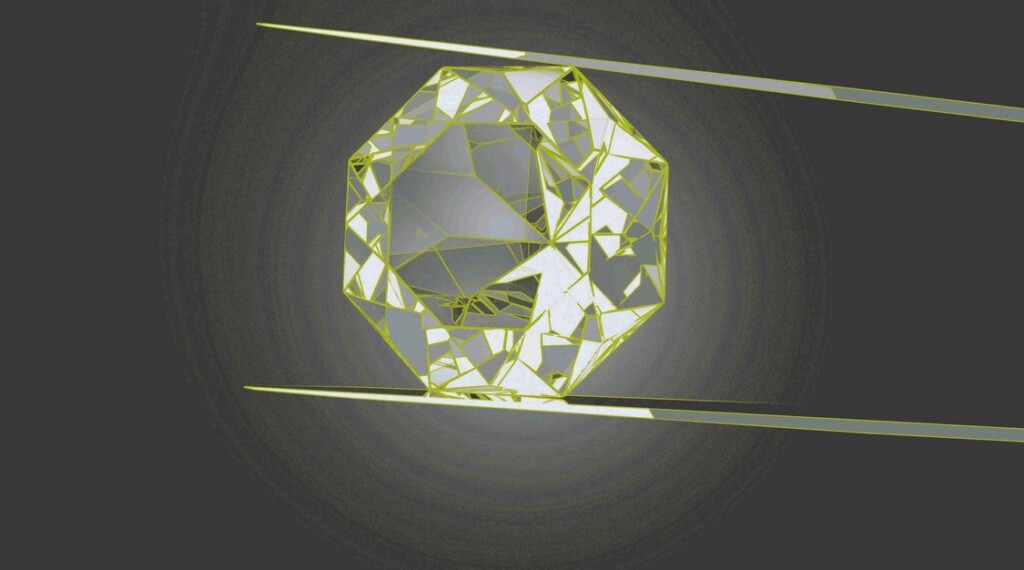
An invention from the UK features diamonds in the first-ever application of the gemstone in battery technology.

Promising to last thousands of years, the microwatt power sources are seen as the perfect solution to devices in environments where neither changing batteries nor carrying around extras are options.

Developed by the University of Bristol in partnership with the UK Atomic Energy Authority (UKAEA), the battery contains a radioactive isotope of carbon called carbon-14.

Isotopes are forms of chemical elements with the same number of protons but a different number of neutrons. Some are stable, but those that aren’t are radioactive and emit radiation as they decay.

In the battery, a radioactive carbon-14 isotope is encased inside a shell of diamond, the hardest substance known to man.

“Diamond batteries offer a safe, sustainable way to provide continuous microwatt levels of power. They are an emerging technology that use a manufactured diamond to safely encase small amounts of carbon-14,” said Sarah Clark, the director of Tritium Fuel Cycle at the (UKAEA), in a statement.

Electricity via the battery is generated in a way similar to a solar panel through the betavoltaic effect—harnessing the electrons emitted by the carbon-14 and captured by the diamond matrix.

Carbon-14 has a half-life of about 5,700 years, meaning that it would be several thousand years before the diamond Duracell bunny inside would start to tire out, making it ideal for spacecraft and satellites which can’t undergo maintenance easily, or in medical devices like pacemakers which have to be implanted and which cannot for the sake of the user have a battery change on the go.

“Our micropower technology can support a whole range of important applications from space technologies and security devices through to medical implants,” Tom Scott, a professor in materials at the University of Bristol, said in the statement. “We’re excited to be able to explore all of these possibilities, working with partners in industry and research, over the next few years.”The idea gives a whole new meaning to that old adage about how diamonds are forever. World's First Diamond Battery Could Power Spacecraft and Pacemakers for Thousands of Years
Read More........