Antarctica gaining more ice than it's losing: NASA

Washington: Antarctica is currently gaining enough ice to outweigh the increased losses from the continent's thinning glaciers, a new NASA study has found. The research challenges the conclusions of other studies, including the Intergovernmental Panel on Climate Change's (IPCC) 2013 report, which says that Antarctica is overall losing land ice. According to the new analysis of satellite data, the Antarctic ice sheet showed a net gain of 112 billion tons of ice a year from 1992 to 2001. That net gain slowed to 82 billion tons of ice per year between 2003 and 2008. "We're essentially in agreement with other studies that show an increase in ice discharge in the Antarctic Peninsula and the Thwaites and Pine Island region of West Antarctica," said lead author Jay Zwally, a glaciologist with NASA Goddard Space Flight Centre in US. "Our main disagreement is for East Antarctica and the interior of West Antarctica — there, we see an ice gain that exceeds the losses in the other areas," said Zwally. But it might only take a few decades for Antarctica's growth to reverse, according to Zwally. "If the losses of the Antarctic Peninsula and parts of West Antarctica continue to increase at the same rate they've been increasing for the last two decades, the losses will catch up with the long-term gain in East Antarctica in 20 or 30 years," Zwally said. The study analysed changes in the surface height of the Antarctic ice sheet measured by radar altimeters on two European Space Agency European Remote Sensing (ERS) satellites, spanning from 1992 to 2001, and by the laser altimeter on NASA's Ice, Cloud, and land Elevation Satellite (ICESat) from 2003 to 2008. The extra snowfall that began 10,000 years ago has been slowly accumulating on the ice sheet and compacting into solid ice over millennia, thickening the ice in East Antarctica and the interior of West Antarctica by an average of 1.7 centimetres per year. This small thickening, sustained over thousands of years and spread over the vast expanse of these sectors of Antarctica, corresponds to a very large gain of ice - enough to outweigh the losses from fast-flowing glaciers in other parts of the continent and reduce global sea level rise. "The good news is that Antarctica is not currently contributing to sea level rise, but is taking 0.23 millimetres per year away," Zwally said. "But this is also bad news. If the 0.27 millimetres per year of sea level rise attributed to Antarctica in the IPCC report is not really coming from Antarctica, there must be some other contribution to sea level rise that is not accounted for," Zwally said. The study was published in the Journal of Glaciology. — PTI. Source: Article
Read More........

Antarctica has a huge, completely hidden mountain range. New data reveals its birth over 500 million years ago

Have you ever imagined what Antarctica looks like beneath its thick blanket of ice? Hidden below are rugged mountains, valleys, hills and plains.

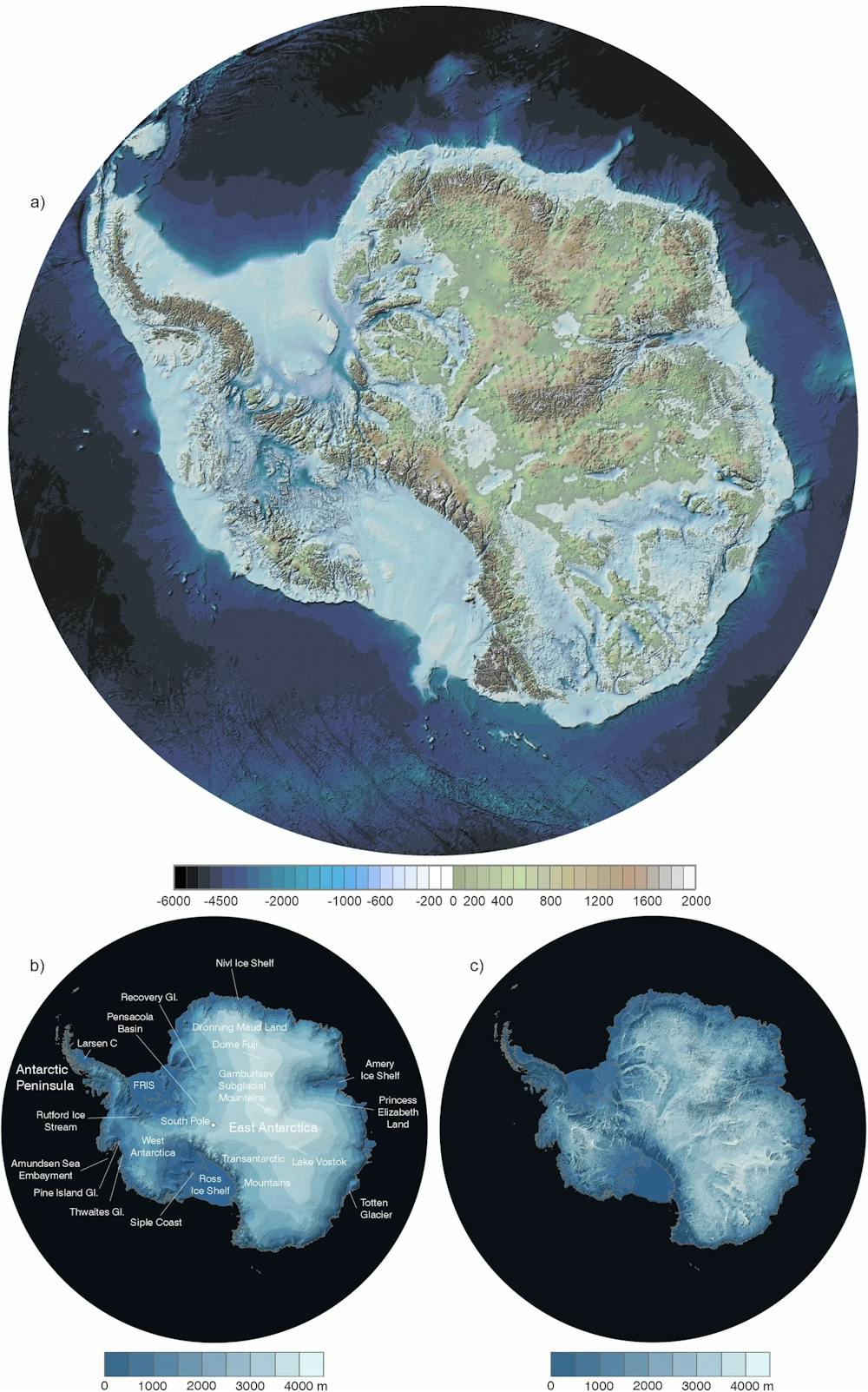
Some peaks, like the towering Transantarctic Mountains, rise above the ice. But others, like the mysterious and ancient Gamburtsev Subglacial Mountains in the middle of East Antarctica, are completely buried.

The Gamburtsev Mountains are similar in scale and shape to the European Alps. But we can’t see them because the high alpine peaks and deep glacial valleys are entombed beneath kilometres of ice.

How did they come to be? Typically, a mountain range will rise in places where two tectonic plates clash with each other. But East Antarctica has been tectonically stable for millions of years.

Our new study, published in Earth and Planetary Science Letters, reveals how this hidden mountain chain emerged more than 500 million years ago when the supercontinent Gondwana formed from colliding tectonic plates.

Our findings offer fresh insight into how mountains and continents evolve over geological time. They also help explain why Antarctica’s interior has remained remarkably stable for hundreds of millions of years.

A radar image showing the Gamburtsev mountain range under layers of ice. Creyts et al., Geophysical Research Letters (2014), CC BY-SA

A buried secret

The Gamburtsev Mountains are buried beneath the highest point of the East Antarctica ice sheet. They were first discovered by a Soviet expedition using seismic techniques in 1958.

Because the mountain range is completely covered in ice, it’s one of the least understood tectonic features on Earth. For scientists, it’s deeply puzzling. How could such a massive mountain range form and still be preserved in the heart of an ancient, stable continent?

Most major mountain chains mark the sites of tectonic collisions. For example, the Himalayas are still rising today as the Indian and Eurasian plates continue to converge, a process that began about 50 million years ago.

Plate tectonic models suggest the crust now forming East Antarctica came from at least two large continents more than 700 million years ago. These continents used to be separated by a vast ocean basin.

A map of the topography (a) and surface elevation (b) of Antarctica, measured in metres above sea level; (c) shows ice thickness in metres. Pritchard et al., Scientific Data (2025), CC BY

The collision of these landmasses was key to the birth of Gondwana, a supercontinent that included what is now Africa, South America, Australia, India and Antarctica.

Our new study supports the idea that the Gamburtsev Mountains first formed during this ancient collision. The colossal clash of continents triggered the flow of hot, partly molten rock deep beneath the mountains.

As the crust thickened and heated during mountain building, it eventually became unstable and began to collapse under its own weight.

Deep beneath the surface, hot rocks began to flow sideways, like toothpaste squeezed from a tube, in a process known as gravitational spreading. This caused the mountains to partially collapse, while still preserving a thick crustal “root”, which extends into Earth’s mantle beneath.

Mountain building causes deep crustal rocks to deform, fold and partially melt. Jacqueline Halpin

Crystal time capsules

To piece together the timing of this dramatic rise and fall, we analysed tiny zircon grains found in sandstones deposited by rivers flowing from the ancient mountains more than 250 million years ago. These sandstones were recovered from the Prince Charles Mountains, which poke out of the ice hundreds of kilometres away.

Zircons are often called “time capsules” because they contain minuscule amounts of uranium in their crystal structure, which decays at a known rate and allows scientists to determine their age with great precision.

These zircon grains preserve a record of the mountain-building timeline: the Gamburtsev Mountains began to rise around 650 million years ago, reached Himalayan heights by 580 million years ago, and experienced deep crustal melting and flow that ended around 500 million years ago.

Most mountain ranges formed by continental collisions are eventually worn down by erosion or reshaped by later tectonic events. Because they’ve been preserved by a deep layer of ice, the Gamburtsev Subglacial Mountains are one of the best-preserved ancient mountain belts on Earth.

While it’s currently very challenging and expensive to drill through the thick ice to sample the mountains directly, our model offers new predictions to guide future exploration.

Geologists Jacqueline Halpin and Jack Mulder stand on the Denman Glacier during recent fieldwork. Jacqueline Halpin

For instance, recent fieldwork near the Denman Glacier on East Antarctica’s coast uncovered rocks that may be related to these ancient mountains. Further analysis of these rock samples will help reconstruct the hidden architecture of East Antarctica.

Antarctica remains a continent full of geological surprises, and the secrets buried beneath its ice are only beginning to be revealed.The Conversation

Jacqueline Halpin, Associate Professor of Geology, University of Tasmania and Nathan R. Daczko, Professor of Earth Science, Macquarie University

This article is republished from The Conversation under a Creative Commons license. Read the original article.

Read More........