Birds all over the world use the same sound to warn of threats

Superb fairy-wrens attacking a taxidermied shining bronze-cuckoo. William Feeney, CC BY
William Feeney, Griffith University; Estación Biológica de Doñana (EBD-CSIC); James Kennerley, Cornell University, and Niki Teunissen, Monash University

Language enables us to connect with each other and coordinate to achieve incredible feats. Our ability to communicate abstract concepts is often seen as a defining feature of our species, and one that separates us from the rest of life on Earth.

This is because while the ability to pair an arbitrary sound with a specific meaning is widespread in human language, it is rarely seen in other animal communication systems. Several recent studies have shown that birds, chimpanzees, dolphins, and elephants also do it. But how such a capacity emerges remains a mystery.

While language is characterised by the widespread use of sounds that have a learned association with the item they refer to, humans and animals also produce instinctive sounds. For example, a scream made in response to pain. Over 150 years ago, naturalist Charles Darwin suggested the use of these instinctive sounds in a new context could be an important step in the development of language-like communication.

In our new study, published today in Nature Ecology and Evolution, we describe the first example of an animal vocalisation that contains both instinctive and learned features – similar to the stepping stone Darwin envisioned.

A unique call towards a unique threat

Birds have a variety of enemies, but brood parasites are unique.

Brood parasites, such as cuckoos, are birds that reproduce by laying their egg in the nest of another species and manipulating the unsuspecting host to incubate their egg and raise their offspring. The first thing a baby cuckoo does after it hatches is heave the other baby birds out of the nest, claiming the effort of its unsuspecting foster parents all to itself.

The high cost of brood parasitism makes it an excellent study system to explore how evolution works in the wild.

For example, our past work has shown that in Australia, the superb fairy-wren has evolved a unique call it makes when it sees a cuckoo. When other fairy-wrens hear this alarm call, they quickly come in and attack the cuckoo.

During these earlier experiments, we couldn’t help but notice other species were responding to this call and making a very similar call themselves. What’s more, discussions with collaborators who were working in countries as far away as China, India and Sweden suggested the birds there were also making a very similar call – and also only towards cuckoos.

Birds from around the world use the same call

First, we explored online wildlife media databases to see if there were other examples of this call towards brood parasites. We found 21 species that produce this call towards their brood parasites, including cuckoos and parasitic finches. Some of these birds were closely related and lived nearby each other, but others shared a last common ancestor over 50 million years ago and live on different continents.

For example, this is a superb fairy-wren responding to a shining bronze-cuckoo in Australia.

Superb fairy-wren responding to a shining bronze-cuckoo. William Feeney, CC BY169 KB (download)

And this is a tawny-flanked prinia responding to a cuckoo finch in Zambia.

Tawny-flanked prinia responding to a cuckoo finch. William Feeney, CC BY160 KB (download)

As vocalisations exist to communicate information, we suspected this call either functioned to attract the attention of their own or other species.

To compare these possibilities, we used a known database of the world’s brood parasites and hosts. If this call exists to communicate information within a species, we expected the species that produce it should be more cooperative, because more birds are better at defending their nest.

We did not find this. Instead, we found that species that produce this call exist in areas with more brood parasites and hosts, suggesting it exists to enable cooperation across different species that are targeted by brood parasites.

Communicating across species to defend against a common threat

To test whether these calls were produced uniquely towards cuckoos in multiple species, we conducted experiments in Australia.

When we presented superb fairy-wrens or white-browed scrubwrens with a taxidermied cuckoo, they made this call and tried to attack it. By contrast, when they were presented with other taxidermied models, such as a predator, this call was very rarely produced.

When we presented the fairy-wrens and scrubwrens with recordings of the call, they responded strongly. This suggests both species produce the call almost exclusively towards cuckoos, and when they hear it they respond predictably.

If this call is something like a “universal word” for a brood parasite across birds, we should expect different species to respond equally to hearing it – even when it is produced by a species they have never seen before. We found exactly this: when we played calls from Australia to birds in China (and vice-versa) they responded the same.

This suggests different species from all around the world use this call because it provides specific information about the presence of a brood parasite.

Superb fairy-wrens attacking a taxidermied shining bronze-cuckoo. William Feeney, CC BY

Insights into the origins of language

Our study suggests that over 20 species of birds from all around the world that are separated by over 50 million years of evolution use the same call when they see their respective brood parasite species.

This is fascinating in and of itself. But while these birds know how to respond to the call, our past work has shown that birds that have never seen a cuckoo do not produce this call, but they do after watching others produce it when there is a cuckoo nearby.

In other words, while the response to the call is instinctive, producing the call itself is learned.

Whereas vocalisations are normally either instinctive or learned, this is the first example of an animal vocalisation across species that has both instinctive and learned components. This is important, because it appears to represent a midpoint between the types of vocalisations that are common in animal communication systems and human language.

So, Darwin may have been right about language all along.The Conversation

William Feeney, Research fellow, Environmental Futures Research Institute, Griffith University; Estación Biológica de Doñana (EBD-CSIC); James Kennerley, Postdoctoral Fellow, Cornell Lab of Ornithology, Cornell University, and Niki Teunissen, Postdoctoral research fellow, Monash University

This article is republished from The Conversation under a Creative Commons license. Read the original article.

Read More........

Record-Breaking Night of Bird Migration Caught on Radar During a ‘Perfect Storm’ for Feathered Flight

BirdCast

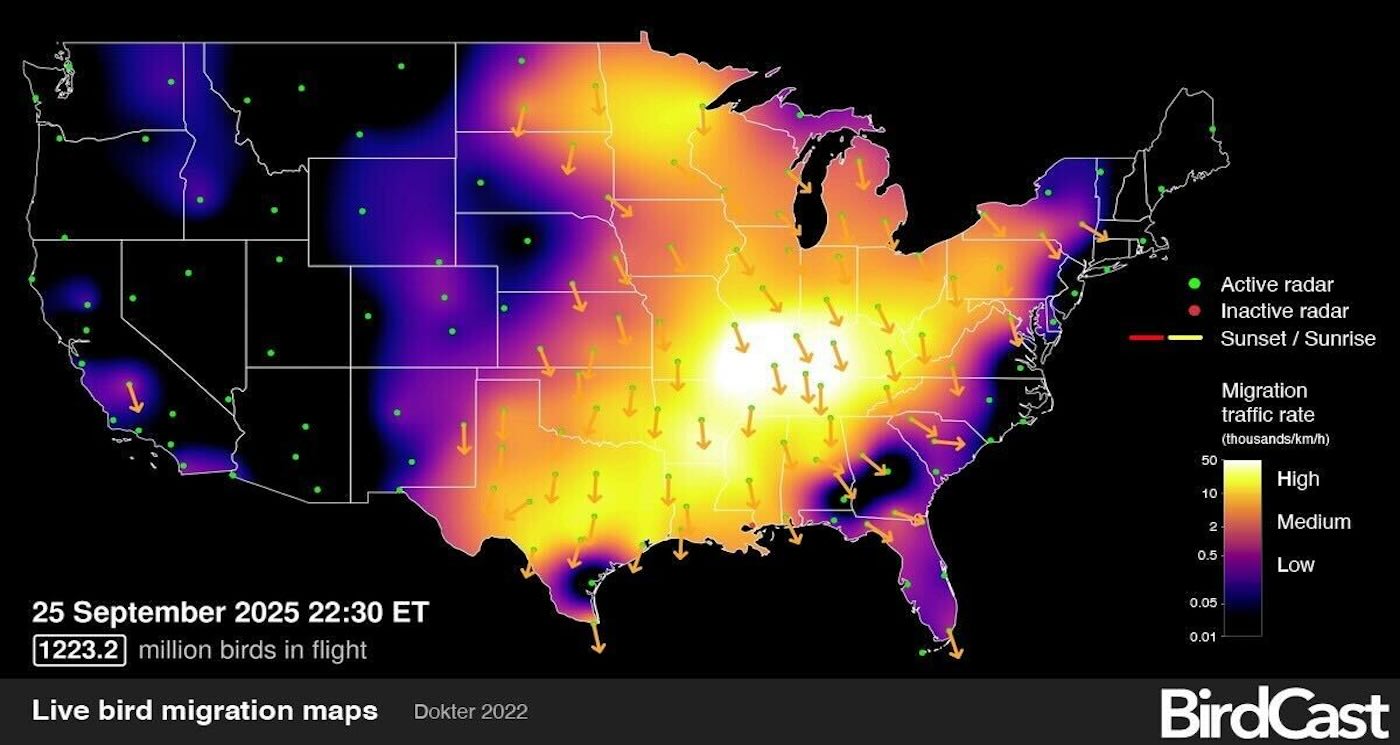
More than 1.2 billion birds streamed south in one night during their Fall migration in late September—the largest single-night total ever recorded by the American live radar project.

Called BirdCast, a collaboration led by the Cornell Lab of Ornithology, the platform uses the same weather radar technology behind daily forecasts to track migrating birds.

On its live migration map, BirdCast tracked more than 1.2 billion birds streaming toward their wintering grounds after sunset on September 25—the largest single-night total recorded since the project began mapping live migrations in 2018.

“These numbers are almost inconceivable,” said Andrew Farnsworth, a visiting scientist at the Cornell Lab of Ornithology and longtime BirdCast researcher. “They’re enormous… even for people that study migration regularly. The scale of how many organisms that this represents, is just mind blowing.”

The surge surpasses the previous milestone of one billion birds, first observed during the migration in October 2023. Both included well over one hundred species flying toward warmer weather, including songbirds and shorebirds.

Farnsworth said this seemingly rare night captured about 10% of the continent’s birds in flight at the same time. On an average fall night during peak migration, about 400 million birds are detected in flight at the same time above the United States, but on this night, the number was three times that.

“It’s really unbelievable,” he said.

While astonishing to both birders and scientists, Farnsworth said this event was not random. It resulted from a combination of ideal migrating conditions coinciding with the peak of fall migration.

The weather that night was perfect for travel, he explained in a media release. It featured calm winds—including tail winds that helped push the birds along their migratory paths across much of the center of the country and the Mississippi River valley.

Farnsworth said this record-breaking migration—documented by radar technology that was never intended to track birds—is a chance to not only to marvel at the immense magnitude of bird migration but also a chance to remind the public that the data is freely available and accessible in real time.

The technology at BirdCast.org allows anyone to view forecast maps that predict the number of birds migrating while live migration maps show migration happening in real time. Both tools let people know when birds are moving nearby, so they can take necessary precautions to protect them.

“BirdCast gives the ability for more people to engage in and participate in this incredible spectacle,” Farnsworth said, whose Cornell Lab partners with three US universities in the project: Purdue, Illinois Urbana-Champaign, and Massachusetts Amherst.

It’s also a timely reminder that you can help make birds’ journeys safer. Every year, more than one billion birds die in collisions with windows in the United States.

Bright lights can disorient birds migrating at night, drawing them into areas where collisions with glass are common. To assist our feathered friends, turn off nonessential lights at night. You can also add bird friendly film or other markings on the outside of windows. Learn more at stopbirdcollisions.org. Record-Breaking Night of Bird Migration Caught on Radar During a ‘Perfect Storm’ for Feathered Flight
Read More........

UK’s Rarest Breeding Birds Raise Chicks for First Time in Six Years

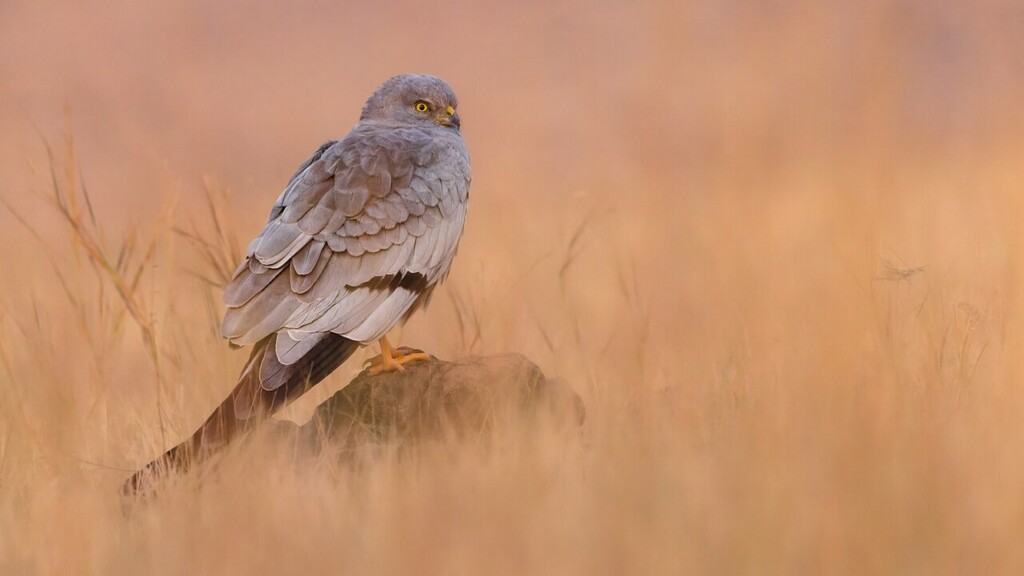
A male Montagu’s harrier in a wheat field – credit, Sumeetmoghe CC 4.0. BY-SA

Adrift amongst a sea of wheat on an English farm, 4 extremely rare birds have successfully fledged, and are almost ready to strike out on their own.

The successfully raised chicks are Montagu’s harriers, England’s rarest breeding bird, and the news the young ones were flying was herald as an “incredible” accomplishment.

For months, tall predator-proof wire fencing has surrounded the nest, sat in the middle of a private landowner’s field of milling wheat.

Conservationists from the Royal Society for the Protection of Birds (RSPB) have worked hand in hand with landowers for years to ensure the harrier clings on.

For six years, no chicks have survived to fledge; an unsustainable trend as the population is incredibly small. Nesting on the ground in wheat fields puts the chicks at risk of predators like foxes, and machines like combine harvesters and crop sprayers.

Populations are much higher in Spain and France, but on Great Britain, each breeding pair has to be monitored from start to finish of the breeding season. In this case, a pair returning from their wintering grounds in sub-Saharan Africa were spotted moving into a field in an undisclosed part of the country.

Once it was confirmed via drone that they had nested, RSPB sprung into action, installing predator-proof fencing and monitoring cameras.

Channel 4 reported that the fences are marked out with flags so that combines can steer well clear of the nests and the chicks, which strangely don’t seem to give a tweet about the giant, noisy machines of death passing by.

As for the farmer, one might think they’d take issue with the lost crop, but quite the contrary.

“It’s fantastic to have these amazing birds on the farm and a just reward for the extensive conservation work we have been undertaking for decades,” the farmer who owns the land where this particular nest was located, told the RSPB.

As the first chicks to successfully fledge in 6 years, these young ones—the males already sporting their iconic “battleship grey” feathers—carry the hope of the British population on their wings. UK’s Rarest Breeding Birds Raise Chicks for First Time in Six Years
Read More........

Bugun Liocichla: A Jewel of the Eastern Himalayas


Vidyasagar Jagtap

In the dense, verdant forests of Arunachal Pradesh, India, a chance encounter sparked a conservation movement that would resonate far beyond its origins. Ramana Athreya, an astrophysicist with a passion for birdwatching, was traversing a narrow jungle trail near the Eaglenest Wildlife Sanctuary when a flash of vibrant color caught his eye. “I was simply passing through when, out of nowhere, a flash of brilliant color stole my attention,” he later recalled. There, gliding gracefully through the foliage, was a bird unlike any he had ever seen—its olive-grey plumage complemented by a striking black cap and vivid patches of yellow, red, and white on its wings. Before Athreya could fully absorb the sight, the bird vanished into the dense canopy, leaving him with a sense of wonder and an unquenchable curiosity to learn more.

An Unexpected Discovery

That fleeting moment set Athreya on a path of discovery. Over a decade later, in 2006, he returned to the area with renewed determination and was able to document the bird meticulously. Given the species' apparent rarity, Athreya and his team employed non-invasive methods, collecting feathers, photographs, and audio recordings of its soft, flute-like calls. This careful approach ensured the bird's safety while allowing for its formal identification as a new species—the Bugun Liocichla.(Liocichlabugunorum)

A Marvel in Miniature

Measuring approximately 20 to 22 centimeters, the Bugun Liocichla is a small yet captivating bird. Its olive-grey body is accentuated by a jet-black cap and radiant orange-yellow markings around the eyes, with wings adorned in a medley of bright colours. Beyond its visual appeal, the bird's melodious and flute-like song adds to its allure, making it a true gem of the Himalayan forests.

Impact on the Bugun Tribe and the Region

The discovery of the Bugun Liocichla holds significant historical importance, being the first bird species described from India in decades. More profoundly, it galvanized the local Bugun tribe to take proactive steps in conserving their natural heritage. Recognizing the bird as a symbol of their rich biodiversity, the Bugun community established community-managed reserves and initiated sustainable ecotourism projects. These efforts not only protected the bird's habitat but also provided economic benefits to the community, exemplifying a harmonious balance between conservation and livelihood. As a major step towards conservation, the Arunachal Pradesh government finally notified Braiduah Community Reserve under the Wildlife Protection Act, 1972. The reserve is situated adjacent to the Eaglenest Wildlife Sanctuary.


Parallels in Conservation Efforts

Athreya's dedication mirrors the passion of other notable conservationists. Sálim Ali, often hailed as the “Birdman of India,” conducted extensive bird surveys across the country and authored “The Book of Indian Birds,” a seminal work that has inspired generations of ornithologists. Similarly, Asad R. Rahmani's memoir, “Living with Birds,” narrates his lifelong commitment to studying and protecting India's avian species, reflecting the broader narrative of India's conservation movement. Internationally, Mya-Rose Craig's “Birdgirl” chronicles her global birdwatching adventures and environmental activism, emphasizing the universal appeal and urgency of bird conservation. These works collectively underscore the profound impact individuals can have on bird conservation, echoing the transformative journey sparked by Athreya's chance encounter with the Bugun Liocichla.

A Legacy of Hope and a Call to Action

Currently listed as Critically Endangered, with an estimated population of only 14 to 20 individuals, the Bugun Liocichla's survival hangs in the balance. Its precarious status underscores the urgent need for continued conservation efforts. Yet, its story serves as a beacon of hope, illustrating how serendipitous discoveries can lead to meaningful change. As Athreya aptly noted, “Sometimes, all it takes is a single moment in the wild to show us the beauty we must fight to protect.”

The story of this remarkable bird is a call to action for everyone: cherish the wonders of nature, work together with communities, and ensure that such treasures endure for generations to come.

References:

Discovery and Conservation of the Bugun Liocichla:
  1. • Ramana Athreya - Sanctuary Nature Foundation: Details Athreya's discovery of the BugunLiocichla and subsequent conservation efforts.
  2. • From a new bird to a new community reserve: India's tribe sets example - Mongabay: Discusses the Bugun tribe's establishment of community reserves following the bird's discovery.
  3. • https://www.iiserpune.ac.in/news/post/postage-stamp-released-of-bugun-liocichla-the-bird-will-now-go-places/3
  4. • https://www.deccanherald.com/india/arunachal-pradesh/arunachal-tribe-donates-land-for-critically-endangered-songbird-bugun-liocichla-2940635
Notable Works in Bird Conservation:
  • • The Book of Indian Birds by Sálim Ali: A seminal guide illustrating and describing over 500 Indian bird species.
  • • Living With Birds by Asad R. Rahmani: A memoir detailing Rahmani's dedication to studying and protecting India's avian species.
  • • Birdgirl by Mya-Rose Craig: Chronicles Craig's global birdwatching experiences and environmental activism.
These sources offer comprehensive information on the topics discussed in the article.Vidyasagar Jagtap is a BSc Zoology graduate from Fergusson College, Pune, with a deep interest in life sciences and nature. Bugun Liocichla: A Jewel of the Eastern Himalayas | MorungExpress | morungexpress.com
Read More........

UK Zoo Helps Hatch Three of World's Rarest Birds–Blue-Eyed Doves–with Only 11 Left in Wild

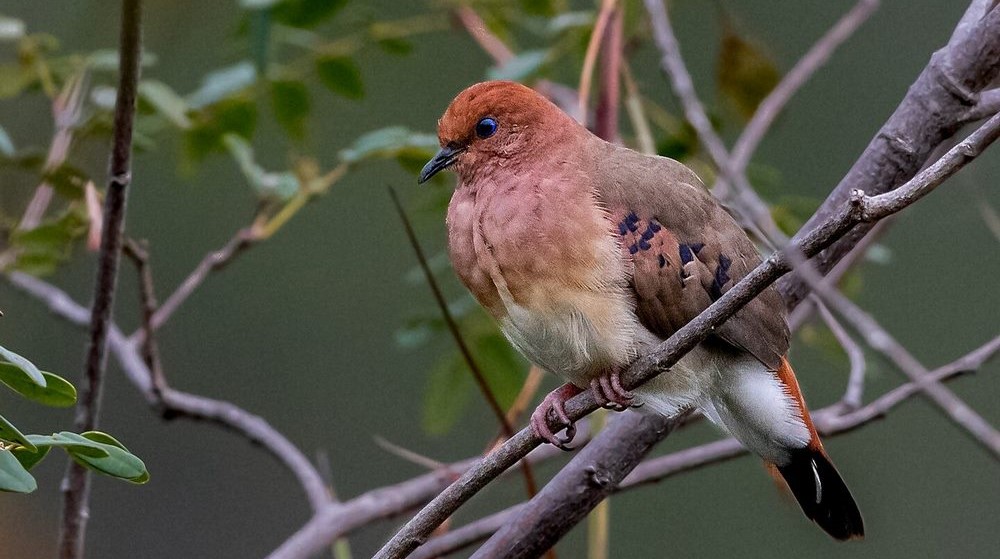
Columbina cyanopis, or the blue-eyed dove, in the Rolinha do Planalto Natural Reserve – credit, Hector Bottai CC BY-SA 4.0.

A UK zoo is celebrating after helping to hatch three of the world’s rarest birds in what could be a breakthrough moment in saving the critically-endangered species from extinction.

The trio of blue-eyed ground dove chicks were successfully hand-reared in Brazil, boosting the survival odds of one of the most endangered birds on the planet, only 11 of which are thought to remain in the wild.

An international team, including British experts from the Chester Zoo, managed to rear the birds in the Brazilian state of Minas Gerais, the only place they are found.

The team, also featuring Brazilian and American conservationists, say their arrival could provide a vital lifeline for the ultra-rare species by boosting their insurance population.

The blue-eyed ground dove was a species shrouded in mystery, with no confirmed records for more than 70 years, until its rediscovery in 2015.

“It’s a real privilege for Chester Zoo to be involved in the work to help conserve the blue-eyed ground dove,” said Andrew Owen, Chester Zoo’s head of birds.

“This unique species is on the brink of extinction and without the dedication and passion of all the conservationists involved, including Chester Zoo’s bird staff, this bird may be lost forever.”

“This year saw the successful hand-rearing of three blue-eyed ground doves – building on the successes of 2023 and 2024 and doubling the conservation-breeding insurance population.”

The effort to build on those successes started earlier this year, when a team of Brazilian and international bird conservationists were tasked with selecting and incubating a small number of wild-laid eggs. The resulting hatchlings would help to create an insurance population in human care.

Andrew traveled to Brazil to provide technical support while Victoria Kaldis, lead keeper for birds at Chester Zoo, also flew over to assist with the hand-rearing of the chicks. The effort was led by Minas Gerais’ Parque das Aves and SAVE Brasil, with additional support coming from the Toledo and Bronx zoos in the United States.

“Seeing these chicks is exciting. Each hatching represents a real chance to reverse the fate of this species,” said Paloma Bosso, technical director of Parque das Aves. “It is a joy and also a great responsibility.”

“With the arrival of these three new individuals, Parque das Aves is now home to six blue-eyed ground doves. All are being carefully monitored and are part of a coordinated reproductive management plan.”

The blue-eyed ground dove is Critically-Endangered according to the the International Union for Conservation of Nature’s Red List.

It once had a wide distribution in the Cerrado biome (the Brazilian savanna), but due to habitat loss driven by farming and timber plantations, it has radically declined.

Currently, the only known population is found in Botumirim in the state of Minas Gerais and a 2025 census confirmed the species remains exceedingly rare.“The blue-eyed ground dove depends on the efforts of many people and institutions, so that its song can be heard in the Cerrado for many years to come,” said Ben Phalan, head of conservation at Parque das Aves. UK Zoo Helps Hatch Three of World's Rarest Birds–Blue-Eyed Doves–with Only 11 Left in Wild
Read More........