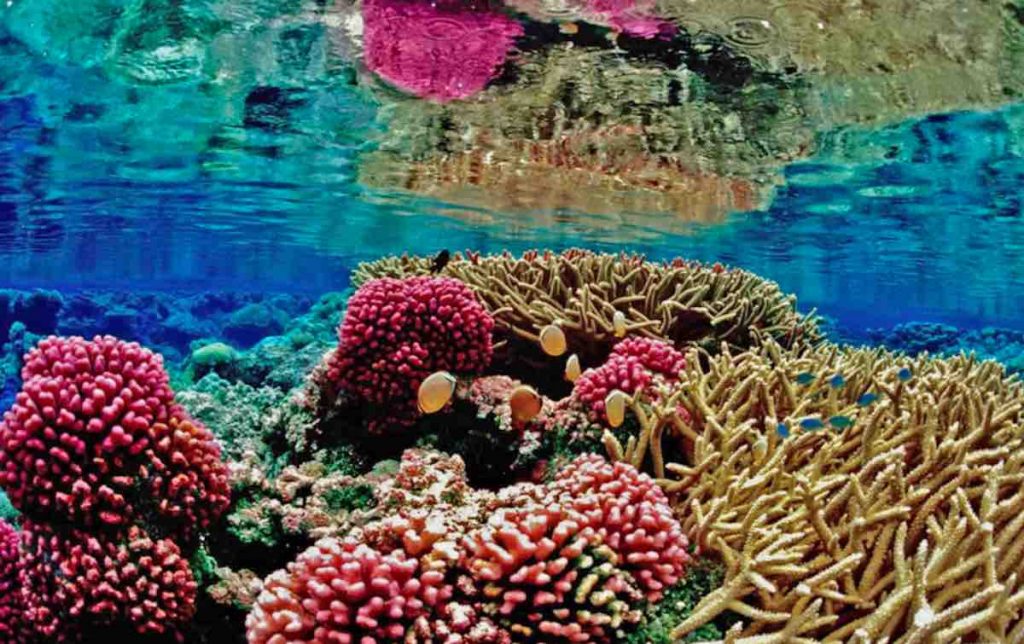
Scientists Have Found Climate-Resistant Coral Reefs Around the World Totaling the Size of Wisconsin


A sophisticated AI-powered examination of coral reef resistance extrapolated into the future found that there’re about 64,000 square miles of coral reefs on Earth that could still be resisting climate change by 2050.

The common theory states that CO2 emissions create a greenhouse effect which warms the seas which causes coral reefs to bleach or even die, yet there are environments—as GNN has frequently reported—where corals seem to be more resilient.


The authors of this new study found that when they used 45,000 observations of coral reefs going back as far as 1960 as the data set for an AI model to examine, it predicted according to 46 different criteria that 25 years from now there’d still be swaths of coal reefs totaling the size of Wisconsin located primarily in 8 countries, and that these would be capable of surviving and thriving in the warming seas.

The findings were presented at Our Ocean Conference in Mombasa, Kenya, and are available on the preprint server EcoEvoRxiv.

Most of the coral distribution was plotted out in the Philippines, Indonesia, Cuba, the Bahamas, and Australia. Belize, Nicaragua, and the Turks and Caicos Islands also showed coral resilience in 2050 according to the estimates.

The criteria for where in the world the AI would map as good coral habitat comes from a concept of ‘coral refuges’ which are observations that coral species can either endure warming seas, recover from damage faster, or avoid damage altogether in certain places.

Where these are in the world comes from the 45,000 observations mentioned earlier.

Why coral seem to enjoy these conditions in these particular places isn’t exactly clear—particularly as regards Nicaragua’s neighbor Honduras, where the country’s largest coral reef is also the victim of substantial ecosystem disturbance by human activity, yet seems to be flourish year round.

Sara Hashemi, a daily correspondent at Smithsonian Magazine, wrote that the authors of the new study want their work “to offer a road map for where countries should invest conservation funding, especially for small nations with limited resources.”

Hashemi started her report by noting that “it’s hard to feel optimistic for coral reefs” these days. It’s hard—if one doesn’t read GNN.

There’s great news on coral all around the world. In terms of protections, 77,000 square miles of tropical seas will be off limits to fishing thanks to bold conservation action by Papua New Guinea this year.

Located in the legendary Coral Triangle, where the Pacific and Indian Oceans meet, the newly-designated Western Manus Marine Protected Area will form part of the newly established Melanesian Ocean Corridor of Reserves, a network of national and jointly managed protected areas spanning Fiji, Vanuatu, and Papua New Guinea.

The science of coral breeding and restoration is advancing in leaps and bounds. This January, GNN reported that scientists on the island nation of Mauritius are naturally breeding heat-resistant corals that faced a bleaching event last summer with 98% survival rates.

Marine biologists weren’t even able to breed coral in a lab 20 years ago, but recently, scientists on the Maldives bred 10,000 corals in just weeks using a portable station shipped in a container to the archipelago.

In 2022, the breeding of coral took a cosmic leap with the first ever out-of-season spawning event for lab-bred corals along Australia’s northeastern coast.Even just learning about these incredible organisms and what they’re capable of is an ongoing and encouraging process. GNN reported in 2024 that a Nat Geo expedition found the world’s largest coral ever, a leviathan shadow on the seabed that stretched out longer than a blue whale—longer than 4 tennis courts. Scientists Have Found Climate-Resistant Coral Reefs Around the World Totaling the Size of Wisconsin
Read More........

Study Finds Many Older Adults Will Improve Over Time–Depending on Their Mindset

Getty Images for Unsplash +

A new study by scientists at Yale University suggests that older individuals can and do ‘improve,’ in all the senses of that word, over time.

Analyzing the results of a large study of older Americans that ran for a decade, a key data point was that the individual’s mindset toward aging plays a major part in their success.

If they believed aging was a process of decline, they declined. If they believed aging was a process of refinement, they improved.


Lead author Dr. Becca R. Levy, PhD, a professor of social and behavioral sciences at the Yale School of Public Health (YSPH) found that nearly half of adults aged 65 and older showed measurable improvement in cognitive function, physical function, or both, over time.

The improvements were not limited to a small group of exceptional individuals and, notably, were linked to a powerful but often overlooked factor: how people think about aging itself.


“Many people equate aging with an inevitable and continuous loss of physical and cognitive abilities,” said Dr. Levy, an international expert on psychosocial determinants of aging health. “What we found is that improvement in later life is not rare, it’s common, and it should be included in our understanding of the aging process.”

The findings are published in the journal Geriatrics.

For the study, the researchers followed more than 11,000 participants in the Health and Retirement Study, a federally supported longitudinal survey of older Americans. The research team tracked changes in cognition using a global performance assessment, and physical function using walking speed—often described by geriatricians as a “vital sign” because of its strong links to disability, hospitalization, and mortality.

Over a follow-up period of up to 12 years, 45% of participants improved in at least one of the two domains, according to the study. About 32% improved cognitively, 28% improved physically, and many experienced gains that exceeded thresholds considered clinically meaningful.

When participants whose cognitive scores remained stable over that period (rather than declining) were included, more than half defied the stereotype of inevitable deterioration in cognition.

“What’s striking is that these gains disappear when you only look at averages,” said Dr. Levy, author of the book 

“If you average everyone together, you see decline,” Dr. Levy continued. “But when you look at individual trajectories, you uncover a very different story. A meaningful percentage of the older participants that we studied got better.”

As for why, Levy and her co-authors hypothesized that an important factor could be participants had assimilated more positive or more negative views about aging by the start of the study. In support of this hypothesis, they found that those with more positive age beliefs were significantly more likely to show improvements in both cognition and walking speed, even after accounting for factors such as age, sex, education, chronic disease, depression, and length of follow-up.

The findings build on Dr. Levy’s stereotype embodiment theory, which posits that age stereotypes absorbed through a range of domains including social media and advertisements eventually become self-relevant and biologically consequential.

Credit: Getty Images for Unsplash+

Dr. Levy’s prior studies have found negative age beliefs predict poorer memory, slower walking speed, higher cardiovascular risk, and biomarkers associated with Alzheimer’s disease. The current study shows that those who have assimilated more positive age beliefs often show improvement, Dr. Levy said.

“Our findings suggest there is often a reserve capacity for improvement in later life,” she said. “And because age beliefs are modifiable, this opens the door to interventions at both the individual and societal level.”

The improvements were not limited to people who started out with impairments. Even among participants who had normal cognitive or physical function at baseline, a substantial proportion improved over time. That challenges the assumption that later-life gains reflect only people getting better after being sick or rebounding from earlier setbacks, the authors said.

The authors hope their findings will reverse the popular perception that continuous decline is inevitable and encourage policy makers to increase their support for preventive care, rehabilitation, and other health-promoting programs for older persons that draw on their potential resilience. https://www.goodnewsnetwork.org/new-study-finds-many-older-adults-can-and-do-improve-over-time-depending-on-their-mindset/
Read More........