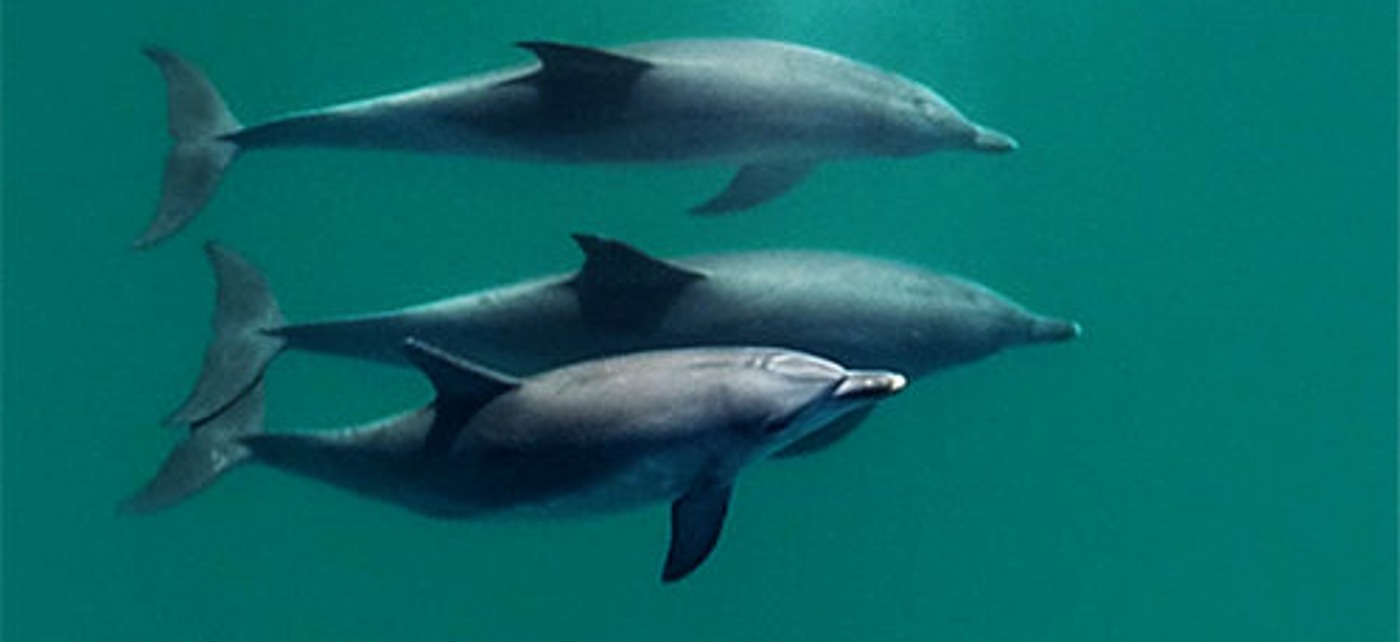
Sampling DNA in Seawater Can Reveal the Health of Dolphin Populations, in First for Conservation

SWNS

DNA floating in seawater is now enough to let scientists monitor the health of America’s dolphin populations.

Sampling DNA in seawater can show the local presence (or absence) of a species, but until now could give little information about those measures of biodiversity that are the most useful in conservation.

But, scientists in the US have now shown that mitochondrial DNA in water sampled near schools of dolphins contains enough information to measure their local effective population size—and monitor the health of these populations.
 
DNA is everywhere in the world’s oceans—not only inside cells from skin, scales, mucous, and feces, but also floating freely. Sequencing such ‘environmental DNA’ (eDNA) from open water has long been used as a cost-effective way of gauging the number and identity of species in a region, especially when they are rare and elusive or living at great depths.

But species richness is only the most basic biodiversity measure. Until now, eDNA-based methods could only give limited insight into the variables that are most relevant for conservation: the number of individuals, the evenness of the abundances of co-occurring species, or their within-species genetic diversity.

But that may be about to change, shows a new groundbreaking study in Frontiers in Marine Science.

“Here we show that repeated eDNA sampling can be used to estimate the genetic diversity of dolphins that occur in large schools and have very large populations,” said corresponding author Dr Frederick Archer from the NOAA/NMFS Southwest Fisheries Science Center in La Jolla, California.

“This is important because genetic diversity, its outcome measure, can be used as a measure of population size and how ready a population is to react to changes in its environment.”

Around Santa Catalina Island, located 47 km off Long Beach, California, the researchers followed 15 schools of dolphins with small boats in 2021. They focused on the four most common species locally: long-beaked common dolphins, short-beaked common dolphins, common bottlenose dolphins, and Risso’s dolphins.

Whenever they encountered a school, the researchers collected two-liter samples of seawater from the surface to compare the mitochondrial eDNA with that in public databases.

The scientists found 836 mitochondrial sequence variants in 126 water samples, of which 76% were from cetaceans and 60% from toothed whales. Overall, 29% were from the species of the school, which had been visually identified.

Long-beaked common dolphins had the greatest genetic diversity, followed by short-beaked common dolphins, while Risso’s and bottlenose dolphins proved much less diverse around Santa Catalina.

“Our study demonstrates the utility [of eDNA surveys] for efficiently assessing and comparing genetic diversity in social odontocetes,” concluded the authors.
Theory holds water

The authors are eager to put their methods to good use in conservation, now that they have been proven to work.

“It would be good to start eDNA monitoring programs as soon as possible that were not possible before. For example, we will be able to see how species composition in very small areas change over the course of a year – including rarer species that we don’t often detect on visual surveys,” said Archer.

“This can give us a lot of information on habitat use and will also allow us to potentially observe how environmental changes and anthropogenic effects such as pollution or underwater sound affect species distributions.” Sampling DNA in Seawater Can Reveal the Health of Dolphin Populations, in First for Conservation
Read More........

Climate change‑related heat increases the risk of premature birth in 13 countries – new study

Dominic Royé, Consejo Superior de Investigaciones Científicas (CSIC); Ana M Vicedo-Cabrera, University of Bern; Aurelio Tobias, Instituto de Diagnóstico Ambiental y Estudios del Agua (IDAEA - CSIC); Carmen Íñiguez, Universitat de València, and Coral Salvador, University of Bern

Picture a sweltering summer’s day. Now imagine enduring the heat while eight months pregnant. Uncomfortable, to say the absolute least.

But in pregnancy, heat is more than just a nuisance, as for many women it can trigger early labour. A premature baby – meaning one born before 37 weeks of gestation – faces a significantly higher risk of mortality, as well as health complications that can affect them for the rest of their lives.

Decades of research has documented the link between exposure to heat and preterm births. However, most studies have been limited to a single city or country, using different methods that yielded results which were difficult to compare.

So how many premature births are actually caused by heat in different parts of the world? Are all pregnant women equally vulnerable? Our new study, published in Environment International, provides the most comprehensive answers to these questions to date.

13 countries, 36 million births

We analysed 36.6 million births that took place during the summer in 250 towns and cities, across 13 countries (Australia, Brazil, Canada, Chile, Ecuador, Estonia, Israel, Italy, Japan, Paraguay, Spain, Switzerland and the United States) between 1979 and 2019. This is the most extensive multi-site analysis conducted on this topic to date.

To estimate the relationship between temperature and the risk of preterm birth, we used cutting edge statistical models that allowed us to see the delayed and non-linear effects of heat exposure in the days leading up to delivery.

The findings are clear: the risk of preterm birth increases linearly as temperatures rise. On days of moderate heat, this risk increases by 2.8%. On days of extreme heat, the increase reaches 3.8%.

855 extra premature births per million

Translating these risks into specific figures provides a clearer picture of the scale of the problem. We estimate that 1.41% of all premature births occurring during the summer are attributable to heat. In absolute terms, this equates to 855 extra premature births per million births.

The magnitude is comparable to that of other well-established factors. For example, it far exceeds the contribution of maternal smoking in low and middle-income countries, and is on a par with that of malaria. And heat is already a major environmental risk factor for reproductive health.

The differences between countries are also revealing. Paraguay has the highest rate, with 1,347 preterm births per million, while Switzerland has the lowest, with 628. Spain falls in the upper-middle range, with 1,080 per million. This variability suggests that climate, the level of socio-economic development, and each country’s capacity to adapt significantly influence the vulnerability of pregnant women.

Not all pregnancies have the same risk

One of our study’s most significant findings suggests that heat may not affect all women equally. Young single mothers with lower levels of education who are in a vulnerable socio-economic situation may be at greater risk of heat-induced preterm birth.

Female foetuses also appear to be more susceptible than male foetuses. However, most of these subgroup analyses were not statistically significant, so further research is needed to confirm them.

There are specific mechanisms behind these differences. People who are economically disadvantaged are more likely to live in particularly hot areas due to the urban heat island effect. They are also more likely to work outdoors, and to lack access to air conditioning or other means of protection against the heat. Social inequality and climate inequality overlap, and the most vulnerable pregnant women pay the highest price.

Heat also speeds up births at term

Perhaps the most surprising finding of our research is that the effect of heat is not limited to preterm births. We have also observed a significant increase in the risk of delivery in pregnancies that would be considered clinically normal, between weeks 37 and 42. Specifically, extreme heat increases the risk of delivery in weeks 37-38 by 3.66%, and in pregnancies of 39 weeks or more by 2.97%.

This means that heat can act as a trigger for labour in foetuses that, under other circumstances, would have continued to develop normally. The most sensitive gestational window is from week 31 to week 40, spanning late preterm and early term births.

Root causes

There are many biological mechanisms at play here. Heat can raise body temperature and trigger uterine contractions. The dehydration caused by heat also disrupts the electrolyte balance and reduces blood flow to the placenta. Furthermore, heat triggers inflammatory processes and oxidative stress, which can compromise foetal development and accelerate cervical ripening.

Pregnant women are particularly vulnerable because their bodies generate more heat than usual due to foetal growth, while also having a reduced ability to dissipate that heat because of weight gain.

Global warming

These findings are particularly worrying in light of climate change. Over the coming decades, heatwaves will become more frequent, more intense, and will last longer. If we fail to act, the burden of preterm births attributable to high temperatures will only increase, undermining decades of progress in neonatal and child health.

A proper response requires action on several fronts. In the clinical setting, health systems must incorporate heat as a risk factor in antenatal care, particularly for socially vulnerable women. In the urban sphere, it is urgent to develop adaptation strategies – green spaces, climate shelters, early warning systems – that protect pregnant women during episodes of extreme heat. And at the policy level, these findings must be translated into ambitious emissions reduction targets.

Extreme heat is no longer just a matter of comfort. It is a question of public health, social equity and climate justice. And pregnant women are on the front line.The Conversation

Dominic Royé, Investigador Ramon y Cajal, Consejo Superior de Investigaciones Científicas (CSIC); Ana M Vicedo-Cabrera, Head Climate Change & Health research group, University of Bern; Aurelio Tobias, Associate professor, Instituto de Diagnóstico Ambiental y Estudios del Agua (IDAEA - CSIC); Carmen Íñiguez, Profesora en el Departamento de Estadística e Investigación Operativa, Universitat de València, and Coral Salvador, Senior Research Assistant, University of Bern

This article is republished from The Conversation under a Creative Commons license. Read the original article.

Read More........