A recent report on global tipping points warned that coral reefs face widespread dieback and have reached a point from which they cannot recover.
But in our new research, we show this might not be the case for some reefs if corals can gain tolerance to rising temperatures, or if we can cut greenhouse gas emissions and restore reefs with heat-tolerant corals at scale.
Nevertheless, the outlook likely remains bleak.

Coral reefs provide habitat for thousands of other species in tropical oceans. They deliver economic value through fisheries and tourism and provide shoreline protection from storm surges and extreme weather by dampening the impact of waves.
However, coral reefs are vulnerable to the effects of climate change. Our study combines previously published assessments of climate impacts on different coral reefs and reviews the scientific consensus to examine how long reef structures could persist as climate change intensifies.
Ocean warming, acidification, darkening and deoxygenation all threaten the persistence of coral reefs. Ocean warming brings marine heatwaves, which are the leading cause of mass coral bleaching that has led to a global decline in coral cover.
 Marine heatwaves have already led to a global decline in coral reefs. Christopher Cornwall, CC BY-NC-ND
Corals are animals that house microalgae within their tissues that provide sugar in exchange for nitrogen. When temperatures become too hot, corals expel these symbiotic microalgae, leaving behind white skeletons.
Ocean acidification reduces the ability of corals to build their skeletons through a process called calcification. Warming, darkening and deoxygenation can also reduce calcification.
 When corals expel their symbiotic algae, all that remains are bleached skeletons. Chris Perry, CC BY-NC-ND
Coral reefs are built by adding calcium carbonate, coming mostly from corals but also coralline algae and other calcareous seaweeds. But as the ocean’s pH (a measure of acidity) is reduced, processes called bio-erosion and dissolution act to remove calcium carbonate.
Our meta-analysis examined how climate change affects the calcification and bio-erosion of coral reefs and we then applied these results to a global data set of reef growth.
There is no scientific consensus on which organisms will build future coral reefs. We explore four most likely scenarios:
1. Present-day extreme reefs represent the future of coral reefs. These are locations where temperatures are already warmer, waters are becoming more acidic and oxygen has dropped to conditions similar to those expected at the end of the century. These reefs are dominated by coralline algae and slow-growing heat-resistant corals.
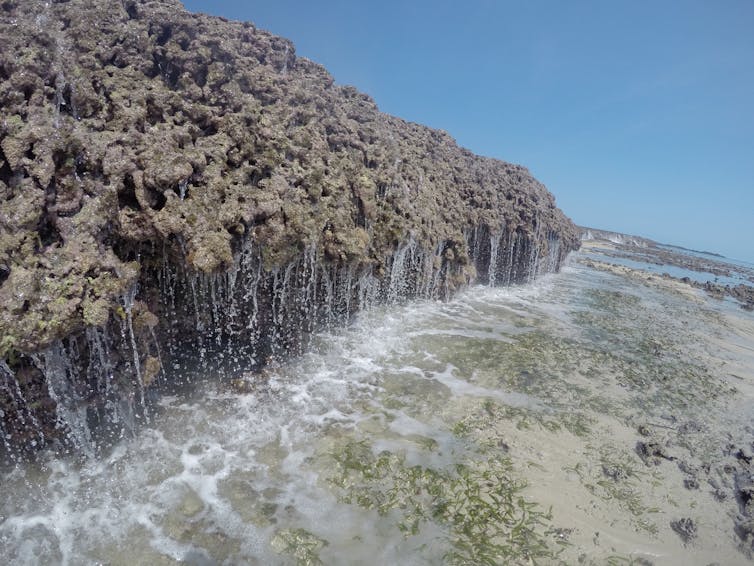 Some reefs already experience conditions expected at the end of the century. Steeve Comeau, CC BY-NC-ND
2. Presently degraded reefs take over future reefs. These reefs are dominated by bio-eroders such as sponges and sea urchins and have low coral cover.
3. Corals can gain heat tolerance to an extent that keeps pace with low to moderate greenhouse gas emissions scenarios. Under these scenarios, only about 36% of global corals would be lost and there would be a moderate reduction in growth. These heat-tolerant reefs are dominated by faster growing corals with symbiotic microalgae that can evolve heat tolerance.
4. Reefs where restoration practices include using heat-tolerant corals that can then disperse to other regions. These restored reefs would have lower coral cover in remote regions lacking restoration or with unsuccessful restoration practices. This kind of reef restoration would need to cover half of global coral reefs to maintain net growth – an unlikely scenario.
We found coral reefs transition to net erosion under all scenarios, even under low to moderate greenhouse gas emissions, meaning they are dissolving or being eaten faster than they can grow. Only reefs with heat-tolerant corals could prevent this from occurring.
The next step for the scientific community is to determine which reefs can persist in the future using global efforts to combine information. The major issues is that we are missing measurements from large parts of the Pacific, and we do not know how deoxygenation or coastal darkening will impact coral reefs. The processes of reef bioerosion and dissolution are also poorly described.
Although the climate has been altered to the point of threatening the future survival of coral reefs, their fate is not doomed yet if we act now.
Another question is how long reef structures will persist after living corals are removed. We do not have an answer yet. It will take global efforts to rapidly obtain these measurements to better manage and protect coral reefs before climate change intensifies.
It is up to governments everywhere, including New Zealand, to better support these initiatives before it is too late.
Christopher Cornwall, Lecturer in Marine Biology, Te Herenga Waka — Victoria University of Wellington and Orlando Timmerman, Doctoral Candidate in Earth Sciences, University of Cambridge
This article is republished from The Conversation under a Creative Commons license. Read the original article.