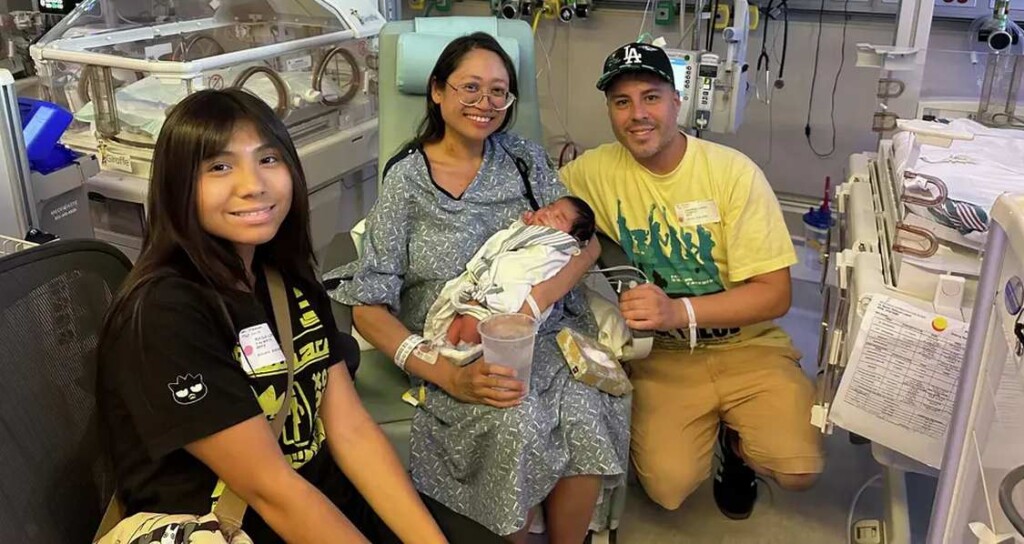
This photo provided by the family shows, from left, Kaila, Suze, Ryu and Andrew Lopez at Cedars-Sinai hospital in Los Angeles in August 2025 – family photo
A Los Angeles woman recently celebrated the first Christmas with her baby boy, Ryu, born to truly remarkable circumstances.
Ryu developed outside his mother’s womb, and remained hidden for months behind an ovarian cyst that grew to be the size of a basketball. It was so unbelievable, the surgical/OBGYN team that delivered Ryu documented it for a case study in a medical journal.
The manner in which Ryu came into being represents a circumstance that’s “far, far less than 1 in a million,” said Dr. John Ozimek, medical director of labor and delivery at Cedars-Sinai in Los Angeles, where Ryu was born. “I mean, this is really insane.”
Now 41, Suze Lopez has always had an irregular cycle, so missed periods—even consecutive ones—are a normal occurrence. It was almost 20 years ago that she was diagnoses with a pair of ovarian cysts, one of which was removed immediately, and one of which was not.
So in early 2025 when Lopez noted her abdomen swelling, her first thought was the cyst. She never felt kicking, and never had morning sickness—and indeed her instinct was at least partly correct.
The pressure and pain in her abdomen grew as days passed, and she was certain that, even if it risked her ability to conceive again, it was time to remove the other cyst which unbeknownst to her had grown to weigh a mind-boggling 22 pounds.
She needed a CT scan to prepare for surgery, which required a pregnancy test for the radiation, and to her utter surprise the test came back positive. Lopez was delighted, but the pain and discomfort grew and soon she had to be hospitalized at Cedars-Sinai where her medical team found a near fully-developed fetus in an amniotic sack lodged against her pelvis.
The term for where the fetus develops is “implants” and the term for a fetus that implants outside of the womb is an “ectopic pregnancy.” Almost all of these go on to rupture and hemorrhage. As such, fetal mortality can be as high as 90% in such cases and birth defects are seen in about 1 in 5 surviving babies, SF Gate reports.
However, because fetal Ryu implanted against the pelvic wall and not against the liver, it was far more manageable, and the reason why Lopez didn’t have more pain earlier.
Lopez and her boy beat the odds, despite a mammoth surgical procedure that both delivered Ryu at 8 pounds and removed the ovarian cyst—together weighing as much as an adult bobcat. During the procedure, Lopez lost half her blood, and had to be continually given transfusions.
“The whole time, I might have seemed calm on the outside, but I was doing nothing but praying on the inside,” Andrew Lopez, Suze’s husband, told SF Gate. “It was just something that scared me half to death, knowing that at any point I could lose my wife or my child.”Instead, they both survived without any maleffects. Ryu “completes” their family, said his mother, and recently celebrated his first Christmas alongside his older sister Kaila. Mom and Baby Beat 1-in-a-Million Odds to Survive the ‘Rarest of Pregnancies