
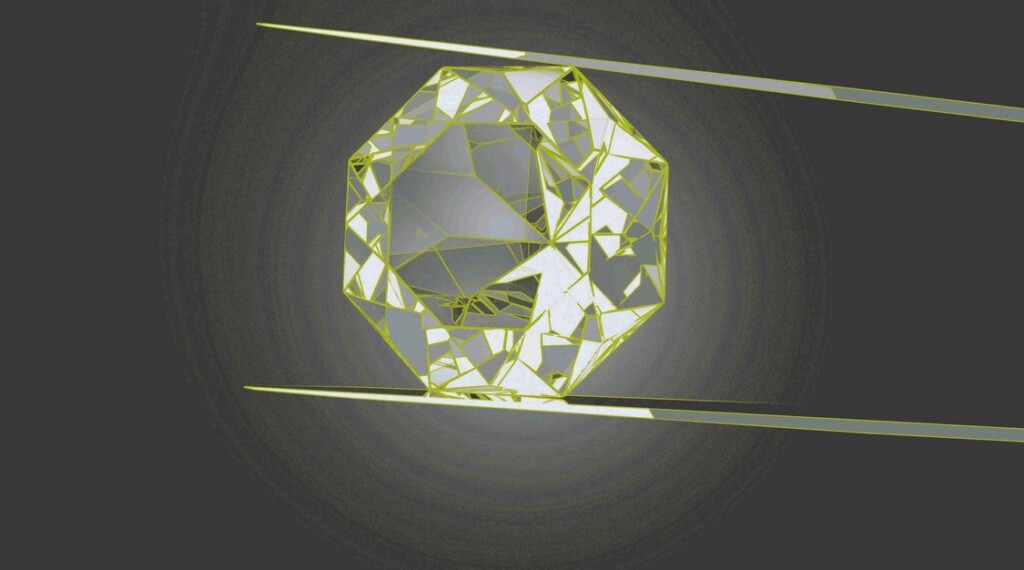
 GNN-created image
An invention from the UK features diamonds in the first-ever application of the gemstone in battery technology.
Promising to last thousands of years, the microwatt power sources are seen as the perfect solution to devices in environments where neither changing batteries nor carrying around extras are options.
Developed by the University of Bristol in partnership with the UK Atomic Energy Authority (UKAEA), the battery contains a radioactive isotope of carbon called carbon-14.
Isotopes are forms of chemical elements with the same number of protons but a different number of neutrons. Some are stable, but those that aren’t are radioactive and emit radiation as they decay.
In the battery, a radioactive carbon-14 isotope is encased inside a shell of diamond, the hardest substance known to man.
“Diamond batteries offer a safe, sustainable way to provide continuous microwatt levels of power. They are an emerging technology that use a manufactured diamond to safely encase small amounts of carbon-14,” said Sarah Clark, the director of Tritium Fuel Cycle at the (UKAEA), in a statement.
Electricity via the battery is generated in a way similar to a solar panel through the betavoltaic effect—harnessing the electrons emitted by the carbon-14 and captured by the diamond matrix.
Carbon-14 has a half-life of about 5,700 years, meaning that it would be several thousand years before the diamond Duracell bunny inside would start to tire out, making it ideal for spacecraft and satellites which can’t undergo maintenance easily, or in medical devices like pacemakers which have to be implanted and which cannot for the sake of the user have a battery change on the go.
“Our micropower technology can support a whole range of important applications from space technologies and security devices through to medical implants,” Tom Scott, a professor in materials at the University of Bristol, said in the statement. “We’re excited to be able to explore all of these possibilities, working with partners in industry and research, over the next few years.”The idea gives a whole new meaning to that old adage about how diamonds are forever. World's First Diamond Battery Could Power Spacecraft and Pacemakers for Thousands of Years


