New Airship-style Wind Turbine Can Find Gusts at Higher Altitudes for Constant, Cheaper Power

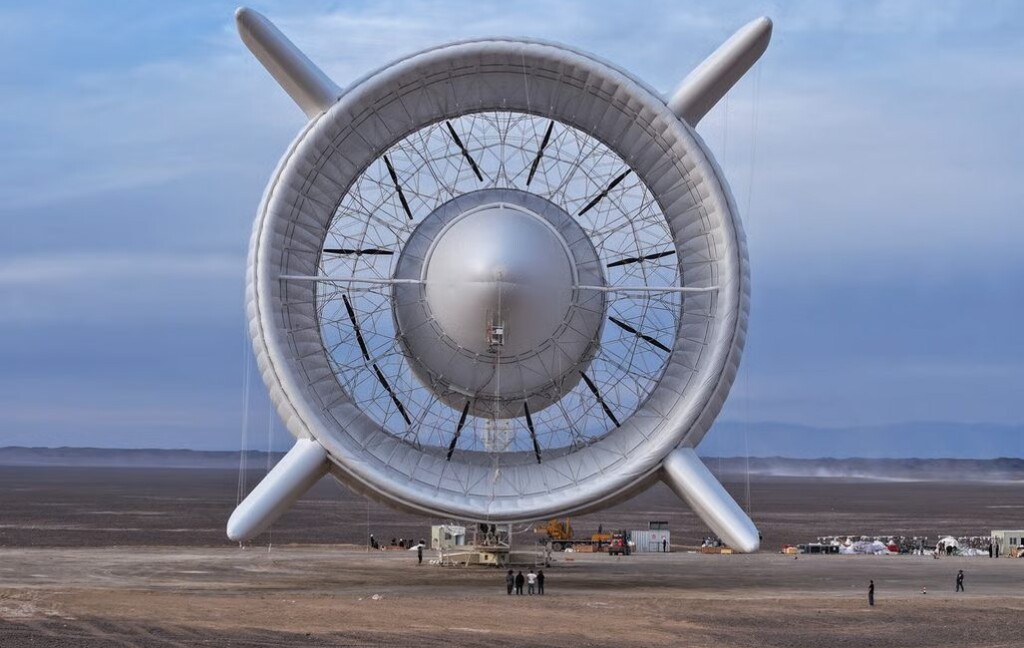
The S1500 from Sawes – credit, handout

A new form of wind energy is under development that promises more consistent power and lower deployment costs by adapting the design of a dirigible, or zeppelin.

Suspended 1,000 feet up where the wind is always blowing, it presents as an ideal energy source for rural communities, disaster areas, or places where wind turbines aren’t feasible to build.

The design has grown through multilateral innovation by dozens of engineers and scientists, but an MIT startup called Altaeros, and Beijing-based start-up Sawes Energy Technology have taken it to market. Both have already produced prototypes that boast some serious performance.


In 2014, Altaeros’ Buoyant Air Turbine (or BAT) was ready for commercial deployment in rural Alaska, where diesel generators are still heavily relied on for power. Its 35-foot-long inflatable shell, made of the same materials as modern blimps, provided 30 kilowatts of wind energy.

As a power provider, though, Altaeros could never get off the ground, and now has adopted much of its technology to the provision of wireless telecommunication services for civil and commercial contracting.

Heir to Altaeros’ throne, Sawes has managed to greatly exceed the former’s power generation, and now hopes to achieve nothing less than contributing a Chinese solution to the world’s energy transition.
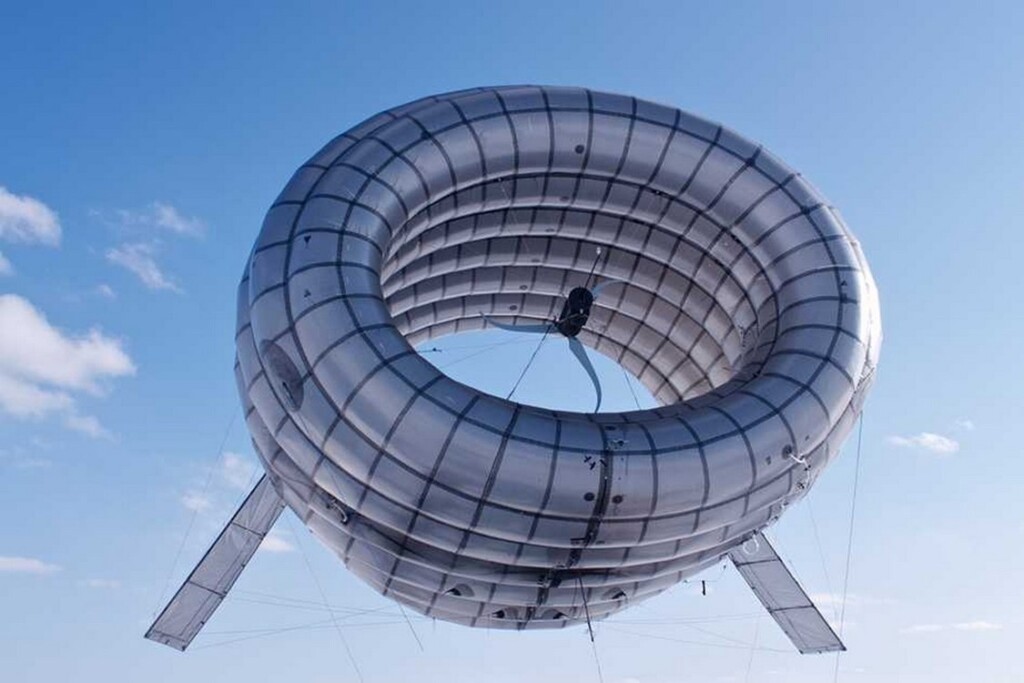
Altaeros’ BAT – credit, Altaeros, via MIT

During a mid-September test, Sawes’ airship-like S1500, as long and wide as a basketball court and as tall as a 13-storey building, generated 1 megawatt of power which it delivered through its tether cable down to a generator below.

Conducted in the windy, western desert province of Xinjiang, the S1500 surpassed the capabilities of its predecessor turbine by 10-times, which achieved 100 kilowatts in October of last year.

Dun Tianrui, the company’s CEO and chief designer, called the megawatt-mark “a critical step towards putting the product into real-world use” which would happen next year when the company expects to begin mass production.

At the same time, the Sawes R&D team is looking into advances in materials sciences and optimization of manufacturing that will ensure the cost of supplying that megawatt to rural grids will be around $0.01 per kilowatt-hour—literally 100-times cheaper than what was theorized as the cost for Altaeros’ model from 10 years ago.

One of the major positives of the BAT is that by floating 1,000 to 2,000 feet above the ground, they render irrelevant the main gripe and failing of wind energy—that some days the wind doesn’t blow. A conventional turbine reaches only between 100 and 300 feet up, putting birds at risk as well as not collecting all the air that’s blowing over the landscape.

Sawes’ unit is about 40% cheaper to build and deploy than a normal turbine, presenting the opportunity for a 30% lower cost for buying the wind energy.According to a piece in the Beijing Daily, reported on by South China Morning Post, challenges remain before commercial deployment can begin, including what to do during storms, and whether or not it will compete in communities with existing coal-power supply. New Airship-style Wind Turbine Can Find Gusts at Higher Altitudes for Constant, Cheaper Power
Read More........

Worldwide spending on AI is expected to be nearly $1.5 trillion in 2025: Report

IANS Photo

New Delhi, (IANS): Worldwide spending on artificial intelligence (AI) is expected to be nearly $1.5 trillion in 2025, up nearly 50 per cent up from $987,904 in 2024, a report said on Monday.

Further, the overall global AI spending is likely to top $2 trillion in 2026, led by AI integration into products such as smartphones and PCs, as well as infrastructure, according to a business and technology insights company Gartner, Inc report.

Mirroring last year's spending graph, generative AI integration in smartphones would lead the spending at $298,189 this year as well, followed by AI services ($282,556), AI-optimised servers ($267,534), AI processing semiconductor ($209,192), AI application software ($172,029) and AI infrastructure Software ($126,177).

"The forecast assumes continued investment in AI infrastructure expansion, as major hyperscalers continue to increase investments in data centres with AI-optimised hardware and GPUs to scale their services," said John-David Lovelock, Distinguished VP Analyst at Gartner.

"The AI investment landscape is also expanding beyond traditional U.S. tech giants, including Chinese companies and new AI cloud providers. Furthermore, venture capital investment in AI providers is providing additional tailwinds for AI spending," he added.

According to the report, the AI spending would reach $2.02 trillion in 2026 following a similar growth trajectory.

In 2026, spending on Generative AI integration in smartphones is likely to be at $393,297. Meanwhile, the spending on AI Services would reach $324,669, and for AI-optimised servers, it would go around $329,528

Similarly, AI processing semiconductor ($267,934), AI application software ($269,703) and AI infrastructure software ($229,885) will also put weight in spending on AI.

The other segments, attracting AI spending, would be AI PCs by ARM and x86, AI-optimised IaaS, and GenAI Models.Gartner providers equip tech leaders and their teams with role-based best practices, industry insights and strategic views into emerging trends and market changes to achieve their mission-critical priorities and build the successful organisations of tomorrow. Worldwide spending on AI is expected to be nearly $1.5 trillion in 2025: Report | MorungExpress | morungexpress.com
Read More........

How math and impatient driving inspired student's award-winning startup

UWM PhD student Joel Roberts is the founder of Shepherd Traffic, a company that uses computer vision, geometry and smart algorithms to capture more detailed and accurate traffic data than what’s currently available. (UWM Photo/Laura Otto)

Joel Roberts really hates sitting at red lights – especially the ones that hold you hostage while not a single car passes in the cross-direction.

“Sitting in traffic bothers me,” said Roberts, a PhD student in civil engineering at UWM. “So, getting drivers through intersections efficiently is interesting to math guys like myself because it’s basically an optimization problem.”

Now, that everyday frustration has fueled something bigger: an award-winning startup.

Roberts is the founder of Shepherd Traffic, a company that uses computer vision, geometry and smart algorithms to capture more detailed and accurate traffic data than what’s currently available. The idea is to let the computer do the watching – and the counting.

When traffic management professionals need to time a light or redesign roads, the initial data they need are object counts and classifications, which you can take from videos.

His pitch for the company beat out top student innovators from across Wisconsin to win the $2,500 grand prize at the WiSys Big Idea Pitch Competition.

Smarter intersections, less waiting

Traffic lights usually run on fixed timing patterns that do not respond to the small nuances of traffic, Roberts said. Timings get the main gist of traffic, but they can’t optimize every exact situation. A fully adaptive system would.

“The first thing I built was an algorithm that recognizes and calculates the delay for every object – cars, trucks, bikes, pedestrians – at any given point when the light changes,” he said. “It figures out the best moment to switch to minimize everyone’s wait.”

His system doesn’t just count objects. It logs trajectories and could help predict movement.

And unlike many competitors who still rely on manual traffic counting (clipboards and all), Roberts’ approach is automated – making it faster, cheaper and more scalable.

From idea to incubator

The turning point came two years ago when Roberts took his idea to UWM’s Lubar Entrepreneurship Center. Encouraged by friends, he applied to I-Corps, a national program that helps turn university research into startups.

He applied to the program as a community member and met Xiao Qin, UWM professor of civil engineering and an expert in traffic systems. Qin not only agreed to help him but also encouraged Roberts to pursue his graduate studies at UWM, where he also received an assistantship.

As a graduate student in the department, Roberts could work on his startup as part of his academic research.

That turned out to be pivotal to advancing his goals, Roberts said.

“I needed time to work on this project, deeper expertise and a way to support myself while doing it,” he said. “I’m grateful to Dr. Qin, who also is an expert in many aspects of what I’m building my business on.”

The road ahead

Through I-Corps, Roberts learned that it’s not uncommon for 40% of traffic project budgets to be spent just on data collection. That’s a huge opportunity, he said, especially if his system can deliver better results at a lower cost.

Looking ahead, he plans to expand his data capabilities to include pedestrians — often overlooked in traffic studies — and to add the aspect of data involving “near misses,” a topic that Qin has conducted research on.

He hopes his system can one day help forecast risky driving behavior — such as the likelihood of someone running a red light. It’s the kind of insight that could transform how cities plan intersections, adjust signal timing and improve safety.

He’s also exploring two business models: selling the traffic insights directly or licensing the software behind them.For now, the demand may be modest. But as smart cities grow and infrastructure modernizes, Roberts believes his vision for data-driven intersections will be right on time. How math and impatient driving inspired student's award-winning startup
Read More........