Spectacular New Species Found in Cambodia’s Limestone Caves–Asia's 'Little Laboratories'

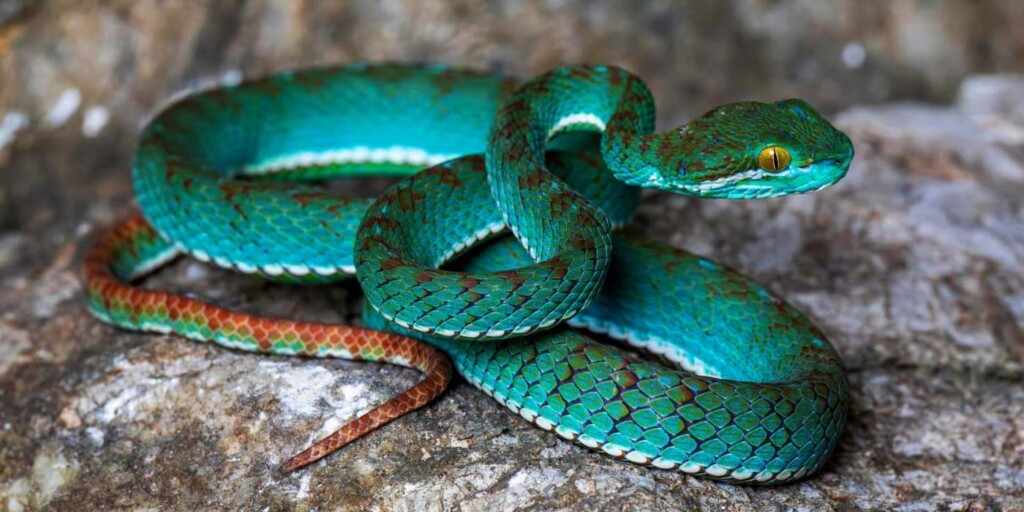
A new species of pit viper found living in the caves – credit, supplied by Fauna & Flora ©

A breathtaking expedition high among limestone escarpments and deep in the cave systems they contain has revealed several new reptile species, including a dazzling pit viper you have to see to believe.

Exploring over 60 caves across 10 hills in the Battambang province, western Cambodia, the survey uncovered a treasure trove of extraordinary creatures besides, many found nowhere else on Earth.

The survey was led by Fauna & Flora International in collaboration with Cambodia’s Ministry of Environment and field experts. The team identified 6 new geckos, 2 micro-snails, and 2 millipedes in addition to the viper.


They also confirmed the presence of many threatened species in the landscape surrounding the caves—such as the Sunda pangolin, Indochinese silvered langur, long-tailed macaque, and green peafowl, further highlighting the critical need to protect this habitat.

Karst covers 20% of the Earth’s landscape. This soluble bedrock made of limestone has created some of the most spectacular rocky landscapes on Earth—including the upturned egg cartons shapes along the great South China Karst, Ha Long Bay in Vietnam, Tsingy de Bemaraha in Madagascar, The Burren in western Ireland, the world’s largest wellspring in Vrelo Bune, Bosnia, the Cenotes of the Yucatan, in Mexico, and Mammoth Cave in the US.

The susceptibility of karst to erode from rainfall has seen it carved into a million beautiful and dramatic shapes that often play host to microclimates where threatened animals can thrive.

Landscapes along the Li River amid the South China Karst – credit, Sam Beasley via Unsplash

Dr. Lee Grismer, a professor of biology at La Sierra University in the US, was part of the expeditionary team, and spoke to F&F about the importance and uniqueness of the landscape.

“Each one of these isolated karst areas act as their own little laboratory where nature is performing the same experiment over and over and over independently. The results are species that exist nowhere else—not just nowhere else in the world, or that country—but in no other cave.”
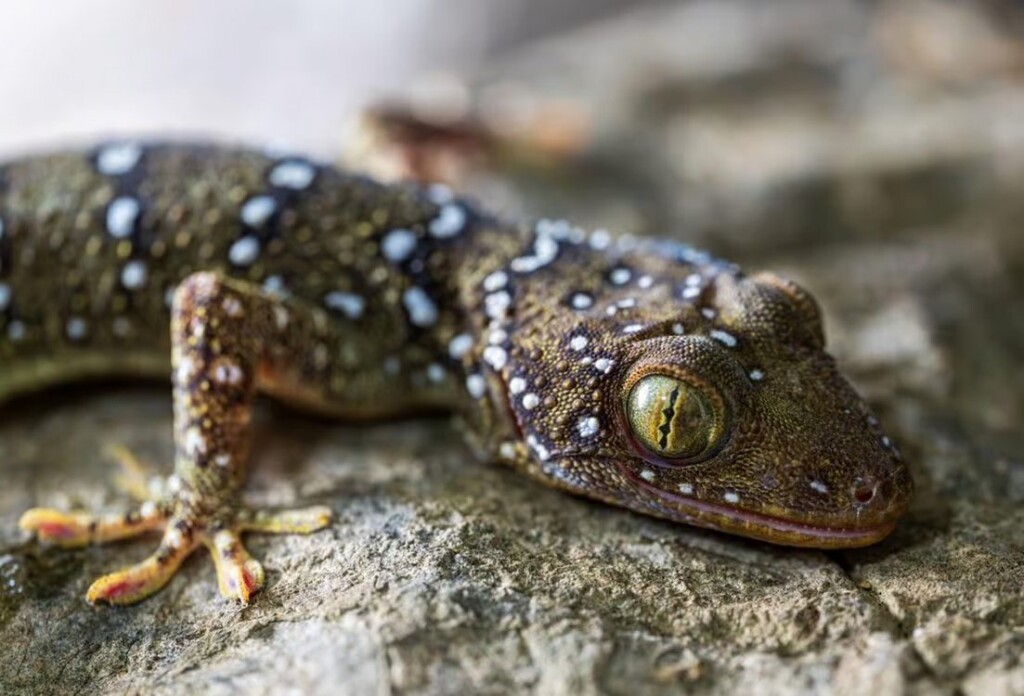
The Shiva Gecko – credit, supplied by Fauna & Flora ©

Indeed, caves from easily in karst landscapes, and many of the world’s longest and largest—and least-explored—cave systems are found in East and Southeast Asia.

This is certainly the case in Battambang, where the survey team had first to ascend the steep forested slopes of the karst outcrops before scrambling and squeezing through crevices and crawlspaces to reach the cave systems.

Inside, they documented a rich array of life, both endemic to the caves and others—like a big reticulated python—who were just visiting. While the chatter of the Endangered silvered langur troupe, faded behind them, the team began encountering animal after animal that had never been described by science.

A spectacular new species of pit viper (from the Trimeresurus genus) was collected during the survey and is currently being described. Recognized by their triangular heads, these highly venomous snakes track down their warm-blooded prey using the heat-sensitive pits behind their nostrils.

4 populations of the striped Kamping Poi bent-toed gecko were found and identified as a new species: Cyrtodactylus kampingpoiensis. Despite being described as just one species, it is thought that, due to the geographic isolation of the karst formations, these 4 populations are on separate evolutionary trajectories, and further genetic analyses may reveal whether they are in fact 4 different species instead of 1.

Another new species of gecko was named after the Hindu god of destruction: Shiva.

In a statement, Fauna & Flora International said it is working with local partners to help conserve Cambodia’s karst landscapes, epitomized through the recent release of guidelines for sustainable development and management of cave ecosystems.
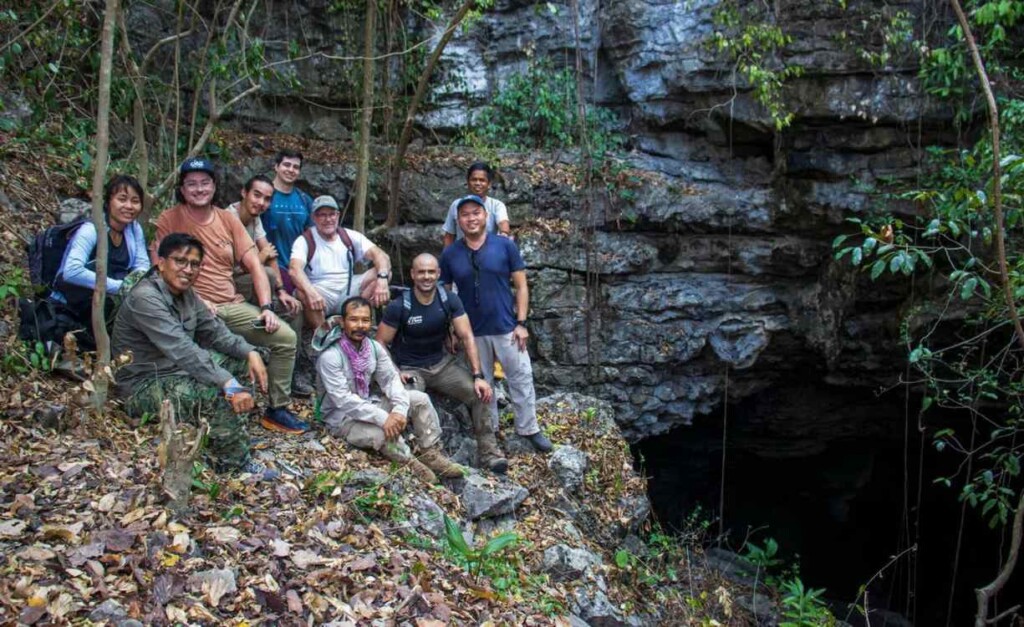
The Fauna & Flora International expeditionary team – credit, supplied by Fauna & Flora ©

The guidelines integrate international best practices with Cambodian context, providing practical measures to safeguard bat colonies, preserve rare and endemic cave biodiversity, promote sustainable guano harvesting and ensure responsible tourism development.

“Cambodia’s karst areas are a treasure trove of scientific secrets waiting to be uncovered,” said Sothearen Thi, Karst Biodiversity Coordinator at Fauna & Flora in the statement.“But, without sustainable management, we may never find out what these areas truly hold. Karst landscapes are facing many human-driven challenges, and biologically significant species could go extinct before they have even been discovered. We are working with the Cambodian government and local partners to increase protection of the landscapes, with sustainable management being the number one priority.” Spectacular New Species Found in Cambodia’s Limestone Caves–Asia's 'Little Laboratories'
Read More........

Quantum computers are coming to break our codes faster than anyone expected

Craig Costello, Queensland University of Technology

Online data is generally pretty secure. Assuming everyone is careful with passwords and other protections, you can think of it as being locked in a vault so strong that even all the world’s supercomputers, working together for 10,000 years, could not crack it.

But last month, Google and others released results suggesting a new kind of computer – a quantum computer – might be able to open the vault with significantly less resources than previously thought.

The changes are coming on two fronts. On one, tech giants such as IBM and Google are racing to build ever-larger quantum computers: IBM hopes to achieve a genuine advantage over classical computers in some special cases this year, and an even more powerful “fault-tolerant” system by 2029.

On the other front, theorists are refining quantum algorithms: recent work shows the resources needed to break today’s cryptography may be far lower than earlier estimates.

The net result? The day quantum computers can break widely used cryptography – portentously dubbed “Q Day” – may be approaching faster than expected.

The quantum hardware race

Quantum computers are built from quantum bits, or qubits, which use the counterintuitive properties of very tiny objects to carry out computations in a different and sometimes far more efficient way from traditional computers.

So far the technology is in its infancy, with the major goal to increase the number of qubits that can be connected to work as a single computer. Bigger quantum computers should be much better at some things than their traditional counterparts – they will have a “quantum advantage”.

Late last year, IBM unveiled a 120-qubit chip which it hopes will demonstrate a quantum advantage for some tasks.

Google also recently announced it planned to speed up its move to adopt encryption techniques that should be safe against quantum computers, known as post-quantum cryptography.

Alongside these tech giants, newer approaches are also flourishing. PsiQuantum is using light-based qubits and traditional chip-manufacturing technology. Experimental platforms such as neutral-atom systems have demonstrated control over thousands of qubits in laboratory settings.

In response, standards bodies and national agencies are setting increasingly concrete timelines for moving away from common encryption systems that are vulnerable to quantum attack.

In the United States, the National Institute of Standards and Technology (NIST) has proposed a transition away from quantum-vulnerable cryptography, with migration largely completed by 2035. In Australia, the Australian Signals Directorate has issued similar guidance, urging organisations to begin planning immediately and transition to post-quantum cryptography by 2030.

Algorithms make the lock-picking faster

Hardware is only half the story. Equally important are advances in quantum algorithms – ways to use quantum computers to attack encryption.

Much interest in quantum computer development was spurred by Peter Shor’s 1994 discovery of an algorithm that showed how quantum computers could efficiently find the prime factors of very large numbers. This mathematical trick is precisely what you need to break the common RSA encryption method.

For decades, it was believed a quantum computer would need millions of physical qubits to pose a threat to real-world encryption. This is far bigger than current systems, so the threat felt comfortably distant.

That picture is now changing.

In March 2026, Google’s Quantum AI team released a detailed study showing that far fewer resources may be needed to attack a different kind of encryption which uses mathematical objects called elliptic curves. This is what systems including Bitcoin and Ethereum use – and the study shows how a quantum computer with fewer than half a million physical qubits may be able to crack it in minutes.

That’s still a long way beyond current quantum computers, but around ten times less than earlier estimates.

At the same time, a March 2026 preprint from a Caltech–Berkeley–Oratomic collaboration explores what might be possible using neutral-atom quantum computers. The researchers estimate that Shor’s algorithm could be implemented with as few as 10,000–20,000 atomic qubits. In one design they propose, a system with around 26,000 qubits could crack Bitcoin’s encryption in a few days, while tougher problems like the RSA method with a 2048-bit key would need more time and resources.

In plain terms: the codebreakers are becoming more efficient. Advances in algorithms and design are steadily lowering the bar for quantum attacks, even before large-scale hardware exists.

What now?

So what does this mean in practice?

First, there is no immediate catastrophe – today’s cryptography won’t be broken overnight. But the direction of travel is clear. Each improvement in hardware or algorithms reduces the gap between current capabilities and useful quantum cracking machines.

Second, viable defences already exist. NIST has standardised several post-quantum cryptographic algorithms which are believed to be resistant to quantum attacks.

Technology companies have begun deploying these in hybrid modes: Google Chrome and Cloudflare, for example, already support post-quantum protections in some protocols and services.

Systems that rely heavily on elliptic-curve cryptography – including cryptocurrencies and many secure communication protocols – will need particular attention. Google’s recent work explicitly highlights the need to migrate blockchain systems to post-quantum schemes.

Finally, this is a two-front race. It is not enough to track progress in quantum hardware alone. Advances in algorithms and error correction can be just as important, and recent results show these improvements can significantly reduce the estimated cost of attacks.

Every new headline about reduced qubit counts or faster quantum algorithms should be understood for what it is: another step toward a future where today’s cryptographic assumptions no longer hold.

The only reliable defence is to move – deliberately but decisively – toward quantum-safe cryptography.The Conversation

Craig Costello, Professor, School of Computer Science, Queensland University of Technology

This article is republished from The Conversation under a Creative Commons license. Read the original article.

Read More........