Record-Breaking Night of Bird Migration Caught on Radar During a ‘Perfect Storm’ for Feathered Flight

BirdCast

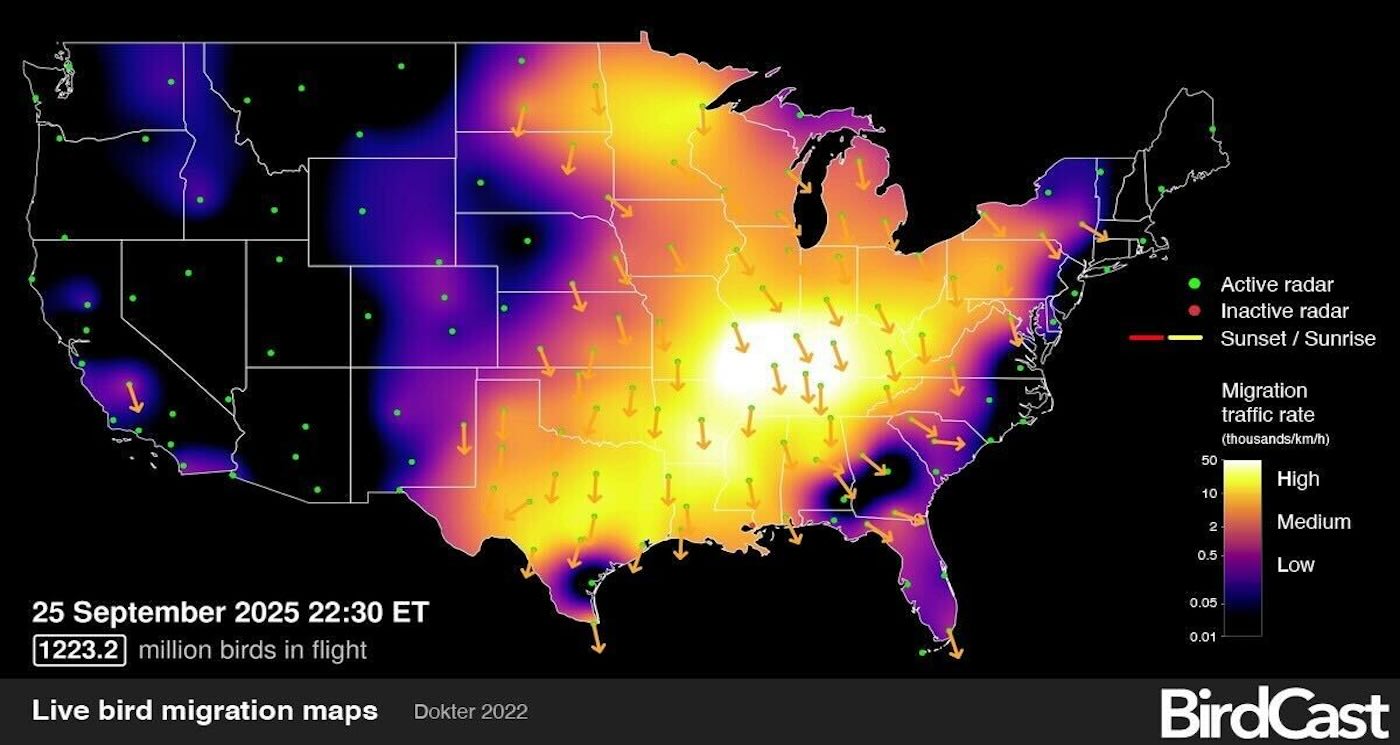
More than 1.2 billion birds streamed south in one night during their Fall migration in late September—the largest single-night total ever recorded by the American live radar project.

Called BirdCast, a collaboration led by the Cornell Lab of Ornithology, the platform uses the same weather radar technology behind daily forecasts to track migrating birds.

On its live migration map, BirdCast tracked more than 1.2 billion birds streaming toward their wintering grounds after sunset on September 25—the largest single-night total recorded since the project began mapping live migrations in 2018.

“These numbers are almost inconceivable,” said Andrew Farnsworth, a visiting scientist at the Cornell Lab of Ornithology and longtime BirdCast researcher. “They’re enormous… even for people that study migration regularly. The scale of how many organisms that this represents, is just mind blowing.”

The surge surpasses the previous milestone of one billion birds, first observed during the migration in October 2023. Both included well over one hundred species flying toward warmer weather, including songbirds and shorebirds.

Farnsworth said this seemingly rare night captured about 10% of the continent’s birds in flight at the same time. On an average fall night during peak migration, about 400 million birds are detected in flight at the same time above the United States, but on this night, the number was three times that.

“It’s really unbelievable,” he said.

While astonishing to both birders and scientists, Farnsworth said this event was not random. It resulted from a combination of ideal migrating conditions coinciding with the peak of fall migration.

The weather that night was perfect for travel, he explained in a media release. It featured calm winds—including tail winds that helped push the birds along their migratory paths across much of the center of the country and the Mississippi River valley.

Farnsworth said this record-breaking migration—documented by radar technology that was never intended to track birds—is a chance to not only to marvel at the immense magnitude of bird migration but also a chance to remind the public that the data is freely available and accessible in real time.

The technology at BirdCast.org allows anyone to view forecast maps that predict the number of birds migrating while live migration maps show migration happening in real time. Both tools let people know when birds are moving nearby, so they can take necessary precautions to protect them.

“BirdCast gives the ability for more people to engage in and participate in this incredible spectacle,” Farnsworth said, whose Cornell Lab partners with three US universities in the project: Purdue, Illinois Urbana-Champaign, and Massachusetts Amherst.

It’s also a timely reminder that you can help make birds’ journeys safer. Every year, more than one billion birds die in collisions with windows in the United States.

Bright lights can disorient birds migrating at night, drawing them into areas where collisions with glass are common. To assist our feathered friends, turn off nonessential lights at night. You can also add bird friendly film or other markings on the outside of windows. Learn more at stopbirdcollisions.org. Record-Breaking Night of Bird Migration Caught on Radar During a ‘Perfect Storm’ for Feathered Flight
Read More........

Shark Net: Dr. Barbara Block/TOPP release great app to track California's white sharks

I have been fortunate to meet and speak with many accomplished marine scientists and researchers. One who is definitely on my Top 10 list is Dr. Barbara Block. Based at Stanford University, California, she oversees TOPP (Tagging of Pacific Predators), a program started in 2000 that tracks pelagic animals from tuna to swordfish to turtles to great white sharks, and more. (Couple of previous posts on the subject here & here.) Barbara is a spunky taskmaster but, working with her staff, it is that very drive  that  has  enabled
TOPP to discover many of the secrets involving the migration patterns of these large and critically important animals.  It was TOPP that coined the phrase "White Shark Cafe" to describe where great white sharks from California and Mexico migrate to in the Pacific Ocean. One particularly important finding regarding these migration patterns was the possible explanation for the seasonal nature of the sharks' sojourns: Mid-Pacific upwellings which bring nutrients that feed the food chain and ultimately replenish the larger fish that the sharks feed on. Cyclical weather and ocean movement patterns produce these upwellings - and as climate change continues to present itself, there is always the possibility of shifts in the upwelling cycle that could have unknown consequences for these animals. Whenever I am called upon to speak about sharks, these fascinating migration patterns are always a topic I include as I am guaranteed they will mesmerize my audience. So, thank you, Dr. Block! While Internet users can monitor the ongoing activities of TOPP through its website, it's now possible to carry it with you on your iPhone or iPad. Shark Net - Predators of the Blue Serengeti is available fromiTunes at no charge (as in free!) and provides a range of features on the cataloging and whereabouts of those most iconic of California ocean predators, the great white shark. Users can get updates on the latest monitoring of sharks, pinpoint the location of the tracking buoys that gather the data, and get biographies, photos, and videos about many of the sharks that frequent California's waters. There are other apps available that provide white shark tracking info but this is thedefinitive app for monitoring the white sharks that ply the waters off California's coast - and beyond, thanks to those incredible migration patterns. In a recent interview for U.K.'s The Guardian, Dr. Block explained her use of the term "Blue Serengeti" to describe California's coastal waters and the large migration patterns that occur within it. "White sharks and tuna travel for thousands of miles before returning to the same hot spot just as salmon do when they return to the same stream. These journeys are the marine equivalent of wildebeest migrations that take place on the Serengeti plain in Africa. That is why I call this part of the Californian coast the Blue Serengeti." "Everyone knows about watering holes on the Serengeti even though most of us have never been there. We can just close our eyes and see the zebras, the elephants and the hyenas. We want to do the same for the migration hot spots we have found off the coast of California." Dr. Block and TOPP are setting new standards for ocean animal tracking, expanding on the various GPS and satellite tracking methods (which can sometimes provide data intermittently) to include cutting-edge, round-the-clock monitoring technology using monitoring networks or even self-contained, solar-powered tracking stations like Wave Glider that travels the currents along the California coast.  Through the efforts of TOPP and consumer apps like Shark Net, Dr. Block hopes to bring the hidden complexity of our ocean planet to a wider audience. Humankind's curiosity makes it look outward, and that has lead us into the stars. But there is a whole world to be discovered starting right at the shoreline. "Human technology has made it to Mars. We are transmitting gorgeous pictures from it. Yet we have not explored our own planet. Two-thirds of it is covered with oceans that are still mysterious places. We are trying to hook people up to what is going on out there now and get them to realize that it could all be lost if we did not do something to protect it. Ultimately, I want to create a world heritage site here. Wiring up the oceans, as we are doing, is our way to get people to understand the importance of these places."Source: RTSea
Read More........