
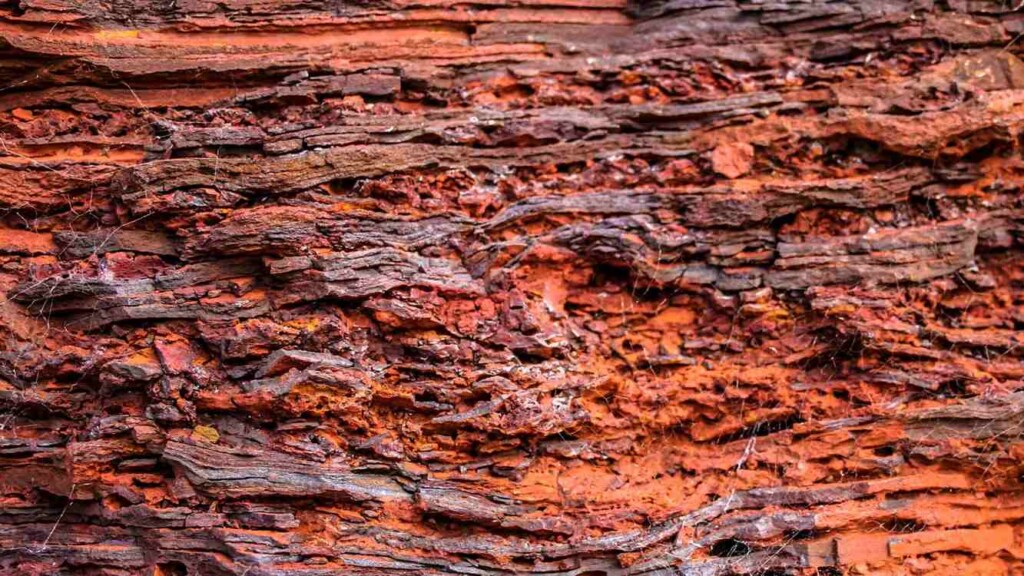
 Classic Australian Pilbara region banded iron formations – credit, Edith Cowan University, released
Scientists have revealed that Australia may hold the key to generating ample green energy while creating a major export industry, and that it’s buried underneath their feet.
The breakthrough centers on magnetite, a mineral found in Western Australia’s vast iron ore deposits throughout the Pilbara region.
Researchers at Edith Cowan University’s School of Engineering have discovered that when magnetite reacts with hot water deep underground, it can generate hydrogen gas: one of the only proven green energies that can power the heaviest machinery, like jets, ships, and trains.
When not thusly found as a naturally occurring deposit, hydrogen gas can be easily created through electrolysis, but if that process is powered by fossil fuels, then the end product cannot really be called zero emission fuel. If it’s powered by renewable energy such as solar and wind, it can be, but issues exist with scaling and economic viability because of the amount of power electrolysis requires.
The ECU team has found a way to stimulate hydrogen production by injecting a solution into banded iron formations, significantly increasing the potential to harness this resource.
“Australia could be sitting on a massive, untapped energy reserve, and the potential is enormous,” Associate Professor Alireza Keshavarz said in a news release from the university. “There is enough hydrogen for Australia to benefit for generations, and potentially enough for us to become a major exporter of clean energy to the rest of the world.”
To test the theory, researchers exposed magnetite samples to water at temperatures of 200°C and under high-pressure conditions for 60 days, replicating the environment found deep beneath the surface of Australia’s famous red deserts, where the rock is so rich in iron oxides that it appears red.
The research provides one of the clearest insights yet into how natural hydrogen forms underground and the conditions needed to sustain production.
“Western Australia has some of the world’s largest banded iron formations. If we can unlock this resource at scale, it could be transformative for our energy future,” lead author Kaveh Moghanirahimi said.
“We even see the potential for Western Australia to strengthen its energy independence during times of crisis through access to this naturally generated hydrogen.”
Professor Stefan Iglauer, from ECU’s School of Engineering, said the study moves the science closer to real-world hydrogen exploration.
“This work helps bridge the gap between laboratory experiments and real geological systems,” Professor Iglauer said.
“Our findings show that hydrogen production depends not only on the amount of magnetite present, but also on how easily water can access fresh mineral surfaces through fractures, pores and permeable pathways.”
The experiment saw a 1.5-gram sample of banded iron slab rock compared with 200 milligrams of magnetite powder. Because of its porosity, the powder produced 5-times more hydrogen gas by weight than the slab.
The amount of hydrogen was minimal—just one 50th the content of an average raindrop—but 200 milligrams of powdered stone is also quite small, and given that the supposition of the scientists is to use a large section of the Australian continent as a hydrogen deposit, scale would presumably make up for the minimal gas generation.The research was published in the International Journal of Hydrogen Energy. Scientists Determine Australia's Vast Red Deserts Could Fuel a Hydrogen-Powered Energy Revolution

 – credit, EverDye
