Rare Bird Moment as Photographer Witnesses Mistle Thrush Feeding Orphaned Blackbird as Her Own

Mistle thrush feeds orphaned blackbird juvenile Credit: Andrew Fusek-Peters via SWNS

Birds of a feather usually flock together, but a lucky blackbird was ‘adopted’ by a mistle thrush mama who took the juvenile ‘under her wing’ in a rare case of inter-species feeding.

Photographer Andrew Fusek-Peters captured the rare phenomenon in adorable close-up photos that show the female adult thrush diligently feeding her own chicks before offering a worm to a baby blackbird.

Andrew watched as the fluffy fledgling ruffled its feathers, waiting its turn before gobbling down the worm from the thrush’s beak.


“It’s such a rare thing to see, let alone photograph,” said the 59-year-old who shot the photos in a field in North Shropshire, England, earlier this month.

“It is known to happen but it almost never photographed—and I’ve not known of a mistle thrush and a blackbird doing this before.”

He believed it was likely the blackbird chick was abandoned by its mother or its mother died leaving it an orphan.

“When the chick opens its mouth, it triggers a maternal response in nearby female birds,” he told SWNS news agency.
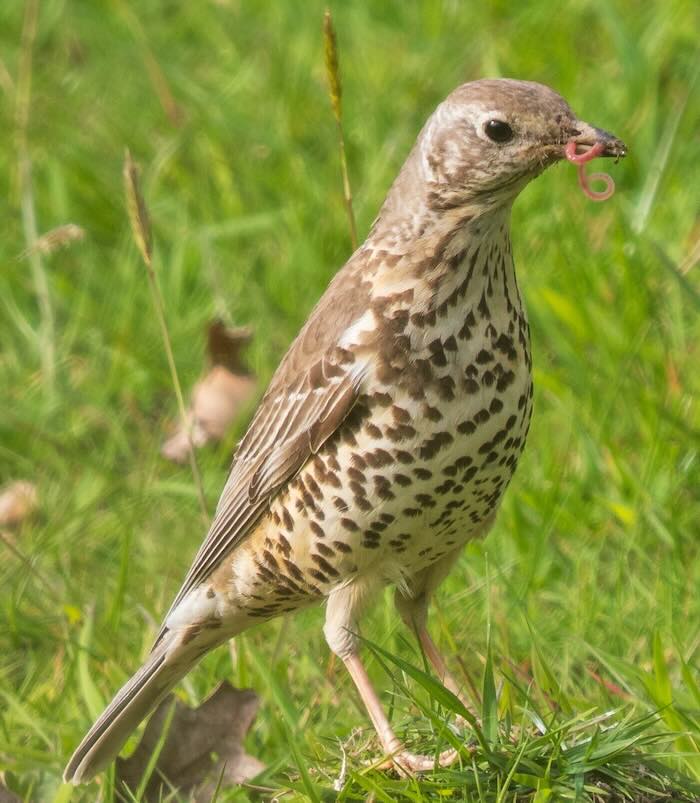
Female Mistle thrush with worm Credit- Andrew Fusek-Peters via SWNS

“The blackbird was sitting with its beak open, and the mistle thrush was close by.

“It fed its own chick first and then the blackbird.”

He searched the internet but couldn’t find an example of this situation ever having been captured on camera before.

“I thought it was a very dark thrush baby at first, then I realized it’s actually a blackbird.

“I was only five yards away. I could get quite close because they aren’t bothered by humans.

“The chicks are only a few weeks old.

“When fledglings leave the nest the parents will keep feeding them,” he explained.“I can’t get over how unbelievably rare this is to capture. It was such a special moment.” Rare Bird Moment as Photographer Witnesses Mistle Thrush Feeding Orphaned Blackbird as Her Own
Read More........

First-Known Sighting of a 'Massive' Antarctic Squid is Caught on Camera During Nat Geo Expedition

First-known sighting of living Antarctic squid Gonatus antarcticus, spotted by researchers on the National Geographic and Rolex Perpetual Planet Expedition in the Southern Ocean – Credit: ROV SuBastian / Schmidt Ocean Institute

Researchers have recorded a video sighting of a three-foot-long deep-sea squid species that’s never been filmed nor seen alive.

Gonatus antarcticus squid, an elusive squid found only in the frigid waters around Antarctica, was discovered on Christmas Day by the Schmidt Ocean Institute’s research vessel, the R/V Falkor (too), in a surprise moment caught on camera via the research vessel’s remotely operated vehicle, SuBastian.

Prior to the astonishing discovery, the species was only known from carcasses in fishing nets or when the squids’ beaks were found in the stomach of fished marine animals.

Footage of the squid shows the animal with scratches on its arms and fresh-looking sucker marks on its mantle but otherwise shows it is in good shape. Spotted at a depth of approximately 2,152 meters—below 6,000 feet—in the Weddell Sea, researchers have not been able to confirm the squid’s sex from the footage, nor age, but the discovery is a reminder of how much more there is to learn about the relatively unexplored polar regions of our world’s ocean.

Undertaken through the National Geographic and Rolex Perpetual Planet Expedition in the Southern Ocean, the footage will be broadcast in an upcoming National Geographic documentary, and more can be read about this amazing encounter and animal on the Nat Geo website.

According to squid expert Dr. Kathrin Bolstad, who worked with marine biologist and expedition team member Manuel Novillo on the species identification, the large single central hook observed on each tentacle club clinched her confirmation that the squid was the elusive Gonatus antarcticus.

It belongs to the family Gonatidae, which contains 19 species across three genera. Known as armhook squids after the central hook spotted by Bolstad,

The research team also mapped several previously unexplored sites throughout the Southern Ocean, including depths that reached 10,000 feet, obtaining various samples of sediment, water, and biota to study the health of various Southern Ocean habitats, including abyssal plains, hydrothermal vents, troughs, canyon walls and sea ice.

This work was conducted aboard the Falkor in collaboration with the Schmidt Ocean Institute, which provided National Geographic Explorers the opportunity to leverage its state-of-the-art tools and capabilities during its maiden voyage to the Southern Ocean.

Though not as large as the giant squid or colossal squid, three feet is a significant size under the pressures of life 3,000 meters below sea level.

GNN reported recently that the colossal squid had been filmed for the first time when a juvenile drifted past the cameras on the same Schmidt Ocean Institute vessel earlier this year. Dr. Bolstad was also consulted to identify the creature.

“We’re finally seeing confirmed footage of this animal that some of us have been studying and dreaming about for decades,” said Dr. Bolstad at the time. “The spots on the mantle [the tube-like body] tells us that it almost certainly can switch back and forth between being completely transparent… to being quite opaque.”

Unlike the colossal squid, however, this armhook squid was an adult, meaning much more can be learned about it.

Read More........