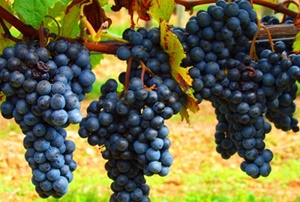
ARI Pune develops grape variety with high juice content


Scientists at the Agharkar Research Institute (ARI), Pune, an autonomous institute of the Department of Science and Technology (DST), have developed a hybrid grape variety which is resistant to fungal diseases, high yielding and has excellent juice quality. It is also suitable for preparation of juice, raisin, jam and red wine and farmers are enthusiastically adopting the variety, says a DST release.
  • The hybrid variety ARI-516 has been developed by interbreeding of two species from the same genus -- Catawba variety of Vitis labrusca and Beauty seedless variety of Vitis vinifera
  • The hybrid variety ARI-516 has been developed by interbreeding of two species from the same genus - Catawba variety of Vitis labrusca and Beauty seedless variety of Vitis vinifera. Maharashtra Association for the Cultivation of Science (MACS) and ARCI has actively collaborated in developing the new grape variety, which will benefit farmers, the processing industry and consumers, according to the DST.
  • The work has been published in the in Proceedings of the International Symposium on Grape Production and Processing.
  • Sujata Tetali, Scientist, Genetics and Plant Breeding Group from MACS-ARI, has developed this inter-specific variety by working on necessary properties. The fungal resistance of ARI-516 has been derived from Catawba, which is an American grape variety. It has superior quality fruits and higher yield per unit area. An early ripening hybrid, it matures in 110 - 120 days after pruning. The variety has elongated bunches and bears pleasant musky flavoured berries and performs well in Maharashtra, Telangana, Tamil Nadu, Punjab and West Bengal.
  • MACS-ARI is involved in the Indian Council of Agricultural Research (ICAR's) grape improvement programme through All India Coordinated Research Project on Fruits. MACS-ARI has developed many inter-specific and intra-specific grape hybrids under the hybridisation programme. The hybrids are evaluated for their disease resistance, fruit quality, and whether they are seedless or not.
  • India ranks twelfth in the world in terms of grape production. About 78 per cent of grape production in India is utilised for consumption, 17-20 per cent for raisin production, 1.5 per cent for wine and 0.5 per cent for juice. Maharashtra leads in the production of grapes in India with a share of 81.22 per cent. A negligible share of grapes is used for juice production.
  • A majority of farmers in Maharashtra cultivate 'Thompson seedless' and its clones for table purpose or raisin making. These varieties are highly susceptible to fungal diseases which increase plant protection cost. Grapes suffer 8.23-16 per cent of post-harvest losses. Juice making is an excellent option to reduce post-harvest losses.
  • ARI-516 grape variety has been recently identified for release by the Varietal Identification Committee of ICAR-All India Co-Ordinated Research Project on Fruit, for cultivation in Maharashtra, Punjab, Telangana and Tamil Nadu.
  • The salient features of ARI-516 include evenly maturing character with long cylindrical medium-sized fruit bunches making this variety superior over other varieties. It has small to medium bluish blackberries with one rudimentary seed in each berry, which is sweet in taste having the value of TSS (Total Soluble Solids) as 20-22 0B with musky flavor having about 65-70 per cent juice content. The berry yield is about 15-20 tonnes per acre, and it is tolerant to downy and powdery mildew diseases as well as resistant to anthracnose disease - a group of fungal diseases that affect a variety of plants in warm, humid areas.
  • The consumers prefer ARI-516 for its unique flavour. Being moderately resistant to a majority of fungal diseases, its cost of production is lower. The area under cultivation of ARI-516 is steadily growing and has reached 100 acres. Source: https://www.domain-b.com/
Read More........

30 Intelligent Civilizations Throughout the Galaxy

Credit: NASA/JPL-Caltech/S. Stolovy (Spitzer Science Center/Caltech)

Is there anyone out there? This is an age-old question that researchers have now shed new light on with a study that calculates there could be more than 30 intelligent civilizations throughout our Galaxy. This is an enormous advance over previous estimates which spanned from zero to billions.

One of the biggest and longest-standing questions in the history of human thought is whether there are other intelligent lifeforms within our Universe. Obtaining good estimates of the number of possible extraterrestrial civilizations has however been very challenging.

"This dazzling infrared image from NASA's Spitzer Space Telescope shows hundreds of thousands of stars crowded into the swirling core of our spiral Milky Way galaxy. In visible-light pictures, this region cannot be seen at all because dust lying between Earth and the galactic center blocks our view." Image downscaled (2x) from original.

A new study led by the University of Nottingham and published in The Astrophysical Journal has taken a new approach to this problem. Using the assumption that intelligent life forms on other planets in a similar way as it does on Earth, researchers have obtained an estimate for the number of intelligent communicating civilizations within our own galaxy -the Milky Way. They calculate that there could be over 30 active communicating intelligent civilizations in our home Galaxy.

Professor of Astrophysics at the University of Nottingham, Christopher Conselice who led the research, explains: “There should be at least a few dozen active civilizations in our Galaxy under the assumption that it takes 5 billion years for intelligent life to form on other planets, as on Earth.” Conselice also explains that, “The idea is looking at evolution, but on a cosmic scale. We call this calculation the Astrobiological Copernican Limit.”

First author Tom Westby explains: “The classic method for estimating the number of intelligent civilizations relies on making guesses of values relating to life, whereby opinions about such matters vary quite substantially. Our new study simplifies these assumptions using new data, giving us a solid estimate of the number of civilizations in our Galaxy.

The two Astrobiological Copernican limits are that intelligent life forms in less than 5 billion years, or after about 5 billion years – similar to on Earth where a communicating civilization formed after 4.5 billion years. In the strong criteria, whereby a metal content equal to that of the Sun is needed (the Sun is relatively speaking quite metal rich), we calculate that there should be around 36 active civilizations in our Galaxy.”

The research shows that the number of civilizations depends strongly on how long they are actively sending out signals of their existence into space, such as radio transmissions from satellites, television, etc. If other technological civilizations last as long as ours which is currently 100 years old, then there will be about 36 ongoing intelligent technical civilizations throughout our Galaxy.

However, the average distance to these civilizations would be 17,000 light-years away, making detection and communication very difficult with our present technology. It is also possible that we are the only civilization within our Galaxy unless the survival times of civilizations like our own are long.

Our new research suggests that searches for extraterrestrial intelligent civilizations not only reveals the existence of how life forms, but also gives us clues for how long our own civilization will last. If we find that intelligent life is common then this would reveal that our civilization could exist for much longer than a few hundred years, alternatively if we find that there are no active civilizations in our Galaxy it is a bad sign for our own long-term existence. By searching for extraterrestrial intelligent life -- even if we find nothing -- we are discovering our own future and fate.Professor Christopher Conselice

Contacts and sources:
Jane Icke
University of Nottingham

Publication: The Astrobiological Copernican Weak and Strong Limits for Intelligent Life. Tom Westby, Christopher J. Conselice. The Astrophysical Journal, 2020; 896 (1): 58 DOI: Source:http://dx.doi.org
Read More........