Space junk removal mission blasts off

space junk removal future timeline
An experimental spacecraft that could remove space junk around Earth has been launched into orbit and will test a number of new technologies.

An Active Debris Removal (ADR) mission, designed to demonstrate technologies to remove space junk, was launched on Monday 2nd April from the Kennedy Space Center to the International Space Station (ISS).

"RemoveDEBRIS" is a mission designed and manufactured by a consortium of leading space companies, led by the University of Surrey and funded by the European Commission. It is one of the world's first concrete steps to begin cleaning up the tens of thousands of space junk pieces currently orbiting Earth.

A SpaceX Falcon 9 rocket delivered the RemoveDEBRIS satellite to the ISS, where it is being deployed, via the NanoRacks Kaber system, to conduct a series of experiments that will demonstrate cost-effective technologies for observing and capturing space debris.

In the first of two capture experiments, a net will be discharged at one of the deployed target cubesats to demonstrate net capture in space. The second capture experiment will see a harpoon launched at a deployable target plate, made of representative satellite panel materials – the first harpoon capture in orbit. The third experiment involves vision-based navigation by deploying the second cubesat and demonstrating rendezvous navigation using cameras and a LiDaR. Finally, the RemoveDEBRIS spacecraft will deploy a large dragsail to speed de-orbit, where it will burn up as it enters Earth's atmosphere.

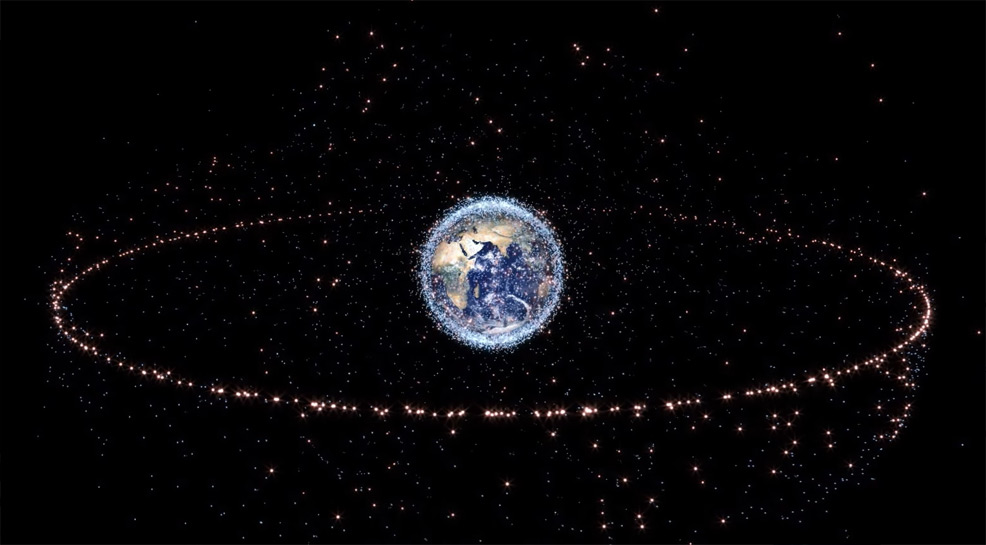
The US Space Surveillance Network tracks 40,000 objects and it is estimated that there are over 7,600 tonnes of space junk in and around Earth's orbit – with some moving faster than a speeding bullet, approaching speeds of 30,000 miles per hour.


"It is important to remember that a few significant collisions have already happened. Therefore, to maintain the safety of current and future space assets, the issue of the control and reduction of the space debris has to be addressed," said Professor Guglielmo Aglietti, Director of the Surrey Space Centre at the University of Surrey. "We believe the technologies demonstrated with RemoveDEBRIS could provide feasible answers to the space junk problem – answers that could be used on future space missions in the very near future."

Aurélien Pisseloup, Space Engineer at Airbus, said: "Airbus has been investing in new technologies for space debris removal in co-operation with space agencies and institutes. Contributing to this exciting mission with our expertise and concretely with our harpoon, net experiments and vision-based navigation (VBN) moves the international space community one big step forward in tackling space debris."Space junk removal mission blasts off
Read More........

‘Mind-reading’ software could record your dreams

By Celeste Biever: Pictures you are observing can now be recreated with software that uses nothing but scans of your brain. It is the first “mind reading” technology to create such images from scratch, rather than picking them out from a pool of possible images.

Earlier this year Jack Gallant and colleagues at the University of California, Berkeley, showed that they could tell which of a set of images someone was looking at from a brain scan.

To do this, they created software that compared the subject’s brain activity while looking at an image with that captured while they were looking at “training” photographs. The program then picked the most likely match from a set of previously unseen pictures.

Now Yukiyasu Kamitani at ATR Computational Neuroscience Laboratories in Kyoto, Japan has gone a step further: his team has used an image of brain activity taken in a functional MRI scanner to recreate a black-and-white image from scratch.

“By analysing the brain signals when someone is seeing an image, we can reconstruct that image,” says Kamitani.

This means that the mind reading isn’t limited to a selection of existing images, but could potentially be used to “read off” anything that someone was thinking of, without prior knowledge of what that might be.

“It’s absolutely amazing, it really is a very significant step forward,” says John-Dylan Haynes of the Max Planck Institute for Human Cognitive and Brain Sciences in Leipzig, Germany.
Dream catcher

Kamitani starts by getting someone to look at a selection of images made up of black and white squares on a 10 by 10 square grid, while having their brain scanned. Software then finds patterns in brain activity that correspond to certain pixels being blacked out. It uses this to record a signature pattern of brain activity for each pixel.

The person then sits in the scanner and is shown fresh patterns. Another piece of software then matches these against the list to reconstruct the pixels on a 10 by 10 grid.

The quality of images that were recreated is quite crude. However, the word “neuron” and several numbers and shapes that people were indeed being shown (see image, top right) could be observed in the reconstructed images. It is an important proof of principle, says Haynes.

As fMRI technology improves, Kamitani adds that an image could potentially be split into many more pixels, producing much higher quality images, and even colour images.

The next step is to find out if it is possible to image things that people are thinking of – as well as what they are looking at – Haynes says it may be possible to “make a videotape of a dream”.
Ethical concerns

Haynes also raises the prospect of “neural marketing”, where advertisers might one day be able to read the thoughts of passers by and use the results to target adverts. “This [new research] specifically doesn’t lead to this – but the whole spirit in which this is done is in line with brain reading and the applications that come with that,” he says.

“If you have a technique that allows you to read out what people are thinking we need clearer ethical guidelines about when and how you are able to do this,” he says. “A lot of people want their minds to be read – take for example a paralysed person. They want us to read their thoughts,” he says. “But it shouldn’t be possible to do this for commercial purposes.”

Kamitani is well aware of the negative potential of the technology. “If the image quality improves, it could have a very serious impact on our privacy and other issues. We will have to discuss with many people – not just scientists – how to apply this technology,” he says.

Journal reference: Neuron (DOI: 10.1016/j.neuron.2008.11.004)' Source:https://www.newscientist.com/
Read More........